
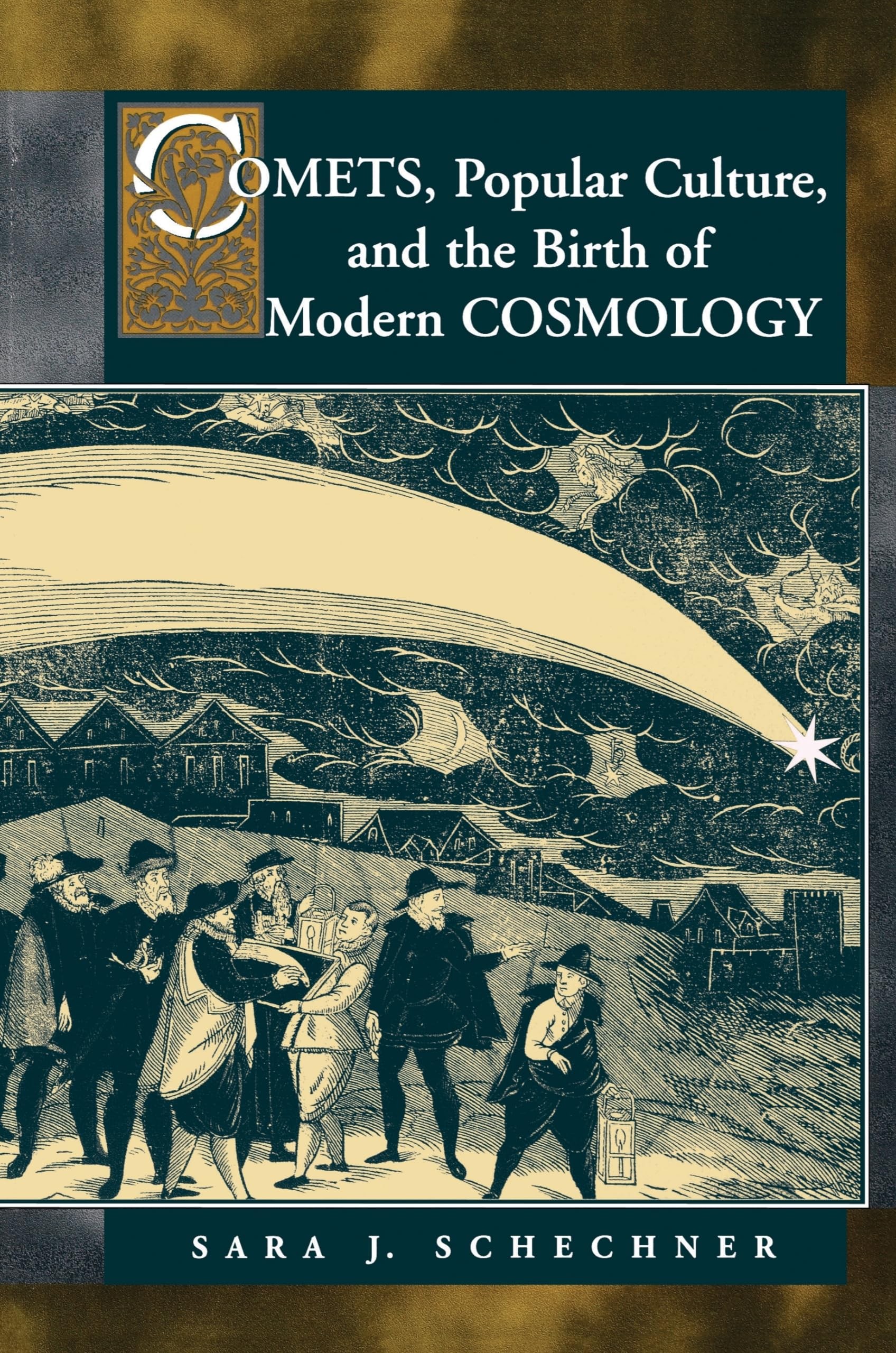
Comets, Popular Culture, and the Birth of Modern Cosmology: How Superstition and Science Converged in the Early-Modern E
Inclusive of all applicable taxes. FREE shipping on all orders.
Available Offers
- 🚚Free Delivery — Free shipping on all orders
- 💵Cash on Delivery — Pay when your order arrives
- ↩️15-Day Easy Returns — Hassle-free return policy
- 🔒Cash on Delivery — Pay safely when your order arrives
Check Delivery
Product Description
Introduction
In the vast tapestry of human history, few celestial phenomena have captured the collective imagination as powerfully as comets. From harbingers of doom to objects of scientific inquiry, these fiery wanderers have shaped not only our understanding of the cosmos but also the very fabric of popular culture. Comets, Popular Culture, and the Birth of Modern Cosmology by Sara Schechner Genuth is a groundbreaking work that bridges the gap between superstition and science, revealing how ancient fears and beliefs quietly influenced the birth of modern astronomy. For Indian readers and students passionate about the history of science, this book offers a unique lens through which to explore the interplay between societal narratives and scientific progress.
Book Overview
This meticulously researched volume, published by Princeton University Press, takes readers on a journey from the medieval dread of comets as divine portents to their reimagining in the age of Newton and Halley. Sara Schechner Genuth challenges the conventional narrative that early modern science emerged purely from rationalism, detached from popular belief. Instead, she demonstrates that the very superstitions dismissed by the elite were absorbed into the scientific theories that laid the foundation for modern cosmology. Through a rich tapestry of historical accounts, theological debates, and cultural artifacts, the book shows how comets served as a meeting point for astrology, religion, and empirical observation. The author’s narrative is both scholarly and accessible, making it an indispensable resource for anyone curious about the cultural roots of scientific discovery.
Key Highlights
- Interdisciplinary Approach: Blends history, astronomy, theology, and folklore to present a holistic view of cometary science.
- Challenging Orthodoxy: Argues that popular superstitions were not obstacles but catalysts for scientific thought.
- Focus on Newton and Halley: Reveals how their theories were subtly shaped by centuries of cometary lore.
- Rich Primary Sources: Draws on manuscripts, broadsides, and illustrations from the sixteenth to eighteenth centuries.
- Relevance to Modern Science: Offers insights into how cultural biases continue to influence scientific paradigms today.
Inside the Book
Opening the pages of this hardcover edition, readers will find a carefully structured exploration divided into thematic chapters. The book begins by examining the medieval worldview where comets were seen as signs of divine wrath, linked to plagues, floods, and political upheaval. It then traces the gradual shift during the Renaissance, when humanists and reformers began to question these interpretations. A significant portion is dedicated to the seventeenth century, where figures like Johannes Kepler, Galileo, and later Isaac Newton and Edmond Halley wrestled with cometary data. Schechner Genuth delves into the theological implications of comets, including their role in Christian eschatology and biblical exegesis. The final chapters show how these threads wove together to form a new cosmological order, where comets became predictable celestial bodies rather than omens.
Key Topics
- Comets as portents in ancient and medieval societies
- The role of comets in astrology and prophecy
- Reformation debates on divine signs and natural law
- Scientific observations and the birth of telescopic astronomy
- Newton’s gravitational theory and cometary orbits
- Halley’s prediction and the secularization of comets
- Popular culture’s influence on elite scientific thought
Reader Benefits
- Deepen Historical Perspective: Understand how pre-scientific beliefs shaped the very questions early astronomers asked.
- Enhance Critical Thinking: Learn to evaluate the interplay between cultural context and scientific progress.
- Rich Narrative: Enjoy a compelling story that reads like a detective investigation into the origins of modern cosmology.
- Academic Rigour: Gain access to extensive footnotes and bibliography for further study.
- Cultural Connection: Draw parallels with Indian traditions of cometary interpretation in astrology and mythology.
Learning Outcomes
By the end of this book, readers will be able to articulate how the fear of comets transitioned into a subject of empirical science. They will grasp the nuanced relationship between popular culture and academic inquiry, recognizing that scientific revolutions are rarely clean breaks from the past. Students will develop a deeper appreciation for the social history of astronomy, understanding that the heavens have always been a mirror for human hopes and anxieties. Additionally, readers will be equipped to critically analyse how contemporary cultural narratives still shape scientific discourse.
Who Should Read
- History of Science Enthusiasts: Those fascinated by the evolution of astronomical thought.
- Undergraduate and Postgraduate Students: Ideal for courses in history, philosophy, or sociology of science.
- Astronomy Lovers: Anyone curious about comets beyond their physical properties.
- Cultural Historians: Scholars interested in the intersection of religion, folklore, and science.
- General Readers: Non-specialists who enjoy intellectually stimulating narratives about the human condition.
About the Author
Sara Schechner Genuth is a distinguished historian of science whose work has focused on the cultural dimensions of astronomy. She has held positions at prestigious institutions and is known for her ability to weave together diverse sources into coherent, engaging narratives. Her expertise in early modern science and material culture shines through in this volume, making her a trusted guide through the complex terrain of cometary history.
About the Publisher
Princeton University Press is a world-renowned academic publisher with a legacy of producing authoritative works in the sciences and humanities. Their commitment to rigorous scholarship and accessible writing ensures that this book meets the highest standards of quality, making it a valuable addition to any library.
Conclusion
Comets, Popular Culture, and the Birth of Modern Cosmology is more than a history of astronomy; it is a meditation on how we come to know what we know. By revealing the hidden threads that connect medieval superstition to Newtonian mechanics, Sara Schechner Genuth invites us to reconsider the boundaries between science and society. For Indian readers, this book offers a timeless lesson: that the stars above are never just points of light, but stories waiting to be told. Order your copy today from Bookshops.in and embark on a journey that will change how you see both the heavens and the human mind.
Quick Summary
Comets, Popular Culture, and the Birth of Modern Cosmology by Sara Schechner Genuth is a groundbreaking historical study that explores how ancient fears of comets as heavenly portents shaped the scientific theories of Isaac Newton and Edmond Halley. The book argues that popular superstitions—such as comets heralding plague, flood, or civil disorder—were not simply dismissed by early-modern scientists but were subtly absorbed into their cosmological frameworks. Genuth traces this evolution from the 16th century, when all social classes dreaded comets, to the 17th century, when elite thinkers began to label such beliefs as 'vulgar superstitions' yet still incorporated them into rational science. This work is ideal for students of history of science, astronomy enthusiasts, and anyone intrigued by the interplay between culture and scientific discovery. Readers will learn how the boundary between popular belief and empirical science was far more fluid than commonly assumed. By purchasing from Bookshops.in, Indian readers gain access to a premium hardcover edition of this Princeton University Press title, delivered reliably across the country.
Book Highlights
Book Specifications
| ISBN-13 | 9780691009254 |
| ISBN-10 | 0691009252 |
| Publisher | Princeton University Press |
| Language | English |
| Dimensions | 15.6 x 2.21 x 23.39 cm |
| Weight | 510 g |
| Category | Science & Mathematics › Astronomy & Astrophysics |
| Genre | Nonfiction |
| Reading Age | Adult |
| Original Language | English |
Frequently Asked Questions
What is this book about?
Who is the author?
Is this book suitable for non-academic readers?
Does the book cover Newton's comet theory?
What time period does the book focus on?
Is this a textbook?
Does the book include illustrations?
Why should I buy from Bookshops.in?
Is this book available in hardcover?
What is the ISBN?
Can I use this for my research paper?
Does the book discuss Halley's comet?
What makes this book unique?
Readers Also Search For
Customers Also Bought
Mathematics
Stereotype Spaces and Algebras: 73 (De Gruyter Expositions in Mathematics, 73)

Mathematics
Semigroups in Algebra, Geometry and Analysis: 20 (De Gruyter Expositions in Mathematics, 20)

Mathematics
Geometry from the Pacific Rim: Proceedings of the Pacific Rim Geometry Conference held at National University of Singapore, Republic of Singapore, ... 1994 (De Gruyter Proceedings in Mathematics)

Mathematics
First International Tainan-Moscow Algebra Workshop: Proceedings of the International Conference held at National Cheng Kung University Tainan, Taiwan, ... 1994 (De Gruyter Proceedings in Mathematics)

Mathematics
Differential Geometry - Proceedings of the VIII International Colloquium (English, Jesus A. Alvarez Lopez | Eduardo Garcia-Rio)

Mathematics
Mathematical Theory of Optimal Processes (Classics of Soviet Mathematics)
Related Products
View All
Science & Mathematics
Squid - Superconducting Quantum Interference Devices and Their Applications: Proceedings of the International Conference on Superconducting Quantum Devices, Berlin-west, October 4-8, 1976

Science & Mathematics
Thermodynamics and Pattern Formation in Biology
Science & Mathematics
The Nature of Mathematics and the Mathematics of Nature by S. Andersson – Mathematics & Science

Science & Mathematics
Linear Algebra | by Stephen Friedberg | Arnold Insel | Lawrence Spence | Pearson | by Stephen Friedberg | Arnold Insel | Lawrence Spence | Pearson | by Stephen Friedberg | Arnold Insel | Lawrence Spence | Pearson | by Stephen Friedberg | Arnold Insel | Lawrence Spence | Pearson | by Stephen Friedberg | Arnold Insel | Lawrence Spence | Pearson | by Stephen Friedberg | Arnold Insel | Lawrence Spence | Pearson | by Stephen Friedberg | Arnold Insel | Lawrence Spence | Pearson | by Stephen Friedberg

Science & Mathematics
University Calculus | by Joel Hass | Christopher Heil | Maurice Weir | Pearson | by Joel Hass | Christopher Heil | Maurice Weir | Pearson | by Joel Hass | Christopher Heil | Maurice Weir | Pearson | by Joel Hass | Christopher Heil | Maurice Weir | Pearson | by Joel Hass | Christopher Heil | Maurice Weir | Pearson | by Joel Hass | Christopher Heil | Maurice Weir | Pearson | by Joel Hass | Christopher Heil | Maurice Weir | Pearson | by Joel Hass | Christopher Heil | Maurice Weir | Pearson | by Joe

Science & Mathematics