
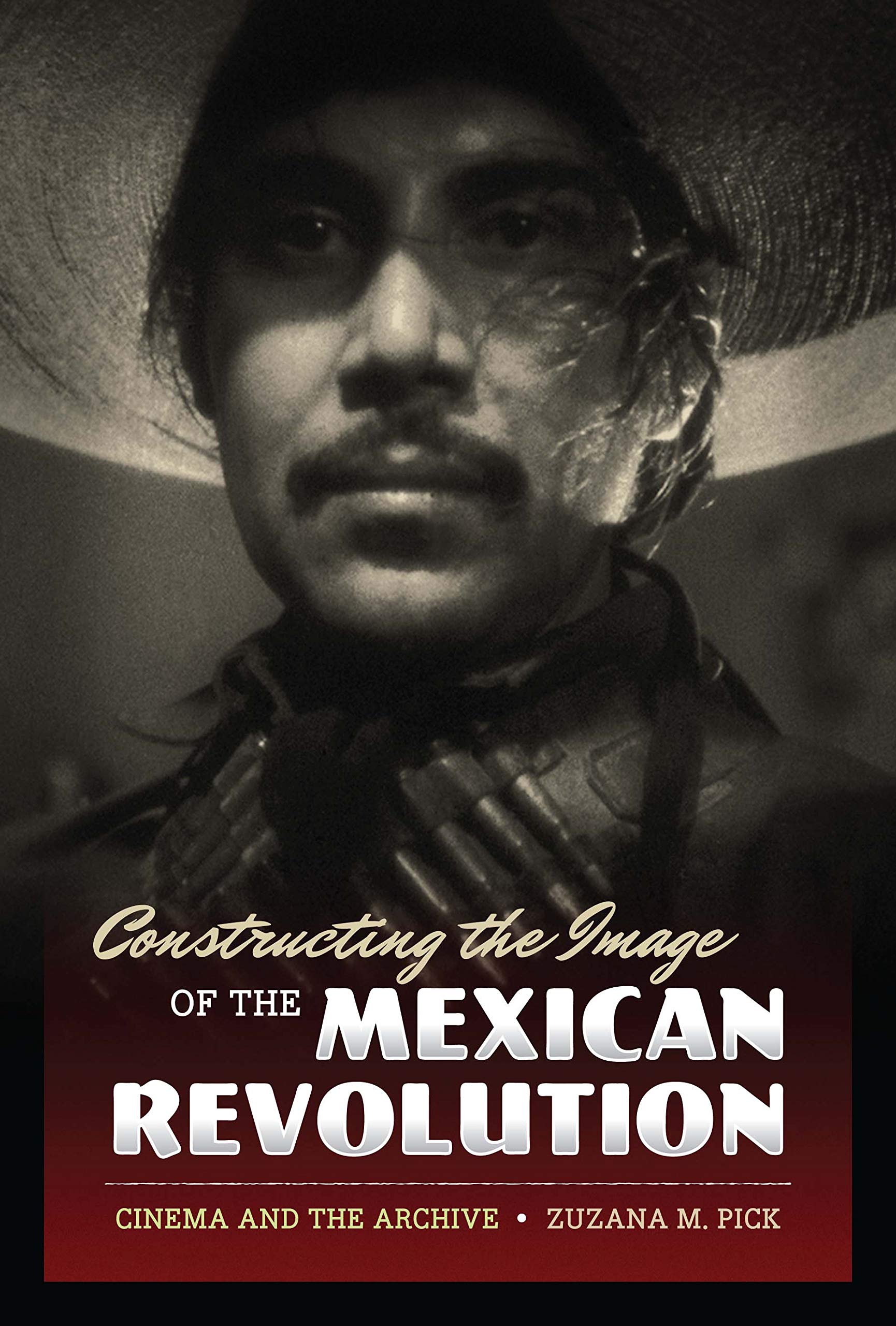
Constructing the Image of the Mexican Revolution: Cinema and the Archive by Zuzana M. Pick – A Scholarly Exploration of
Inclusive of all applicable taxes. FREE shipping on all orders.
Available Offers
- 🚚Free Delivery — Free shipping on all orders
- 💵Cash on Delivery — Pay when your order arrives
- ↩️15-Day Easy Returns — Hassle-free return policy
- 🔒Cash on Delivery — Pay safely when your order arrives
Check Delivery
Product Description
Introduction
In the vast landscape of visual culture and historical memory, few movements have been as visually transformative as the Mexican Revolution. Zuzana M. Pick's Constructing the Image of the Mexican Revolution: Cinema and the Archive offers a profound exploration of how cinema, photography, and graphic arts converged to forge a lasting national iconography. This hardcover volume from the University of Texas Press is an indispensable resource for Indian scholars, film students, and history enthusiasts seeking to understand the interplay between revolutionary politics, modernist aesthetics, and media representation.
Book Overview
Published as a winner of the prestigious Katherine Singer Kovács Book Award in 2011, this meticulously researched work investigates twelve foundational films—from Sergei Eisenstein's Que Viva Mexico! (1931–1932) to the Hollywood production And Starring Pancho Villa as Himself (2003). Pick demonstrates how cinematic images did not simply document the revolution but actively constructed its visual mythology. By examining the archive of photographs, paintings, and film footage created during and after the conflict (1910–1917), the book reveals how modernist sensibilities reinvented traditional symbols of Mexican identity for both domestic and international audiences.
Key Highlights
- Award-Winning Scholarship: Recipient of the 2011 Katherine Singer Kovács Book Award for excellence in film and media studies.
- Interdisciplinary Approach: Seamlessly bridges film studies, art history, photography, and cultural theory.
- Foundational Films Analyzed: In-depth case studies of twelve key films spanning seven decades of cinematic production.
- Visual Archive Exploration: Examines how revolutionary imagery was shaped by both Mexican and foreign artists, including figures like Pancho Villa, Dolores del Río, and Tina Modotti.
- Modernism and National Identity: Argues that the revolution coincided with the birth of media culture, making its iconography a global phenomenon.
Inside the Book
Pick structures her argument around the concept of the “image repertoire”—the stock of visual motifs that circulated through postcards, newsreels, murals, and feature films. She shows how directors and photographers drew on pre-existing nationalist themes, folkloric motifs designed for export, and avant-garde techniques to create a dynamic, often contradictory, visual narrative. The book includes detailed readings of how figures like Villa became media celebrities, how the pistolero and revolucionaria archetypes were codified, and how the revolution's memory was later repackaged for Hollywood and European art cinema.
Key Topics
- The convergence of cinema, photography, and painting in revolutionary Mexico.
- Media culture and modernity in the early twentieth century.
- National iconography and its global circulation.
- Gender and revolutionary representation (e.g., Dolores del Río as symbol of modern womanhood).
- The role of foreign filmmakers and photographers in shaping Mexican identity.
- Archival theory and the politics of image preservation.
Reader Benefits
- Gain a nuanced understanding of how visual media shape historical memory.
- Access sophisticated theoretical frameworks applicable to Indian cinema and revolutionary iconography.
- Discover lesser-known films and photographic archives that defined an era.
- Develop critical tools for analyzing the relationship between art, politics, and national identity.
Learning Outcomes
By engaging with this book, readers will be able to: identify the key visual tropes of the Mexican Revolution and trace their evolution across different media; analyze how modernist aesthetics transformed traditional symbols into global commodities; evaluate the ethical and political implications of representing revolutionary violence; and apply these insights to comparative studies of other national cinemas, including Indian parallel and historical cinema.
Who Should Read
This book is essential for postgraduate students and researchers in film studies, Latin American history, visual culture, and art history. It will also appeal to Indian filmmakers, documentary practitioners, and curators interested in the politics of archival imagery. General readers with a passion for revolutionary history and the golden age of cinema will find it equally rewarding.
About the Author
Zuzana M. Pick is a professor of film studies at Carleton University, Canada, with a specialization in Latin American cinema, documentary theory, and visual archives. Her scholarship has been widely published in leading journals, and she is known for her rigorous interdisciplinary methods that combine close textual analysis with historical contextualization. Constructing the Image of the Mexican Revolution represents the culmination of years of archival research in Mexico, the United States, and Europe.
About the Publisher
University of Texas Press is a distinguished academic publisher based in Austin, Texas, renowned for its contributions to Latin American studies, film and media scholarship, and art history. With a commitment to producing high-quality hardcover editions that stand the test of time, UT Press has long been a trusted name for scholars and libraries worldwide.
Conclusion
Constructing the Image of the Mexican Revolution: Cinema and the Archive is more than a book—it is a gateway to understanding how revolutions are not only fought but also seen, remembered, and reinvented. For Indian readers interested in the intersections of cinema, history, and identity, this volume offers a rich comparative framework that resonates with our own cinematic traditions. Order your hardcover copy from Bookshops.in today and add a landmark work of visual culture scholarship to your library.
Quick Summary
Constructing the Image of the Mexican Revolution: Cinema and the Archive by Zuzana M. Pick is an award-winning scholarly work that examines how visual media—cinema, photography, painting, and graphic arts—collectively forged Mexico's national image in the aftermath of the revolution. The book analyses twelve foundational films from Que Viva Mexico! (1931–1932) to And Starring Pancho Villa as Himself (2003), demonstrating how cinematic images draw from and reinterpret the visual repertoire produced during the revolutionary period. Pick argues that the revolution's timeline (1910–1917) coincided with the emergence of global media culture and modernity, making this a pivotal case for understanding the intersection of art, politics, and national identity. The book is ideal for students and researchers in film studies, Latin American history, art history, and visual culture, as well as general readers interested in revolutionary iconography. By exploring the work of figures like Pancho Villa, Dolores del Río, and Tina Modotti, Pick offers fresh insights into how visual artists—both Mexican and foreign—shaped enduring national symbols. Readers will gain a deeper understanding of how archives function as both repositories and conceptual tools for cultural memory. Purchase your copy from Bookshops.in, India's premium online bookstore, for a reliable and authentic edition.
Book Highlights
Book Specifications
| ISBN-13 | 9780292725621 |
| ISBN-10 | 0292725620 |
| Publisher | Univ of Texas Pr |
| Language | English |
| Dimensions | 15.24 x 1.52 x 22.86 cm |
| Weight | 408 g |
| Country | India |
| Category | Performing Arts › Film & Television |
| Genre | Nonfiction |
| Reading Age | Adult |
| Original Language | English |
Frequently Asked Questions
What is the main focus of Constructing the Image of the Mexican Revolution?
Who is the author Zuzana M. Pick?
Which films are analysed in this book?
Who is the target audience for this book?
Is this book suitable for Indian readers?
What award did this book win?
Does the book cover photography as well as cinema?
What is the role of the archive in this study?
Can I use this book for a university course?
Does the book discuss Pancho Villa?
Is this book available in hardcover?
Does the book include illustrations?
How does this book relate to media modernity?
Readers Also Search For
Customers Also Bought
Mathematics
Stereotype Spaces and Algebras: 73 (De Gruyter Expositions in Mathematics, 73)

Mathematics
Semigroups in Algebra, Geometry and Analysis: 20 (De Gruyter Expositions in Mathematics, 20)

Mathematics
Geometry from the Pacific Rim: Proceedings of the Pacific Rim Geometry Conference held at National University of Singapore, Republic of Singapore, ... 1994 (De Gruyter Proceedings in Mathematics)

Mathematics
First International Tainan-Moscow Algebra Workshop: Proceedings of the International Conference held at National Cheng Kung University Tainan, Taiwan, ... 1994 (De Gruyter Proceedings in Mathematics)

Mathematics
Differential Geometry - Proceedings of the VIII International Colloquium (English, Jesus A. Alvarez Lopez | Eduardo Garcia-Rio)

Mathematics
Mathematical Theory of Optimal Processes (Classics of Soviet Mathematics)
Related Products
View All
Science & Mathematics
Elements of Pelagos Biology: With Focus on the Mediterranean Sea

Science & Mathematics
Squid - Superconducting Quantum Interference Devices and Their Applications: Proceedings of the International Conference on Superconducting Quantum Devices, Berlin-west, October 4-8, 1976

Science & Mathematics
Thermodynamics and Pattern Formation in Biology
Science & Mathematics
The Nature of Mathematics and the Mathematics of Nature by S. Andersson – Mathematics & Science

Science & Mathematics
Linear Algebra | by Stephen Friedberg | Arnold Insel | Lawrence Spence | Pearson | by Stephen Friedberg | Arnold Insel | Lawrence Spence | Pearson | by Stephen Friedberg | Arnold Insel | Lawrence Spence | Pearson | by Stephen Friedberg | Arnold Insel | Lawrence Spence | Pearson | by Stephen Friedberg | Arnold Insel | Lawrence Spence | Pearson | by Stephen Friedberg | Arnold Insel | Lawrence Spence | Pearson | by Stephen Friedberg | Arnold Insel | Lawrence Spence | Pearson | by Stephen Friedberg
Science & Mathematics