
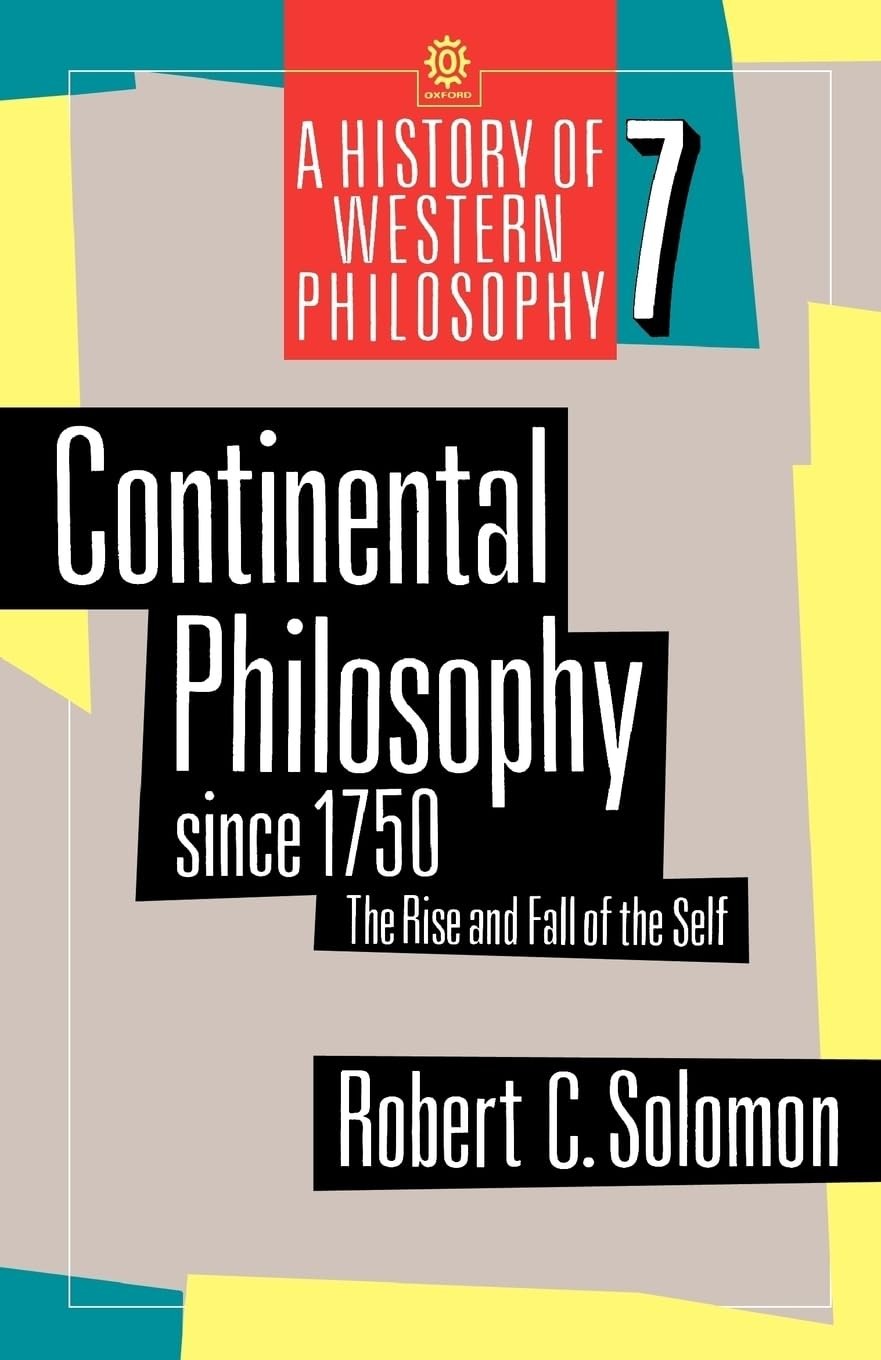
Continental Philosophy Since 1750: The Rise and Fall of the Self by Robert C. Solomon – A Complete Overview of Modern Eu
Inclusive of all applicable taxes. FREE shipping on all orders.
Available Offers
- 🚚Free Delivery — Free shipping on all orders
- 💵Cash on Delivery — Pay when your order arrives
- ↩️15-Day Easy Returns — Hassle-free return policy
- 🔒Cash on Delivery — Pay safely when your order arrives
Check Delivery
Product Description
Introduction
Continental philosophy has shaped the way we think about selfhood, freedom, and meaning in the modern world. Robert C. Solomon's Continental Philosophy Since 1750: The Rise and Fall of the Self offers Indian students and scholars a compelling journey through two and a half centuries of European thought. This hardcover edition from OUP Oxford is an essential companion for anyone seeking to understand the intellectual currents that define our times.
Book Overview
In this masterful synthesis, Solomon traces the evolution of the concept of the self from the Enlightenment through Romanticism, German Idealism, and into the existential and postmodern critiques of the twentieth century. The book covers major figures including Rousseau, Kant, Fichte, Hegel, Schopenhauer, Kierkegaard, Nietzsche, Husserl, Heidegger, Sartre, Foucault, and Derrida. Rather than a dry chronology, Solomon presents philosophy as a dramatic narrative—a story of how the self was elevated to cosmic significance, then deconstructed and questioned. The author's accessible style makes complex ideas relatable without sacrificing depth, making it ideal for Indian readers new to continental traditions.
Key Highlights
- Comprehensive scope from 1750 to the late twentieth century, covering the Enlightenment, Romanticism, German Idealism, existentialism, phenomenology, structuralism, and postmodernism.
- Integrative narrative that connects philosophical movements with historical and cultural contexts, showing how ideas evolve in response to each other.
- Focus on the self as the central thread, exploring how thinkers defined, celebrated, and ultimately dismantled the autonomous subject.
- Clear explanations of difficult concepts like the noumenal self, the dialectic, Dasein, and the death of the subject, without oversimplification.
- Critical engagement with both canonical and lesser-known philosophers, including Feuerbach, Dilthey, Bergson, and Frege.
Inside the Book
Solomon organizes the material into thematic chapters that follow the rise of the self in Enlightenment optimism, its apotheosis in German Idealism, and its fragmentation in existentialism and postmodern thought. Readers will encounter Rousseau's passionate individualism, Kant's transcendental unity of apperception, Hegel's world-historical Spirit, Kierkegaard's leap of faith, Nietzsche's will to power, and Heidegger's Being-in-the-world. The book also examines the contributions of Freud, Wittgenstein, and the hermeneutic tradition, culminating in the structuralist and post-structuralist critiques that announced the 'end of man.' Each chapter includes summaries of key arguments and suggestions for further reading.
Key Topics
- The Enlightenment and the birth of the modern self
- Romanticism and the cult of individual genius
- Kant's Copernican revolution and the limits of reason
- Fichte, Schelling, and the absolute ego
- Hegel's dialectic and the social self
- Schopenhauer's pessimistic will
- Kierkegaard's existential subjectivity
- Nietzsche's critique of morality and the Übermensch
- Husserlian phenomenology and intentionality
- Heidegger's Being and Time
- Sartrean freedom and bad faith
- Structuralism, Foucault, and the death of the subject
- Derrida and deconstruction
Reader Benefits
This book helps Indian readers grasp the philosophical foundations behind contemporary debates on identity, agency, and culture. It bridges the gap between Anglo-American analytic philosophy and the richer, more historically engaged continental tradition. Students will gain a coherent framework for understanding thinkers often taught in isolation, while general readers will appreciate Solomon's engaging storytelling. The hardcover binding ensures durability for repeated reference, and the OUP Oxford imprint guarantees scholarly rigour. By tracing the 'rise and fall of the self,' the book also offers insights into modern Indian engagements with Western philosophy, from Tagore's humanism to contemporary critiques of individualism.
Learning Outcomes
- Understand the historical development of continental philosophy from 1750 to the present.
- Analyse the concept of the self as it evolves through different philosophical movements.
- Critically evaluate key arguments from Kant, Hegel, Nietzsche, Heidegger, and Sartre.
- Connect philosophical ideas to broader cultural and political contexts in Europe.
- Identify the differences between continental and analytic approaches to philosophy.
- Apply continental perspectives to contemporary issues in ethics, politics, and identity.
- Recognise the influence of continental thought on literature, art, and social theory.
Who Should Read
This book is ideal for undergraduate and postgraduate students of philosophy, especially those enrolled in Indian universities that offer courses on European thought. It will also benefit scholars of literature, political science, sociology, and cultural studies who need a solid grounding in continental philosophy. General readers with an interest in intellectual history, as well as teachers preparing lectures on modern philosophy, will find it invaluable. The accessible writing makes it suitable for self-study, while the depth of analysis satisfies academic requirements. Whether you are a beginner at Delhi University or a researcher at JNU, this book will enrich your understanding of the Western philosophical tradition.
About the Author
Robert C. Solomon (1942–2007) was a distinguished professor of philosophy at the University of Texas at Austin. He was renowned for his work on existentialism, emotions, and the history of philosophy. Solomon authored numerous influential books, including The Passions, In the Spirit of Hegel, and From Hegel to Existentialism. His teaching earned him multiple awards, and he was known for making complex ideas accessible without losing nuance. Solomon's expertise in both continental and analytic traditions gives this book a unique breadth and clarity.
About the Publisher
Oxford University Press (OUP) is the world's largest university press, with a history spanning over 500 years. OUP Oxford is renowned for its rigorous academic standards and authoritative publications in philosophy, history, and the social sciences. This hardcover edition reflects OUP's commitment to quality, featuring durable binding, clear typography, and archival-grade paper. For Indian readers, OUP's global network ensures that this book meets the highest scholarly benchmarks while remaining accessible to students and general readers alike.
Conclusion
Continental Philosophy Since 1750: The Rise and Fall of the Self is more than a textbook—it is an intellectual adventure that reveals how European thinkers have wrestled with the question of what it means to be a self. Robert C. Solomon's engaging narrative makes this journey accessible to Indian readers, whether you are a philosophy student in Kolkata, a researcher in Mumbai, or a curious reader in Chennai. By understanding the rise and fall of the self in continental thought, you will gain deeper insights into your own place in a rapidly changing world. Order your copy from Bookshops.in today and embark on this transformative exploration of ideas.
Quick Summary
Continental Philosophy Since 1750: The Rise and Fall of the Self by Robert C. Solomon is an authoritative yet accessible narrative of modern European philosophy. Spanning from the Enlightenment and Romanticism through German Idealism, existentialism, and postmodernism, the book traces how philosophers from Kant to Derrida have conceptualised the self. Solomon’s engaging prose makes complex ideas understandable for students and general readers alike. The book covers major figures such as Kant, Fichte, Schelling, Hegel, Schopenhauer, Kierkegaard, Nietzsche, Husserl, Heidegger, Sartre, Foucault, and Derrida, while also addressing movements like phenomenology, hermeneutics, structuralism, and post-structuralism. This volume is ideal for Indian university courses in philosophy, intellectual history, and cultural studies. Readers will gain a coherent understanding of the continental tradition and its central preoccupation with the nature of selfhood. By purchasing from Bookshops.in, you receive a genuine hardcover edition from Oxford University Press, supported by reliable customer service and prompt delivery across India.
Book Highlights
Book Specifications
| ISBN-13 | 9780192892027 |
| ISBN-10 | 0192892029 |
| Publisher | Oxford Univ Pr on Demand |
| Language | English |
| Dimensions | 19.63 x 1.73 x 12.93 cm |
| Weight | 159 g |
| Country | United Kingdom |
| Category | Politics › Political Theory |
| Genre | Non-fiction |
| Reading Age | 18+ |
| Original Language | English |
Frequently Asked Questions
What is Continental Philosophy Since 1750 about?
Who is the author of this book?
Which philosophers are covered in this book?
Is this book suitable for beginners in philosophy?
Does the book cover both analytic and continental philosophy?
What is the ISBN for this book?
Is this book used in Indian university courses?
What is the price of the book?
What is the main theme of the book?
Does the book include postmodern thinkers?
Is this a primary text or a secondary commentary?
Can I use this book for self-study?
Why should I buy from Bookshops.in?
Readers Also Search For
Customers Also Bought

International Relations
Clients, Rivals, and Rogues: Why Great Powers Intervene in Revolutionary Civil Wars

International Relations
Foreign Ministries and the Information Revolution: Going Virtual?: 2 (Diplomatic Studies)
International Relations
From Pki to Comintern, 1924-1941: The Apprenticeship of the Malayan Communist Party: 8 (Southeast Asia Program Series, 8)

International Relations
The Evolving Terrorist Threat to Southeast Asia: A Net Assessment
International Relations
The Naval Policy of Austria-Hungary 1867-1918: Navalism, Industrial Development, and the Politics of Dualism (Central European Studies)

International Relations
New Technologies and Law of the Marine Environment: Nouvelles Technologies Et Droit De L'Environment Marin: 55 (International Enviornmental Law and Policy, 55)
Related Products
View All
Political Theory
A Midwestern Mosaic: Immigration and Political Socialization in Rural America (Social Logic of Politics)
Political Theory
Youth Work Ethics (English, Jonathan Roberts)
Political Theory
Race, Law, and Culture (English, Austin Sarat)
Political Theory
Ideology After Poststructuralism (English, Sinisa Malesevic | Iain MacKenzie)

Political Theory
The Constitution of Equality: Democratic Authority and Its Limits by Thomas Christiano

Political Theory