
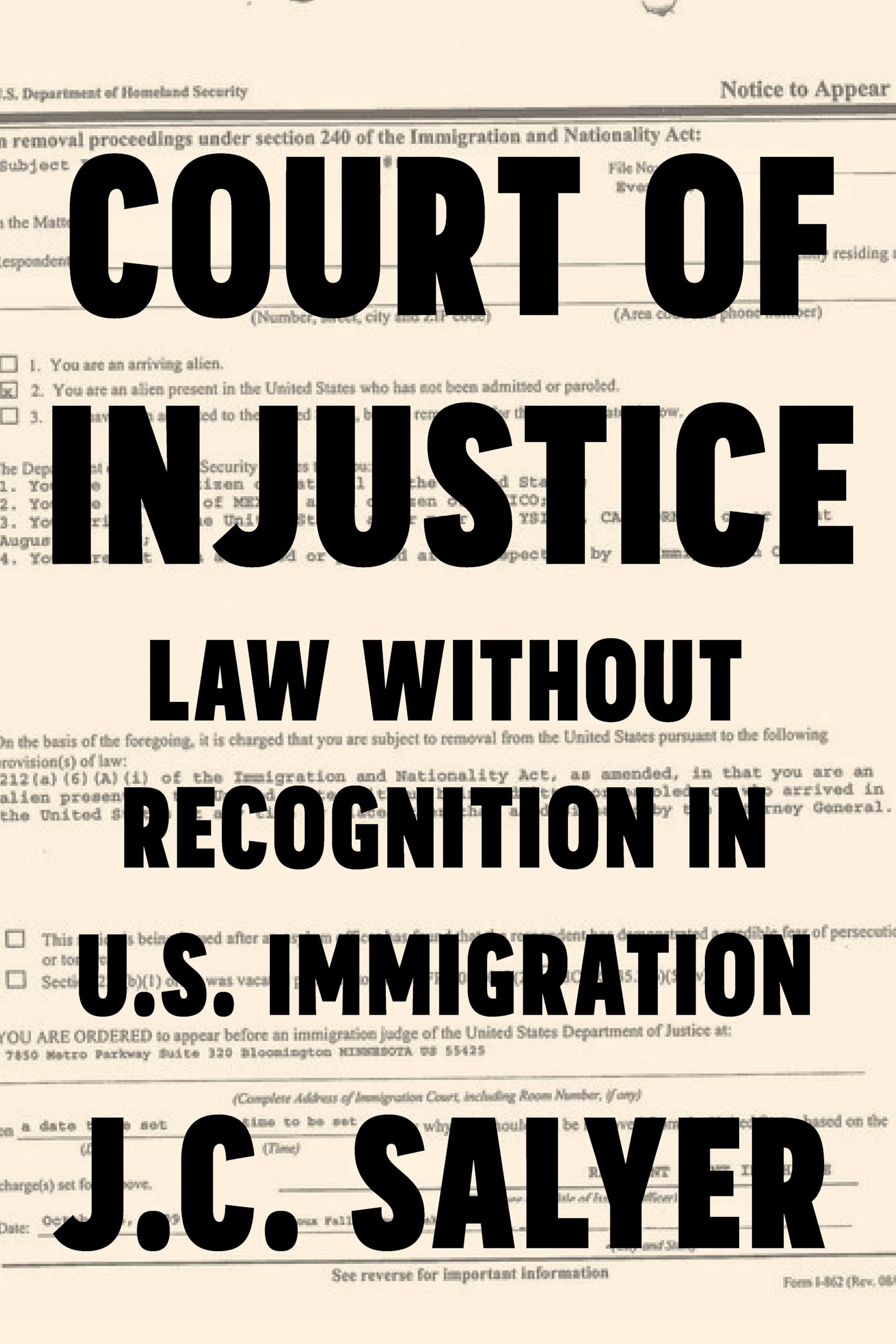
Court of Injustice: Law Without Recognition in U.S. Immigration by J. C. Salyer – A Critical Examination of Immigration
Inclusive of all applicable taxes. FREE shipping on all orders.
Available Offers
- 🚚Free Delivery — Free shipping on all orders
- 💵Cash on Delivery — Pay when your order arrives
- ↩️15-Day Easy Returns — Hassle-free return policy
- 🔒Cash on Delivery — Pay safely when your order arrives
Check Delivery
Product Description
Introduction
Court of Injustice: Law Without Recognition in U.S. Immigration by J. C. Salyer is a groundbreaking work that peels back the layers of a deeply flawed immigration system. Published by Stanford University Press, this hardcover volume offers an unflinching look at how legal frameworks, designed to uphold justice, instead perpetuate inequity for millions of non-citizens. For Indian readers, students, and legal professionals seeking to understand the human cost of immigration law, this book provides a powerful and necessary perspective.
Book Overview
This book is not a dry legal treatise; it is a vivid ethnographic account that follows migrants, their lawyers, and non-governmental organizations into the immigration courtrooms of New York City. J. C. Salyer, drawing on years of experience as a practicing immigration lawyer and anthropologist, reveals the day-to-day struggles of individuals fighting for recognition in a system that often treats them as invisible. The narrative exposes the gap between law on paper and law in practice, showing how procedures meant to be neutral can produce harsh and inhumane outcomes. Through detailed case studies, the book demonstrates how economic pressures, historical biases, and political forces combine to construct inequality under law.
Key Highlights
- Ethnographic Depth: Based on extensive fieldwork inside New York City immigration courts, offering a rare, ground-level view of proceedings.
- Lawyer’s Insight: Written by a practitioner who has represented migrants, blending legal expertise with anthropological rigor.
- Critical Analysis: Examines specific laws and policies that mandate harsh consequences for migrants and their families.
- Human Stories: Centres the voices and experiences of individual migrants, making the legal system’s impact tangible.
- Timely Relevance: Addresses ongoing debates about immigration reform, citizenship, and the meaning of justice in a globalized world.
Inside the Book
The book is structured around the journey of migrants through the enforcement apparatus. It begins by setting the historical and political context of U.S. immigration law, then moves into the courtroom, where judges, lawyers, and migrants negotiate cases. Salyer highlights the role of legal representation—or the lack of it—in determining outcomes. She also explores the work of NGOs that step in to fill gaps left by the state. Each chapter unpacks how law creates categories of belonging and exclusion, and how migrants resist or navigate these boundaries. The author’s dual perspective as both scholar and advocate enriches every page, making the legal complexities accessible without oversimplifying them.
Key Topics
- Immigration enforcement and courtroom procedures in the United States
- The intersection of law, race, and class in shaping migrant experiences
- Legal recognition and the denial of rights to non-citizens
- The role of lawyers and NGOs in challenging systemic injustice
- Historical and economic forces behind immigration policy
- The human impact of deportation and detention
Reader Benefits
- For Law Students: Gain a real-world understanding of immigration law beyond textbooks, with case studies that illustrate how statutes play out in practice.
- For Activists and Policy Makers: Access critical insights into the gaps between policy intent and implementation, informing advocacy for reform.
- For General Readers: Develop empathy and awareness about the struggles of migrants, a topic increasingly relevant to India’s own diaspora and global connections.
- For Academics: A rich source for research in legal anthropology, sociology of law, and migration studies, with rigorous methodology and compelling narratives.
Learning Outcomes
After reading this book, you will be able to: critically analyse how legal systems create inequality; understand the specific challenges faced by non-citizens in U.S. immigration courts; identify the roles of various actors—judges, lawyers, advocates—in shaping outcomes; evaluate the ethical dimensions of immigration enforcement; and connect historical and political contexts to contemporary legal practices. The book fosters a deeper appreciation of the gap between law’s promise and its lived reality.
Who Should Read
This book is essential for law students, legal professionals, and scholars of migration, but it also speaks powerfully to anyone concerned with social justice. Indian readers studying comparative law, international relations, or human rights will find it particularly valuable. Activists, journalists, and policy analysts working on immigration issues in India or abroad will gain fresh perspectives. Even curious general readers who want to understand one of the most pressing issues of our time will be captivated by Salyer’s storytelling and analysis.
About the Author
J. C. Salyer is both a practicing immigration lawyer and an anthropologist, a rare combination that gives her work unique depth. She has represented migrants in New York City for years, fighting for just outcomes in a system she knows intimately. Her academic training allows her to step back and analyse the broader structures that shape individual cases. She is committed to bridging the gap between legal practice and critical scholarship, making her voice essential in debates about immigration reform. Her work has been recognised for its humanity and rigour.
About the Publisher
Stanford University Press is a prestigious academic publisher known for producing influential works in law, social sciences, and humanities. With a commitment to intellectual excellence, they publish books that challenge conventional thinking and advance knowledge. Their titles are widely used in universities and by professionals worldwide. This book upholds their tradition of publishing rigorous, impactful scholarship that speaks to urgent public issues.
Conclusion
Court of Injustice is more than a book; it is a call to recognise the humanity behind every legal case. J. C. Salyer’s work forces us to confront uncomfortable truths about how law can be used as a tool of exclusion. For Indian readers, it offers a comparative lens to examine our own legal systems and their treatment of marginalised communities. Whether you are a student, a lawyer, or simply a concerned citizen, this book will change the way you think about justice, law, and the people caught in between. Add it to your library and engage with one of the most important conversations of our time.
Quick Summary
Court of Injustice: Law Without Recognition in U.S. Immigration by J. C. Salyer is a groundbreaking work that takes readers inside the American immigration court system. Through vivid ethnographic storytelling, Salyer follows migrants, their lawyers, and the NGOs that support them as they navigate a legal framework designed to exclude. The book reveals how even well-intentioned legal professionals struggle to achieve justice when the law itself is built on denial of rights. Combining anthropological observation with legal analysis, Salyer shows how race, class, and nationality shape court outcomes, and how historical policies continue to produce inequity. This book is essential for law students, activists, scholars, and anyone who wants to understand the human cost of immigration enforcement. By choosing Bookshops.in, Indian readers gain access to this critical study with fast delivery and genuine copies. It is a must-read for those concerned with justice, human rights, and the future of migration law.
Book Highlights
Book Specifications
| ISBN-13 | 9781503611405 |
| ISBN-10 | 150361140X |
| Publisher | Stanford Univ Pr |
| Language | English |
| Dimensions | 15.84 x 1.85 x 23.46 cm |
| Weight | 476 g |
| Category | Law › Constitutional Law |
| Genre | Nonfiction |
| Original Language | English |
Frequently Asked Questions
What is Court of Injustice about?
Who is the author of Court of Injustice?
Is this book based on real cases?
What makes this book different from other immigration law books?
Who should read this book?
Does the book cover recent immigration policies?
What is the main argument of the book?
How is the book structured?
Is this book suitable for a general audience?
What topics does the book cover?
Does the book offer solutions?
Is this book available in India?
What is the price in India?
What format is the book?
Readers Also Search For
Customers Also Bought
Constitutional Law
Indigenous law and the state
Constitutional Law
Great Cases in Constitutional Law (English, Robert P. George)
Constitutional Law
Guilty Pleas in International Criminal Law (English, Nancy Amoury Combs)
Constitutional Law
The Growth of the Law by Benjamin N. Cardozo – Jurisprudence
Constitutional Law
Constitutionalism in Islamic Countries by Rainer Grote – Comparative Constitutional Law
Constitutional Law
Youth: Learning Through Cases
Related Products
View AllConstitutional Law
Indigenous law and the state
Constitutional Law
Great Cases in Constitutional Law (English, Robert P. George)
Constitutional Law
Guilty Pleas in International Criminal Law (English, Nancy Amoury Combs)
Constitutional Law
The Growth of the Law by Benjamin N. Cardozo – Jurisprudence
Constitutional Law
Constitutionalism in Islamic Countries by Rainer Grote – Comparative Constitutional Law
Constitutional Law