
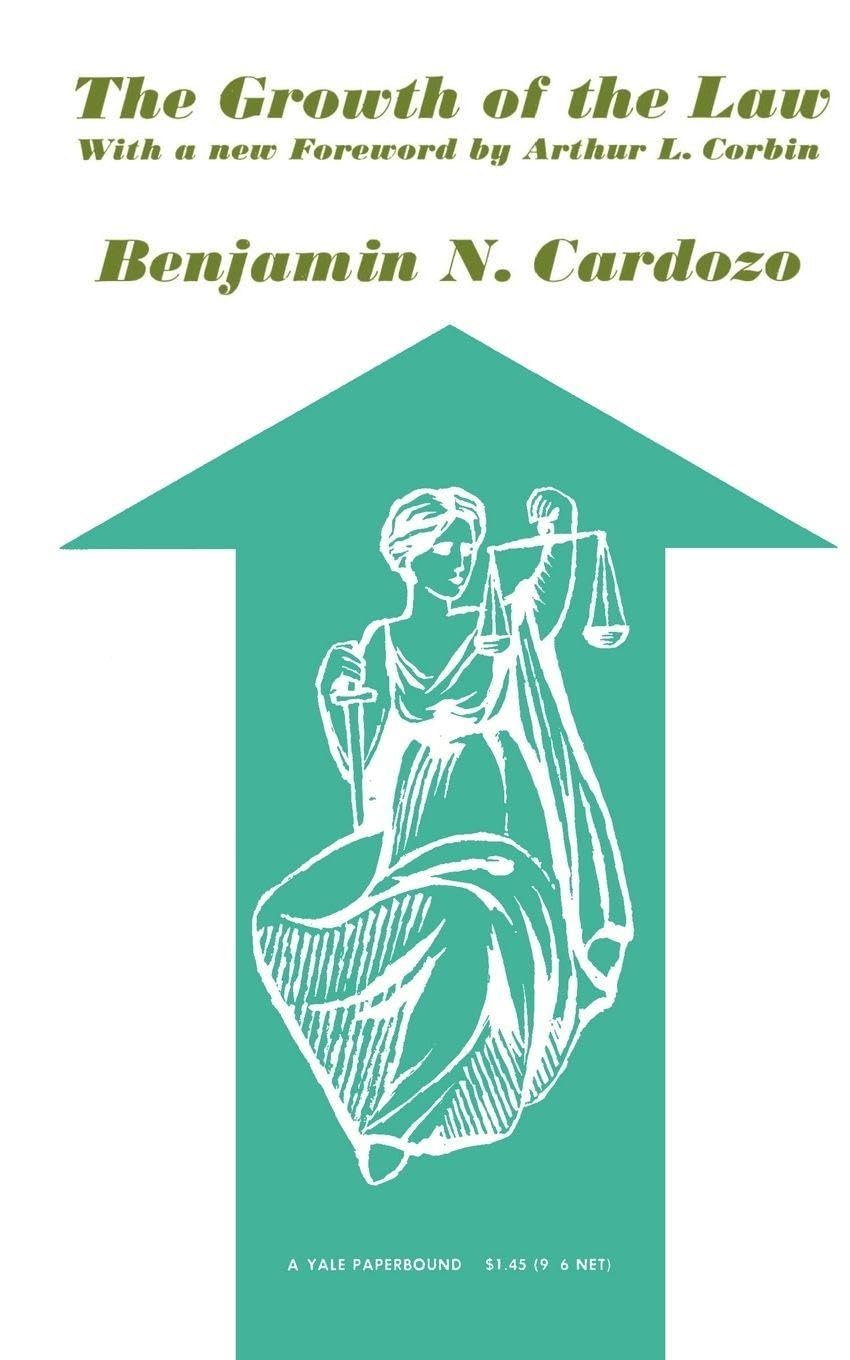
The Growth of the Law by Benjamin N. Cardozo – A Foundational Work on Legal Philosophy and Judicial Process
Inclusive of all applicable taxes. FREE shipping on all orders.
Available Offers
- 🚚Free Delivery — Free shipping on all orders
- 💵Cash on Delivery — Pay when your order arrives
- ↩️15-Day Easy Returns — Hassle-free return policy
- 🔒Cash on Delivery — Pay safely when your order arrives
Check Delivery
Product Description
Introduction
In the vast landscape of legal philosophy, few works have shaped modern judicial thought as profoundly as Benjamin N. Cardozo’s The Growth of the Law. A natural successor to his seminal The Nature of the Judicial Process, this volume moves beyond the mechanics of judicial decision-making to explore the ethical and philosophical foundations that guide a judge’s hand. For Indian law students, practitioners, and scholars, this book offers timeless insights into how law evolves—not merely through statutes, but through the conscience of the judiciary. Published by Yale University Press, this hardcover edition is an essential addition to any serious legal library.
Book Overview
The Growth of the Law is more than a treatise; it is a reflective journey into the soul of jurisprudence. Cardozo, a towering figure in American legal history, poses a fundamental question: having decided a case, how should a judge decide it? The book answers this by examining the interplay between logic, history, custom, and social welfare. It challenges readers to see law not as a static code but as a living organism that grows through the wisdom of its interpreters. Written with elegance and passion, this work remains as relevant today as when first published, especially for those navigating India’s dynamic legal system.
Key Highlights
- Continues Cardozo’s exploration of judicial philosophy from The Nature of the Judicial Process.
- Focuses on the ethical dimensions of judicial decision-making, moving from “how” to “how should.”
- Blends practical reasoning with profound philosophical inquiry.
- Praised by the Columbia Law Review for its passionate sincerity, breadth of imagination, and lucidity.
- Premium hardcover edition from Yale University Press, ideal for long-term study and reference.
Inside the Book
Cardozo structures his argument with the clarity of a master judge. The book opens with a reflection on the nature of law itself, then delves into the sources that feed its growth: logic, history, and custom. He examines the role of social utility and the judge’s responsibility to balance stability with progress. Each chapter builds on the previous, leading to a powerful conclusion about the moral duty of the judiciary. The prose is accessible yet profound, making complex ideas digestible for students while offering depth for seasoned practitioners.
Key Topics
- The dynamic nature of law and its evolution through judicial interpretation.
- The role of logic and precedent in shaping legal outcomes.
- Historical and customary influences on legal development.
- Social welfare and public policy as guiding principles for judges.
- The judge’s ethical responsibility to adapt law to changing societal needs.
Reader Benefits
- Deepen your understanding of how Indian and global legal systems evolve.
- Enhance your analytical skills by studying Cardozo’s reasoning process.
- Gain a philosophical toolkit for tackling complex legal dilemmas.
- Appreciate the human element in law—the conscience behind the judgment.
- Prepare for competitive exams and academic discussions with foundational legal theory.
Learning Outcomes
- Articulate the difference between descriptive and prescriptive judicial reasoning.
- Identify the key forces—logic, history, custom, and social welfare—that drive legal growth.
- Critically evaluate the balance between legal stability and progressive adaptation.
- Apply Cardozo’s framework to contemporary Indian case law and judgments.
- Develop a nuanced perspective on the judge’s role as both interpreter and creator of law.
Who Should Read
- Law students seeking a strong foundation in legal philosophy and jurisprudence.
- Judges and legal practitioners looking to refine their decision-making approach.
- Academics and researchers exploring the evolution of judicial thought.
- Civil services aspirants preparing for law-related papers and interviews.
- Anyone curious about the moral and intellectual underpinnings of the legal system.
About the Author
Benjamin N. Cardozo (1870–1938) was one of the most influential American jurists of the twentieth century. He served as Chief Judge of the New York Court of Appeals and later as an Associate Justice of the United States Supreme Court. Renowned for his eloquent opinions and profound legal writings, Cardozo’s works—including The Nature of the Judicial Process and The Growth of the Law—remain cornerstones of legal education worldwide. His philosophy emphasizes the human and social dimensions of law, making his insights timeless.
About the Publisher
Yale University Press is a prestigious academic publisher known for producing authoritative works in law, history, philosophy, and the social sciences. With a legacy spanning over a century, Yale University Press ensures that each volume meets the highest standards of scholarship and production quality. This hardcover edition of The Growth of the Law reflects that commitment, offering readers a durable and elegant book for years of study and reflection.
Conclusion
The Growth of the Law is not merely a book—it is a conversation with one of the greatest legal minds in history. For Indian readers, it offers a bridge between Western legal philosophy and the unique challenges of our own legal landscape. Whether you are a student preparing for exams, a judge seeking wisdom, or a scholar exploring the depths of jurisprudence, this volume will illuminate your path. Order your copy from Bookshops.in today and own a piece of legal heritage that continues to inspire and guide.
Quick Summary
The Growth of the Law by Benjamin N. Cardozo is a landmark work in legal philosophy that explores how law develops and adapts through the judicial process. Building on his earlier classic 'The Nature of Judicial Process', Cardozo asks not just how judges decide cases, but how they should decide them, delving into the ethical, logical, and social forces that shape legal principles. This book is essential for law students, legal professionals, judges, and anyone interested in the foundations of common law. Readers will learn about the dynamic nature of law, the role of judicial discretion, and the balance between precedent and social change. By purchasing from Bookshops.in, you receive a premium hardcover edition from Yale University Press, with reliable delivery across India. This is a must-have for any serious legal library.
Book Highlights
Book Specifications
| ISBN-13 | 9780300094824 |
| ISBN-10 | 0300094825 |
| Publisher | Yale University Press |
| Language | English |
| Dimensions | 20.07 x 12.8 x 1.14 cm |
| Weight | 204 g |
| Category | Law › Constitutional Law |
| Genre | Non-fiction |
| Original Language | English |
Frequently Asked Questions
What is The Growth of the Law about?
Who is Benjamin N. Cardozo?
Is this book suitable for Indian law students?
How does this book relate to The Nature of Judicial Process?
What is the ISBN for this book?
Is this book available in hardcover?
What is the price of The Growth of the Law on Bookshops.in?
What language is the book in?
What is the rating of this book?
Can I buy this book for a law library?
How is this book different from other jurisprudence texts?
Readers Also Search For
Customers Also Bought
Constitutional Law
Indigenous law and the state
Constitutional Law
Great Cases in Constitutional Law (English, Robert P. George)
Constitutional Law
Guilty Pleas in International Criminal Law (English, Nancy Amoury Combs)
Constitutional Law
Court of Injustice: Law Without Recognition in U.S. Immigration by J. C. Salyer
Constitutional Law
Constitutionalism in Islamic Countries by Rainer Grote – Comparative Constitutional Law
Constitutional Law
Youth: Learning Through Cases
Related Products
View AllConstitutional Law
Indigenous law and the state
Constitutional Law
Great Cases in Constitutional Law (English, Robert P. George)
Constitutional Law
Guilty Pleas in International Criminal Law (English, Nancy Amoury Combs)
Constitutional Law
Court of Injustice: Law Without Recognition in U.S. Immigration by J. C. Salyer
Constitutional Law
Constitutionalism in Islamic Countries by Rainer Grote – Comparative Constitutional Law
Constitutional Law