
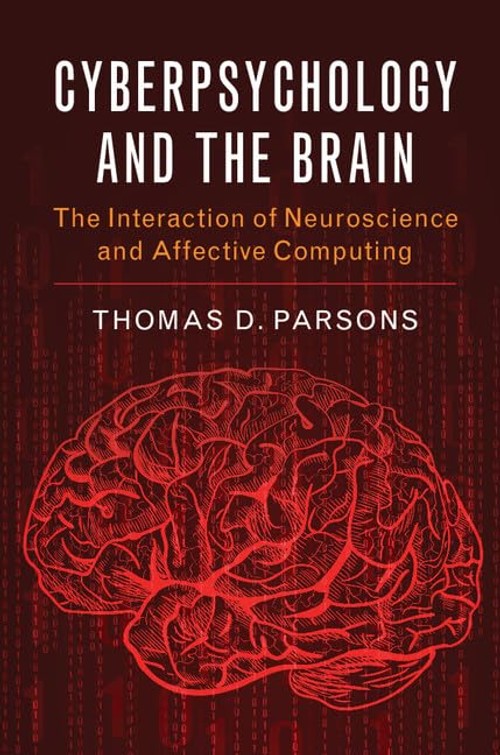
Cyberpsychology and the Brain: The Interaction of Neuroscience and Affective Computing by Thomas D. Parsons – A Comprehe
Inclusive of all applicable taxes. FREE shipping on all orders.
Available Offers
- 🚚Free Delivery — Free shipping on all orders
- 💵Cash on Delivery — Pay when your order arrives
- ↩️15-Day Easy Returns — Hassle-free return policy
- 🔒Cash on Delivery — Pay safely when your order arrives
Check Delivery
Product Description
Introduction
In an age where digital interfaces mediate almost every aspect of our lives, understanding the neural and cognitive underpinnings of human–technology interaction has become essential. Cyberpsychology and the Brain: The Interaction of Neuroscience and Affective Computing by Thomas D. Parsons offers a groundbreaking synthesis of cyberpsychology, neuroscience, and affective computing. This hardcover volume from Cambridge University Press provides Indian students, researchers, and professionals with a rigorous yet accessible framework for exploring how our brains engage with digital environments, from social media to virtual reality.
Book Overview
This book bridges two rapidly evolving fields: cyberpsychology—the study of human behaviour in digital contexts—and affective computing, which focuses on systems that recognise, interpret, and simulate human emotions. Thomas D. Parsons proposes a brain-based cyberpsychology that examines not only how we use technology but also the neurocognitive processes, motivations, and emotional responses that shape these interactions. Drawing on cutting-edge neuroscience, the book explores how neural systems support social, cognitive, and affective processes when humans engage with computational devices. It is a comprehensive resource for anyone seeking to understand the mind–machine interface from a scientific perspective.
Key Highlights
- Integrated Framework: The first book to systematically combine neuroscience and cyberpsychology for studying human–technology interaction.
- Affective Computing Focus: Detailed coverage of how machines can detect and respond to human emotions, with implications for mental health and education.
- Evidence-Based Approach: Rich with empirical studies, neuroimaging findings, and real-world applications.
- Indian Context Relevance: Applicable to India’s growing digital ecosystem, from online learning platforms to telemedicine and gaming.
- Authoritative Publisher: Published by Cambridge University Press, ensuring scholarly rigour and credibility.
Inside the Book
The book is structured to guide readers from foundational concepts to advanced applications. Early chapters introduce the principles of cyberpsychology and the architecture of the human brain, while later sections delve into affective computing algorithms, virtual reality neuroscience, and the ethical implications of brain–computer interfaces. Each chapter includes case studies, discussion questions, and references to Indian research where relevant. The hardcover edition is printed on high-quality paper, making it a durable addition to any academic library.
Key Topics
- Neural correlates of online social interaction and digital empathy
- Brain-based models of internet addiction and gaming disorder
- Affective computing for emotion recognition and mental health assessment
- Neurocognitive effects of virtual and augmented reality
- Ethical considerations in neuromarketing and brain–computer interfaces
- Applications in Indian education, healthcare, and e-governance
Reader Benefits
- For Students: A clear, textbook-style introduction to interdisciplinary topics, with summaries and glossaries.
- For Researchers: A comprehensive literature review and methodological guidance for designing studies in cyberpsychology.
- For Professionals: Practical insights for UX designers, AI developers, and clinicians working with digital tools.
- For Educators: Ready-to-use lecture material and discussion prompts for psychology and computer science courses.
Learning Outcomes
After reading this book, you will be able to: (1) Explain how neural systems underpin human interactions with digital technologies; (2) Critically evaluate affective computing systems and their limitations; (3) Design experiments that integrate neuroimaging and behavioural measures; (4) Apply cyberpsychological principles to improve user experience and digital well-being; and (5) Understand the ethical landscape of brain-based technology in Indian and global contexts.
Who Should Read
This book is ideal for postgraduate students and academics in psychology, neuroscience, computer science, and human–computer interaction. It is also highly relevant for Indian professionals in UX research, artificial intelligence, mental health counselling, and educational technology. Undergraduates with a background in cognitive science or programming will find it accessible with some guidance. The book is a must-read for anyone curious about how our brains adapt to—and shape—the digital world.
About the Author
Thomas D. Parsons is a leading researcher at the intersection of neuroscience, cyberpsychology, and technology. With over two decades of experience, he has published extensively on neurocognitive assessment, virtual reality, and affective computing. His work has been funded by major institutions and cited globally. Parsons currently serves as a professor at the University of North Carolina, where he directs the Computational Neuropsychology and Simulation (CNS) Lab. His interdisciplinary approach makes complex topics accessible to both technical and non-technical readers.
About the Publisher
Cambridge University Press is one of the world’s oldest and most respected academic publishers, with a history dating back to 1534. Known for rigorous peer review and high editorial standards, Cambridge publishes groundbreaking works across all disciplines. This hardcover edition exemplifies their commitment to quality, with clear typesetting, durable binding, and archival-grade paper. For Indian readers, Cambridge titles are a benchmark of scholarly excellence in psychology, neuroscience, and technology studies.
Conclusion
Cyberpsychology and the Brain is more than a textbook—it is a roadmap for understanding the human mind in the digital age. As India embraces digital transformation, this book equips readers with the scientific tools to navigate opportunities and challenges, from online learning to mental health apps. Whether you are a student, researcher, or professional, this volume will deepen your appreciation of how our brains interact with technology and inspire new ways to design humane, effective digital experiences. Order your copy from Bookshops.in today and join the conversation at the frontier of mind and machine.
Quick Summary
Cyberpsychology and the Brain: The Interaction of Neuroscience and Affective Computing by Thomas D. Parsons is a groundbreaking work that establishes a brain-based framework for cyberpsychology. The book integrates neuroscience, cognitive science, and affective computing to explore how humans interact with technology at neural, cognitive, and emotional levels. It examines the neurocognitive and social processes underlying digital behaviour, making it essential reading for students and researchers in psychology, neuroscience, human-computer interaction, and related fields. Readers will learn how neural systems support our engagement with computational devices and how affective computing can enhance human-technology relationships. Published by Cambridge University Press, this hardcover edition is ideal for Indian academic libraries, university courses, and personal reference. By purchasing from Bookshops.in, customers receive an authentic, high-quality print edition with reliable service across India, supporting their academic and professional growth in this rapidly evolving discipline.
Book Highlights
Book Specifications
| ISBN-13 | 9781107094871 |
| ISBN-10 | 1107094879 |
| Publisher | Cambridge University Press |
| Language | English |
| Dimensions | 15.24 x 2.54 x 22.86 cm |
| Weight | 870 g |
| Category | Basic Sciences › Neuroscience |
| Genre | Non-fiction |
| Original Language | English |
Frequently Asked Questions
What is Cyberpsychology and the Brain about?
Who is the author of this book?
Is this book suitable for Indian students?
What is the price of this book?
Does the book cover affective computing?
Is this book part of a series?
What is the ISBN of this book?
Can I use this book for research?
Does the book include case studies?
What language is the book in?
Is the book available in digital format?
Why buy from Bookshops.in?
Readers Also Search For
Customers Also Bought

Anatomy
Ultrastructure of the Digestive Tract: 4 (Electron Microscopy in Biology and Medicine)

Anatomy
Ultrastructure of the Connective Tissue Matrix: 3 (Electron Microscopy in Biology and Medicine)

Anatomy
Reproductive Genetics (Royal College of Obstetricians and Gynaecologists Study Group)

Anatomy
Human Gross Anatomy: An Outline Text by Robert J. Leonard – Medical Anatomy

Pharmacology
Mathematical Modeling and Simulation in Enteric Neurobiology

Anatomy
Nature’s Patterns and the Fractional Calculus: 2 (Fractional Calculus in Applied Sciences and Engineering, 2)
Related Products
View All
Medicine & Health Sciences
Handbook of Hospitality Strategic Management | by Olsen Michael | Taylor & Francis Ltd | by Olsen Michael | Taylor & Francis Ltd | by Olsen Michael | Taylor & Francis Ltd | by Olsen Michael | Taylor & Francis Ltd | by Olsen Michael | Taylor & Francis Ltd | by Olsen Michael | Taylor & Francis Ltd | by Olsen Michael | Taylor & Francis Ltd | by Olsen Michael | Taylor & Francis Ltd | by Olsen Michael | Taylor & Francis Ltd | by Olsen Michael | Taylor & Francis

Medicine & Health Sciences
Pediatrics on Call | by Charles A. Pohl | Kathleen Bradford | Clara Callahan | McGraw Hill / Medical | by Charles A. Pohl | Kathleen Bradford | Clara Callahan | McGraw Hill / Medical | by Charles A. Pohl | Kathleen Bradford | Clara Callahan | McGraw Hill / Medical | by Charles A. Pohl | Kathleen Bradford | Clara Callahan | McGraw Hill / Medical | by Charles A. Pohl | Kathleen Bradford | Clara Callahan | McGraw Hill / Medical | by Charles A. Pohl | Kathleen Bradford | Clara Callahan | McGraw Hill

Medicine & Health Sciences
The Physician's Guide to Depression and Bipolar Disorders | by Dwight L. Evans | Dennis S. Charney | Lydia Lewis | McGraw Hill / Medical | by Dwight L. Evans | Dennis S. Charney | Lydia Lewis | McGraw Hill / Medical | by Dwight L. Evans | Dennis S. Charney | Lydia Lewis | McGraw Hill / Medical | by Dwight L. Evans | Dennis S. Charney | Lydia Lewis | McGraw Hill / Medical | by Dwight L. Evans | Dennis S. Charney | Lydia Lewis | McGraw Hill / Medical | by Dwight L. Evans | Dennis S. Charney | Lydi

Medicine & Health Sciences
First Exposure to Internal Medicine | by Andrew R. Hoellein | Charles H. Griffith | McGraw Hill / Medical | by Andrew R. Hoellein | Charles H. Griffith | McGraw Hill / Medical | by Andrew R. Hoellein | Charles H. Griffith | McGraw Hill / Medical | by Andrew R. Hoellein | Charles H. Griffith | McGraw Hill / Medical | by Andrew R. Hoellein | Charles H. Griffith | McGraw Hill / Medical | by Andrew R. Hoellein | Charles H. Griffith | McGraw Hill / Medical | by Andrew R. Hoellein | Charles H. Griffit

Medicine & Health Sciences
First Exposure to Internal Medicine | by Charles H. Griffith | Andrew R. Hoellein | McGraw Hill / Medical | by Charles H. Griffith | Andrew R. Hoellein | McGraw Hill / Medical | by Charles H. Griffith | Andrew R. Hoellein | McGraw Hill / Medical | by Charles H. Griffith | Andrew R. Hoellein | McGraw Hill / Medical | by Charles H. Griffith | Andrew R. Hoellein | McGraw Hill / Medical | by Charles H. Griffith | Andrew R. Hoellein | McGraw Hill / Medical | by Charles H. Griffith | Andrew R. Hoellei

Medicine & Health Sciences