
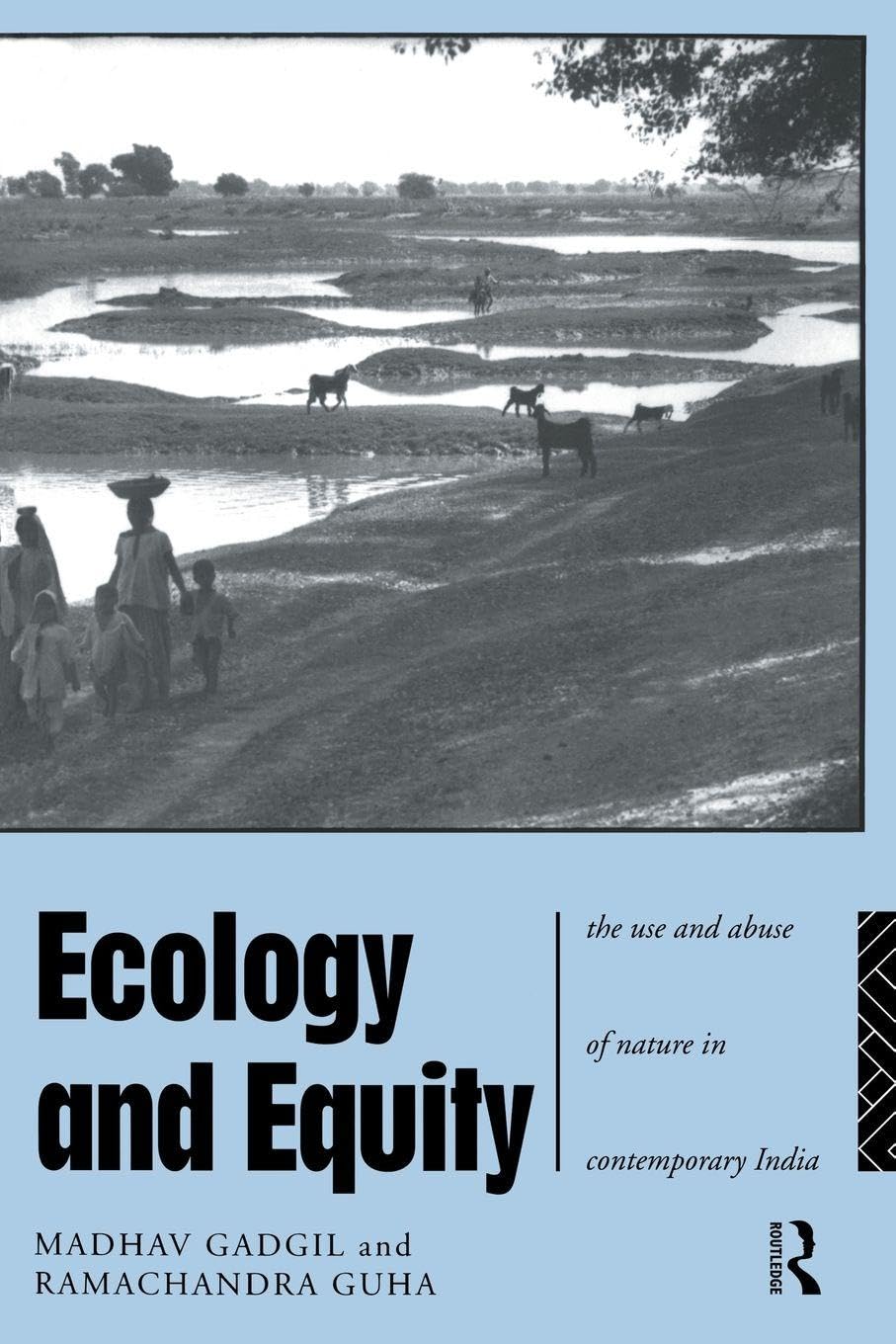
Ecology and Equity: The Use and Abuse of Nature in Contemporary India by Gadgil Madhav – A Deep Dive into Environmental
Inclusive of all applicable taxes. FREE shipping on all orders.
Available Offers
- 🚚Free Delivery — Free shipping on all orders
- 💵Cash on Delivery — Pay when your order arrives
- ↩️15-Day Easy Returns — Hassle-free return policy
- 🔒Cash on Delivery — Pay safely when your order arrives
Check Delivery
Product Description
Introduction
India stands at a crossroads where rapid economic growth meets deep ecological fragility. In a nation where dense forests coexist with sprawling wastelands, and where high-tech innovators live alongside traditional hunter-gatherers, the relationship between people and nature is anything but simple. Ecology and Equity: The Use and Abuse of Nature in Contemporary India by Madhav Gadgil offers a powerful, original lens through which to understand this complex interplay. This hardbound edition from Routledge is an essential resource for students, environmentalists, policymakers, and anyone concerned about the social and ecological future of India.
Book Overview
This book goes beyond surface-level environmentalism to explore the deep-rooted conflicts that define India's ecological landscape. Gadgil argues that environmental destruction is not merely a technical or economic problem—it is fundamentally a social one. The book reveals how competition between different social groups, economic interests, and classes over natural resources lies at the heart of India's environmental crisis. Rather than treating the environment as a separate issue, Ecology and Equity weaves together threads of ecology, equity, and social justice to show how the abuse of nature is inseparable from the marginalization of communities. It is a radical critique that calls for systemic reform, making it a landmark work in Indian environmental studies.
Key Highlights
- Original and provocative analysis of India's environmental challenges, connecting local conflicts to global patterns.
- Interdisciplinary approach merging ecology, sociology, economics, and political science.
- Focus on equity—how the poor and marginalized bear the brunt of environmental degradation.
- Case studies from across India, including forests, coasts, and urban landscapes.
- Actionable proposals for ecological reform rooted in grassroots realities.
Inside the Book
The book is structured to take readers on a journey from understanding the diversity of India's ecosystems to diagnosing the social drivers of environmental abuse. It examines the role of the state, market forces, and traditional communities in shaping how nature is used—and misused. Through detailed examples, Gadgil shows how deforestation, water scarcity, and pollution are not random events but outcomes of power imbalances. The narrative is both scholarly and accessible, making complex ideas understandable without losing depth. Each chapter builds a case for why equity must be central to any genuine environmental movement.
Key Topics
- The ecological diversity of India and its social dimensions
- Competition for natural resources among different social groups
- Environmental degradation as a consequence of inequality
- Global North–South dynamics in environmental discourse
- Traditional ecological knowledge vs. modern developmental models
- Policy failures and the path toward sustainable, equitable reform
Reader Benefits
This book equips readers with a deeper understanding of why environmental issues in India cannot be solved by technical fixes alone. It challenges conventional wisdom and encourages critical thinking about development, justice, and sustainability. Students will gain a robust framework for analyzing ecological conflicts, while activists and policymakers will find practical insights for creating more inclusive environmental policies. The book also broadens one's perspective on how India's environmental story is connected to global patterns of consumption and exploitation.
Learning Outcomes
- Understand the social roots of environmental problems in India
- Analyze the relationship between economic inequality and ecological damage
- Critically evaluate mainstream environmental policies and narratives
- Identify the roles of different stakeholders—from tribal communities to corporations—in shaping nature use
- Develop a nuanced view of conservation and development trade-offs
Who Should Read
This book is ideal for undergraduate and postgraduate students in environmental science, ecology, sociology, geography, and development studies. It is equally valuable for environmental activists, NGO workers, journalists covering ecological issues, and government officials involved in natural resource management. Anyone interested in India's environmental future and the pursuit of social justice will find this book indispensable. It speaks directly to Indian readers who want to understand the land they live in beyond headlines and stereotypes.
About the Author
Madhav Gadgil is one of India's most respected ecologists and environmental thinkers. A professor at the Indian Institute of Science, Bangalore, and a former chairman of the Western Ghats Ecology Expert Panel, Gadgil has spent decades studying the interplay between human societies and natural ecosystems. His work has been instrumental in shaping conservation policy in India, and he is known for his commitment to involving local communities in environmental management. Ecology and Equity is a culmination of his deep research and passionate advocacy for a fairer, more sustainable world.
About the Publisher
Routledge is a globally renowned academic publisher, known for producing high-quality books in the social sciences, humanities, and environmental studies. Their titles are widely used in universities and research institutions across the world. This hardcover edition ensures durability and a premium reading experience, making it a valuable addition to any personal or institutional library.
Conclusion
Ecology and Equity is not just a book—it is a call to rethink our relationship with nature and with each other. In a time of climate crisis and deepening inequality, Madhav Gadgil's insights are more relevant than ever. Whether you are a student, a scholar, or a concerned citizen, this book will change how you see India's environment and your place within it. Order your copy today from Bookshops.in and join the conversation on building a more just and sustainable future.
Quick Summary
Ecology and Equity: The Use and Abuse of Nature in Contemporary India by Gadgil Madhav is a seminal work that delves into the intricate relationship between social conflict and environmental degradation on the Indian subcontinent. The book argues that the root cause of ecological crisis lies in competition among different social groups and economic interests for natural resources. It examines India's diverse environments—from dense forests to degraded wastelands—and highlights how these conflicts play out at local, national, and global levels. Written by a leading ecologist, the text is both a radical critique of current practices and a call for equitable, sustainable reform. This book is ideal for students of environmental science, policymakers, activists, and anyone concerned with social justice and the future of our planet. By purchasing from Bookshops.in, you support a trusted Indian bookstore committed to delivering high-quality physical books to your doorstep.
Book Highlights
Book Specifications
| ISBN-13 | 9780415125246 |
| ISBN-10 | 0415125243 |
| Publisher | Routledge |
| Language | English |
| Dimensions | 15.6 x 1.32 x 23.39 cm |
| Weight | 522 g |
| Country | India |
| Category | Science & Mathematics › Earth Sciences |
| Genre | Non-fiction |
| Original Language | English |
Frequently Asked Questions
What is Ecology and Equity about?
Who is the author of Ecology and Equity?
Is this book suitable for beginners?
What makes this book unique?
Does the book focus only on India?
What is the ISBN?
Is it available in hardcover?
What language is the book in?
Can I use this book for academic research?
Does it include case studies?
What are the main themes?
Is the book still relevant today?
Where can I buy it?
Readers Also Search For
Customers Also Bought
Mathematics
Stereotype Spaces and Algebras: 73 (De Gruyter Expositions in Mathematics, 73)

Mathematics
Semigroups in Algebra, Geometry and Analysis: 20 (De Gruyter Expositions in Mathematics, 20)

Mathematics
Geometry from the Pacific Rim: Proceedings of the Pacific Rim Geometry Conference held at National University of Singapore, Republic of Singapore, ... 1994 (De Gruyter Proceedings in Mathematics)

Mathematics
First International Tainan-Moscow Algebra Workshop: Proceedings of the International Conference held at National Cheng Kung University Tainan, Taiwan, ... 1994 (De Gruyter Proceedings in Mathematics)

Mathematics
Differential Geometry - Proceedings of the VIII International Colloquium (English, Jesus A. Alvarez Lopez | Eduardo Garcia-Rio)

Mathematics
Mathematical Theory of Optimal Processes (Classics of Soviet Mathematics)
Related Products
View All
Science & Mathematics
Squid - Superconducting Quantum Interference Devices and Their Applications: Proceedings of the International Conference on Superconducting Quantum Devices, Berlin-west, October 4-8, 1976

Science & Mathematics
Thermodynamics and Pattern Formation in Biology

Science & Mathematics
The Nature of Mathematics and the Mathematics of Nature by S. Andersson – Mathematics & Science

Science & Mathematics
Linear Algebra | by Stephen Friedberg | Arnold Insel | Lawrence Spence | Pearson | by Stephen Friedberg | Arnold Insel | Lawrence Spence | Pearson | by Stephen Friedberg | Arnold Insel | Lawrence Spence | Pearson | by Stephen Friedberg | Arnold Insel | Lawrence Spence | Pearson | by Stephen Friedberg | Arnold Insel | Lawrence Spence | Pearson | by Stephen Friedberg | Arnold Insel | Lawrence Spence | Pearson | by Stephen Friedberg | Arnold Insel | Lawrence Spence | Pearson | by Stephen Friedberg

Science & Mathematics
University Calculus | by Joel Hass | Christopher Heil | Maurice Weir | Pearson | by Joel Hass | Christopher Heil | Maurice Weir | Pearson | by Joel Hass | Christopher Heil | Maurice Weir | Pearson | by Joel Hass | Christopher Heil | Maurice Weir | Pearson | by Joel Hass | Christopher Heil | Maurice Weir | Pearson | by Joel Hass | Christopher Heil | Maurice Weir | Pearson | by Joel Hass | Christopher Heil | Maurice Weir | Pearson | by Joel Hass | Christopher Heil | Maurice Weir | Pearson | by Joe
Science & Mathematics