
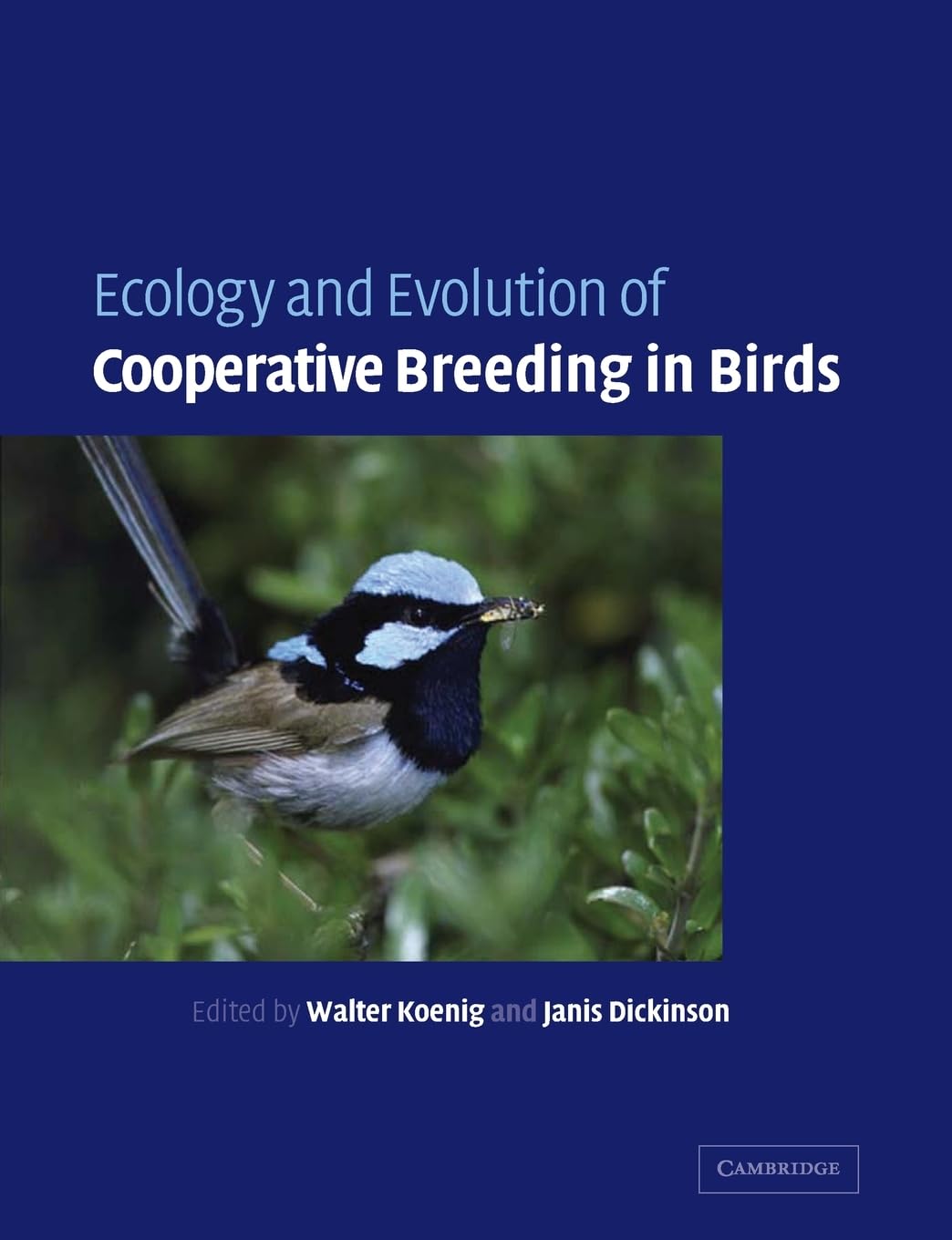
Ecology and Evolution of Cooperative Breeding in Birds by Walter D. Koenig – A Detailed Scientific Analysis of Avian Soc
Inclusive of all applicable taxes. FREE shipping on all orders.
Available Offers
- 🚚Free Delivery — Free shipping on all orders
- 💵Cash on Delivery — Pay when your order arrives
- ↩️15-Day Easy Returns — Hassle-free return policy
- 🔒Cash on Delivery — Pay safely when your order arrives
Check Delivery
Product Description
Introduction
In the vast and vibrant world of avian biology, few phenomena captivate researchers and nature enthusiasts as profoundly as cooperative breeding. Ecology and Evolution of Cooperative Breeding in Birds, edited by Walter D. Koenig, offers an authoritative and comprehensive exploration of this remarkable behaviour. Published by the prestigious Cambridge University Press, this hardbound volume is an essential addition to the library of any serious student or professional in ornithology, behavioural ecology, or evolutionary biology. This book delves into the intricate social systems where more than two individuals collaborate to raise young, a behaviour that challenges conventional Darwinian expectations and opens a window into the evolution of altruism and complex societies.
Book Overview
Building on the foundation of the earlier classic Cooperative Breeding in Birds, this updated and conceptually organised volume synthesises decades of long-term field studies and modern theoretical advances. The book moves beyond mere description to test and refine evolutionary theories related to sexual selection, life-history strategies, sex-ratio manipulation, and incest avoidance. It brings together contributions from leading scientists who have dedicated years to observing species like acorn woodpeckers, superb fairy-wrens, and meerkats (though the focus remains avian). The result is a rich, data-driven narrative that illuminates how cooperative breeding shapes avian life and offers broader insights into the evolution of cooperation across the animal kingdom.
Key Highlights
- Conceptual Organisation: Unlike traditional species-by-species accounts, this book is structured around key evolutionary questions, making it easier to compare patterns across different bird families.
- Long-Term Data: Draws on decades of meticulous fieldwork, providing rare insights into lifetime fitness, kinship dynamics, and ecological constraints.
- Modern Analytical Tools: Incorporates molecular genetics, phylogenetic comparisons, and advanced statistical methods to test hypotheses rigorously.
- Global Perspective: Covers cooperative breeding systems from tropical rainforests to arid Australian scrublands, offering a truly worldwide view.
- Relevance to Human Societies: The principles of cooperation, conflict, and reproductive sharing resonate with broader questions in human evolutionary psychology and sociology.
Inside the Book
The chapters are carefully crafted to guide readers from foundational concepts to cutting-edge research. Early sections revisit the definition and prevalence of cooperative breeding, then move into the ecological drivers—such as habitat saturation and resource predictability—that favour helping behaviour. Later chapters explore the genetic basis of cooperation, the role of helpers in increasing fledgling success, and the complex dynamics of reproductive skew. The book also tackles controversial topics like the evolution of delayed dispersal and the adaptive significance of alloparental care. Each chapter ends with a summary of unresolved questions, encouraging readers to think critically and identify future research directions.
Key Topics
- Ecological constraints and the evolution of delayed dispersal
- Kinship selection and indirect fitness benefits
- Reproductive partitioning and conflict resolution within groups
- Sex-ratio adjustment and parental investment strategies
- Life-history trade-offs in cooperative versus solitary breeders
- Incest avoidance mechanisms and inbreeding depression
- Comparative phylogenetics of social systems
- Climate change and its impact on cooperative behaviour
Reader Benefits
This book empowers readers with a deep, nuanced understanding of one of nature's most intriguing social systems. Students will gain clarity on complex theoretical models through real-world examples. Researchers will find a treasure trove of hypotheses to test and methodological innovations to adopt. For Indian readers, the principles discussed are directly applicable to studying the many cooperative bird species found in the subcontinent, such as jungle babblers, pied babblers, and certain drongos. The book bridges the gap between abstract theory and observable field behaviour, making it an invaluable resource for those pursuing careers in wildlife biology, conservation, or evolutionary studies.
Learning Outcomes
- Understand the ecological and evolutionary drivers of cooperative breeding in birds.
- Analyse the costs and benefits of helping behaviour using inclusive fitness theory.
- Evaluate modern genetic and phylogenetic approaches to studying social evolution.
- Critically assess long-term field data and its implications for life-history theory.
- Apply comparative methods to test hypotheses about social organisation across species.
- Identify gaps in current knowledge and formulate original research questions.
Who Should Read
This book is ideally suited for postgraduate students in zoology, ecology, and evolutionary biology. It is also highly recommended for advanced undergraduates undertaking projects in behavioural ecology, as well as professional ornithologists and wildlife researchers. Wildlife managers and conservation biologists will find valuable insights into how social systems affect population dynamics and vulnerability to environmental change. Finally, any curious naturalist with a serious interest in bird behaviour will find this book both challenging and deeply rewarding.
About the Author
Walter D. Koenig is a research zoologist and adjunct professor at the University of California, Berkeley, and a senior scientist at the Cornell Lab of Ornithology. He has spent decades studying the behavioural ecology of acorn woodpeckers and other cooperative breeders. His pioneering work on kinship, reproductive strategies, and habitat dynamics has shaped modern understanding of avian social systems. Koenig has authored and edited several landmark volumes and is widely regarded as one of the foremost authorities in the field.
About the Publisher
Cambridge University Press is one of the world's oldest and most respected academic publishers. With a legacy spanning nearly five centuries, Cambridge University Press is renowned for producing high-quality scholarly works that advance knowledge across science, humanities, and social sciences. This hardcover edition reflects their commitment to excellence in academic publishing, with durable binding and clear, readable typography suitable for long-term reference.
Conclusion
Ecology and Evolution of Cooperative Breeding in Birds is more than a textbook—it is a gateway to understanding the profound complexities of social life in the avian world. By combining rigorous science with accessible writing, Walter D. Koenig and his collaborators have created a work that will inspire the next generation of behavioural ecologists. Whether you are a student preparing for a research career or a seasoned scientist seeking a comprehensive update, this book deserves a prominent place on your shelf. Order your copy today from Bookshops.in and embark on a fascinating journey into the cooperative lives of birds.
Quick Summary
Ecology and Evolution of Cooperative Breeding in Birds, edited by Walter D. Koenig, is an authoritative scientific compilation that updates the foundational work on avian cooperative breeding. This book delves into the evolutionary puzzles of altruistic behavior where non-breeding birds help raise offspring that are not their own. It presents cutting-edge theoretical models, empirical evidence from long-term field studies, and modern molecular techniques that have reshaped our understanding of social evolution. The volume is structured thematically, covering topics such as kin selection, ecological constraints, delayed dispersal, and the genetic basis of helping behavior. It is designed for graduate students, researchers, and professionals in ornithology, evolutionary biology, and behavioral ecology. Readers will gain a nuanced appreciation of how cooperation arises in nature and the ecological factors that sustain it. By purchasing from Bookshops.in, Indian customers receive an authentic hardcover edition with fast shipping, ensuring they have access to this essential academic resource for their studies or research.
Book Highlights
Book Specifications
| ISBN-13 | 9780521822718 |
| ISBN-10 | 0521822718 |
| Publisher | Cambridge University Press |
| Language | English |
| Dimensions | 19.05 x 1.91 x 24.77 cm |
| Weight | 842 g |
| Category | Biology & Life Sciences › Ecology |
| Genre | Non-fiction |
| Original Language | English |
Frequently Asked Questions
What is cooperative breeding in birds?
Who is the author of this book?
Is this book suitable for beginners?
How does this book differ from the 1990 edition?
Does the book cover Indian bird species?
What is the main theme of the book?
Is this book used in university courses?
Are there illustrations or diagrams?
Can I find research data in this book?
Does the book discuss human cooperation?
Is this a hardcover edition?
What is the price in India?
Why buy from Bookshops.in?
Readers Also Search For
Customers Also Bought
Mathematics
Stereotype Spaces and Algebras: 73 (De Gruyter Expositions in Mathematics, 73)

Mathematics
Semigroups in Algebra, Geometry and Analysis: 20 (De Gruyter Expositions in Mathematics, 20)

Mathematics
Geometry from the Pacific Rim: Proceedings of the Pacific Rim Geometry Conference held at National University of Singapore, Republic of Singapore, ... 1994 (De Gruyter Proceedings in Mathematics)

Mathematics
First International Tainan-Moscow Algebra Workshop: Proceedings of the International Conference held at National Cheng Kung University Tainan, Taiwan, ... 1994 (De Gruyter Proceedings in Mathematics)

Mathematics
Differential Geometry - Proceedings of the VIII International Colloquium (English, Jesus A. Alvarez Lopez | Eduardo Garcia-Rio)

Mathematics
Mathematical Theory of Optimal Processes (Classics of Soviet Mathematics)
Related Products
View All
Science & Mathematics
Squid - Superconducting Quantum Interference Devices and Their Applications: Proceedings of the International Conference on Superconducting Quantum Devices, Berlin-west, October 4-8, 1976

Science & Mathematics
Thermodynamics and Pattern Formation in Biology

Science & Mathematics
The Nature of Mathematics and the Mathematics of Nature by S. Andersson – Mathematics & Science

Science & Mathematics
Linear Algebra | by Stephen Friedberg | Arnold Insel | Lawrence Spence | Pearson | by Stephen Friedberg | Arnold Insel | Lawrence Spence | Pearson | by Stephen Friedberg | Arnold Insel | Lawrence Spence | Pearson | by Stephen Friedberg | Arnold Insel | Lawrence Spence | Pearson | by Stephen Friedberg | Arnold Insel | Lawrence Spence | Pearson | by Stephen Friedberg | Arnold Insel | Lawrence Spence | Pearson | by Stephen Friedberg | Arnold Insel | Lawrence Spence | Pearson | by Stephen Friedberg

Science & Mathematics
University Calculus | by Joel Hass | Christopher Heil | Maurice Weir | Pearson | by Joel Hass | Christopher Heil | Maurice Weir | Pearson | by Joel Hass | Christopher Heil | Maurice Weir | Pearson | by Joel Hass | Christopher Heil | Maurice Weir | Pearson | by Joel Hass | Christopher Heil | Maurice Weir | Pearson | by Joel Hass | Christopher Heil | Maurice Weir | Pearson | by Joel Hass | Christopher Heil | Maurice Weir | Pearson | by Joel Hass | Christopher Heil | Maurice Weir | Pearson | by Joe

Science & Mathematics