
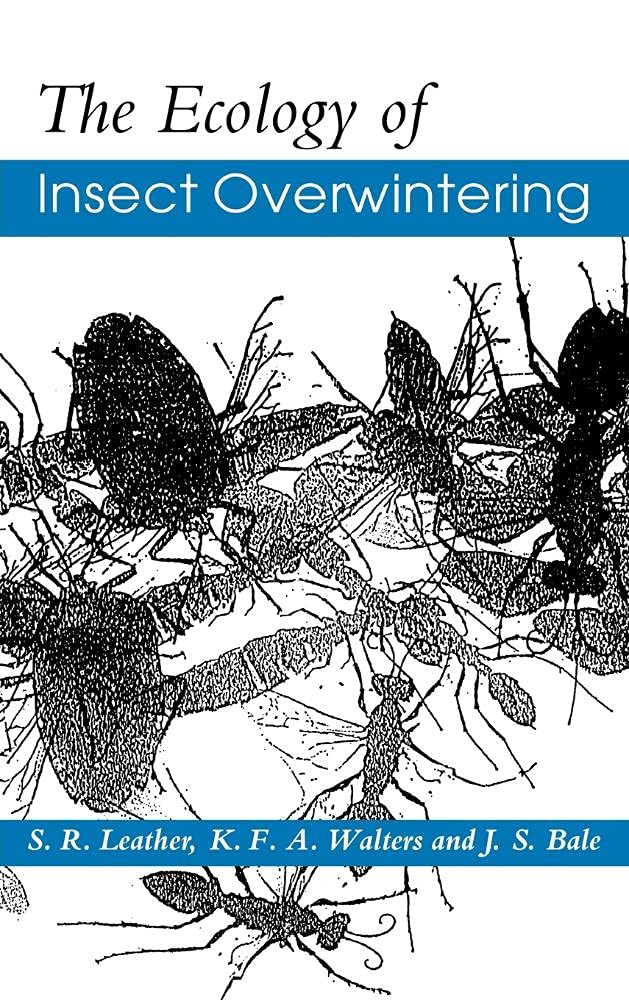
The Ecology of Insect Overwintering by S. R. Leather – A Comprehensive Guide to Insect Hibernation, Physiology, and Surv
Inclusive of all applicable taxes. FREE shipping on all orders.
Available Offers
- 🚚Free Delivery — Free shipping on all orders
- 💵Cash on Delivery — Pay when your order arrives
- ↩️15-Day Easy Returns — Hassle-free return policy
- 🔒Cash on Delivery — Pay safely when your order arrives
Check Delivery
Product Description
Introduction
Insect overwintering is one of nature’s most remarkable survival strategies, yet it often goes unnoticed beneath the snow or within the bark of trees. For students and researchers in ecology, agriculture, and forestry, understanding how insects endure harsh winter conditions is key to predicting pest outbreaks and protecting crops. The Ecology of Insect Overwintering by S. R. Leather offers a deep, scientific exploration of this vital process, making it an indispensable resource for Indian scholars and professionals working in entomology, pest management, and environmental science.
Book Overview
Published by Cambridge University Press, this hardcover volume presents a comprehensive account of the physiological, biochemical, and behavioural adaptations that allow insects to survive winter. The book bridges fundamental ecology with practical applications, examining how overwintering strategies influence insect population dynamics, disease transmission, and agricultural damage. With a strong focus on temperate and subtropical regions—including insights relevant to Indian agroecosystems—this text equips readers with the knowledge to interpret seasonal patterns in insect life cycles.
Key Highlights
- In-depth coverage of diapause, cold hardiness, and metabolic adjustments.
- Economic relevance: links overwintering to crop loss and vector-borne diseases.
- Authoritative source: written by S. R. Leather, a leading entomologist.
- Research-oriented: ideal for advanced undergraduate and postgraduate study.
- Global perspective with examples applicable to Indian agriculture and forestry.
Inside the Book
This volume systematically unpacks the overwintering phenomenon. Early chapters define key concepts such as diapause—a programmed dormancy—and cold hardiness, explaining how insects avoid freezing or tolerate ice formation. Later sections delve into the biochemical changes, including the production of cryoprotectants like glycerol and antifreeze proteins. The book also explores behavioural strategies, such as migration and microhabitat selection, and their ecological consequences. Each chapter is supported by detailed diagrams, tables, and case studies that illustrate real-world scenarios.
Key Topics
- Physiological mechanisms of overwintering: diapause, quiescence, and cold tolerance.
- Biochemical adaptations: antifreeze compounds and metabolic rate suppression.
- Behavioural ecology: hibernation sites, aggregation, and seasonal movement.
- Epidemiological implications: how overwintering affects insect-borne plant and animal diseases.
- Agricultural impact: predicting pest outbreaks and designing control strategies.
- Climate change effects: shifting overwintering patterns and range expansions.
Reader Benefits
Readers gain a solid foundation in insect overwintering ecology that directly supports research and fieldwork. The book helps identify critical stages in pest life cycles, enabling better timing of insecticide applications or biological control measures. For those studying vector-borne diseases, it clarifies how pathogens persist through winter in insect hosts. The clear, logical structure makes complex topics accessible, while the extensive references guide further reading. Indian students will particularly appreciate the emphasis on temperate and subtropical systems, which mirror many Indian agroclimatic zones.
Learning Outcomes
- Understand the physiological and biochemical basis of insect winter survival.
- Evaluate how overwintering strategies influence population dynamics and pest status.
- Apply knowledge of diapause and cold hardiness to predict seasonal outbreaks.
- Analyze the role of overwintering in disease transmission cycles.
- Assess the impact of climate change on insect overwintering and distribution.
Who Should Read
This book is essential for advanced students and researchers in zoology, entomology, ecology, agriculture, and forestry. It is also highly valuable for pest management professionals, plant protection officers, and scientists working in agricultural universities and research institutes across India. Anyone involved in integrated pest management, crop protection, or environmental monitoring will find practical insights. The content is pitched at a level suitable for postgraduate coursework and independent research projects.
About the Author
S. R. Leather is a distinguished entomologist and ecologist with decades of experience studying insect life cycles and pest dynamics. Formerly a professor at Imperial College London and the University of Helsinki, he has published extensively on insect overwintering, population ecology, and forest entomology. His research has informed sustainable pest management practices worldwide, and his writing style combines scientific rigour with clarity, making complex topics approachable for students and professionals alike.
About the Publisher
Cambridge University Press is one of the world’s oldest and most respected academic publishers. Known for its rigorous peer-review process and high-quality scientific books, Cambridge brings authoritative voices to readers globally. This hardcover edition reflects the Press’s commitment to excellence in scholarly publishing, with durable binding and clear typography that withstands years of use in libraries and laboratories.
Conclusion
The Ecology of Insect Overwintering is more than a textbook—it is a gateway to understanding one of nature’s most critical survival strategies. For Indian students and researchers grappling with pest challenges in a changing climate, this book provides the theoretical and practical tools needed to make informed decisions. Whether you are studying for an exam, planning a research project, or advising farmers on pest control, this volume will deepen your insight and sharpen your scientific skills. Order your copy from Bookshops.in today and add a cornerstone reference to your library.
Quick Summary
The Ecology of Insect Overwintering by S. R. Leather is a comprehensive scientific treatise that explores the multifaceted phenomenon of how insects survive the winter. The book delves into physiological, biochemical, behavioural, and ecological adaptations, offering readers a deep understanding of insect hibernation, cold hardiness, and dormancy. It highlights the economic implications of overwintering, such as predicting crop damage and insect-borne disease outbreaks, making it invaluable for pest management and agricultural planning. Targeted at advanced students and researchers in zoology, agriculture, forestry, and ecology, this book bridges fundamental biology with practical applications. Readers will learn about the intricate mechanisms insects employ to endure harsh conditions, including metabolic changes, diapause regulation, and behavioural shifts. Published by Cambridge University Press, this hardcover edition is a durable reference for academic libraries and professional collections. By purchasing from Bookshops.in, Indian customers gain access to a trusted source for premium academic books, with reliable delivery and competitive pricing.
Book Highlights
Book Specifications
| ISBN-13 | 9780521417587 |
| ISBN-10 | 0521417589 |
| Publisher | Cambridge University Press |
| Language | English |
| Dimensions | 15.88 x 1.91 x 24.13 cm |
| Weight | 572 g |
| Country | India |
| Category | Biology & Life Sciences › Ecology |
| Genre | Science & Mathematics |
| Original Language | English |
Frequently Asked Questions
What is insect overwintering?
Who is the author of this book?
What topics does this book cover?
Is this book suitable for Indian students?
What is the ISBN-13?
Is this book a hardcover?
What language is the book in?
Who should read this book?
Does the book help in pest management?
Can this book be used for university courses?
What makes this book unique?
Is the book available in India?
What is the price?
Readers Also Search For
Customers Also Bought
Mathematics
Stereotype Spaces and Algebras: 73 (De Gruyter Expositions in Mathematics, 73)

Mathematics
Semigroups in Algebra, Geometry and Analysis: 20 (De Gruyter Expositions in Mathematics, 20)

Mathematics
Geometry from the Pacific Rim: Proceedings of the Pacific Rim Geometry Conference held at National University of Singapore, Republic of Singapore, ... 1994 (De Gruyter Proceedings in Mathematics)

Mathematics
First International Tainan-Moscow Algebra Workshop: Proceedings of the International Conference held at National Cheng Kung University Tainan, Taiwan, ... 1994 (De Gruyter Proceedings in Mathematics)

Mathematics
Differential Geometry - Proceedings of the VIII International Colloquium (English, Jesus A. Alvarez Lopez | Eduardo Garcia-Rio)

Mathematics
Mathematical Theory of Optimal Processes (Classics of Soviet Mathematics)
Related Products
View All
Science & Mathematics
Squid - Superconducting Quantum Interference Devices and Their Applications: Proceedings of the International Conference on Superconducting Quantum Devices, Berlin-west, October 4-8, 1976
Science & Mathematics
Thermodynamics and Pattern Formation in Biology

Science & Mathematics
The Nature of Mathematics and the Mathematics of Nature by S. Andersson – Mathematics & Science

Science & Mathematics
Linear Algebra | by Stephen Friedberg | Arnold Insel | Lawrence Spence | Pearson | by Stephen Friedberg | Arnold Insel | Lawrence Spence | Pearson | by Stephen Friedberg | Arnold Insel | Lawrence Spence | Pearson | by Stephen Friedberg | Arnold Insel | Lawrence Spence | Pearson | by Stephen Friedberg | Arnold Insel | Lawrence Spence | Pearson | by Stephen Friedberg | Arnold Insel | Lawrence Spence | Pearson | by Stephen Friedberg | Arnold Insel | Lawrence Spence | Pearson | by Stephen Friedberg

Science & Mathematics
University Calculus | by Joel Hass | Christopher Heil | Maurice Weir | Pearson | by Joel Hass | Christopher Heil | Maurice Weir | Pearson | by Joel Hass | Christopher Heil | Maurice Weir | Pearson | by Joel Hass | Christopher Heil | Maurice Weir | Pearson | by Joel Hass | Christopher Heil | Maurice Weir | Pearson | by Joel Hass | Christopher Heil | Maurice Weir | Pearson | by Joel Hass | Christopher Heil | Maurice Weir | Pearson | by Joel Hass | Christopher Heil | Maurice Weir | Pearson | by Joe

Science & Mathematics