
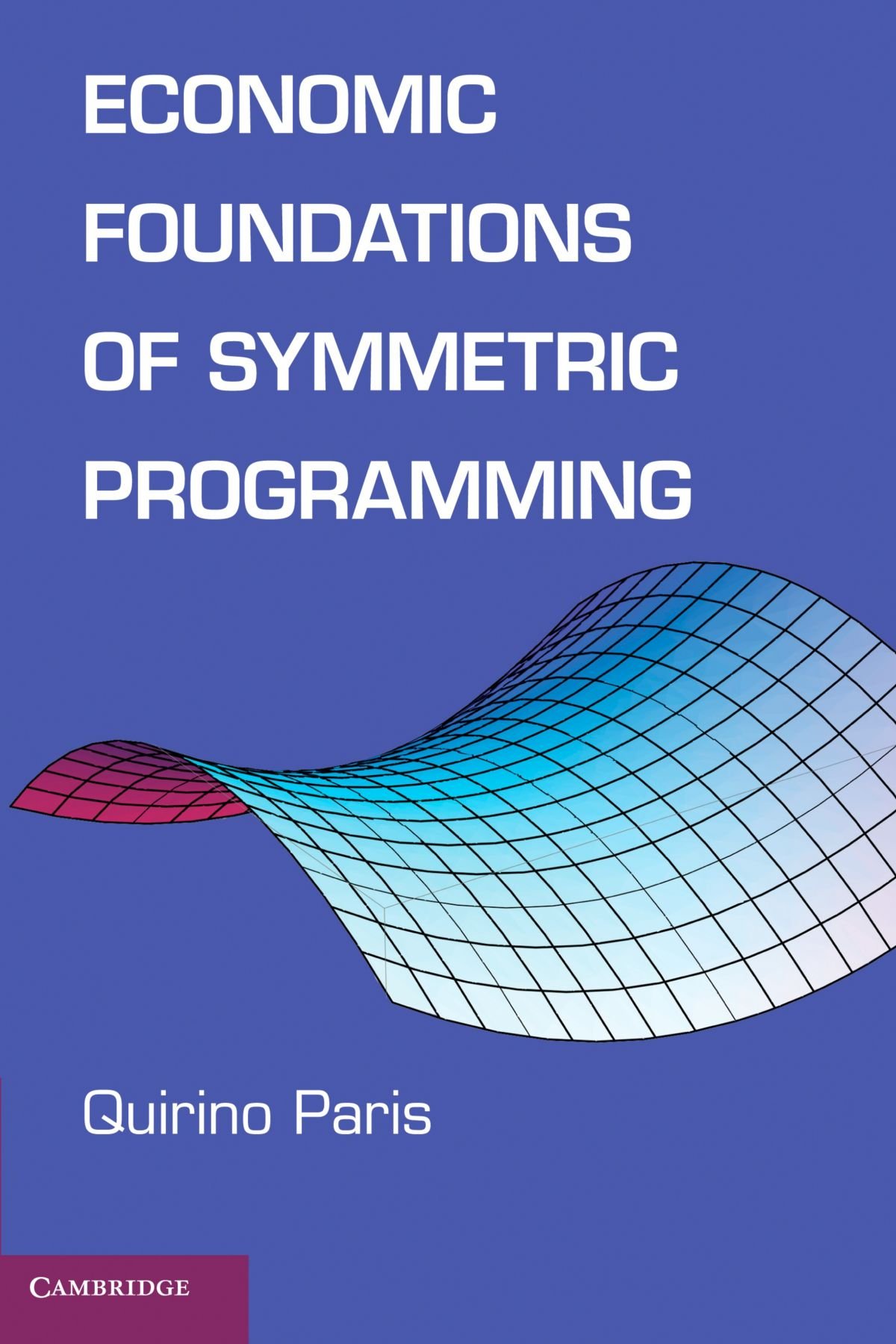
Economic Foundations of Symmetric Programming: A Mathematical Economics and Optimization Textbook by Quirino Paris
Inclusive of all applicable taxes. FREE shipping on all orders.
Available Offers
- 🚚Free Delivery — Free shipping on all orders
- 💵Cash on Delivery — Pay when your order arrives
- ↩️15-Day Easy Returns — Hassle-free return policy
- 🔒Cash on Delivery — Pay safely when your order arrives
Check Delivery
Product Description
Introduction
For students and researchers navigating the intersection of economics and mathematical programming, Economic Foundations of Symmetric Programming by Quirino Paris offers a rigorous yet accessible framework. This hardcover edition, published by Cambridge University Press, is an essential reference for Indian graduate programmes in economics, operations research, and applied mathematics. The book bridges abstract theory with practical applications, making it a valuable addition to any academic library.
Book Overview
This volume presents a comprehensive treatment of symmetric programming—a class of optimisation problems that includes linear and quadratic programming as special cases. Paris develops the economic rationale behind symmetric duality theorems, complementarity problems, and equilibrium models. The text is built around the concept of a symmetric pair of primal and dual problems, showing how economic principles such as marginal cost pricing, resource allocation, and market equilibrium emerge naturally from the mathematical structure. With over 300 pages of carefully constructed explanations, it serves both as a textbook for advanced courses and a reference for researchers.
Key Highlights
- First comprehensive book on symmetric programming from an economic perspective
- Rigorous mathematical treatment with intuitive economic interpretations
- Self-contained chapters that can be studied independently
- Numerous solved examples drawn from agricultural economics, production theory, and environmental modelling
- End-of-chapter exercises with varying difficulty levels for self-assessment
- Hardcover binding ensures durability for repeated use in libraries and classrooms
Inside the Book
The book is structured into twelve chapters, beginning with the foundations of convex analysis and linear programming. It then moves into quadratic programming, complementarity problems, and the symmetric duality framework. Later chapters explore applications to spatial equilibrium models, risk programming in agriculture, and environmental policy analysis. Each chapter builds on the previous one, gradually introducing more complex concepts such as variational inequalities and nonlinear complementarity problems. The final chapters present case studies from Indian and international contexts, demonstrating how symmetric programming can solve real-world resource allocation problems.
Key Topics
- Convex sets, convex functions, and separation theorems
- Linear programming duality and complementary slackness
- Quadratic programming and the Karush-Kuhn-Tucker conditions
- Symmetric duality and self-dual problems
- Linear complementarity problems and Lemke's algorithm
- Variational inequalities and their economic applications
- Risk programming using symmetric formulations
- Spatial equilibrium and trade models
- Environmental policy modelling with pollution constraints
Reader Benefits
By studying this book, readers will gain a deep understanding of how optimisation theory underpins modern economic analysis. The symmetric approach provides a unified framework that reduces the complexity of solving large-scale problems. Indian students preparing for UGC-NET, JRF, or doctoral coursework in economics will find the clear notation and step-by-step derivations particularly helpful. Practitioners in agricultural economics and policy analysis can directly apply the models to crop planning, water resource management, and supply chain optimisation. The book also helps develop the mathematical maturity needed to read contemporary research in computational economics.
Learning Outcomes
Upon completing this book, readers will be able to: formulate economic problems as symmetric programming models; derive dual problems and interpret shadow prices economically; apply complementarity theory to market equilibrium and policy analysis; solve linear and quadratic programming problems using symmetric algorithms; construct risk models for agricultural and financial decision-making; and critically evaluate research papers that use optimisation methods. These skills are directly transferable to sectors such as agribusiness, energy, transportation, and public policy.
Who Should Read
- Graduate students in economics, agricultural economics, and operations research
- Researchers working on optimisation models for resource allocation
- Faculty members teaching advanced microeconomics or mathematical programming
- Policy analysts in government and non-profit organisations
- Professionals in agribusiness, logistics, and environmental consulting
- Self-learners with a strong background in calculus and linear algebra
About the Author
Quirino Paris is a distinguished professor emeritus at the University of California, Davis, where he has spent decades teaching and researching at the intersection of economics and mathematical programming. His work has been widely cited in agricultural economics, production theory, and environmental modelling. Paris is known for his ability to explain complex mathematical concepts through economic intuition, making his textbooks popular among both economists and mathematicians. He has also contributed to the development of symmetric programming as a distinct field, and this book represents the culmination of his life's work.
About the Publisher
Cambridge University Press is one of the oldest and most respected academic publishers in the world, with a strong presence in India. Known for its rigorous editorial standards and commitment to scholarly excellence, CUP publishes textbooks and monographs that are used in leading universities across the country. This hardcover edition is printed on high-quality paper and bound to withstand years of use, making it a wise investment for students and institutions alike.
Conclusion
Economic Foundations of Symmetric Programming is a definitive work that fills a critical gap in the literature on optimisation and economics. Its clear exposition, practical examples, and comprehensive coverage make it an indispensable resource for anyone serious about understanding how mathematical programming can illuminate economic phenomena. Whether you are a student beginning your journey into advanced economic theory or a seasoned researcher seeking a unified framework, this book will serve as a trusted companion. Order your copy today from Bookshops.in and add this classic to your collection.
Quick Summary
Economic Foundations of Symmetric Programming by Quirino Paris is a comprehensive academic textbook that delves into the mathematical and economic principles of symmetric duality. Designed for graduate students and researchers in economics, operations research, and applied mathematics, the book provides a rigorous exploration of optimization theory as it applies to production, cost, and profit analysis. Readers will learn to formulate and solve primal and dual problems, understand Kuhn-Tucker conditions, and apply Lagrange multiplier methods to economic models. The text bridges the gap between abstract mathematical theory and practical economic applications, making it an essential resource for advanced coursework and research. By purchasing from Bookshops.in, Indian students and academics receive a high-quality hardcover edition with prompt delivery, ensuring they have a durable reference for years of study.
Book Highlights
Book Specifications
| ISBN-13 | 9780521123020 |
| ISBN-10 | 052112302X |
| Publisher | Cambridge University Press |
| Language | English |
| Dimensions | 15.24 x 3.25 x 22.86 cm |
| Weight | 760 g |
| Category | Exam Preparation › Professional Certification Exams |
| Genre | Nonfiction |
| Original Language | English |
Frequently Asked Questions
What is symmetric programming in economics?
Who is Quirino Paris?
Is this book suitable for beginners?
What topics does the book cover?
Does the book include exercises?
Is this book used in Indian universities?
What is the ISBN?
Is the book available in hardcover?
How does this book differ from standard optimization texts?
Can this book help with research in operations research?
What is the price in India?
Does Bookshops.in deliver across India?
Is the book written in English?
What is the reading level?
Readers Also Search For
Customers Also Bought
Related Products
View All
Exam Preparation
American Literature in Transition, 1970–1980
Exam Preparation
500 SAT Reading, Writing and Language Questions to Know by Test Day by Inc Anaxos
Exam Preparation
Chaotic Dynamics by Geoffrey R. Goodson – Dynamical Systems

Exam Preparation
Mindfulness and Performance by Amy L. Baltzell – Performance Psychology

Exam Preparation
Probability on Real Lie Algebras

Exam Preparation