
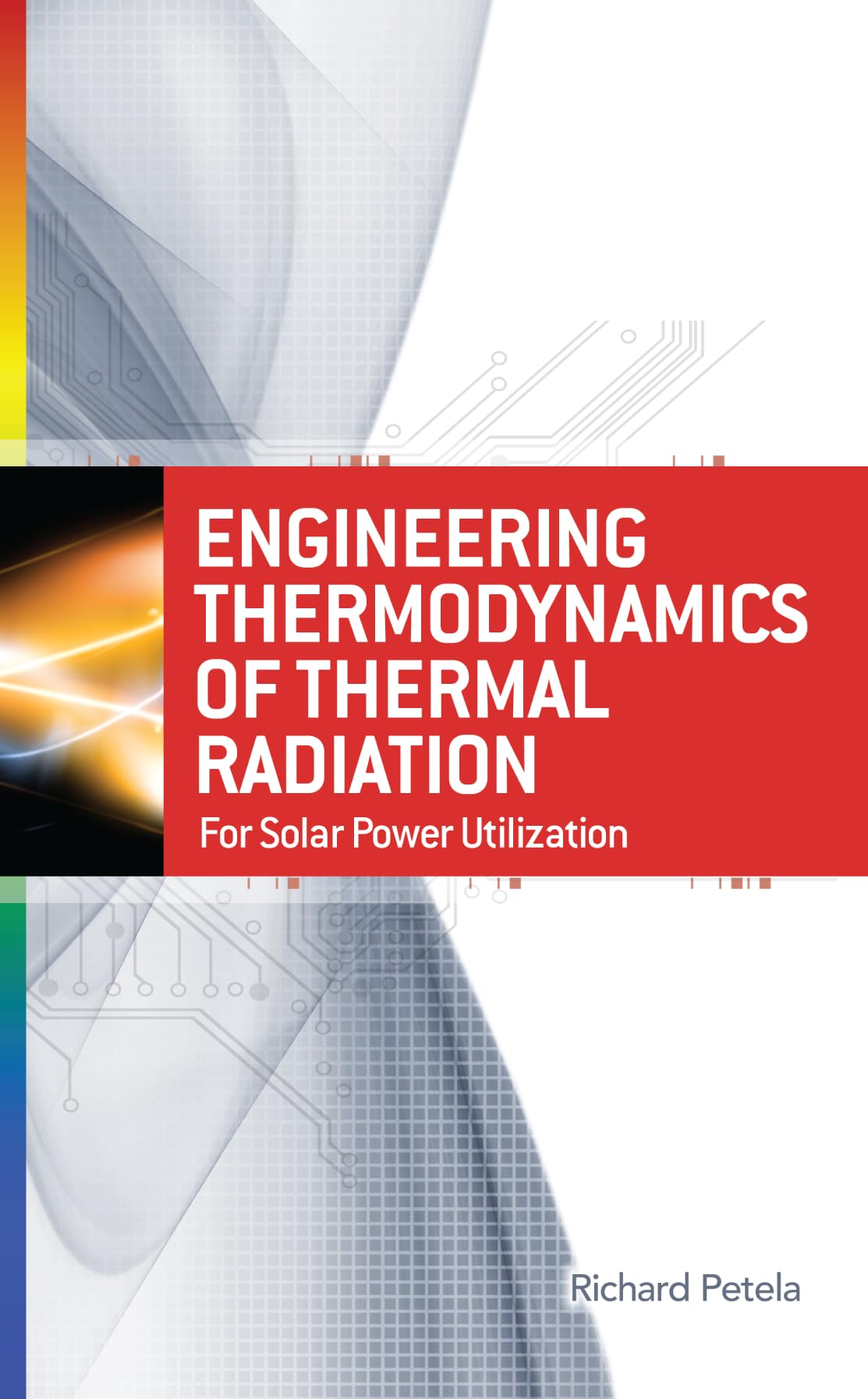
Engineering Thermodynamics of Thermal Radiation: For Solar Power Utilization by Richard Petela – A Comprehensive Guide t
Inclusive of all applicable taxes. FREE shipping on all orders.
Available Offers
- 🚚Free Delivery — Free shipping on all orders
- 💵Cash on Delivery — Pay when your order arrives
- ↩️15-Day Easy Returns — Hassle-free return policy
- 🔒Cash on Delivery — Pay safely when your order arrives
Check Delivery
Product Description
Introduction
In an era where renewable energy is no longer a choice but a necessity, understanding the science behind solar power utilization becomes critical for engineers, researchers, and students alike. Engineering Thermodynamics of Thermal Radiation: For Solar Power Utilization by Richard Petela offers a deep dive into the thermodynamic principles governing thermal radiation, specifically tailored for solar energy applications. Published by McGraw-Hill, this hardbound volume is an authoritative resource for anyone serious about mastering the conversion of solar radiation into usable power.
Book Overview
This book stands as a comprehensive reference that bridges the gap between classical thermodynamics and the unique behavior of thermal radiation. It treats radiation as a thermodynamic medium—a photon gas—and applies rigorous exergy analysis to evaluate the true potential of solar processes. Unlike conventional texts that focus solely on energy balances, this work emphasizes the quality of energy (exergy) to provide a more realistic assessment of solar power systems. From basic principles to advanced modeling, the book equips readers with tools to analyze solar heating, photovoltaic systems, solar chimneys, and even photosynthesis from a thermodynamic perspective.
Key Highlights
- First-of-its-kind coverage: Exhaustive thermodynamic analysis of radiation matter, treating photons as a working fluid.
- Exergy-based approach: Goes beyond energy efficiency to evaluate the maximum useful work obtainable from solar radiation.
- Practical focus: Includes quantitative calculation examples for real-world solar technologies.
- Research-oriented: Designed for scientists and engineers working on advanced solar power systems.
- Authoritative publisher: Published by McGraw-Hill, a trusted name in engineering education for decades.
Inside the Book
The book systematically builds from fundamental concepts to advanced applications. Early chapters introduce the thermodynamics of photon gas, including entropy, energy, and exergy of radiation. Mid-sections delve into radiation heat transfer and spectral distribution, while later chapters apply these principles to solar power systems. Each concept is reinforced with numerical examples, making complex theories accessible. The final chapters explore cutting-edge topics like the exergy of solar radiation at Earth's surface and the thermodynamic limits of photovoltaic conversion.
Key Topics
- Thermodynamics of photon gas and blackbody radiation
- Exergy analysis of solar radiation
- Energy and exergy efficiencies of solar collectors
- Solar chimney power plant thermodynamics
- Photosynthesis as a radiation conversion process
- Photovoltaic cell performance and limits
- Radiation heat transfer in engineering systems
Reader Benefits
By studying this book, readers will gain a rigorous understanding of how thermal radiation behaves as a thermodynamic system. They will learn to apply exergy analysis to evaluate the true efficiency of solar technologies—a skill increasingly demanded in research and industry. The worked examples provide hands-on practice, while the theoretical depth prepares readers for original research. Whether you are designing a solar power plant or conducting academic studies, this book gives you the analytical edge to optimize performance and minimize waste.
Learning Outcomes
- Understand the thermodynamic properties of thermal radiation and photon gas
- Calculate exergy of solar radiation under varying conditions
- Perform energy and exergy balances for solar heating and power systems
- Evaluate the thermodynamic limits of photovoltaic and thermal conversion
- Analyze real-world solar installations using quantitative methods
- Apply second-law analysis to radiation processes for better system design
Who Should Read
This book is essential for mechanical and energy engineering students at postgraduate level, research scholars working on solar energy, practicing engineers in the renewable energy sector, and faculty members teaching advanced thermodynamics. It is also valuable for physicists and chemists interested in the thermodynamics of radiation. Indian readers, especially those involved in the National Solar Mission or related R&D programs, will find the quantitative examples directly applicable to local conditions.
About the Author
Richard Petela is a renowned researcher in the field of thermodynamics and energy systems. With decades of academic and industrial experience, he has contributed significantly to the understanding of exergy analysis and its applications in solar energy. His work is widely cited in international journals, and this book represents the culmination of his research on radiation thermodynamics. Dr. Petela's clear writing style and methodical approach make complex topics accessible to serious learners.
About the Publisher
McGraw-Hill Companies is a globally respected publisher of educational and professional content, particularly in engineering and science. Known for titles like Heat and Mass Transfer and Thermodynamics: An Engineering Approach, McGraw-Hill has been a trusted partner for Indian students and professionals for generations. This hardcover edition is produced to the highest standards of durability and print quality, suitable for long-term reference in libraries and labs.
Conclusion
Engineering Thermodynamics of Thermal Radiation: For Solar Power Utilization is not just a textbook—it is a definitive guide for anyone aiming to push the boundaries of solar energy technology. With its unique exergy-based perspective, rigorous mathematics, and practical examples, it empowers readers to design more efficient systems and contribute meaningfully to India's renewable energy goals. Add this essential volume to your collection and deepen your understanding of the thermodynamics that drive the sun's power.
Quick Summary
Engineering Thermodynamics of Thermal Radiation: For Solar Power Utilization by Richard Petela is a definitive academic resource that explores the thermodynamics of radiation matter, specifically photon gas, and its application to solar energy conversion. The book is the first to provide an exhaustive energy and exergy analysis of radiation processes, offering detailed methods for evaluating the exergy of radiation for practical solar power systems. Targeted at graduate and postgraduate engineering students, researchers, and professionals in the renewable energy sector, this work bridges fundamental theory with real-world solar utilization. Readers will learn to apply thermodynamic principles to solar collector design, power plant efficiency, and sustainable energy planning. Published by McGraw-Hill, this hardcover edition ensures durability for repeated reference. By purchasing from Bookshops.in, Indian customers receive a genuine copy at a fair price with prompt service, supporting their academic and professional growth in the rapidly expanding field of solar energy.
Book Highlights
Book Specifications
| ISBN-13 | 9780071639620 |
| ISBN-10 | 0071639624 |
| Publisher | Tata Mcgrawhill |
| Language | English |
| Dimensions | 16 x 2.77 x 23.62 cm |
| Weight | 703 g |
| Category | Chemical Engineering › Energy & Fuel Engineering |
| Genre | Non-fiction |
| Original Language | English |
Frequently Asked Questions
What is the main focus of Engineering Thermodynamics of Thermal Radiation?
Who is the author of this book?
Is this book suitable for Indian engineering students?
What is the ISBN of this book?
Does the book cover exergy analysis?
What practical applications does the book address?
Is this book available in hardcover?
What language is the book written in?
What is the price of this book at Bookshops.in?
Does the book include digital access?
How is this book different from other thermodynamics texts?
Can researchers benefit from this book?
Why should I buy from Bookshops.in?
Readers Also Search For
Customers Also Bought
Mathematics
Stereotype Spaces and Algebras: 73 (De Gruyter Expositions in Mathematics, 73)

Mathematics
Semigroups in Algebra, Geometry and Analysis: 20 (De Gruyter Expositions in Mathematics, 20)

Mathematics
Geometry from the Pacific Rim: Proceedings of the Pacific Rim Geometry Conference held at National University of Singapore, Republic of Singapore, ... 1994 (De Gruyter Proceedings in Mathematics)

Mathematics
First International Tainan-Moscow Algebra Workshop: Proceedings of the International Conference held at National Cheng Kung University Tainan, Taiwan, ... 1994 (De Gruyter Proceedings in Mathematics)
Mathematics
Differential Geometry - Proceedings of the VIII International Colloquium (English, Jesus A. Alvarez Lopez | Eduardo Garcia-Rio)
Mathematics
Mathematical Theory of Optimal Processes (Classics of Soviet Mathematics)
Related Products
View All
Science & Mathematics
Elements of Pelagos Biology: With Focus on the Mediterranean Sea

Science & Mathematics
Squid - Superconducting Quantum Interference Devices and Their Applications: Proceedings of the International Conference on Superconducting Quantum Devices, Berlin-west, October 4-8, 1976

Science & Mathematics
Thermodynamics and Pattern Formation in Biology

Science & Mathematics
The Nature of Mathematics and the Mathematics of Nature by S. Andersson – Mathematics & Science

Science & Mathematics
Linear Algebra | by Stephen Friedberg | Arnold Insel | Lawrence Spence | Pearson | by Stephen Friedberg | Arnold Insel | Lawrence Spence | Pearson | by Stephen Friedberg | Arnold Insel | Lawrence Spence | Pearson | by Stephen Friedberg | Arnold Insel | Lawrence Spence | Pearson | by Stephen Friedberg | Arnold Insel | Lawrence Spence | Pearson | by Stephen Friedberg | Arnold Insel | Lawrence Spence | Pearson | by Stephen Friedberg | Arnold Insel | Lawrence Spence | Pearson | by Stephen Friedberg
Science & Mathematics