
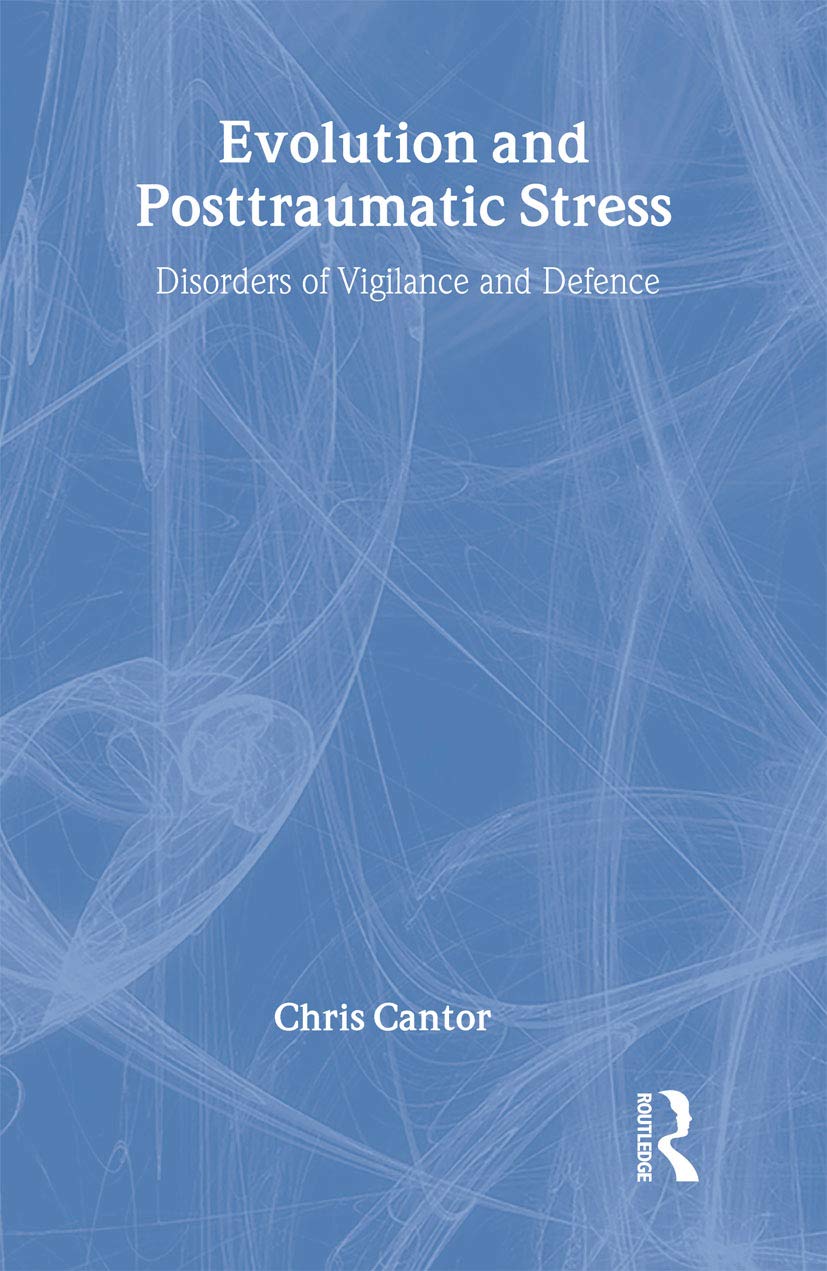
Evolution And Posttraumatic Stress: Disorders Of Vigilance And Defence by Chris Cantor – An Evolutionary Approach to Und
Inclusive of all applicable taxes. FREE shipping on all orders.
Available Offers
- 🚚Free Delivery — Free shipping on all orders
- 💵Cash on Delivery — Pay when your order arrives
- ↩️15-Day Easy Returns — Hassle-free return policy
- 🔒Cash on Delivery — Pay safely when your order arrives
Check Delivery
Product Description
Introduction
Posttraumatic Stress Disorder (PTSD) has long puzzled clinicians and researchers, often misunderstood and misdiagnosed. Evolution And Posttraumatic Stress: Disorders Of Vigilance And Defence by Chris Cantor offers a groundbreaking perspective that reframes PTSD not as a simple malfunction, but as a natural defensive strategy rooted in our evolutionary past. This hardcover edition, published by Routledge, is an essential read for Indian students and professionals in psychiatry, psychology, and anthropology who seek a deeper, more coherent understanding of trauma responses.
Book Overview
This book is the first of its kind to apply evolutionary theory to the study of PTSD. Chris Cantor challenges conventional models by arguing that many symptoms of PTSD—hypervigilance, intrusive memories, and avoidance—are not random errors but evolved defensive behaviours that have gone into 'overdrive'. The text bridges the gap between clinical psychiatry and evolutionary biology, providing a fresh lens for diagnosis and treatment. Written in clear, accessible language, it is suitable for advanced undergraduates, postgraduate students, and practising professionals alike.
Key Highlights
- Evolutionary Framework: The first comprehensive integration of Darwinian principles into PTSD research.
- Clinical Relevance: Offers practical insights for understanding mystifying symptoms and improving therapeutic approaches.
- Parsimonious Model: Presents a unified theory that explains diverse PTSD phenomena with elegant simplicity.
- Interdisciplinary Appeal: Connects psychiatry, psychology, anthropology, and evolutionary biology.
- Authoritative Source: Published by Routledge, a trusted name in academic publishing.
Inside the Book
The book begins with a thorough review of conventional PTSD theories, covering its history, clinical features, and epidemiology. Chris Cantor then introduces evolutionary concepts such as defence mechanisms, vigilance, and threat detection. Key chapters explore how human defensive behaviours evolved, how they manifest in PTSD, and why they sometimes become maladaptive. The author uses parsimony—the principle that simpler explanations are better—to argue that PTSD is a defensive strategy gone awry, not a disease. Each chapter builds logically, making complex ideas easy to follow.
Key Topics
- Evolution of human defensive behaviours
- PTSD as a disorder of vigilance and defence
- Clinical features and epidemiology of PTSD
- Defence in overdrive: evolution and parsimony
- Comparison of conventional vs. evolutionary models
- Implications for diagnosis and treatment
Reader Benefits
Indian students and professionals will gain a radically new understanding of PTSD that goes beyond symptom checklists. This book helps readers see trauma responses as adaptive mechanisms, reducing stigma and opening new avenues for therapy. It also equips clinicians with a conceptual toolkit to explain puzzling patient behaviours to colleagues and patients themselves. For researchers, it provides a testable framework for future studies in trauma and stress disorders.
Learning Outcomes
- Understand the evolutionary origins of defensive behaviours in humans
- Critically evaluate conventional PTSD theories and their limitations
- Apply evolutionary principles to clinical case formulations
- Recognise PTSD as a spectrum of defensive responses rather than a discrete illness
- Develop more compassionate and effective treatment strategies
Who Should Read
This book is ideal for psychiatrists, psychotherapists, clinical psychologists, and anthropologists. It is also highly relevant for postgraduate students in psychology and neuroscience, as well as advanced undergraduate students in life sciences or medicine. Indian readers working in mental health, trauma counselling, or disaster management will find the evolutionary perspective invaluable for understanding diverse cultural expressions of distress.
About the Author
Chris Cantor is a psychiatrist and researcher with a deep interest in the evolutionary underpinnings of mental disorders. He has published extensively on PTSD, suicide prevention, and the application of Darwinian medicine to psychiatry. His work bridges clinical practice with theoretical biology, making him a unique voice in the field.
About the Publisher
Routledge is a leading global academic publisher, known for producing high-quality books in the social sciences, humanities, and behavioural sciences. Their titles are widely used in Indian universities and research institutions, ensuring reliability and scholarly rigour.
Conclusion
Evolution And Posttraumatic Stress: Disorders Of Vigilance And Defence is a transformative work that will change how you think about trauma. By placing PTSD in an evolutionary context, Chris Cantor offers a model that is both scientifically robust and clinically useful. This hardcover edition from Bookshops.in is a must-have for any serious student or professional in mental health and allied fields.
Quick Summary
Evolution And Posttraumatic Stress: Disorders Of Vigilance And Defence by Chris Cantor is a pioneering work that reinterprets Posttraumatic Stress Disorder through the lens of evolutionary biology. The book argues that PTSD is not merely a malfunction but an overdrive of ancient defensive and vigilance systems that once helped humans survive threats. Cantor begins with a thorough review of conventional PTSD theories, clinical features, and epidemiology, then seamlessly integrates evolutionary concepts to offer a more parsimonious and coherent model. Readers will explore topics such as the evolution of human defensive behaviours, the clinical perspective of PTSD, and how defence mechanisms in overdrive explain the disorder's symptoms. This book is ideal for Indian psychology and psychiatry students, clinicians, and researchers who want a deeper, biologically grounded understanding of trauma. By purchasing from Bookshops.in, you get a genuine hardcover edition from Routledge, ensuring reliable academic quality. The book challenges mainstream psychiatric dogma and provides a fresh framework that can inspire new therapeutic approaches. Whether you are a student preparing for exams or a professional seeking innovative insights, this book will transform how you think about PTSD and human resilience.
Book Highlights
Book Specifications
| ISBN-13 | 9781583917701 |
| ISBN-10 | 1583917705 |
| Publisher | Routledge |
| Language | English |
| Dimensions | 15.19 x 2.36 x 22.56 cm |
| Weight | 408 g |
| Category | Clinical › Neurology |
| Genre | Non-fiction |
| Reading Age | Adult |
| Original Language | English |
Frequently Asked Questions
What is Evolution And Posttraumatic Stress about?
Who is the author of this book?
Is this book suitable for undergraduate students?
Does the book cover clinical treatment of PTSD?
What makes this book different from other PTSD books?
Is this book available in hardcover?
Which publisher released this book?
Can I use this book for my research on trauma?
Does the book include case studies?
What is the ISBN of this book?
Is this book recommended for Indian readers?
Does the book discuss treatment methods?
Is this book part of a series?
Readers Also Search For
Customers Also Bought

Anatomy
Ultrastructure of the Digestive Tract: 4 (Electron Microscopy in Biology and Medicine)

Anatomy
Ultrastructure of the Connective Tissue Matrix: 3 (Electron Microscopy in Biology and Medicine)

Anatomy
Reproductive Genetics (Royal College of Obstetricians and Gynaecologists Study Group)

Anatomy
Human Gross Anatomy: An Outline Text by Robert J. Leonard – Medical Anatomy

Pharmacology
Mathematical Modeling and Simulation in Enteric Neurobiology

Anatomy
Nature’s Patterns and the Fractional Calculus: 2 (Fractional Calculus in Applied Sciences and Engineering, 2)
Related Products
View All
Medicine & Health Sciences
Handbook of Hospitality Strategic Management | by Olsen Michael | Taylor & Francis Ltd | by Olsen Michael | Taylor & Francis Ltd | by Olsen Michael | Taylor & Francis Ltd | by Olsen Michael | Taylor & Francis Ltd | by Olsen Michael | Taylor & Francis Ltd | by Olsen Michael | Taylor & Francis Ltd | by Olsen Michael | Taylor & Francis Ltd | by Olsen Michael | Taylor & Francis Ltd | by Olsen Michael | Taylor & Francis Ltd | by Olsen Michael | Taylor & Francis

Medicine & Health Sciences
Pediatrics on Call | by Charles A. Pohl | Kathleen Bradford | Clara Callahan | McGraw Hill / Medical | by Charles A. Pohl | Kathleen Bradford | Clara Callahan | McGraw Hill / Medical | by Charles A. Pohl | Kathleen Bradford | Clara Callahan | McGraw Hill / Medical | by Charles A. Pohl | Kathleen Bradford | Clara Callahan | McGraw Hill / Medical | by Charles A. Pohl | Kathleen Bradford | Clara Callahan | McGraw Hill / Medical | by Charles A. Pohl | Kathleen Bradford | Clara Callahan | McGraw Hill

Medicine & Health Sciences
The Physician's Guide to Depression and Bipolar Disorders | by Dwight L. Evans | Dennis S. Charney | Lydia Lewis | McGraw Hill / Medical | by Dwight L. Evans | Dennis S. Charney | Lydia Lewis | McGraw Hill / Medical | by Dwight L. Evans | Dennis S. Charney | Lydia Lewis | McGraw Hill / Medical | by Dwight L. Evans | Dennis S. Charney | Lydia Lewis | McGraw Hill / Medical | by Dwight L. Evans | Dennis S. Charney | Lydia Lewis | McGraw Hill / Medical | by Dwight L. Evans | Dennis S. Charney | Lydi
Medicine & Health Sciences
First Exposure to Internal Medicine | by Andrew R. Hoellein | Charles H. Griffith | McGraw Hill / Medical | by Andrew R. Hoellein | Charles H. Griffith | McGraw Hill / Medical | by Andrew R. Hoellein | Charles H. Griffith | McGraw Hill / Medical | by Andrew R. Hoellein | Charles H. Griffith | McGraw Hill / Medical | by Andrew R. Hoellein | Charles H. Griffith | McGraw Hill / Medical | by Andrew R. Hoellein | Charles H. Griffith | McGraw Hill / Medical | by Andrew R. Hoellein | Charles H. Griffit
Medicine & Health Sciences
First Exposure to Internal Medicine | by Charles H. Griffith | Andrew R. Hoellein | McGraw Hill / Medical | by Charles H. Griffith | Andrew R. Hoellein | McGraw Hill / Medical | by Charles H. Griffith | Andrew R. Hoellein | McGraw Hill / Medical | by Charles H. Griffith | Andrew R. Hoellein | McGraw Hill / Medical | by Charles H. Griffith | Andrew R. Hoellein | McGraw Hill / Medical | by Charles H. Griffith | Andrew R. Hoellein | McGraw Hill / Medical | by Charles H. Griffith | Andrew R. Hoellei
Medicine & Health Sciences