
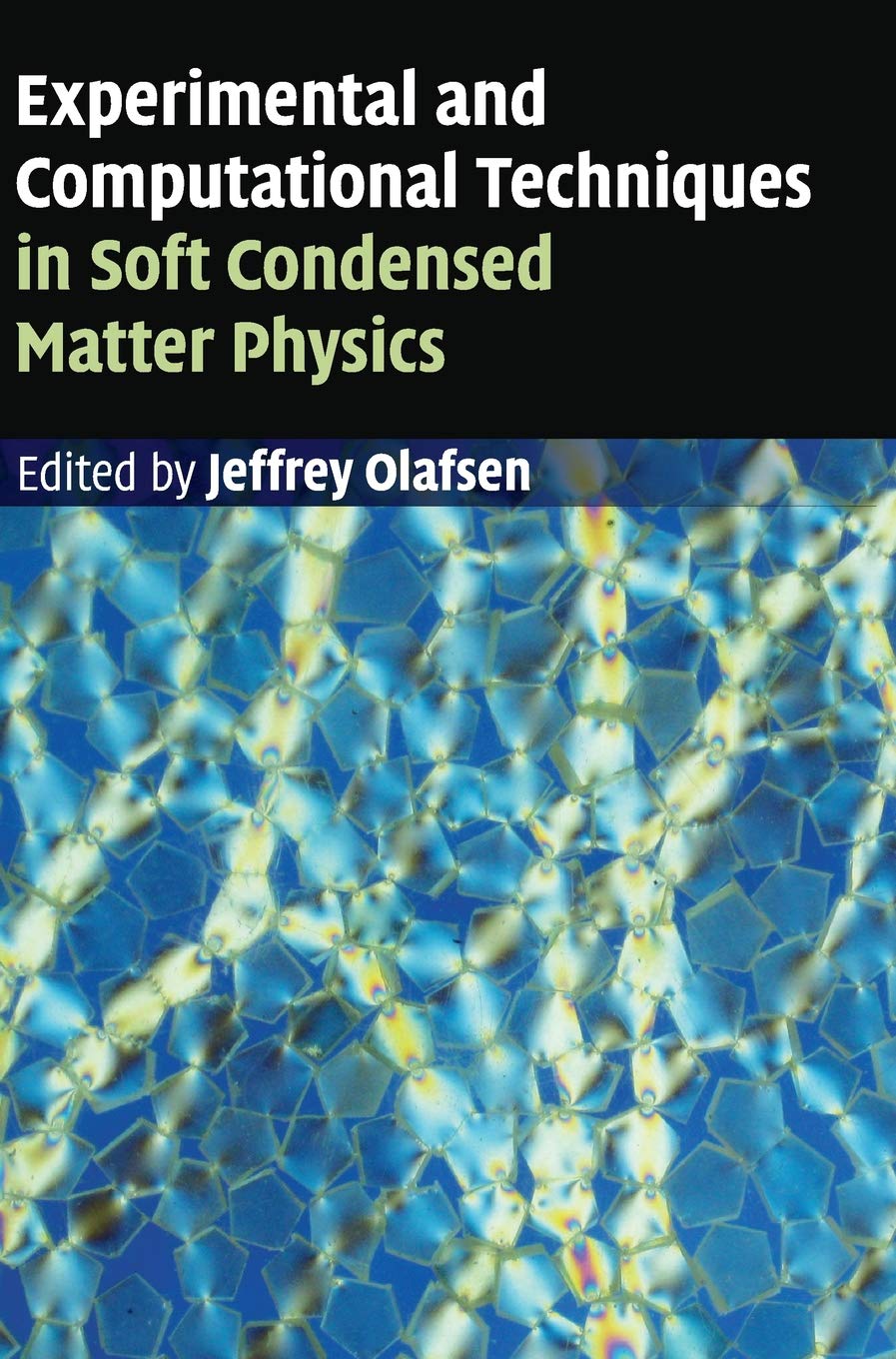
Experimental and Computational Techniques in Soft Condensed Matter Physics by Jeffrey Olafsen – A Practical Resource for
Inclusive of all applicable taxes. FREE shipping on all orders.
Available Offers
- 🚚Free Delivery — Free shipping on all orders
- 💵Cash on Delivery — Pay when your order arrives
- ↩️15-Day Easy Returns — Hassle-free return policy
- 🔒Cash on Delivery — Pay safely when your order arrives
Check Delivery
Product Description
Introduction
Soft condensed matter physics sits at the crossroads of physics, chemistry, biology, and engineering, governing the behaviour of materials that are neither simple solids nor ideal fluids. From gels and colloids to liquid crystals and biological tissue, these systems demand a unique blend of experimental insight and computational modelling. Experimental and Computational Techniques in Soft Condensed Matter Physics, edited by Jeffrey Olafsen and published by Cambridge University Press, is a definitive guide for anyone seeking to master the tools of this interdisciplinary field. Written for both graduate students and experienced researchers, this hardbound volume delivers a hands-on approach to the modern methods that drive contemporary discoveries.
Book Overview
This book is a carefully curated collection of contributions from leading researchers worldwide. It moves beyond traditional thermodynamics and statistical mechanics to present the actual techniques used in today's laboratories and computational clusters. The chapters cover particle tracking, image analysis, confocal microscopy, bacterial assays, and novel computational algorithms. Each section is designed to help readers transition from theoretical understanding to practical application, making it an essential resource for collaborative, cross-disciplinary research in nonlinear and non-equilibrium systems.
Key Highlights
- Comprehensive coverage of both experimental and computational approaches in one cohesive volume
- Authored by international experts who share real-world insights and methodological tips
- Focus on contemporary problems such as active matter, jamming, and glassy dynamics
- Richly illustrated with diagrams, micrographs, and data plots to aid visual learning
- Practical emphasis on techniques like particle tracking, confocal microscopy, and molecular simulations
- Hardcover edition from Cambridge University Press, ensuring durability for frequent reference
Inside the Book
The book is structured to guide readers from foundational principles to advanced applications. Early chapters establish the physical framework of soft materials, while later sections dive into specific experimental setups—such as optical tweezers, microfluidics, and rheology—and computational methods including Monte Carlo simulations, molecular dynamics, and data-driven modelling. Each chapter includes detailed protocols, troubleshooting advice, and references to seminal works. The text also features colour versions of key figures, enhancing clarity for complex concepts.
Key Topics
- Particle tracking and image analysis techniques for colloidal systems
- Confocal and fluorescence microscopy for soft matter imaging
- Bacterial assays and active matter dynamics
- Computational methods: molecular dynamics, Monte Carlo, and coarse-graining
- Rheology and mechanical characterization of soft materials
- Non-equilibrium thermodynamics and nonlinear phenomena
- Novel materials including gels, foams, and liquid crystals
- Data analysis and statistical inference for experimental results
Reader Benefits
By engaging with this book, readers gain a robust toolkit for tackling real-world research questions. The practical orientation helps reduce the learning curve when entering a new lab or starting a collaborative project. The interdisciplinary nature of the content means that a physicist can learn biological assays, a chemist can grasp computational modelling, and an engineer can appreciate the underlying physics. The book also serves as a bridge between theory and experiment, enabling researchers to design better experiments and interpret results with confidence.
Learning Outcomes
- Understand the fundamental principles governing soft condensed matter systems
- Learn to set up and execute key experimental techniques like particle tracking and confocal microscopy
- Gain proficiency in computational simulations relevant to soft materials
- Develop the ability to analyse complex data from non-equilibrium systems
- Acquire skills to collaborate effectively across physics, chemistry, biology, and engineering domains
Who Should Read
This book is ideal for graduate students in physics, chemistry, materials science, and bioengineering who are beginning research in soft condensed matter. It is equally valuable for postdoctoral researchers and faculty members who wish to expand their methodological repertoire. Industry professionals working with soft materials—such as in food science, cosmetics, pharmaceuticals, or advanced coatings—will also find the practical techniques directly applicable. Anyone seeking a single, authoritative reference on modern soft matter techniques will benefit from this volume.
About the Author
Jeffrey Olafsen is a respected physicist known for his contributions to the study of granular materials, active matter, and non-equilibrium statistical mechanics. He has held academic positions at leading institutions and has published extensively on experimental and computational approaches in soft condensed matter. His editorial leadership ensures that the book maintains a consistent, high-quality standard while covering a diverse range of perspectives from the global research community.
About the Publisher
Cambridge University Press is a world-renowned academic publisher with a history spanning nearly five centuries. Known for its rigorous peer-review process and commitment to scholarly excellence, Cambridge University Press produces textbooks, monographs, and reference works that are trusted by students and researchers across the globe. This hardcover edition reflects the publisher's dedication to producing durable, high-quality books that serve as lasting resources in the scientific community.
Conclusion
Experimental and Computational Techniques in Soft Condensed Matter Physics is more than a textbook—it is a practical companion for anyone serious about mastering the methods that define this vibrant field. With its blend of experimental protocols, computational strategies, and interdisciplinary insights, the book equips readers to contribute meaningfully to modern science. Whether you are setting up your first particle-tracking experiment or writing code for a molecular dynamics simulation, this volume provides the guidance you need. Order your copy today from Bookshops.in and take a decisive step forward in your research journey.
Quick Summary
Experimental and Computational Techniques in Soft Condensed Matter Physics by Jeffrey Olafsen is a comprehensive guide that bridges the gap between experimental and computational approaches in the study of soft matter. The book brings together contributions from leading researchers to cover a wide range of techniques, including particle tracking, confocal microscopy, image analysis, bacterial assays, and computational simulations. It is designed for graduate students and researchers working at the intersection of physics, chemistry, biology, and engineering, providing them with the tools needed to tackle modern problems in nonlinear and non-equilibrium systems. Readers will gain practical knowledge of how to design experiments, analyze data, and apply computational methods to soft condensed matter systems. By choosing Bookshops.in, Indian students and professionals can access this essential resource with convenient ordering and fast delivery across India.
Book Highlights
Book Specifications
| ISBN-13 | 9780521115902 |
| ISBN-10 | 0521115906 |
| Publisher | Cambridge University Press |
| Language | English |
| Dimensions | 17.78 x 1.91 x 25.4 cm |
| Weight | 810 g |
| Country | India |
| Category | Engineering Textbooks › Mechanical Engineering |
| Genre | Science & Mathematics |
| Original Language | English |
Frequently Asked Questions
What is the main focus of this book?
Who is the author of this book?
Is this book suitable for beginners in soft matter physics?
Does the book cover computational methods?
What experimental techniques are discussed?
Is this book interdisciplinary?
What is the ISBN for this book?
What is the price of this book on Bookshops.in?
What language is the book written in?
Does the book include practical examples?
Is this book available in hardcover?
Can this book help with research in nonlinear systems?
Why should I buy this book from Bookshops.in?
Readers Also Search For
Customers Also Bought
Mathematics
Stereotype Spaces and Algebras: 73 (De Gruyter Expositions in Mathematics, 73)

Chemistry
Concise Encyclopedia of Biochemistry

Chemistry
Proceedings of the Third USSR - FRG Symposium, Makhachkala (USSR), October 2–6, 1980: 001

Physics
Quantum Theory at the Crossroads by Guido Bacciagaluppi – Quantum Mechanics History
Physics
The Quantum and Cosmic Codes of the Universe
Mathematics
Mathematical Theory of Optimal Processes (Classics of Soviet Mathematics)
Related Products
View All
Science & Mathematics
Squid - Superconducting Quantum Interference Devices and Their Applications: Proceedings of the International Conference on Superconducting Quantum Devices, Berlin-west, October 4-8, 1976

Science & Mathematics
Thermodynamics and Pattern Formation in Biology
Science & Mathematics
The Nature of Mathematics and the Mathematics of Nature by S. Andersson – Mathematics & Science

Science & Mathematics
Linear Algebra | by Stephen Friedberg | Arnold Insel | Lawrence Spence | Pearson | by Stephen Friedberg | Arnold Insel | Lawrence Spence | Pearson | by Stephen Friedberg | Arnold Insel | Lawrence Spence | Pearson | by Stephen Friedberg | Arnold Insel | Lawrence Spence | Pearson | by Stephen Friedberg | Arnold Insel | Lawrence Spence | Pearson | by Stephen Friedberg | Arnold Insel | Lawrence Spence | Pearson | by Stephen Friedberg | Arnold Insel | Lawrence Spence | Pearson | by Stephen Friedberg

Science & Mathematics
University Calculus | by Joel Hass | Christopher Heil | Maurice Weir | Pearson | by Joel Hass | Christopher Heil | Maurice Weir | Pearson | by Joel Hass | Christopher Heil | Maurice Weir | Pearson | by Joel Hass | Christopher Heil | Maurice Weir | Pearson | by Joel Hass | Christopher Heil | Maurice Weir | Pearson | by Joel Hass | Christopher Heil | Maurice Weir | Pearson | by Joel Hass | Christopher Heil | Maurice Weir | Pearson | by Joel Hass | Christopher Heil | Maurice Weir | Pearson | by Joe

Science & Mathematics