
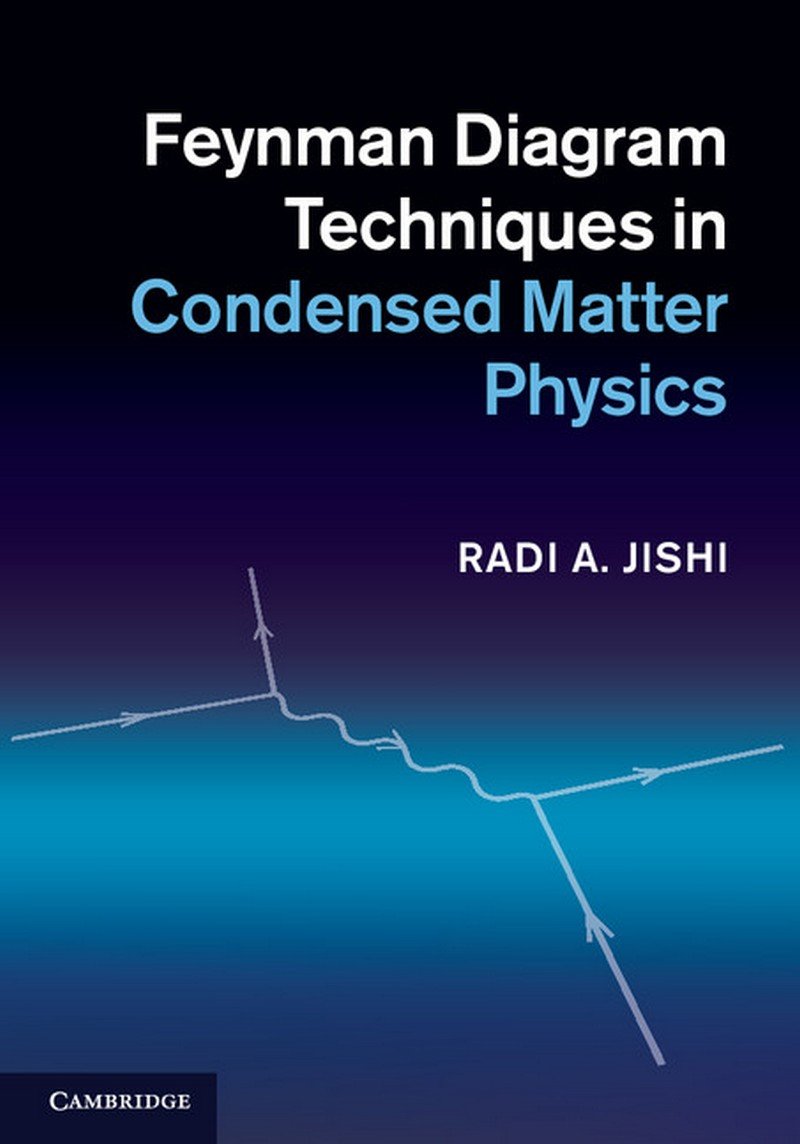
Feynman Diagram Techniques in Condensed Matter Physics by Radi Jishi – A Complete Guide to Many-Particle Systems and Gre
Inclusive of all applicable taxes. FREE shipping on all orders.
Available Offers
- 🚚Free Delivery — Free shipping on all orders
- 💵Cash on Delivery — Pay when your order arrives
- ↩️15-Day Easy Returns — Hassle-free return policy
- 🔒Cash on Delivery — Pay safely when your order arrives
Check Delivery
Product Description
Introduction
For students and researchers venturing into the intricate world of condensed matter physics, mastering Feynman diagrams is a rite of passage. Radi Jishi's Feynman Diagram Techniques in Condensed Matter Physics offers a rigorous yet accessible gateway into this essential theoretical toolkit. Published by Cambridge University Press, this hardbound volume is designed to transform a potentially overwhelming subject into a clear, step-by-step intellectual journey. Whether you are an advanced undergraduate in India beginning your research career or a seasoned physicist seeking a refresher, this book provides the conceptual scaffolding and practical skills to analyze complex many-particle systems with confidence.
Book Overview
This book bridges the gap between foundational quantum mechanics and the advanced diagrammatic methods used in modern condensed matter theory. It systematically builds from the method of second quantization through Green's functions and correlation functions, culminating in detailed applications to superconductivity and other phenomena. The text assumes some prior knowledge of quantum mechanics, solid state physics, and mathematical methods, but it does not assume expertise. Every derivation is presented in full detail, making it an ideal companion for self-study or as a textbook for graduate-level courses in many-body physics and electrical engineering in Indian universities.
Key Highlights
- Comprehensive yet concise: Covers essential topics from second quantization to advanced diagrammatic expansions without unnecessary digressions.
- Step-by-step derivations: Every formula is derived in full, ensuring readers understand the logic behind each expression.
- Real-world case studies: In-depth examples drawn from superconductivity, electron-phonon interactions, and magnetic systems connect theory to experimental phenomena.
- End-of-chapter exercises: Carefully crafted problems reinforce learning, with solutions available online for instructors and self-learners.
- Self-contained approach: Includes a review of essential quantum mechanics, solid state physics, and statistical mechanics to refresh your foundation.
Inside the Book
The journey begins with a thorough exposition of second quantization, the language of many-particle physics. From there, the book introduces single-particle and many-body Green's functions, showing how they encode information about particle propagation, interactions, and response functions. The core of the text is devoted to diagrammatic perturbation theory, where Feynman diagrams are used to visualize and compute complex interactions. Later chapters explore the theory of superconductivity, including the BCS theory and the Eliashberg equations, along with applications to disordered systems and electron transport. Each chapter builds logically on the previous one, ensuring a smooth learning curve.
Key Topics
- Second quantization and occupation number representation
- Single-particle and many-body Green's functions
- Feynman diagrams for interacting electron systems
- Self-energy, vertex corrections, and Dyson's equation
- Linear response theory and correlation functions
- Electron-phonon interactions and polarons
- Superconductivity: BCS theory, gap equation, and Eliashberg formalism
- Disordered systems and localization
- Magnetic systems and spin waves
Reader Benefits
By working through this book, you will gain the ability to read, interpret, and construct Feynman diagrams for a wide range of condensed matter problems. You will develop a deep understanding of how to calculate physical observables such as conductivity, susceptibility, and superconducting gaps. The detailed derivations eliminate the guesswork often found in more terse textbooks, empowering you to apply these techniques to your own research. Moreover, the inclusion of case studies from contemporary condensed matter physics ensures that the skills you learn are immediately relevant to cutting-edge problems in Indian and global research labs.
Learning Outcomes
After studying this book, you will be able to: (1) formulate many-particle problems using second quantization; (2) construct and evaluate Feynman diagrams for interacting systems; (3) derive and solve Dyson's equation for self-consistent calculations; (4) compute Green's functions and correlation functions for electrons, phonons, and mixed systems; (5) apply diagrammatic techniques to superconductivity and transport phenomena; and (6) critically analyze research papers that use diagrammatic methods.
Who Should Read
This book is tailored for advanced undergraduate and graduate students in physics, especially those specializing in condensed matter theory, many-body physics, and quantum materials. It is equally valuable for researchers in electrical engineering working on quantum devices, as well as experimental physicists who wish to deepen their theoretical understanding. Indian students preparing for competitive exams or pursuing MSc/PhD programs at institutes like IISc, IITs, TIFR, and IISERs will find this an indispensable resource for mastering a challenging but essential subject.
About the Author
Radi Jishi is a physicist with extensive experience in condensed matter theory and pedagogy. He has taught courses on many-body physics and quantum mechanics at leading universities, and his research spans topics such as superconductivity, electron correlations, and topological materials. His clear, student-focused writing style reflects years of teaching complex concepts to diverse audiences, making this book both rigorous and approachable.
About the Publisher
Cambridge University Press is one of the world's oldest and most respected academic publishers, known for producing authoritative textbooks and monographs in the sciences. Their commitment to high-quality scholarship and meticulous editorial standards ensures that every title, including this one, meets the needs of serious students and researchers worldwide.
Conclusion
Feynman Diagram Techniques in Condensed Matter Physics by Radi Jishi is more than a textbook—it is a mentor in print. With its patient explanations, rich examples, and practical exercises, it demystifies one of the most powerful tools in theoretical physics. For anyone in India seeking to build a robust foundation in many-body physics and condensed matter theory, this hardcover volume deserves a prominent place on your bookshelf. Order your copy today from Bookshops.in and take the next step in your scientific journey.
Quick Summary
Feynman Diagram Techniques in Condensed Matter Physics by Radi Jishi is a comprehensive guide designed for advanced students and researchers who want to master the use of Feynman diagrams in many-body physics. The book begins with essential background in quantum mechanics, solid state physics, and statistical mechanics, then delves into the method of second quantization, Green's functions, and correlation functions. It provides a detailed account of diagrammatic techniques, with applications to superconductivity and other condensed matter phenomena. Each chapter includes rigorous derivations, worked examples, and exercises that bridge theory and practice. This Cambridge University Press title is ideal for Indian graduate students preparing for research careers or competitive exams, as well as faculty and researchers seeking a clear, self-contained reference. By purchasing from Bookshops.in, you get a genuine hardcover edition delivered to your doorstep in India, backed by reliable service and competitive pricing.
Book Highlights
Book Specifications
| ISBN-13 | 9781107025172 |
| ISBN-10 | 1107025176 |
| Publisher | Cambridge University Press |
| Language | English |
| Dimensions | 17.15 x 2.54 x 24.77 cm |
| Weight | 770 g |
| Category | Mechanical Engineering › Material Science & Engineering |
| Genre | Science & Mathematics |
| Original Language | English |
Frequently Asked Questions
What is Feynman Diagram Techniques in Condensed Matter Physics about?
Who is the author of this book?
What prerequisites do I need to understand this book?
Is this book suitable for beginners in Feynman diagrams?
Does the book include exercises?
What topics are covered in the book?
Is this book used in Indian university courses?
What is the ISBN of this book?
Is the book available in hardcover?
Can I use this book for self-study?
Does the book cover superconductivity?
What is the price of the book on Bookshops.in?
Why should I buy from Bookshops.in?
Readers Also Search For
Customers Also Bought
Mathematics
Stereotype Spaces and Algebras: 73 (De Gruyter Expositions in Mathematics, 73)

Mathematics
Semigroups in Algebra, Geometry and Analysis: 20 (De Gruyter Expositions in Mathematics, 20)

Mathematics
Geometry from the Pacific Rim: Proceedings of the Pacific Rim Geometry Conference held at National University of Singapore, Republic of Singapore, ... 1994 (De Gruyter Proceedings in Mathematics)

Mathematics
First International Tainan-Moscow Algebra Workshop: Proceedings of the International Conference held at National Cheng Kung University Tainan, Taiwan, ... 1994 (De Gruyter Proceedings in Mathematics)
Mathematics
Differential Geometry - Proceedings of the VIII International Colloquium (English, Jesus A. Alvarez Lopez | Eduardo Garcia-Rio)
Mathematics
Mathematical Theory of Optimal Processes (Classics of Soviet Mathematics)
Related Products
View All
Science & Mathematics
Elements of Pelagos Biology: With Focus on the Mediterranean Sea

Science & Mathematics
Squid - Superconducting Quantum Interference Devices and Their Applications: Proceedings of the International Conference on Superconducting Quantum Devices, Berlin-west, October 4-8, 1976

Science & Mathematics
Thermodynamics and Pattern Formation in Biology
Science & Mathematics
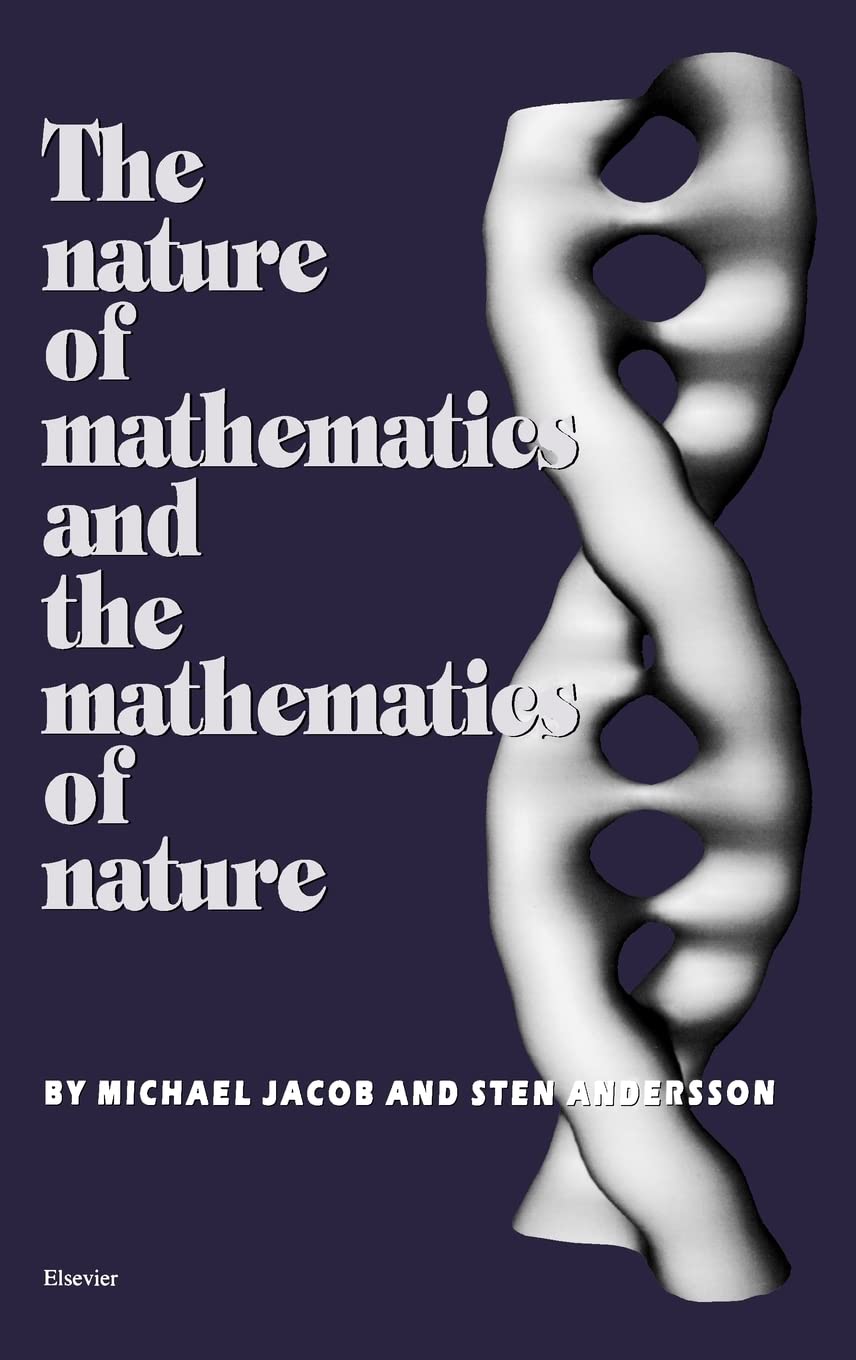
The Nature of Mathematics and the Mathematics of Nature by S. Andersson – Mathematics & Science

Science & Mathematics
Linear Algebra | by Stephen Friedberg | Arnold Insel | Lawrence Spence | Pearson | by Stephen Friedberg | Arnold Insel | Lawrence Spence | Pearson | by Stephen Friedberg | Arnold Insel | Lawrence Spence | Pearson | by Stephen Friedberg | Arnold Insel | Lawrence Spence | Pearson | by Stephen Friedberg | Arnold Insel | Lawrence Spence | Pearson | by Stephen Friedberg | Arnold Insel | Lawrence Spence | Pearson | by Stephen Friedberg | Arnold Insel | Lawrence Spence | Pearson | by Stephen Friedberg

Science & Mathematics