
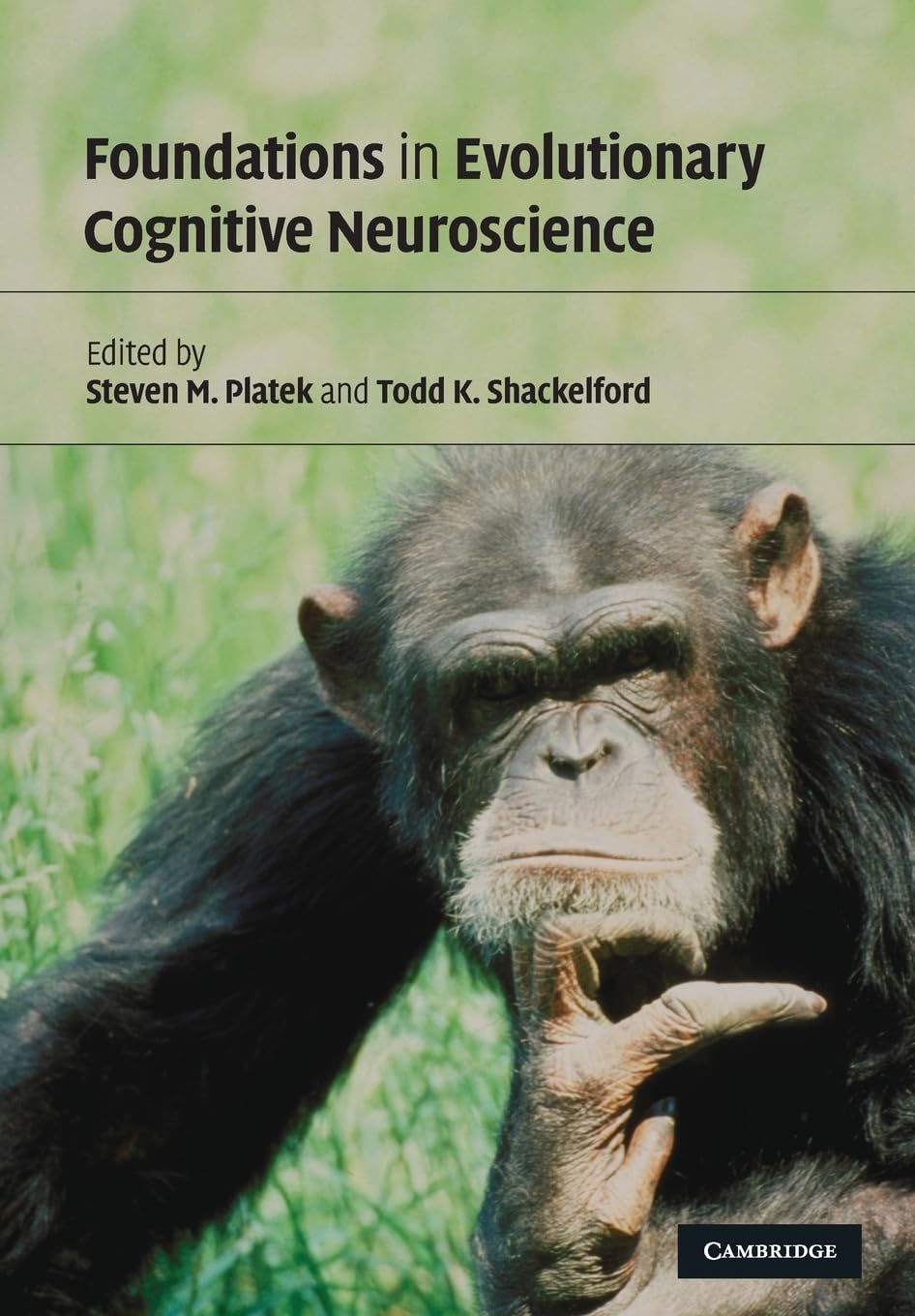
Foundations in Evolutionary Cognitive Neuroscience: An Introduction to Evolutionary Psychology and Brain Science by Stev
Inclusive of all applicable taxes. FREE shipping on all orders.
Available Offers
- 🚚Free Delivery — Free shipping on all orders
- 💵Cash on Delivery — Pay when your order arrives
- ↩️15-Day Easy Returns — Hassle-free return policy
- 🔒Cash on Delivery — Pay safely when your order arrives
Check Delivery
Product Description
Introduction
Welcome to the fascinating intersection of evolution and brain science. Foundations in Evolutionary Cognitive Neuroscience by Steven M. Platek is a landmark hardcover publication from Cambridge University Press that introduces readers to a revolutionary way of understanding the human mind. This book bridges two powerful disciplines—evolutionary psychology and cognitive neuroscience—to explore how our brains have been shaped by millions of years of natural selection. Whether you are a graduate student, a researcher, or simply a curious mind in India, this volume offers a rigorous yet accessible entry point into a field that is redefining modern psychology and neuroscience.
Book Overview
This comprehensive text serves as a primer on evolutionary cognitive neuroscience, a branch of neuroscience that uses advanced brain-imaging tools like functional magnetic resonance imaging (fMRI), transcranial magnetic stimulation (TMS), and electroencephalography (EEG) to test hypotheses about evolved cognitive adaptations. Instead of merely describing brain functions, the book asks why certain cognitive abilities exist and how they helped our ancestors survive. Written in clear, academic prose, it guides readers through the core questions: How did language evolve? Why do we recognise faces so effortlessly? What makes human intelligence unique? Each chapter builds a foundation for deeper study, making it an essential resource for Indian universities and libraries.
Key Highlights
- Interdisciplinary Approach: Merges evolutionary theory with cutting-edge cognitive neuroscience methods.
- Empirical Focus: Shows how neuroimaging and patient studies can answer evolutionary questions.
- Authoritative Source: Published by Cambridge University Press, a world leader in academic publishing.
- Hardcover Quality: Durable binding ideal for repeated reference in academic settings.
- Graduate-Level Content: Perfect for advanced coursework, seminars, and self-study in Indian universities.
Inside the Book
The book is structured to take you from basic principles to advanced applications. Early chapters outline the fundamentals of cognitive evolution and explain how neuroscientific methods can be used to test hypotheses about evolved mental modules. Later chapters dive into specific topics such as the evolution of language, the neural basis of face processing, the origins of intelligence, and the cognitive architecture of social behaviour. Each section includes case studies from neuropsychiatric and neurosurgical patients, offering real-world evidence that brings theories to life. The text is richly referenced, providing a springboard for further research.
Key Topics
- Evolutionary meta-theory and its application to cognitive neuroscience
- Methods: fMRI, TMS, EEG, MEG, and lesion studies
- Evolution of language and communication
- Face perception and social cognition
- Intelligence and executive functions
- Neuropsychiatric disorders as windows into evolved adaptations
- Sex differences and mating cognition
- Consciousness and self-awareness from an evolutionary perspective
Reader Benefits
By reading this book, you will gain a solid grounding in how evolutionary thinking can reshape our understanding of the brain. You will learn to critically evaluate research that uses brain imaging to study human nature. For Indian students preparing for competitive exams or pursuing research in psychology, neuroscience, or anthropology, this book provides a unique edge. It equips you with a framework to ask deeper questions about why we think, feel, and behave the way we do—questions that are increasingly relevant in a world shaped by both ancient biology and modern technology.
Learning Outcomes
- Understand the core principles of evolutionary cognitive neuroscience
- Identify how neuroscientific methods can test evolutionary hypotheses
- Analyse the neural basis of evolved cognitive adaptations like language and face recognition
- Critically evaluate research on the evolution of intelligence and social cognition
- Apply evolutionary perspectives to understand psychiatric and neurological conditions
- Develop a foundation for advanced study or research in the field
Who Should Read
This book is primarily aimed at graduate students and researchers in cognitive neuroscience, evolutionary psychology, anthropology, and related fields. However, it is also highly valuable for advanced undergraduate students in India who wish to explore a cutting-edge area of brain science. Clinicians, psychiatrists, and neurologists interested in the evolutionary roots of mental disorders will find fresh insights. Science communicators and educators looking for a rigorous yet engaging text will also benefit. If you are passionate about understanding the human mind from both a biological and evolutionary perspective, this book belongs on your shelf.
About the Author
Steven M. Platek is a prominent cognitive neuroscientist known for his pioneering work in evolutionary psychology and brain imaging. He has published extensively on topics such as self-recognition, face processing, and the neural correlates of social cognition. His research combines experimental psychology with neuroimaging to explore how evolution has shaped the human brain. With a career dedicated to bridging disciplines, Platek brings both authority and clarity to this complex subject.
About the Publisher
Cambridge University Press is one of the oldest and most respected academic publishers in the world. Founded in 1534, it has a long tradition of publishing groundbreaking research across all fields of science and humanities. This book reflects Cambridge's commitment to high-quality scholarship, rigorous peer review, and global accessibility. For Indian readers, a Cambridge University Press publication is a mark of trust and academic excellence.
Conclusion
Foundations in Evolutionary Cognitive Neuroscience is more than a textbook—it is an intellectual journey into the deepest questions about human nature. By combining evolutionary theory with the latest neuroscientific tools, Steven M. Platek offers a fresh and powerful perspective on why our brains work the way they do. Whether you are studying in Delhi, Mumbai, Bengaluru, or anywhere in India, this hardcover volume will serve as a reliable companion for your academic growth. Order your copy today from Bookshops.in and take the first step toward mastering this exciting field.
Quick Summary
Foundations in Evolutionary Cognitive Neuroscience by Steven M. Platek is a pioneering textbook that bridges evolutionary psychology and cognitive neuroscience. It provides a comprehensive introduction to how modern brain imaging techniques—such as fMRI, TMS, MEG, and EEG—can be used to test hypotheses about evolved cognitive adaptations. The book also draws on studies of neuropsychiatric and neurosurgical patients to illustrate how the human mind has been shaped by evolution. Written for graduate students and researchers, it covers the basics of cognitive evolution and the methodological toolkit needed to investigate it. Readers will gain a deep understanding of the evolutionary origins of human cognition and learn to apply neuroscientific methods in an evolutionary framework. This hardcover edition from Cambridge University Press is an essential resource for Indian students and academics in neuroscience, psychology, and anthropology. Buying from Bookshops.in ensures you receive a genuine, high-quality print copy delivered across India.
Book Highlights
Book Specifications
| ISBN-13 | 9780521884211 |
| ISBN-10 | 0521884217 |
| Publisher | Cambridge University Press |
| Language | English |
| Dimensions | 17.78 x 1.91 x 24.77 cm |
| Weight | 620 g |
| Category | Basic Sciences › Neuroscience |
| Genre | Science & Mathematics |
| Original Language | English |
Frequently Asked Questions
What is Foundations in Evolutionary Cognitive Neuroscience about?
Who is the author of this book?
What is the ISBN for this book?
Is this book suitable for Indian graduate students?
What methods are covered in the book?
Does the book include case studies?
What is the price in India?
Is this a hardcover or paperback?
What language is the book in?
Can I use this book for self-study?
What topics are covered in the book?
Where can I buy this book in India?
Readers Also Search For
Customers Also Bought

Anatomy
Ultrastructure of the Digestive Tract: 4 (Electron Microscopy in Biology and Medicine)

Anatomy
Ultrastructure of the Connective Tissue Matrix: 3 (Electron Microscopy in Biology and Medicine)

Anatomy
Reproductive Genetics (Royal College of Obstetricians and Gynaecologists Study Group)

Anatomy
Human Gross Anatomy: An Outline Text by Robert J. Leonard – Medical Anatomy

Pharmacology
Mathematical Modeling and Simulation in Enteric Neurobiology

Anatomy
Nature’s Patterns and the Fractional Calculus: 2 (Fractional Calculus in Applied Sciences and Engineering, 2)
Related Products
View All
Medicine & Health Sciences
Pediatrics on Call | by Charles A. Pohl | Kathleen Bradford | Clara Callahan | McGraw Hill / Medical | by Charles A. Pohl | Kathleen Bradford | Clara Callahan | McGraw Hill / Medical | by Charles A. Pohl | Kathleen Bradford | Clara Callahan | McGraw Hill / Medical | by Charles A. Pohl | Kathleen Bradford | Clara Callahan | McGraw Hill / Medical | by Charles A. Pohl | Kathleen Bradford | Clara Callahan | McGraw Hill / Medical | by Charles A. Pohl | Kathleen Bradford | Clara Callahan | McGraw Hill

Medicine & Health Sciences
The Physician's Guide to Depression and Bipolar Disorders | by Dwight L. Evans | Dennis S. Charney | Lydia Lewis | McGraw Hill / Medical | by Dwight L. Evans | Dennis S. Charney | Lydia Lewis | McGraw Hill / Medical | by Dwight L. Evans | Dennis S. Charney | Lydia Lewis | McGraw Hill / Medical | by Dwight L. Evans | Dennis S. Charney | Lydia Lewis | McGraw Hill / Medical | by Dwight L. Evans | Dennis S. Charney | Lydia Lewis | McGraw Hill / Medical | by Dwight L. Evans | Dennis S. Charney | Lydi

Medicine & Health Sciences
First Exposure to Internal Medicine | by Andrew R. Hoellein | Charles H. Griffith | McGraw Hill / Medical | by Andrew R. Hoellein | Charles H. Griffith | McGraw Hill / Medical | by Andrew R. Hoellein | Charles H. Griffith | McGraw Hill / Medical | by Andrew R. Hoellein | Charles H. Griffith | McGraw Hill / Medical | by Andrew R. Hoellein | Charles H. Griffith | McGraw Hill / Medical | by Andrew R. Hoellein | Charles H. Griffith | McGraw Hill / Medical | by Andrew R. Hoellein | Charles H. Griffit

Medicine & Health Sciences
First Exposure to Internal Medicine | by Charles H. Griffith | Andrew R. Hoellein | McGraw Hill / Medical | by Charles H. Griffith | Andrew R. Hoellein | McGraw Hill / Medical | by Charles H. Griffith | Andrew R. Hoellein | McGraw Hill / Medical | by Charles H. Griffith | Andrew R. Hoellein | McGraw Hill / Medical | by Charles H. Griffith | Andrew R. Hoellein | McGraw Hill / Medical | by Charles H. Griffith | Andrew R. Hoellein | McGraw Hill / Medical | by Charles H. Griffith | Andrew R. Hoellei

Medicine & Health Sciences
Internal Medicine | by Paul G. Schmitz | Kevin J. Martin | McGraw Hill / Medical | by Paul G. Schmitz | Kevin J. Martin | McGraw Hill / Medical | by Paul G. Schmitz | Kevin J. Martin | McGraw Hill / Medical | by Paul G. Schmitz | Kevin J. Martin | McGraw Hill / Medical | by Paul G. Schmitz | Kevin J. Martin | McGraw Hill / Medical | by Paul G. Schmitz | Kevin J. Martin | McGraw Hill / Medical | by Paul G. Schmitz | Kevin J. Martin | McGraw Hill / Medical | by Paul G. Schmitz | Kevin J. Martin |

Medicine & Health Sciences