
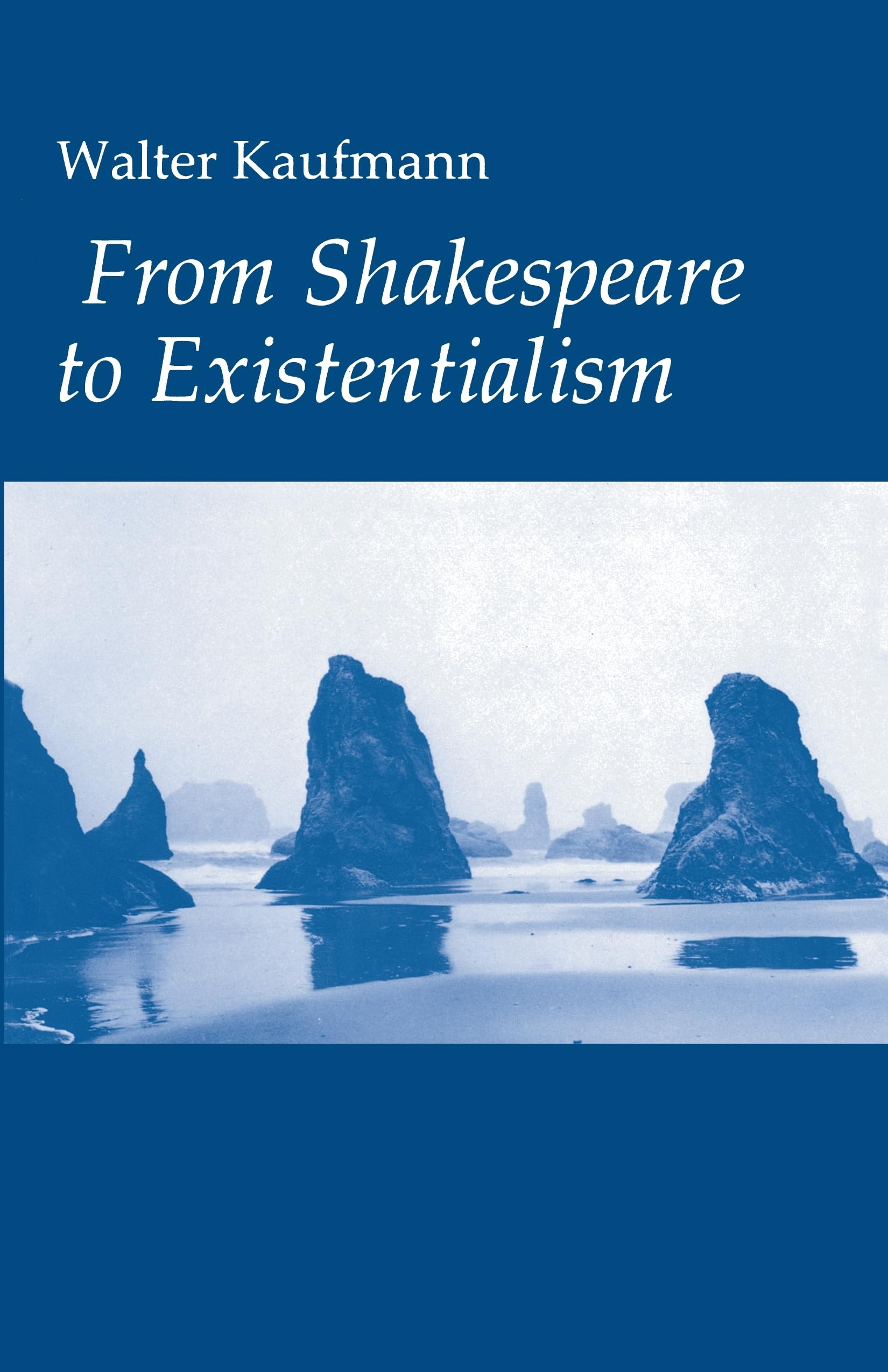
From Shakespeare to Existentialism: Essays on Shakespeare, Goethe, Hegel, Kierkegaard, Nietzsche, Rilke, Freud, Jaspers,
Inclusive of all applicable taxes. FREE shipping on all orders.
Available Offers
- 🚚Free Delivery — Free shipping on all orders
- 💵Cash on Delivery — Pay when your order arrives
- ↩️15-Day Easy Returns — Hassle-free return policy
- 🔒Cash on Delivery — Pay safely when your order arrives
Check Delivery
Product Description
Introduction
Walter A. Kaufmann’s From Shakespeare to Existentialism is a landmark work that bridges the worlds of literature, philosophy, and psychology with extraordinary depth and clarity. First published in 1959, this collection of essays remains a vital resource for students, scholars, and curious readers who wish to explore the intellectual currents that shaped modern Western thought. Kaufmann, a renowned philosopher and translator, brings his sharp analytical mind to bear on figures as diverse as Shakespeare, Goethe, Hegel, Kierkegaard, Nietzsche, Rilke, Freud, Jaspers, Heidegger, and Toynbee. This hardcover edition from Princeton University Press is a treasure for anyone building a serious library in the humanities.
Book Overview
In this wide-ranging volume, Kaufmann examines the evolution of key ideas from the Renaissance through the existentialist movement of the twentieth century. The essays are unified by a central theme: the quest for the “great-souled” individual, an Aristotelian ideal that was lost during medieval times, rediscovered by Shakespeare, and later celebrated by Nietzsche. Kaufmann’s approach is both critical and appreciative, offering readers a nuanced understanding of how these thinkers influenced one another and how their ideas remain relevant today. The book is divided into sections that each focus on a cluster of thinkers, allowing for deep dives into their philosophies and literary contributions.
Key Highlights
- Interdisciplinary brilliance: Kaufmann seamlessly weaves together literature, philosophy, psychology, and theology, showing how these fields enrich one another.
- Original interpretations: The essays challenge conventional readings of Shakespeare, Goethe, and Nietzsche, offering fresh perspectives that have influenced generations of scholars.
- Accessible yet profound: Despite the complexity of the subject matter, Kaufmann writes with clarity and passion, making the book suitable for both advanced students and general readers.
- Historical context: Each essay situates the thinker in their historical moment, helping readers understand the social and intellectual forces at play.
- Enduring relevance: The themes of individuality, morality, and the search for meaning are as pressing today as they were when the book was first published.
Story Themes
While this is not a work of fiction, the essays are driven by powerful narrative themes. The central thread is the journey of the human spirit from the Renaissance to the existentialist era, tracing how ideas of selfhood, freedom, and greatness evolved. Kaufmann explores the tension between faith and reason, the role of art in shaping human consciousness, and the struggle to define a meaningful life in a world without absolute certainties. The book also delves into the psychology of creativity, examining how figures like Rilke and Freud understood the depths of the human mind. Ultimately, the essays are a meditation on what it means to be fully human, to live with purpose, and to engage with the great questions of existence.
Reader Benefits
- Deepen your understanding of Western thought: Gain a comprehensive overview of the intellectual lineage from Shakespeare to existentialism, all in one volume.
- Enhance critical thinking skills: Kaufmann’s rigorous analysis will sharpen your ability to evaluate complex ideas and arguments.
- Prepare for academic study: This book is an excellent companion for courses in philosophy, literature, or intellectual history.
- Discover new connections: See how seemingly disparate thinkers—like Hegel and Rilke or Freud and Nietzsche—are linked by common questions and concerns.
- Build a personal library: The hardcover edition from Princeton University Press is a durable, beautifully produced volume that will last for generations.
Who Should Read
This book is ideal for Indian students and readers who are passionate about philosophy, literature, and the history of ideas. It will particularly appeal to those studying English literature, Western philosophy, psychology, or comparative religion at the undergraduate or postgraduate level. Teachers and professors seeking a rich, thought-provoking text for their courses will find it invaluable. Additionally, general readers with a curiosity about the great minds of the West—and how their ideas continue to shape our world—will be rewarded by Kaufmann’s engaging prose. If you enjoyed works like The Critique of Religion and Philosophy or Nietzsche: Philosopher, Psychologist, Antichrist, also by Kaufmann, this volume is a natural next step.
About the Author
Walter A. Kaufmann (1921–1980) was a German-American philosopher, translator, and poet, celebrated for his groundbreaking work on Nietzsche and existentialism. He taught at Princeton University for over three decades, where he inspired countless students with his interdisciplinary approach. Kaufmann was also a prolific translator, bringing Nietzsche’s works to English-speaking audiences with unmatched precision and style. His own writings, including Critique of Religion and Philosophy and The Faith of a Heretic, are known for their intellectual honesty and breadth. In From Shakespeare to Existentialism, he demonstrates his remarkable ability to traverse fields as diverse as drama, metaphysics, and psychoanalysis, all while maintaining a clear and compelling voice.
About the Publisher
Princeton University Press is one of the most respected academic publishers in the world, with a history dating back to 1905. Based in Princeton, New Jersey, the Press is known for producing authoritative works in the humanities, social sciences, and natural sciences. This hardcover edition of From Shakespeare to Existentialism reflects their commitment to quality—from the sturdy binding and acid-free paper to the meticulous editorial standards. For Indian readers, this book represents a chance to own a piece of scholarly excellence that has stood the test of time, delivered with the care that only a premier university press can provide.
Conclusion
From Shakespeare to Existentialism is more than a collection of essays; it is an intellectual adventure. Walter Kaufmann’s erudition and passion leap off every page, inviting readers to think deeply about the ideas that have shaped our world. Whether you are a student grappling with existentialist thought, a lover of Shakespeare seeking new insights, or a lifelong learner hungry for wisdom, this book will enrich your mind and spirit. Add this classic to your collection today and join the generations of readers who have been transformed by Kaufmann’s vision.
Quick Summary
From Shakespeare to Existentialism by Walter A. Kaufmann is a landmark collection of essays that bridges literature, philosophy, and psychology. Written by one of the twentieth century's most innovative thinkers, the book traces the Aristotelian ideal of the great-souled individual through the works of Shakespeare, Goethe, Hegel, Kierkegaard, Nietzsche, Rilke, Freud, Jaspers, Heidegger, and Toynbee. Kaufmann's interdisciplinary approach makes complex ideas accessible, showing how existentialist thought evolved from classical and Renaissance roots. This book is ideal for Indian students and scholars of philosophy, literature, and intellectual history who want a deep, critical understanding of Western thought. Readers will learn how Shakespeare revived classical magnanimity, how Nietzsche apotheosized the individual, and how existentialism remains a vital tradition. By purchasing from Bookshops.in, you get a premium hardcover edition from Princeton University Press, delivered reliably across India.
Book Highlights
Book Specifications
| ISBN-13 | 9780691013671 |
| ISBN-10 | 0691013675 |
| Publisher | Princeton University Press |
| Language | English |
| Dimensions | 13.34 x 2.77 x 21.59 cm |
| Weight | 595 g |
| Country | India |
| Category | Literature & Fiction › Literary Theory, History & Criticism |
| Genre | Non-fiction |
| Original Language | English |
Frequently Asked Questions
What is From Shakespeare to Existentialism about?
Who is the author of this book?
Is this book suitable for Indian students?
What topics are covered in the essays?
Is this a difficult read?
How is this book different from other philosophy collections?
Can I use this book for my university course?
Is this a hardcover edition?
What is the ISBN?
What is the price in India?
Does the book have reader reviews?
Where can I buy this book in India?
Readers Also Search For
Customers Also Bought

Contemporary Fiction
Stepladder Junction and Other Stories

Contemporary Fiction
Fabrications by Pamela Painter – Short Story Collection

Contemporary Fiction
The Double Life of an Alaskan Sled Dog (English, Andrea Finney Aufder Heyde)

Contemporary Fiction
The Alabaster Girl by Zan Perrion

Contemporary Fiction
Grimm and Grimmer: Classic Fairy Tales Rebooted by Mark Russell
Classic Literature
The Prose Works of Andrew Marvell: 1676-1678 by Andrew Marvell – Restoration Literature
Related Products
View All
Literature & Fiction
Shakespeare, Madness, and Music: Scoring Insanity in Cinematic Adaptations
Literature & Fiction
Literary Research and Canadian Literature: Strategies and Sources: 10 (Literary Research: Strategies and Sources, 10)

Literature & Fiction
Crime Fiction and National Identities in the Global Age | by Julie H. Kim | McFarland & Company | by Julie H. Kim | McFarland & Company | by Julie H. Kim | McFarland & Company | by Julie H. Kim | McFarland & Company | by Julie H. Kim | McFarland & Company | by Julie H. Kim | McFarland & Company | by Julie H. Kim | McFarland & Company | by Julie H. Kim | McFarland & Company | by Julie H. Kim | McFarland & Company | by Julie H. Kim | McFarland & Company | by
Literature & Fiction
Greek Literature in the Classical Period: The Poetics of Drama in Athens: 4 (Greek Literature Vol. 4)
Literature & Fiction
Greek Literature and Philosophy (Greek Literature, Volume 6)
Literature & Fiction