
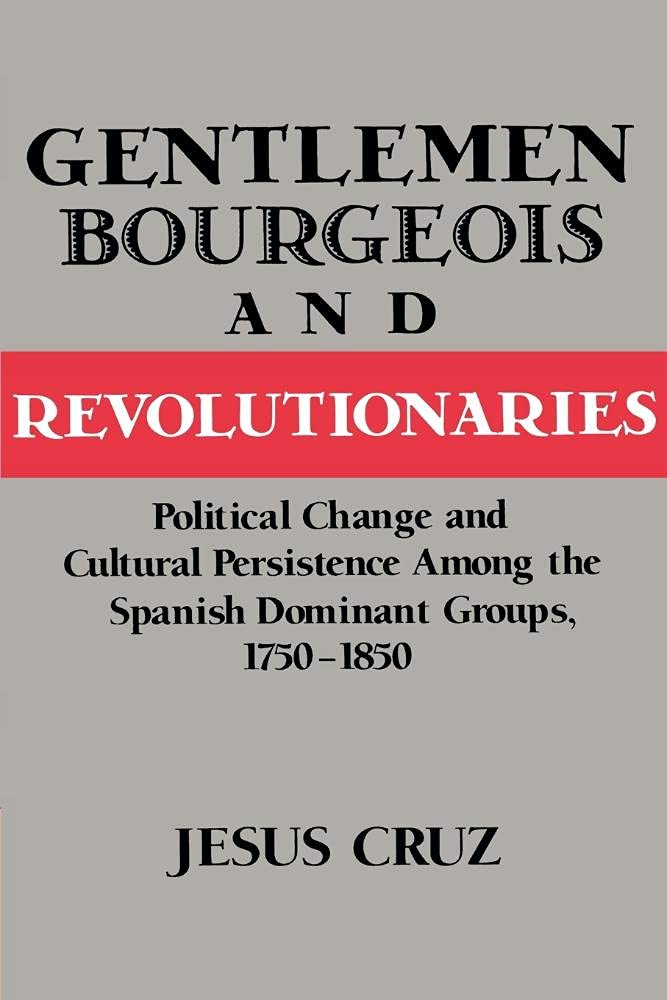
Gentlemen, Bourgeois, and Revolutionaries: Political Change and Cultural Persistence among the Spanish Dominant Groups,
Inclusive of all applicable taxes. FREE shipping on all orders.
Available Offers
- 🚚Free Delivery — Free shipping on all orders
- 💵Cash on Delivery — Pay when your order arrives
- ↩️15-Day Easy Returns — Hassle-free return policy
- 🔒Cash on Delivery — Pay safely when your order arrives
Check Delivery
Product Description
Introduction
In the vast landscape of Spanish historiography, few works have dared to challenge the entrenched narrative of bourgeois revolution as boldly as Jesus Cruz's Gentlemen, Bourgeois, and Revolutionaries: Political Change and Cultural Persistence among the Spanish Dominant Groups, 1750–1850. Published by Cambridge University Press, this hardcover volume is a rigorous scholarly intervention that repositions Spain within the mainstream of European modernity. For Indian readers and students of history, political science, and sociology, this book offers a compelling comparative lens through which to examine the relationship between elite groups, cultural continuity, and political transformation.
Book Overview
This meticulously researched work dismantles the long-held assumption that Spain's transition from the Old Regime to modernity was driven by an ascendant bourgeoisie. Instead, Cruz argues that no national bourgeoisie existed in Spain before the second half of the nineteenth century. The book reinterprets the period between 1750 and 1850 as one marked not by revolutionary rupture but by cultural persistence among dominant groups—gentlemen, landowners, and officeholders—who adapted to change without losing their social hegemony. By doing so, it rescues Spain from the label of 'failure' and places it firmly in the European mainstream of industrialisation, urbanisation, and democratisation.
Key Highlights
- Revisionist Thesis: Challenges the bourgeois revolution model as inadequate for explaining Spanish modernisation before 1850.
- Comparative Framework: Situates Spain within broader European patterns, refuting claims of exceptionalism.
- Cultural Persistence: Examines how elite groups maintained cultural and social dominance despite political upheaval.
- Inclusive Analysis: Covers political, economic, and cultural dimensions of change over a century of transformation.
Inside the Book
The book is structured around a deep investigation of the Spanish dominant groups—their identities, strategies, and adaptations. Cruz draws on extensive archival sources to reconstruct the lives of merchants, landowners, bureaucrats, and aristocrats. He shows how these groups navigated the collapse of the Old Regime, the Napoleonic wars, and the rise of liberal institutions. The narrative weaves together quantitative data on wealth and occupation with qualitative insights into family networks, education, and patronage. Readers will find detailed case studies of prominent families and regions, offering a granular view of how power was preserved and reconfigured.
Key Topics
- The myth of the Spanish bourgeoisie and its historiographical origins
- Economic structures and elite wealth in eighteenth-century Spain
- Political revolutions and their limited social impact
- Cultural codes of honour, patronage, and lineage among dominant groups
- Comparisons with France, England, and other European states
Reader Benefits
For Indian scholars and students, this book provides a sophisticated model for analysing elite continuity in contexts of political change. It offers tools to question teleological narratives of progress and to appreciate the resilience of traditional hierarchies. The clear prose and logical argumentation make complex historiographical debates accessible, while the comparative perspective enriches understanding of non-Western modernities. Additionally, the book serves as an excellent resource for those interested in the intersection of cultural history and political sociology.
Learning Outcomes
- Critically evaluate the concept of bourgeois revolution in European history
- Understand the mechanisms of cultural persistence among ruling elites
- Analyse Spain's political development in a comparative European framework
- Develop skills in interpreting archival evidence and historiographical debates
- Apply revisionist approaches to other national contexts, including India
Who Should Read
This book is ideal for postgraduate students and researchers in modern European history, political science, and sociology. It is also highly relevant for undergraduate courses on revolutions, social change, and elite studies. Indian readers with an interest in comparative historical sociology or the history of colonialism and its aftermath will find Cruz's arguments thought-provoking. The book assumes some familiarity with European history but is written in a style that welcomes dedicated non-specialists.
About the Author
Jesus Cruz is a distinguished historian of modern Spain and Europe. He has taught at several leading universities and published extensively on the social and cultural history of the Spanish elite. His scholarship is known for its methodological rigour and its willingness to challenge orthodox interpretations. Cruz's work has been influential in reorienting the study of Spanish history toward transnational and comparative perspectives.
About the Publisher
Cambridge University Press is one of the world's oldest and most respected academic publishers. With a legacy dating back to 1534, it is renowned for publishing groundbreaking scholarship across all disciplines. This hardcover edition is produced to the highest academic standards, featuring durable binding, clear typography, and archival-quality paper—making it a lasting addition to any serious library.
Conclusion
Gentlemen, Bourgeois, and Revolutionaries is a landmark work that compels us to rethink the very categories of social change. By foregrounding cultural persistence rather than revolutionary rupture, Jesus Cruz offers a more nuanced and historically accurate portrait of Spain's path to modernity. For anyone seeking to understand how dominant groups adapt and endure, this book is an indispensable guide. Order your copy today from Bookshops.in and add a critical voice to your collection.
Quick Summary
Gentlemen, Bourgeois, and Revolutionaries by Jesus Cruz is a revisionist historical work that reinterprets Spain's transformation from the Old Regime to modernity between 1750 and 1850. The author challenges the dominant bourgeois revolution theory, arguing that a national bourgeoisie did not exist in Spain before the second half of the nineteenth century. Instead, he shows that Spain's modernisation—including industrialisation, urbanisation, and democratisation—followed a mainstream European pattern, contrary to the notion of Spanish exceptionalism. The book focuses on the cultural persistence and political roles of Spanish dominant groups, including gentlemen, bourgeois, and revolutionaries. It is ideal for Indian students and scholars of modern European history, especially those interested in comparative historiography and social change. By purchasing from Bookshops.in, readers get a high-quality hardcover edition from Cambridge University Press, ensuring reliable academic content and durable binding for long-term study and reference.
Book Highlights
Book Specifications
| ISBN-13 | 9780521894166 |
| ISBN-10 | 0521894166 |
| Publisher | Cambridge University Press |
| Language | English |
| Dimensions | 15.24 x 2.31 x 22.86 cm |
| Weight | 557 g |
| Country | India |
| Category | World › Civilization & Culture |
| Genre | History |
| Original Language | English |
Frequently Asked Questions
What is the main argument of Gentlemen, Bourgeois, and Revolutionaries?
Who is the author Jesus Cruz?
What time period does the book cover?
Is this book suitable for Indian students?
Does the book include comparisons with other European countries?
Is the book available in hardcover?
What is the ISBN of this book?
What language is the book written in?
What is the price of the book in India?
Does the book discuss the Spanish nobility?
Is this book a critique of Marxist historiography?
Can this book be used for a PhD research?
Where can I buy this book in India?
Readers Also Search For
Customers Also Bought
Related Products
View All
History
Human Nature and the French Revolution: From the Enlightenment to the Napoleonic Code: 3 (Polygons: Cultural Diversities and Intersections, 3)
History
The Unmaking of Home in Contemporary Art (Cultural Spaces)

History
Handbook to Life in Medieval and Early Modern Japan | by William E. Deal | Oxford University Press | by William E. Deal | Oxford University Press | by William E. Deal | Oxford University Press | by William E. Deal | Oxford University Press | by William E. Deal | Oxford University Press | by William E. Deal | Oxford University Press | by William E. Deal | Oxford University Press | by William E. Deal | Oxford University Press | by William E. Deal | Oxford University Press | by William E. Deal | Ox

History
The Narrators of Barbarian History (A.D. 550-800) | by Walter Goffart | University of Notre Dame Press | by Walter Goffart | University of Notre Dame Press | by Walter Goffart | University of Notre Dame Press | by Walter Goffart | University of Notre Dame Press | by Walter Goffart | University of Notre Dame Press | by Walter Goffart | University of Notre Dame Press | by Walter Goffart | University of Notre Dame Press | by Walter Goffart | University of Notre Dame Press | by Walter Goffart | Univ

History
The Collected Mathematical Papers of Arthur Cayley.Vol. 12

History