
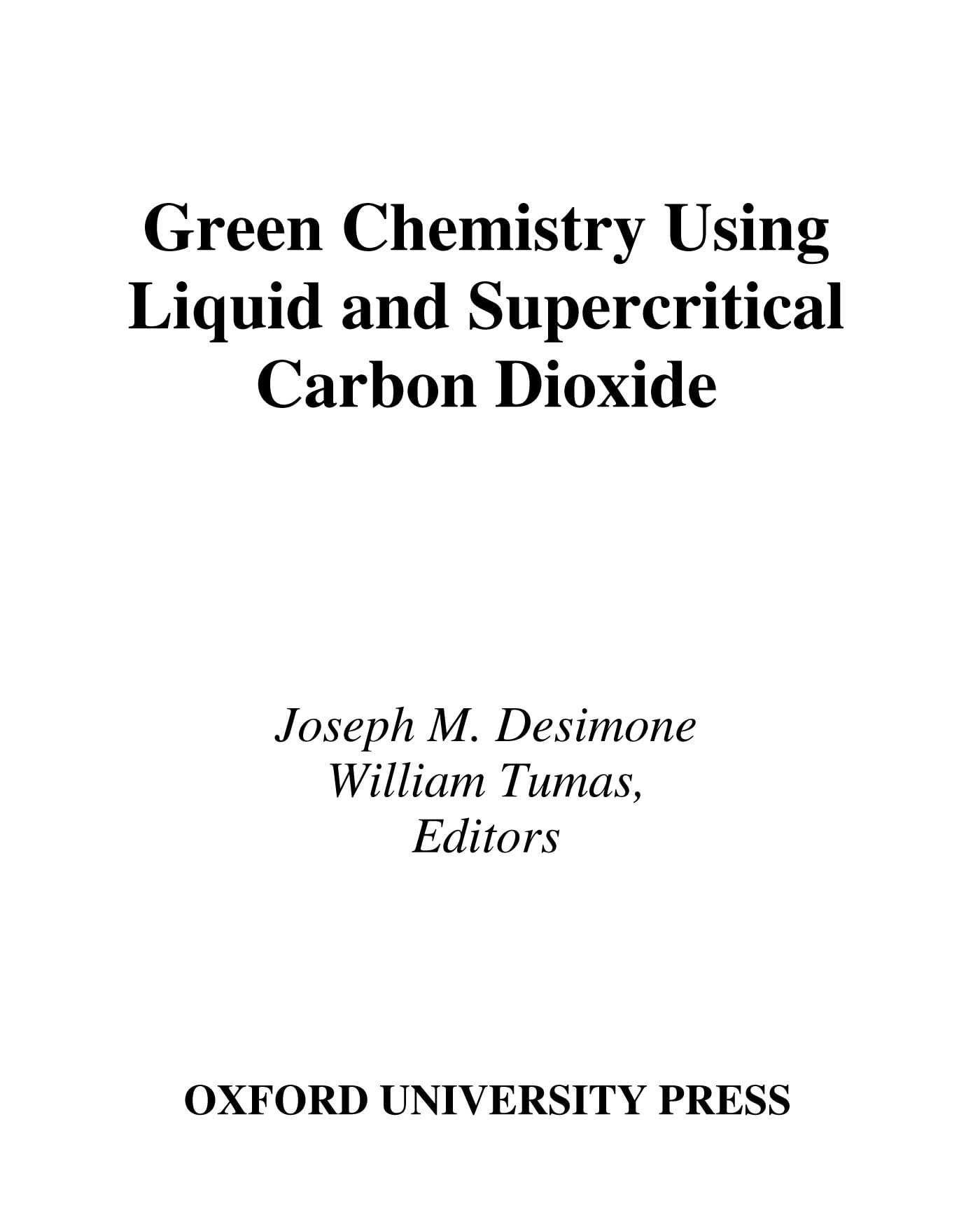
Green Chemistry Using Liquid and Supercritical Carbon Dioxide by Joseph M. Desimone – Sustainable Catalysis, Polymers, a
Inclusive of all applicable taxes. FREE shipping on all orders.
Available Offers
- 🚚Free Delivery — Free shipping on all orders
- 💵Cash on Delivery — Pay when your order arrives
- ↩️15-Day Easy Returns — Hassle-free return policy
- 🔒Cash on Delivery — Pay safely when your order arrives
Check Delivery
Product Description
Introduction
In an era where environmental consciousness is reshaping the chemical industry, Green Chemistry Using Liquid and Supercritical Carbon Dioxide emerges as a definitive guide for sustainable innovation. Edited by renowned chemist Joseph M. Desimone and published by Oxford University Press, this hardbound volume offers a deep dive into the transformative potential of carbon dioxide as a green solvent. For Indian researchers, students, and industry professionals seeking to align with global sustainability goals, this book presents both foundational knowledge and cutting-edge applications in a clear, authoritative manner.
Book Overview
This comprehensive reference work explores the science and engineering behind using liquid and supercritical carbon dioxide as an environmentally benign alternative to traditional organic solvents. The book systematically examines how CO₂ can replace hazardous solvents in chemical synthesis, polymer processing, and industrial manufacturing. With contributions from leading experts worldwide, the volume bridges theoretical principles with practical implementation, making it an essential resource for anyone engaged in green chemistry research or application.
Key Highlights
- Authored by Joseph M. Desimone, a pioneer in green chemistry and polymer science
- Published by Oxford University Press, ensuring rigorous academic quality
- Hardcover edition built to last through years of laboratory and classroom use
- Comprehensive coverage of catalysis, polymer science, and industrial processes
- Expert contributions from international researchers at the forefront of CO₂-based technologies
Inside the Book
The volume is structured into three major thematic sections, each addressing a critical domain of CO₂ utilization. The first section delves into catalysis and chemical synthesis, explaining how supercritical CO₂ can serve as a reaction medium for homogeneous and heterogeneous catalysis. The second section focuses on polymers, covering topics such as polymer synthesis, processing, and the design of CO₂-philic materials. The final section examines industrial applications, including extraction, cleaning, and manufacturing processes that leverage the unique properties of liquid and supercritical carbon dioxide. Each chapter is enriched with experimental data, mechanistic insights, and case studies that illustrate real-world relevance.
Key Topics
- Fundamentals of supercritical fluid behaviour and phase equilibria
- Catalytic reactions in liquid and supercritical CO₂
- Synthesis of polymers and copolymers using CO₂ as a solvent
- Design of surfactants and stabilizers for CO₂-based systems
- Industrial extraction, cleaning, and coating processes
- Environmental and safety advantages of CO₂ compared to volatile organic compounds
- Scale-up challenges and economic considerations
Reader Benefits
Readers gain a thorough understanding of how liquid and supercritical carbon dioxide can be harnessed for greener chemical processes. The book equips you with the knowledge to evaluate CO₂ as a solvent in your own research or industrial setting. It provides practical guidelines for experimental design, process optimization, and safety protocols. Moreover, the interdisciplinary approach helps chemists, chemical engineers, and material scientists collaborate effectively on sustainability-driven projects. Indian students preparing for competitive exams or pursuing advanced degrees will find the content aligned with emerging global trends in green chemistry.
Learning Outcomes
- Understand the physical and chemical properties of liquid and supercritical CO₂
- Identify suitable reactions and processes for CO₂-based green chemistry
- Analyze the role of catalysts, surfactants, and polymers in CO₂ systems
- Evaluate industrial applications from an environmental and economic perspective
- Apply principles of green chemistry to design safer, more sustainable solutions
Who Should Read
This book is ideal for postgraduate students and researchers in chemistry, chemical engineering, and materials science. It is equally valuable for industry professionals working in pharmaceuticals, polymers, coatings, and specialty chemicals who are seeking to reduce their environmental footprint. Faculty members designing advanced courses on green chemistry or supercritical fluids will find it an excellent textbook or reference. Additionally, environmental scientists and policy makers interested in sustainable industrial practices will benefit from its comprehensive coverage.
About the Author
Joseph M. Desimone is a distinguished professor and entrepreneur known for his pioneering work in green chemistry and polymer science. He has authored numerous influential papers and holds several patents related to carbon dioxide-based technologies. His research has been recognized with multiple awards, including the National Medal of Technology and Innovation. Desimone's expertise ensures that this book reflects the highest standards of scientific accuracy and practical relevance.
About the Publisher
Oxford University Press (OUP) is one of the world's most respected academic publishers, with a history spanning over five centuries. OUP is committed to disseminating scholarship of the highest quality, and its science and mathematics titles are trusted by students, researchers, and professionals globally. This hardcover edition reflects OUP's dedication to producing durable, well-edited resources that support learning and discovery.
Conclusion
Green Chemistry Using Liquid and Supercritical Carbon Dioxide is more than a textbook—it is a roadmap for a cleaner, more sustainable chemical industry. By combining theoretical depth with practical guidance, Joseph M. Desimone and his co-authors have created an indispensable resource for anyone committed to advancing green chemistry. Whether you are a student in an Indian university, a researcher in a national lab, or a professional in the chemical sector, this book will inspire and equip you to make a meaningful impact. Order your copy from Bookshops.in today and join the movement toward a greener future.
Quick Summary
Green Chemistry Using Liquid and Supercritical Carbon Dioxide, edited by Joseph M. Desimone, is a seminal reference that explores the transformative potential of carbon dioxide as an environmentally benign solvent. Published by Oxford University Press, this hardcover volume brings together contributions from leading experts to cover three core areas: catalysis and chemical synthesis in CO2, polymer chemistry in CO2, and industrial processes utilizing CO2. The book is designed for researchers in academia and industry who are seeking sustainable alternatives to traditional organic solvents. Readers will gain insights into how liquid and supercritical CO2 can enable efficient catalytic reactions, facilitate the synthesis of advanced polymers, and be integrated into real-world manufacturing processes. By emphasizing green chemistry principles, the book addresses the urgent need for cleaner technologies in chemical production. For Indian students and professionals, this resource is invaluable for staying at the forefront of sustainable chemistry. Purchasing from Bookshops.in ensures you receive a genuine, high-quality print edition delivered to your doorstep.
Book Highlights
Book Specifications
| ISBN-13 | 9780195154832 |
| ISBN-10 | 0195154835 |
| Publisher | Oxford Univ Pr on Demand |
| Language | English |
| Dimensions | 15.6 x 1.75 x 23.39 cm |
| Weight | 544 g |
| Category | Civil Engineering › Ecology & Environment |
| Genre | Non-fiction |
| Original Language | English |
Frequently Asked Questions
What is the main focus of this book?
Who is the editor of this book?
Is this book suitable for Indian students?
What are supercritical carbon dioxide and its advantages?
Does the book cover industrial applications?
Is the book available in hardcover?
Who is the publisher?
What is the ISBN of this book?
Can this book be used for teaching a green chemistry course?
Does the book include contributions from multiple experts?
What topics in catalysis are covered?
Is the book relevant for polymer scientists?
How does this book contribute to sustainability?
Where can I buy this book in India?
Readers Also Search For
Customers Also Bought
Mathematics
Stereotype Spaces and Algebras: 73 (De Gruyter Expositions in Mathematics, 73)

Mathematics
Semigroups in Algebra, Geometry and Analysis: 20 (De Gruyter Expositions in Mathematics, 20)

Mathematics
Geometry from the Pacific Rim: Proceedings of the Pacific Rim Geometry Conference held at National University of Singapore, Republic of Singapore, ... 1994 (De Gruyter Proceedings in Mathematics)

Mathematics
First International Tainan-Moscow Algebra Workshop: Proceedings of the International Conference held at National Cheng Kung University Tainan, Taiwan, ... 1994 (De Gruyter Proceedings in Mathematics)
Mathematics
Differential Geometry - Proceedings of the VIII International Colloquium (English, Jesus A. Alvarez Lopez | Eduardo Garcia-Rio)
Mathematics
Mathematical Theory of Optimal Processes (Classics of Soviet Mathematics)
Related Products
View All
Science & Mathematics
Squid - Superconducting Quantum Interference Devices and Their Applications: Proceedings of the International Conference on Superconducting Quantum Devices, Berlin-west, October 4-8, 1976
Science & Mathematics
Thermodynamics and Pattern Formation in Biology
Science & Mathematics
The Nature of Mathematics and the Mathematics of Nature by S. Andersson – Mathematics & Science

Science & Mathematics
Linear Algebra | by Stephen Friedberg | Arnold Insel | Lawrence Spence | Pearson | by Stephen Friedberg | Arnold Insel | Lawrence Spence | Pearson | by Stephen Friedberg | Arnold Insel | Lawrence Spence | Pearson | by Stephen Friedberg | Arnold Insel | Lawrence Spence | Pearson | by Stephen Friedberg | Arnold Insel | Lawrence Spence | Pearson | by Stephen Friedberg | Arnold Insel | Lawrence Spence | Pearson | by Stephen Friedberg | Arnold Insel | Lawrence Spence | Pearson | by Stephen Friedberg
Science & Mathematics
University Calculus | by Joel Hass | Christopher Heil | Maurice Weir | Pearson | by Joel Hass | Christopher Heil | Maurice Weir | Pearson | by Joel Hass | Christopher Heil | Maurice Weir | Pearson | by Joel Hass | Christopher Heil | Maurice Weir | Pearson | by Joel Hass | Christopher Heil | Maurice Weir | Pearson | by Joel Hass | Christopher Heil | Maurice Weir | Pearson | by Joel Hass | Christopher Heil | Maurice Weir | Pearson | by Joel Hass | Christopher Heil | Maurice Weir | Pearson | by Joe
Science & Mathematics