
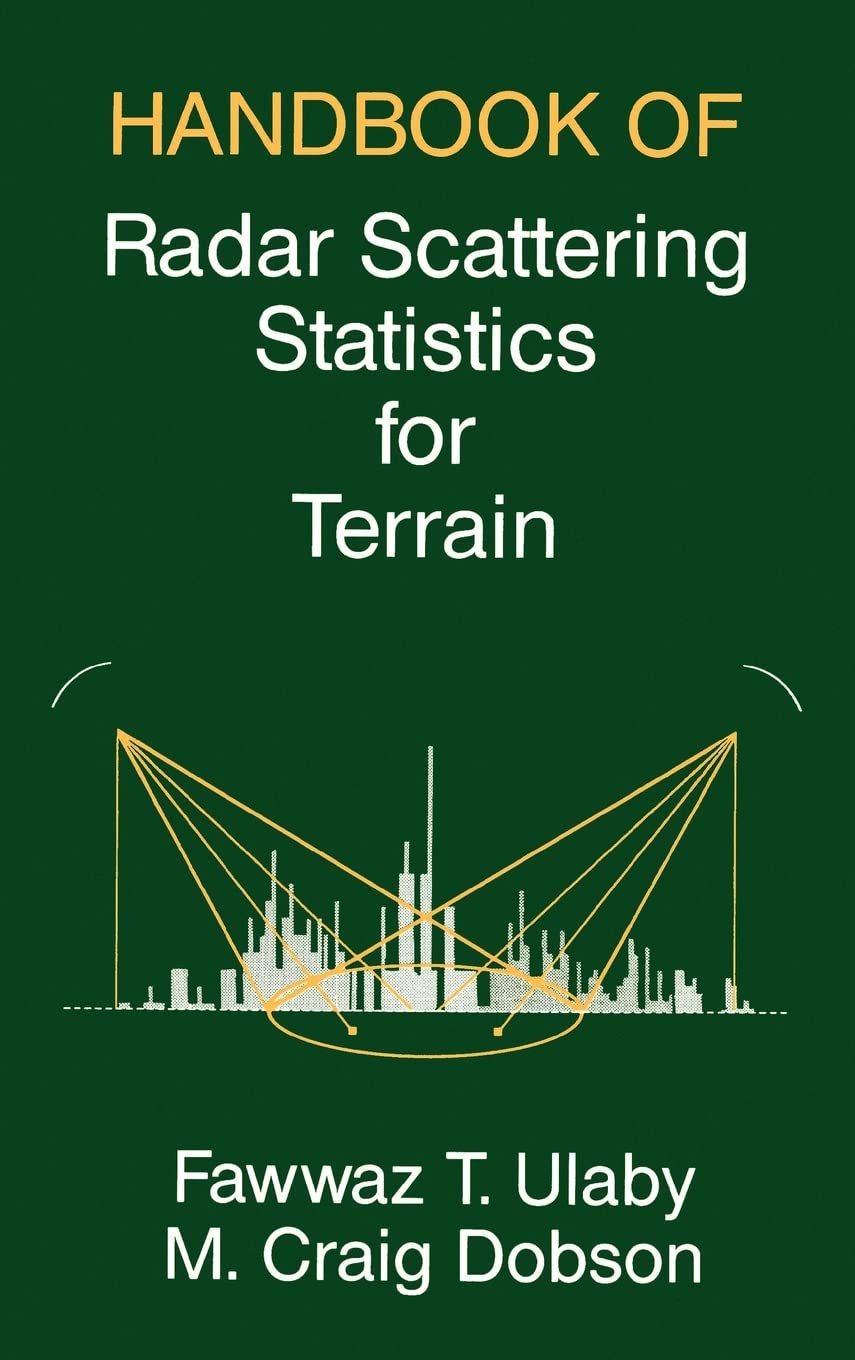
Handbook of Radar Scattering Statistics for Terrain by Fawwaz T. Ulaby – A Definitive Reference on Radar Scattering and
Inclusive of all applicable taxes. FREE shipping on all orders.
Available Offers
- 🚚Free Delivery — Free shipping on all orders
- 💵Cash on Delivery — Pay when your order arrives
- ↩️15-Day Easy Returns — Hassle-free return policy
- 🔒Cash on Delivery — Pay safely when your order arrives
Check Delivery
Product Description
Introduction
The Handbook of Radar Scattering Statistics for Terrain by Fawwaz T. Ulaby is an authoritative reference work that has become indispensable for researchers, engineers, and students working in remote sensing, radar systems, and geoscience. Published by Artech House Publishers, this hardcover volume offers a comprehensive compilation of radar backscatter data and statistical models for various terrain types. For Indian students and professionals engaged in defence technology, agricultural monitoring, or environmental studies, this book provides the foundational knowledge required to interpret radar signals reflected from land surfaces. It bridges the gap between theoretical electromagnetics and practical terrain analysis, making it a vital resource for anyone involved in radar-based earth observation.
Book Overview
This handbook systematically presents measured radar scattering statistics for a wide range of natural and man-made terrain features. It covers important parameters such as backscattering coefficient, probability distributions, and correlation properties. The data is drawn from extensive experiments conducted over forests, agricultural fields, deserts, urban areas, and snow-covered regions. The book also includes models for surface roughness, soil moisture, and vegetation cover effects. Each chapter is structured to provide both raw data tables and analytical expressions, enabling readers to apply these statistics directly to their own radar system design or data interpretation tasks. The hardcover binding ensures durability for frequent use in labs and field stations.
Key Highlights
- Comprehensive Data Compilation: Over 200 tables of measured radar backscatter statistics for diverse terrain types, including Indian agricultural landscapes.
- Statistical Models: Detailed coverage of probability density functions, autocorrelation functions, and power spectral density models.
- Frequency and Polarization Dependence: Analysis of how radar response varies with frequency bands (L, S, C, X, Ku, Ka) and polarization (HH, VV, HV, VH).
- Terrain Classification: Systematic categorization of surfaces into bare soil, vegetation, snow, ice, urban, and water bodies.
- Experimental Methodology: Clear descriptions of measurement setups, calibration techniques, and error analysis used to gather the data.
- Practical Applications: Examples of how these statistics are used in synthetic aperture radar (SAR) image interpretation and target detection.
Inside the Book
The handbook is organized into ten major chapters. The opening chapter introduces fundamental concepts of radar scattering, including the radar equation and scattering mechanisms. Subsequent chapters delve into specific terrain categories: agricultural fields, forests, grasslands, arid regions, snow and ice, urban areas, and water surfaces. Each chapter presents statistical parameters such as mean backscatter, standard deviation, skewness, and kurtosis. The book also includes appendices with conversion factors, mathematical derivations, and a glossary of symbols. Numerous graphs and plots illustrate the variability of scattering across different incidence angles and environmental conditions. A special section on Indian monsoon-influenced terrain provides relevant data for regional studies.
Key Topics
- Backscattering Coefficient (Sigma Zero): Measurement techniques and typical values for different terrain types.
- Probability Distributions: Rayleigh, Weibull, log-normal, K-distribution, and gamma models for radar clutter.
- Surface Roughness Effects: Correlation between root mean square height, correlation length, and scattering behaviour.
- Dielectric Properties: Influence of soil moisture, salinity, and organic content on radar returns.
- Vegetation Canopy Modelling: Attenuation and volume scattering from crops, forests, and shrubs.
- Polarimetric Analysis: Decomposition techniques for identifying scattering mechanisms.
- Temporal Variations: Diurnal and seasonal changes in radar signatures due to weather and growth cycles.
Reader Benefits
- Accurate Data Reference: Eliminates the need to search scattered journals for reliable scattering coefficients.
- Improved System Design: Helps engineers optimize radar parameters like frequency, polarization, and incidence angle for specific Indian terrains.
- Enhanced Interpretation Skills: Enables better classification of land cover from SAR imagery used in Indian agricultural and forestry applications.
- Research Foundation: Provides a solid statistical base for developing new algorithms for target detection and terrain mapping.
- Time-Saving Resource: Consolidated tables and formulas reduce calculation time during project work or thesis research.
Learning Outcomes
By studying this handbook, readers will be able to: identify the dominant scattering mechanisms for different terrain types; select appropriate statistical distributions for radar clutter modelling; estimate backscatter values for given surface parameters; analyse the impact of frequency and polarization on radar returns; design experiments for collecting ground truth data; and apply the data to real-world problems such as flood mapping, crop monitoring, and urban planning. The book also equips readers to critically evaluate radar measurement errors and uncertainties, a crucial skill for Indian researchers working with indigenous radar systems like RISAT or NISAR.
Who Should Read
- Graduate Students: In electrical engineering, remote sensing, geography, and environmental science programmes at Indian universities.
- Radar Engineers: Involved in the design and testing of ground-based, airborne, or spaceborne radar systems.
- Remote Sensing Scientists: Analysing SAR data for land cover classification, soil moisture estimation, or disaster management.
- Defence Personnel: Working on target detection, surveillance, and terrain intelligence using radar.
- Agricultural Researchers: Studying crop growth stages and soil conditions through radar signatures.
- Geophysicists: Investigating surface roughness and subsurface properties of Indian landscapes.
About the Author
Fawwaz T. Ulaby is a globally recognized authority in microwave remote sensing and radar scattering. He is the Emmett Leith Distinguished Professor Emeritus at the University of Michigan and the founding director of the Michigan Institute for Global Change. Dr. Ulaby has authored several seminal textbooks, including the three-volume series Microwave Remote Sensing: Active and Passive. His research has significantly advanced the understanding of radar interaction with natural surfaces, particularly soil moisture and vegetation. He is a member of the U.S. National Academy of Engineering and has received numerous awards, including the IEEE Gold Medal for Remote Sensing. His work continues to influence radar system development worldwide, including in India’s space and defence sectors.
About the Publisher
Artech House Publishers is a premier international publisher of professional books and reference works in engineering and technology. With a strong focus on radar, antennas, communications, and signal processing, Artech House is trusted by engineers and academics for its rigorous peer-review process and high-quality content. Their books are known for combining theoretical depth with practical applicability, making them essential resources for both industry professionals and university libraries. This handbook upholds that tradition by offering meticulously curated data and analysis that meet the highest standards of technical accuracy.
Conclusion
The Handbook of Radar Scattering Statistics for Terrain is more than just a data repository; it is a gateway to mastering the complexities of radar-terrain interaction. Whether you are a student in Bangalore studying remote sensing, a defence scientist in Hyderabad working on radar systems, or an agricultural researcher in Punjab analysing crop health, this book provides the statistical tools and empirical data you need. Its hardcover format and clear organization make it a lasting reference for years of use. By integrating this handbook into your work, you will gain a deeper understanding of how radar waves reveal the hidden characteristics of the earth’s surface, enabling more accurate observations and smarter decisions.
Quick Summary
Handbook of Radar Scattering Statistics for Terrain by Fawwaz T. Ulaby is a definitive reference work that compiles extensive empirical data and statistical models on radar scattering from natural and man-made terrain surfaces. Covering frequency bands from L-band to Ka-band, the book examines how factors such as incidence angle, polarization, surface roughness, and dielectric constant influence backscatter coefficients. It includes detailed tables, graphs, and formulas for soil, vegetation, snow, ice, and urban areas, making it indispensable for radar engineers, remote sensing scientists, and graduate students. Readers will learn to predict radar returns, interpret SAR imagery, and design radar systems with improved accuracy. The book is particularly valuable for Indian researchers working on agricultural monitoring, forestry, and defence applications. Buying from Bookshops.in ensures you receive a genuine hardcover edition at a competitive price, with trusted delivery across India.
Book Highlights
Book Specifications
| ISBN-13 | 9780890063361 |
| ISBN-10 | 0890063362 |
| Publisher | Artech House Publishers |
| Language | English |
| Dimensions | 17.48 x 2.92 x 22.4 cm |
| Weight | 680 g |
| Category | Sciences, Technology & Medicine › Engineering & Technology |
| Genre | Non-fiction |
| Original Language | English |
Frequently Asked Questions
What is Handbook of Radar Scattering Statistics for Terrain about?
Who is the author of this book?
Is this book suitable for Indian students?
Does the book include data for Indian terrain?
What is the binding type of this book?
What is the price of this book on Bookshops.in?
What are the key topics covered in the book?
Is this book useful for SAR data analysis?
Does the book include practical examples?
What is the language of the book?
Can this book be used for PhD research?
Is the book available in digital format?
Why should I buy from Bookshops.in?
Readers Also Search For
Customers Also Bought

Research
Mathematical Modeling of Biological Systems, Volume I (English, Andreas Deutsch | Lutz Brusch | Helen Byrne)
Research
Intermediate Statistics (English, James P. Stevens)

Research
Statistics Explained by Steve McKillup – Life Science Statistics Guide

Research
Data Analysis and Graphics Using R by John Maindonald – Statistical Computing
Research
Applied Longitudinal Data Analysis (English, Judith D. Singer | John B. Willett)
Research
Bayesian Biostatistics (STATISTICS, A SERIES OF TEXTBOOKS AND MONOGRAPHS)
Related Products
View All
Sciences, Technology & Medicine
African Philosophy and the Epistemic Marginalization of Women (Routledge African Studies)

Sciences, Technology & Medicine
Evolution Interrupted: How We Change Nature and How Nature Changes Us
Sciences, Technology & Medicine
The Tragicomedy of Classical Thermodynamics: Course Held at the Department of Mechanics of Solids (July 1971): 70 (CISM International Centre for Mechanical Sciences)

Sciences, Technology & Medicine
DNA Repair Protocols: 113 (Methods in Molecular Biology)
Sciences, Technology & Medicine
Acoustic Fish Reconnaissance: 32 (Marine Science, 32)

Sciences, Technology & Medicine