All Books
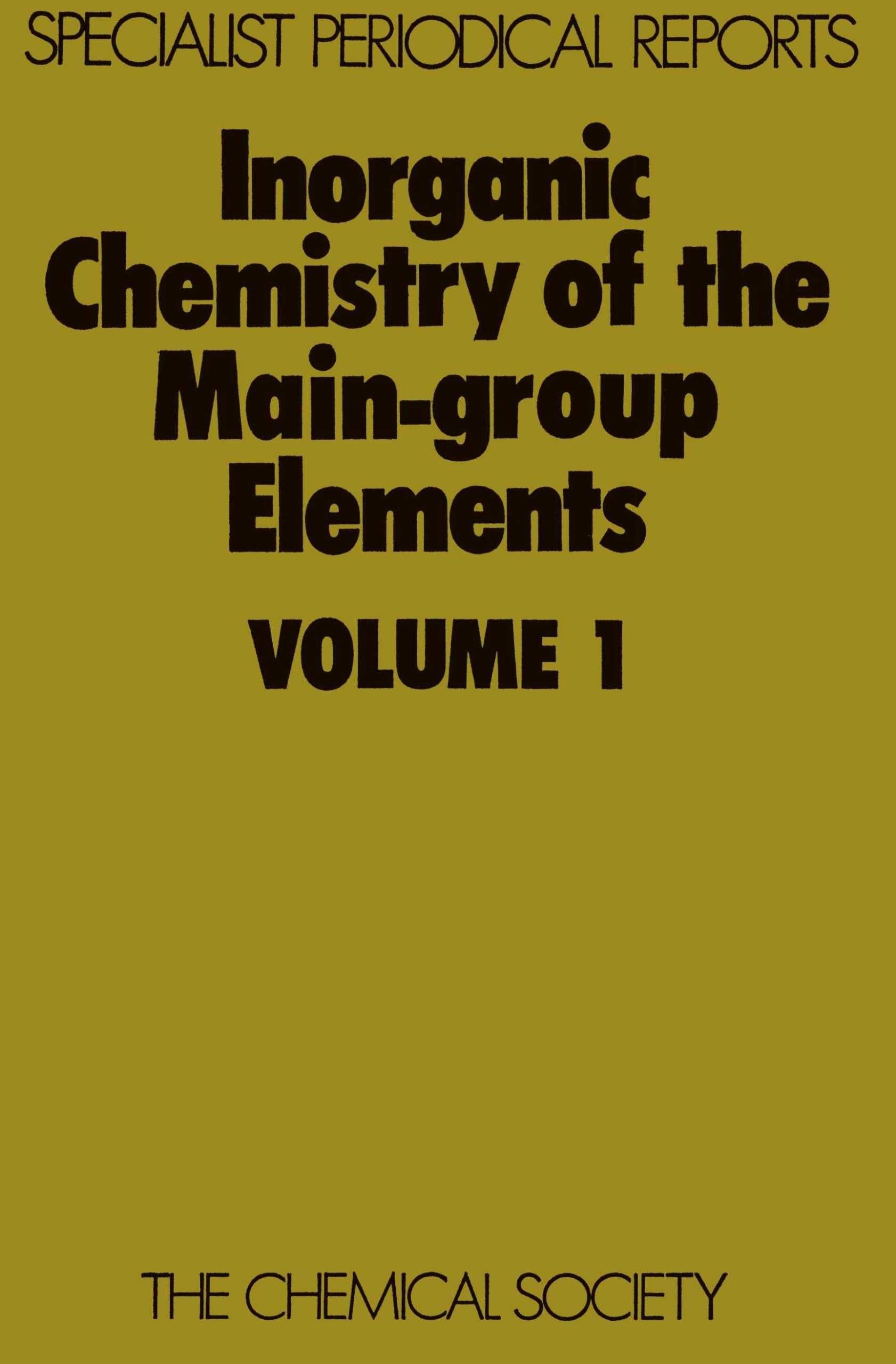
Inorganic Chemistry of the Main-Group Elements: Volume 1 (Specialist Periodical Reports - Inorganic Chemistry of the Main-Group Elements)
Chemistry

Inorganic Chemistry of the Main-Group Elements: Volume 1 (Specialist Periodical Reports - Inorganic Chemistry of the Main-Group Elements)

5,312

Inclusive of all applicable taxes. FREE shipping on all orders.

Quantity:
1
Share:
Free DeliveryOn every order
15-Day ReturnEasy returns
Genuine BookPhysical copy only

Available Offers

  • 🚚Free DeliveryFree shipping on all orders
  • 💵Cash on DeliveryPay when your order arrives
  • ↩️15-Day Easy ReturnsHassle-free return policy
  • 🔒Cash on DeliveryPay safely when your order arrives

Check Delivery

Product Description

About This Book

Specialist Periodical Reports provide systematic and detailed review coverage of progress in the major areas of chemical research. Written by experts in their specialist fields the series creates a unique service for the active research chemist, supplying regular critical in-depth accounts of progress in particular areas of chemistry. For over 80 years the Royal Society of Chemistry and its predecessor, the Chemical Society, have been publishing reports charting developments in chemistry, which originally took the form of Annual Reports. However, by 1967 the whole spectrum of chemistry could no longer be contained within one volume and the series Specialist Periodical Reports was born. The Annual Reports themselves still existed but were divided into two, and subsequently three, volumes covering Inorganic, Organic and Physical Chemistry. For more general coverage of the highlights in chemistry they remain a 'must'. Since that time the SPR series has altered according to the fluctuating degree of activity in various fields of chemistry. Some titles have remained unchanged, while others have altered their emphasis along with their titles; some have been combined under a new name whereas others have had to be discontinued. The current list of Specialist Periodical Reports can be seen on the inside flap of this volume.

About the Author

Inorganic Chemistry of the Main-Group Elements: Volume 1 is authored by C. C. Addison.

Product description Excerpt. © Reprinted by permission. All rights reserved. Inorganic Chemistry of the Main-group Elements Volume 1A Review of the Literature Published Between July 1971 and September 1972By C. C. AddisonThe Royal Society of ChemistryCopyright © 1973 The Royal Society of ChemistryAll rights reserved.ISBN: 978-0-85186-752-6ContentsChapter 1 Elements of Group I By R. J. Pulham, 1, Chapter 2 Elements of Group II By R. J. Pulham, 31, Chapter 3 Elements of Group III By G. Davidson, 53, Chapter 4 Elements of Group IV By P. G. Harrison and P. Hubberstey, 143, Chapter 5 Elements of Group V By N. Logan and D. B. Sowerby, 231, Chapter 6 Elements of Group VI By M. G. Barker, 324, Chapter 7 The Halogens and Hydrogen By M. F. A. Dove, 373, Chapter 8 The Noble Gases By M. F. A. Dove, 412, Author Index, 421, CHAPTER 1Elements of Group IBY R. J. PULHAMIn this chapter individual references which are inter-related are grouped together to make a section and, therefore, reference to several alkali metals may feature in a single section. Each reference, however, appears once only within this chapter so that if described in one section, it will not be duplicated in any other. Single references to topics are presented systematically in the section on the appropriate metal.The elements of Groups I and II are so closely linked in some instances that a section describing them jointly is presented to avoid duplication in Chapter 2. Such a case is the section on 'Molten Salts' which covers the chemistry of the molten salts of both Groups I and II but is presented only in this chapter. A similar situation exists with the section on 'Solutions in Liquid Ammonia' and also with a few other isolated references.1 The Alkali MetalsIsolation. — The preparation of lithium, (like calcium, strontium, and barium) may be achieved by reduction of its fluoride or oxide by hydrogen in the presence of noble metals. The method seems applicable, in principle, to all alkali metals. A finely ground mixture of metal oxide (Li2O, CaO, SrO, or BaO) and noble metal (Pt, Pd, or Ir) is heated above 1100 °C in a stream of pure hydrogen. The noble metal functions as a catalyst in this reduction which is normally not possible. The required metal forms an intermetallic compound of composition AB2, AB3, AB5, and/or AB7, where A = Li, Ca, Sr, or Ba and B = Pt, Pd, or Ir. At higher temperatures and lower pressures (10-5 — 10-6 Torr) part of the more volatile component A volatilizes and is isolated by condensation.Vapours. — The vapour pressure of potassium up to the critical point (1925 ± 30 °C and 155 ± 15 bar) has been obtained by measuring the pressure needed to collapse a bubble of vapour in the liquid metal. The appearance and disappearance of the vapour bubble was followed by its effect on the resistance and thermo-power of the system. The tabulated data are largely summarized by the equation[MATHEMATICAL EXPRESSION NOT REPRODUCIBLE IN ASCII]The rate of ionization of alkali-metal atoms in flames of H2 + O2 + N2 has been measured using a quadrupole mass spectrometer to determine concentrations of each ion in the flame. The results confirm that the atoms, M, ionize by collision with flame gas molecules, X:M + X -> M+ + e- + XThe measured activation energy is, within experimental error, the ionization potential of the alkali metal. The associated cross-sections πσ2 are anomalously large, being similar for each metal and in the range 2.5 ± 1.1 × 10⁻¹⁶. The transfer of excitation energy in caesium vapour induced by collision with a molecule of nitrogen or hydrogen at 450 K has also been studied. The effective cross-sections (Å2)of the transfer of excitation energy from the 82P1/2 to the 82P3/2, 72P3/2, and 72D5/2 states of caesium are 55 ± 11, 1.8 ± 0.5, and 3.3 ± 1 for nitrogen and 80 ± 16, 4.7 ± 1.3, and 6.6 ± 2 for hydrogen, respectively. An indication of the electron density in ionized caesium vapour has been deduced from the emission spectrum and an increase in the intensity of certain spectral lines during the post-luminescence of the ionized vapour was attributed to the process of recombination.Theoretical Aspects. — An approximate equation of state for liquid metals, including the alkali metals, has been developed using a corrected entropy of melting (constant for all metals), the Lindemann law for melting, and a specific heat which has universal dependence on the ratio of the temperature to the melting temperature. A mean spherical model for the structure of liquid metals is also proposed, applicable to sodium, which is a perturbation of the Percus–Yevick hard-sphere model.There are several reports on alkali-metal molecules. The bond energies (calculated by LCAO MO) in small clusters of lithium atoms are shown to change with both the number of atoms in the cluster and their configuration. A previously developed valence-electron model is used in theoretical calculations on states of the molecules Li2, Na2, K2, LiNa, LiK, and NaK, which dissoc

Book Highlights

Published by ‎ Royal Society of Chemistry
Language: ‎ English
Publication date: ‎ 1 January 1973
Edition: ‎ Edition. ed.
Category: Science & Mathematics > Chemistry
Dimensions: ‎ 13.8 x 3.02 x 21.59 cm
Weight: ‎ 730 g
FREE shipping on all BookShops.in orders
15-day hassle-free return policy
Cash on Delivery (COD) available across India

Book Specifications

ISBN-139780851867526
ISBN-100851867529
Publisher‎ Royal Society of Chemistry
Language‎ English
Dimensions‎ 13.8 x 3.02 x 21.59 cm
Weight‎ 730 g
CategoryScience & Mathematics › Chemistry

Frequently Asked Questions

What is the price of Inorganic Chemistry of the Main-Group Elements: Volume 1?
Inorganic Chemistry of the Main-Group Elements: Volume 1 is available at ₹5,312 on BookShops.in.
Does BookShops.in offer free delivery for Inorganic Chemistry of the Main-Group Elements: Volume 1?
FREE delivery on all orders for Inorganic Chemistry of the Main-Group Elements: Volume 1.
Is Cash on Delivery available for Inorganic Chemistry of the Main-Group Elements: Volume 1?
Yes, Cash on Delivery (COD) is available for Inorganic Chemistry of the Main-Group Elements: Volume 1 on BookShops.in. Pay when your order arrives.
What is the return policy for Inorganic Chemistry of the Main-Group Elements: Volume 1?
BookShops.in offers a 15-day hassle-free return policy for Inorganic Chemistry of the Main-Group Elements: Volume 1. Contact us at [email protected] or call +91 81899 68108.
Is Inorganic Chemistry of the Main-Group Elements: Volume 1 authentic?
Inorganic Chemistry of the Main-Group Elements: Volume 1 is listed on BookShops.in after verification of product details including ISBN, title, and availability information.
Get In Touch

Contact BookShops.in

Find our bookstore in Madurai on the map below, or let us know about your reading experience by leaving a review.

Phone+91 81899 68108
Address12, Rajan Street, Main Road, KK Nagar, Madurai — 625020, Tamil Nadu, India
Support HoursMon–Sat, 10:00 AM – 6:00 PM (IST)

Value your feedback

Enjoyed the books you ordered from us? Your review helps fellow readers discover our store and helps us improve.

Leave a Google Review

Your Cart

Your cart is empty

Add books to get started