All Books
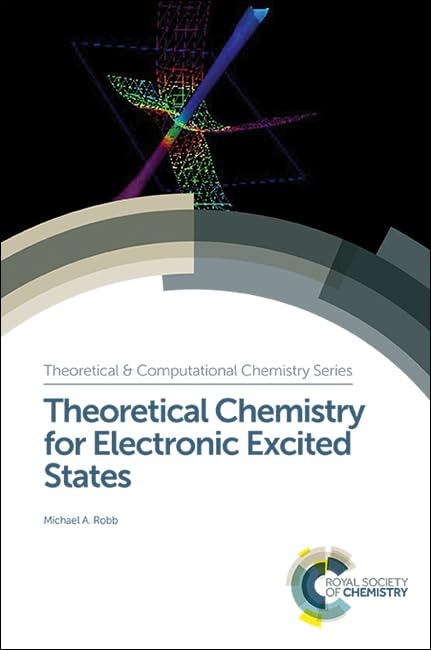
Theoretical Chemistry for Electronic Excited States: Volume 12 (Theoretical and Computational Chemistry Series)
Chemistry

Theoretical Chemistry for Electronic Excited States: Volume 12 (Theoretical and Computational Chemistry Series)

3,876

Inclusive of all applicable taxes. FREE shipping on all orders.

Quantity:
1
Share:
Free DeliveryOn every order
15-Day ReturnEasy returns
Genuine BookPhysical copy only

Available Offers

  • 🚚Free DeliveryFree shipping on all orders
  • 💵Cash on DeliveryPay when your order arrives
  • ↩️15-Day Easy ReturnsHassle-free return policy
  • 🔒Cash on DeliveryPay safely when your order arrives

Check Delivery

Product Description

Over the past few decades, experimental excited state chemistry has moved into the femtochemistry era, where time resolution is short enough to resolve nuclear dynamics. Recently, the time resolution has moved into the attosecond domain, where electronic motion can be resolved as well. Theoretical chemistry is becoming an essential partner in such experimental investigations; not only for the interpretation of the results, but also to suggest new experiments.This book provides an integrated approach. The three main facets of excited-state theoretical chemistry; namely, mechanism, which focuses on the shape of the potential surface along the reaction path, multi-state electronic structure methods, and non-adiabatic dynamics, have been brought together into one volume. Theoretical Chemistry for Electronic Excited States is aimed at both theorists and experimentalists, involved in theoretical chemistry, in electronic structure computations and in molecular dynamics. The book will provide both with the knowledge and understanding to discover ways to work together more closely through its unified approach.

Product description Review Select Guide Rating From the Inside Flap Over the past few decades, experimental excited state chemistry has moved into the femtochemistry era, where time resolution is short enough to resolve nuclear dynamics. Recently, the time resolution has moved into the attosecond domain, where electronic motion can be resolved as well. Theoretical chemistry is becoming an essential partner in such experimental investigations; not only for the interpretation of the results, but also to suggest new experiments.This book provides an integrated approach. The three main facets of excited-state theoretical chemistry; namely, mechanism, which focuses on the shape of the potential surface along the reaction path, multi-state electronic structure methods, and non-adiabatic dynamics, have been brought together into one volume. Theoretical Chemistry for Electronic Excited States is aimed at both theorists and experimentalists, involved in theoretical chemistry, in electronic structure computations and in molecular dynamics. The book is intended to provide both with the knowledge and understanding to discover ways to work together more closely through its unified approach. From the Back Cover Over the past few decades, experimental excited state chemistry has moved into the femtochemistry era, where time resolution is short enough to resolve nuclear dynamics. Recently, the time resolution has moved into the attosecond domain, where electronic motion can be resolved as well. Theoretical chemistry is becoming an essential partner in such experimental investigations; not only for the interpretation of the results, but also to suggest new experiments.This book provides an integrated approach. The three main facets of excited-state theoretical chemistry; namely, mechanism, which focuses on the shape of the potential surface along the reaction path, multi-state electronic structure methods, and non-adiabatic dynamics, have been brought together into one volume. Theoretical Chemistry for Electronic Excited States is aimed at both theorists and experimentalists, involved in theoretical chemistry, in electronic structure computations and in molecular dynamics. The book is intended to provide both with the knowledge and understanding to discover ways to work together more closely through its unified approach. Excerpt. © Reprinted by permission. All rights reserved. Theoretical Chemistry for Electronic Excited StatesBy Michael A. RobbThe Royal Society of ChemistryCopyright © 2018 Michael A. RobbAll rights reserved.ISBN: 978-1-78262-864-4ContentsChapter 1 Introduction and Motivation, 1, Chapter 2 Conceptual Development Centred on the Shapes and Topological Features of Potential Surfaces, 34, Chapter 3 Electronic Structure Methods for the Computation of Electronic States, 90, Chapter 4 The Dynamics of Nuclear Motion, 134, Chapter 5 Applications and Case Studies in Nonadiabatic Chemistry, 153, Chapter 6 Conclusion and Future Developments, 215, Subject Index, 221, CHAPTER 1Introduction and MotivationThere are two main threads associated with the theoretical chemistry of the excited state. On the one hand, we have to understand the shapes of potential energy surfaces that are associated with the nonadiabatic event that occurs when the reaction path passes from one state to another. This is associated with a conical intersection. The other thread is associated with methods for computing such potential energy surfaces and possibly studying the dynamics associated with nuclear motion.The shapes of these potential surfaces result from the fact that the force field of an excited state, i.e. the strength and position of the various bonds, is different from that of the ground state. We will show that the shapes of potential energy surfaces are intimately connected with a theory that can be used to predict their shape, but without doing actual computations. This is valence bond (VB) theory. So in this chapter we briefly introduce the subject of VB theory and how it controls the shapes of potential energy surfaces.Electronic structure methods for computing potential energy surfaces and studying the dynamics associated with nuclear motion are huge fields. Our discussion must be limited. In this book our objective is not to discuss the various methods associated with electronic structure techniques or dynamics. Rather, we wish to elucidate the general conceptual principles that lie behind these methods. Our objective is to suggest how the reader can make informed decisions about which methods may be most appropriate for the problem to hand. Thus we believe that we can present the important aspects of the relevant electronic structure methods from a unified point of view using the partitioned eigenvalue problem and the perturbation theory that stems from this partitioning. So our purpose in this chapter is just to give the most basic algebraic development.1.1 The Chemical Nature of Electronic Excited StatesAny discussion of elect

Book Specifications

ISBN-139781782628644
ISBN-101782628649
Publisher‎ Royal Society of Chemistry
Language‎ English
Dimensions‎ 15.6 x 1.71 x 23.4 cm
Weight‎ 500 g
Country‎ India
CategoryScience & Mathematics › Chemistry

Frequently Asked Questions

What is the price of Theoretical Chemistry for Electronic Excited States: Volume 12?
Theoretical Chemistry for Electronic Excited States: Volume 12 is available at ₹3,876 on BookShops.in.
Does BookShops.in offer free delivery for Theoretical Chemistry for Electronic Excited States: Volume 12?
FREE delivery on all orders for Theoretical Chemistry for Electronic Excited States: Volume 12.
Is Cash on Delivery available for Theoretical Chemistry for Electronic Excited States: Volume 12?
Yes, Cash on Delivery (COD) is available for Theoretical Chemistry for Electronic Excited States: Volume 12 on BookShops.in. Pay when your order arrives.
What is the return policy for Theoretical Chemistry for Electronic Excited States: Volume 12?
BookShops.in offers a 15-day hassle-free return policy for Theoretical Chemistry for Electronic Excited States: Volume 12. Contact us at [email protected] or call +91 81899 68108.
Is Theoretical Chemistry for Electronic Excited States: Volume 12 authentic?
Theoretical Chemistry for Electronic Excited States: Volume 12 is listed on BookShops.in after verification of product details including ISBN, title, and availability information.
Get In Touch

Contact BookShops.in

Find our bookstore in Madurai on the map below, or let us know about your reading experience by leaving a review.

Phone+91 81899 68108
Address12, Rajan Street, Main Road, KK Nagar, Madurai — 625020, Tamil Nadu, India
Support HoursMon–Sat, 10:00 AM – 6:00 PM (IST)

Value your feedback

Enjoyed the books you ordered from us? Your review helps fellow readers discover our store and helps us improve.

Leave a Google Review

Your Cart

Your cart is empty

Add books to get started