
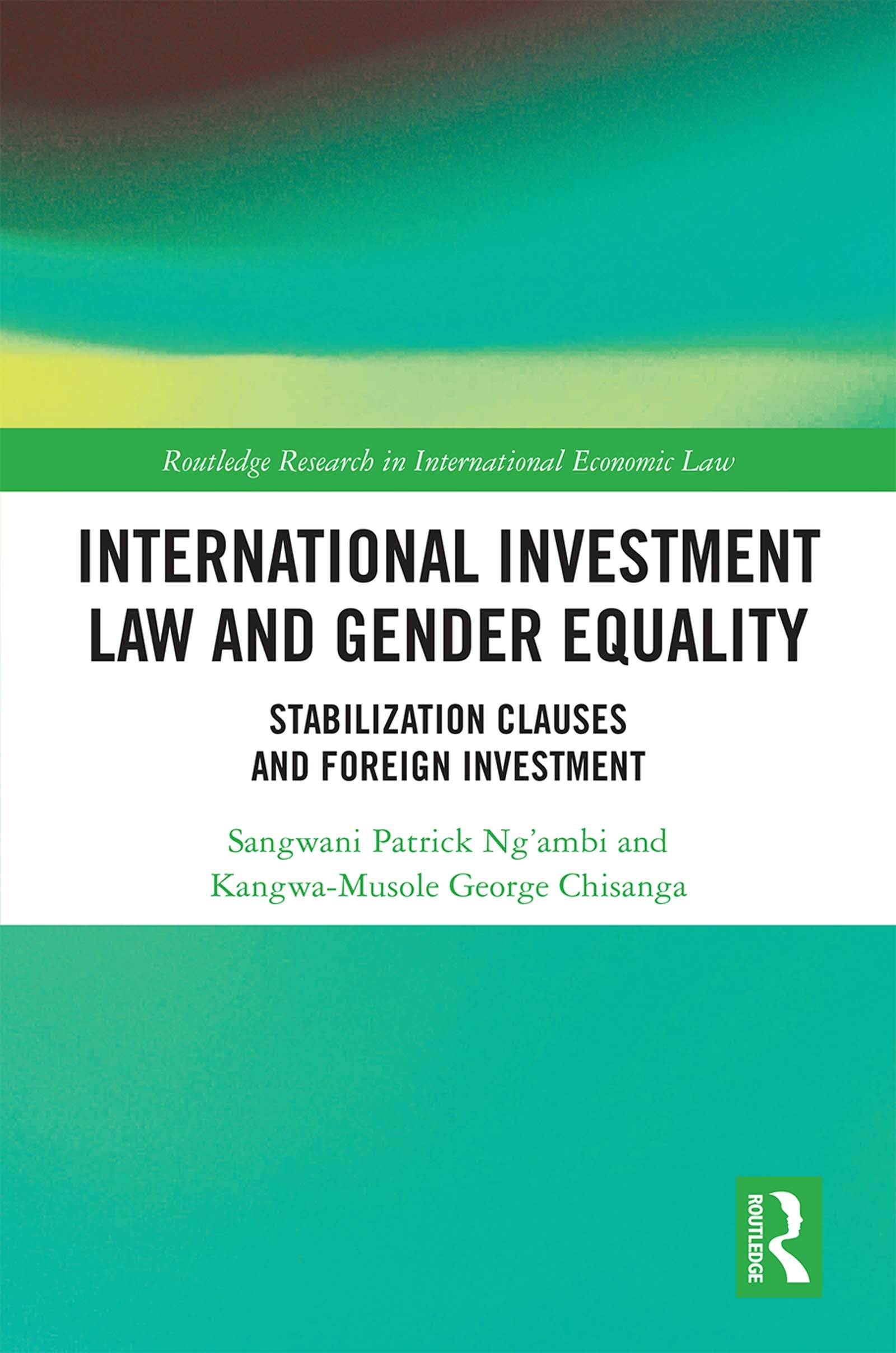
International Investment Law and Gender Equality: Stabilization Clauses and Foreign Investment by Ng’ambi Sangwani Patri
Inclusive of all applicable taxes. FREE shipping on all orders.
Available Offers
- 🚚Free Delivery — Free shipping on all orders
- 💵Cash on Delivery — Pay when your order arrives
- ↩️15-Day Easy Returns — Hassle-free return policy
- 🔒Cash on Delivery — Pay safely when your order arrives
Check Delivery
Product Description
Introduction
In an era where foreign investment drives economic growth in resource-rich nations, the tension between investor protection and domestic legal sovereignty has never been more pronounced. International Investment Law and Gender Equality: Stabilization Clauses and Foreign Investment by Ng’ambi Sangwani Patrick offers a rigorous, timely examination of how stabilization clauses in investment contracts can inadvertently hinder the progressive development of human rights, particularly gender equality laws. This hardcover volume from Routledge is an essential resource for Indian legal scholars, policymakers, and students of international law who seek to understand the delicate balance between attracting foreign capital and safeguarding fundamental rights.
Book Overview
This scholarly work delves into the complex interplay between international investment law and domestic gender legislation. It begins by dissecting the mechanisms investors use to shield themselves from host state prerogatives, focusing on stabilization clauses that freeze legal frameworks for the duration of a contract. The book then explores the theoretical foundations that arbitral tribunals rely upon to uphold these clauses, while critically assessing their impact on human rights. Using Zambia’s Gender Equity and Equality Act of 2015 as a compelling case study, the author evaluates whether such progressive laws can coexist with stabilization clauses without deterring foreign direct investment. The analysis is both global in scope and locally grounded, making it highly relevant for developing economies like India.
Key Highlights
- Critical analysis of stabilization clauses: Examines how these contractual tools affect the evolution of human rights and gender laws in resource-rich nations.
- Case study approach: Uses Zambia’s 2015 Gender Equity and Equality Act to illustrate real-world tensions between investment treaties and domestic legislation.
- Arbitral tribunal insights: Explores how international tribunals interpret and apply stabilization clauses, offering a roadmap for more balanced drafting.
- Gender equality focus: Highlights the often-overlooked impact of investment law on women’s rights and anti-discrimination measures.
- Practical drafting guidance: Suggests ways to craft stabilization clauses that protect investor interests without freezing progressive social laws.
Inside the Book
The volume is structured to guide readers from foundational concepts to advanced applications. Early chapters introduce the evolution of stabilization clauses and their theoretical underpinnings in international investment law. Subsequent sections analyze the clash between contractual stability and the dynamic nature of human rights obligations, with a dedicated chapter on gender discrimination. The heart of the book presents the Zambian case study, detailing the provisions of the Gender Equity and Equality Act and testing its compatibility with existing stabilization clauses in mining and energy contracts. The concluding chapters offer innovative drafting solutions that reconcile investor certainty with the state’s duty to progressively realize gender equality. Each chapter is supported by extensive references to treaties, arbitral awards, and national legislation.
Key Topics
- Stabilization clauses in international investment agreements
- Human rights obligations of host states under investment contracts
- Gender equality legislation and its intersection with foreign investment law
- Arbitral jurisprudence on stabilization and human rights
- Balancing investor protection with progressive legal reform
- Case study: Zambia’s Gender Equity and Equality Act of 2015
- Drafting clauses that accommodate both investment security and social change
Reader Benefits
This book empowers readers to understand the hidden legal dynamics that shape resource-rich economies. It provides a clear framework for analyzing investment contracts through a human rights lens, enabling legal practitioners to advise clients on risk mitigation without compromising ethical standards. Students will gain a nuanced appreciation of how international law interacts with domestic policy, while policymakers will find actionable insights for drafting legislation that attracts investment without sacrificing gender equality. The Zambian case study offers a replicable model for assessing legal compatibility in other jurisdictions, including India’s own resource-rich states.
Learning Outcomes
- Understand the legal mechanics of stabilization clauses and their enforcement in international arbitration.
- Analyze the tension between contractual stability and the progressive realization of human rights, especially gender equality.
- Evaluate the compatibility of gender-focused legislation with existing investment treaties and contracts.
- Identify drafting strategies that protect investor interests while allowing states to enact new social laws.
- Apply the Zambian case study methodology to assess similar conflicts in other developing nations.
Who Should Read
This book is indispensable for law students specializing in international investment law, human rights, or gender studies. It is equally valuable for legal practitioners handling cross-border investment disputes, corporate counsels advising multinational companies, and government officials negotiating bilateral investment treaties. Academics researching the intersection of economic law and social justice will find the theoretical depth and case study analysis particularly enriching. Indian readers—especially those in states like Odisha, Jharkhand, or Rajasthan where mining contracts are prevalent—will benefit from the comparative insights applicable to domestic legal frameworks.
About the Author
Ng’ambi Sangwani Patrick is a distinguished legal scholar and practitioner with expertise in international investment law, human rights, and natural resources governance. He has published extensively on the regulatory challenges facing developing nations, with a particular focus on Southern Africa. His research bridges the gap between abstract legal theory and on-the-ground policy implementation, drawing on years of experience advising governments and civil society organizations. This book reflects his commitment to ensuring that economic development does not come at the cost of fundamental rights.
About the Publisher
Routledge is a globally respected academic publisher known for advancing knowledge in law, social sciences, and humanities. With a rigorous peer-review process and a commitment to publishing cutting-edge research, Routledge ensures that works like this one meet the highest standards of scholarly excellence. Their law catalog includes seminal texts on investment arbitration, human rights, and comparative legal systems, making them the ideal publisher for a work that bridges these fields.
Conclusion
International Investment Law and Gender Equality is a groundbreaking contribution to the discourse on sustainable development and legal harmonization. By exposing the hidden costs of stabilization clauses on gender equality, Ng’ambi Sangwani Patrick challenges both investors and states to rethink traditional contract models. For Indian readers navigating the complexities of foreign investment in a rapidly evolving legal landscape, this book offers both a cautionary tale and a constructive path forward. Order your hardcover copy from Bookshops.in today and deepen your understanding of how law can serve both economic growth and social justice.
Quick Summary
International Investment Law and Gender Equality: Stabilization Clauses and Foreign Investment by Ng’ambi Sangwani Patrick is a groundbreaking academic work that dissects the tension between international investment protections and domestic gender equality laws. The book focuses on stabilization clauses—contractual provisions that freeze the legal environment for foreign investors—and their often detrimental effect on progressive gender legislation in resource-rich developing countries. Through detailed analysis of arbitral tribunal decisions, investor protection mechanisms, and theoretical foundations, the author demonstrates how these clauses can create a 'regulatory chill' that hinders reforms against gender discrimination. The book is ideal for law students, legal practitioners, policymakers, and human rights advocates who seek to understand the intersection of international economic law and social justice. It offers not only critique but also pragmatic drafting suggestions to reconcile investment attractiveness with gender-sensitive governance. By purchasing this hardcover from Bookshops.in, Indian readers gain access to a Routledge publication that is both authoritative and timely, delivered with trusted service across India.
Book Highlights
Book Specifications
| ISBN-13 | 9780367075965 |
| ISBN-10 | 0367075962 |
| Publisher | Routledge |
| Language | English |
| Dimensions | 15.88 x 1.27 x 22.86 cm |
| Weight | 363 g |
| Country | India |
| Category | Economics › Development & Growth |
| Series | Routledge Research in International Economic Law |
| Genre | Academic Law |
| Reading Age | 18+ |
| Original Language | English |
Frequently Asked Questions
What is the main focus of this book?
Who is the author of this book?
Is this book suitable for Indian law students?
Does the book include case studies?
What are stabilization clauses?
How does the book relate to gender equality?
Is this book technical or accessible?
What is the ISBN of this book?
Does the book offer practical drafting advice?
Can this book help in investment arbitration practice?
Is the book available in hardcover?
What is the price in India?
Why should I buy from Bookshops.in?
Readers Also Search For
Related Products
View All
Law
Xenophon's Spartan Constitution: Introduction. Text. Commentary: 24 (Texte und Kommentare)

Law
Wurzel, Wandel und Wert der strafrechtlichen Legalordnung: 1 (Mnsterische Beitrge Zur Rechts- Und Staatswissenschaft)
Law
Le Droit de Reprise Du Bailleur Rural Travers La Loi Et La Jurisprudence de la Cour de Cassation de 1945 1963 (Publications de la Facult de Droit Et Des Sciences Economiq)

Law
ENVIRONMENTAL LAW P

Law
Leading Cases in the Common Law by A. W. Brian Simpson – Legal History

Law