
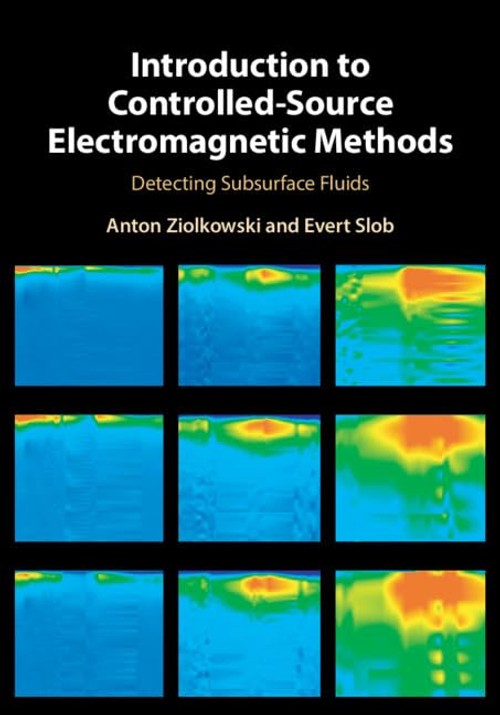
Introduction to Controlled-Source Electromagnetic Methods: Detecting Subsurface Fluids by Anton Ziolkowski – A Cambridge
Inclusive of all applicable taxes. FREE shipping on all orders.
Available Offers
- 🚚Free Delivery — Free shipping on all orders
- 💵Cash on Delivery — Pay when your order arrives
- ↩️15-Day Easy Returns — Hassle-free return policy
- 🔒Cash on Delivery — Pay safely when your order arrives
Check Delivery
Product Description
Introduction
Controlled-source electromagnetic (CSEM) methods have become indispensable for detecting and characterizing subsurface fluids, especially hydrocarbons. This comprehensive volume from Cambridge University Press offers a rigorous yet accessible introduction to the theory, acquisition, processing, and interpretation of CSEM data. Written by a leading expert in the field, the book bridges the gap between fundamental electromagnetic theory and practical geophysical exploration, making it an essential resource for Indian students, researchers, and professionals working in oil, gas, and groundwater studies.
Book Overview
Introduction to Controlled-Source Electromagnetic Methods: Detecting Subsurface Fluids is a hardbound reference that systematically explains how CSEM techniques map electrical conductivity in the Earth's upper crust—on land and at sea. The author, Anton Ziolkowski, guides readers through the complete workflow: from designing field surveys with optimal signal-to-noise ratios to deriving full impulse responses for every source-receiver combination. The book also covers 1D, 2D, and 3D modelling and inversion, emphasizing the integration of complementary geophysical data and rock physics to refine conductivity models. No prior knowledge of electromagnetics is assumed, and the mathematics is presented step by step, making this an ideal textbook for advanced graduate courses and a practical manual for industry practitioners.
Key Highlights
- Comprehensive coverage of CSEM principles, from basic theory to advanced inversion techniques
- Complete impulse responses derived for all electric and magnetic source and receiver configurations
- Practical guidance on maximizing signal-to-noise ratio through optimal acquisition and processing parameters
- Integration of rock physics and geophysical data to constrain Earth conductivity models
- Accessible mathematics with step-by-step derivations suitable for students and professionals alike
Inside the Book
The volume is structured to build understanding progressively. Early chapters introduce electromagnetic theory and the physical basis of CSEM methods, including the behaviour of electric and magnetic fields in layered media. Subsequent sections delve into survey design, data processing, and noise reduction strategies. The heart of the book presents detailed derivations of impulse responses for horizontal and vertical electric dipoles, magnetic dipoles, and combinations thereof—both in marine and land environments. Later chapters explore 1D, 2D, and 3D forward modelling and inversion, with clear explanations of regularization, sensitivity analysis, and the role of prior information. Real-world examples illustrate how CSEM data are interpreted to detect resistive hydrocarbon-bearing formations and map fluid fronts.
Key Topics
- Fundamentals of electromagnetic induction and wave propagation in conductive media
- Controlled-source acquisition systems: sources, receivers, and field layouts
- Signal processing and noise suppression for land and marine CSEM
- Analytical and numerical modelling of EM fields in 1D, 2D, and 3D Earth models
- Inversion algorithms for recovering subsurface conductivity distribution
- Integration of seismic, well-log, and rock physics data for improved interpretation
- Case studies in hydrocarbon exploration, groundwater mapping, and geothermal reservoir assessment
Reader Benefits
- Gain a solid foundation in CSEM theory without needing prior electromagnetics background
- Learn to design effective surveys by understanding source-receiver configurations and noise characteristics
- Master data processing workflows to extract clean impulse responses from field measurements
- Develop inversion skills to transform resistivity data into geological models
- Bridge theory and practice with real-data examples and rock physics constraints
Learning Outcomes
By the end of this book, readers will be able to: describe the physical principles underlying CSEM methods; calculate the electromagnetic response of layered Earth models; evaluate the impact of acquisition parameters on data quality; apply inversion techniques to recover subsurface resistivity; and integrate CSEM results with other geophysical and petrophysical data for robust fluid detection. These outcomes equip students and professionals to contribute effectively to exploration projects and research in applied geophysics.
Who Should Read
- Postgraduate students in geophysics, petroleum engineering, and earth sciences
- Exploration geophysicists working in oil and gas, groundwater, or mineral exploration
- Researchers developing new EM acquisition or inversion methods
- Industry professionals in energy companies seeking to enhance subsurface imaging capabilities
- Faculty members teaching advanced courses in electromagnetic methods
About the Author
Anton Ziolkowski is a distinguished professor of petroleum geophysics at the University of Edinburgh and a Fellow of the Royal Society of Edinburgh. With decades of experience in both academia and industry, he has pioneered advances in controlled-source electromagnetics, seismic imaging, and integrated geophysical interpretation. His research has been instrumental in developing practical CSEM techniques for hydrocarbon detection, and he has authored numerous influential papers and patents. This book distills his deep expertise into a clear, pedagogical format.
About the Publisher
Cambridge University Press is one of the world's oldest and most respected academic publishers, known for producing authoritative texts in science, engineering, and the humanities. Their geophysics catalogue includes essential references used by universities and research institutions globally, including in India. This hardcover edition reflects the high production standards expected from Cambridge, with clear diagrams, careful typesetting, and durable binding suitable for repeated reference.
Conclusion
Introduction to Controlled-Source Electromagnetic Methods: Detecting Subsurface Fluids is a definitive guide for anyone serious about understanding and applying CSEM technology. Whether you are a student entering the field, a researcher pushing methodological boundaries, or a practitioner seeking to improve exploration outcomes, this book provides the theoretical depth and practical insights you need. Order your copy today from Bookshops.in and add this essential resource to your geophysics library.
Quick Summary
Introduction to Controlled-Source Electromagnetic Methods: Detecting Subsurface Fluids by Anton Ziolkowski is a definitive guide for geoscientists and engineers seeking to understand and apply CSEM techniques for hydrocarbon exploration. Published by Cambridge University Press, this hardcover volume covers the entire workflow—from survey design and data acquisition to advanced inversion and interpretation. The book explains how to maximize signal-to-noise ratio, derives impulse responses for all common source-receiver configurations, and presents 1D, 2D, and 3D modeling approaches. A key strength is its integration of rock physics and complementary geophysical data to improve conductivity models. Written for graduate students, researchers, and industry professionals, it offers both theoretical depth and practical insights. Readers will learn to design effective EM surveys, process data optimally, and interpret results for subsurface fluid detection. By purchasing from Bookshops.in, Indian customers receive a genuine imported edition with fast delivery and reliable service. This book is an essential addition to any geophysics library.
Book Highlights
Book Specifications
| ISBN-13 | 9781107058620 |
| ISBN-10 | 1107058627 |
| Publisher | Cambridge University Press |
| Language | English |
| Dimensions | 21.34 x 2.03 x 25.15 cm |
| Weight | 776 g |
| Country | India |
| Category | Science & Mathematics › Earth Sciences |
| Genre | Non-fiction |
| Original Language | English |
Frequently Asked Questions
What is the main focus of this book?
Who is the author of this book?
Is this book suitable for beginners in geophysics?
Does the book cover both land and marine EM methods?
What type of modeling is discussed?
Are there practical examples or case studies?
How does the book help with signal quality?
Does the book include rock physics integration?
Is this book available in hardcover?
Can I use this book for petroleum exploration?
Are impulse responses derived for all configurations?
What is the ISBN of this book?
Who publishes this book?
Where can I buy this book in India?
Readers Also Search For
Customers Also Bought
Mathematics
Stereotype Spaces and Algebras: 73 (De Gruyter Expositions in Mathematics, 73)
Mathematics
Semigroups in Algebra, Geometry and Analysis: 20 (De Gruyter Expositions in Mathematics, 20)
Mathematics
Geometry from the Pacific Rim: Proceedings of the Pacific Rim Geometry Conference held at National University of Singapore, Republic of Singapore, ... 1994 (De Gruyter Proceedings in Mathematics)

Mathematics
First International Tainan-Moscow Algebra Workshop: Proceedings of the International Conference held at National Cheng Kung University Tainan, Taiwan, ... 1994 (De Gruyter Proceedings in Mathematics)

Mathematics
Differential Geometry - Proceedings of the VIII International Colloquium (English, Jesus A. Alvarez Lopez | Eduardo Garcia-Rio)
Mathematics
Mathematical Theory of Optimal Processes (Classics of Soviet Mathematics)
Related Products
View All
Science & Mathematics
Squid - Superconducting Quantum Interference Devices and Their Applications: Proceedings of the International Conference on Superconducting Quantum Devices, Berlin-west, October 4-8, 1976

Science & Mathematics
Thermodynamics and Pattern Formation in Biology

Science & Mathematics
The Nature of Mathematics and the Mathematics of Nature by S. Andersson – Mathematics & Science

Science & Mathematics
Linear Algebra | by Stephen Friedberg | Arnold Insel | Lawrence Spence | Pearson | by Stephen Friedberg | Arnold Insel | Lawrence Spence | Pearson | by Stephen Friedberg | Arnold Insel | Lawrence Spence | Pearson | by Stephen Friedberg | Arnold Insel | Lawrence Spence | Pearson | by Stephen Friedberg | Arnold Insel | Lawrence Spence | Pearson | by Stephen Friedberg | Arnold Insel | Lawrence Spence | Pearson | by Stephen Friedberg | Arnold Insel | Lawrence Spence | Pearson | by Stephen Friedberg

Science & Mathematics
University Calculus | by Joel Hass | Christopher Heil | Maurice Weir | Pearson | by Joel Hass | Christopher Heil | Maurice Weir | Pearson | by Joel Hass | Christopher Heil | Maurice Weir | Pearson | by Joel Hass | Christopher Heil | Maurice Weir | Pearson | by Joel Hass | Christopher Heil | Maurice Weir | Pearson | by Joel Hass | Christopher Heil | Maurice Weir | Pearson | by Joel Hass | Christopher Heil | Maurice Weir | Pearson | by Joel Hass | Christopher Heil | Maurice Weir | Pearson | by Joe

Science & Mathematics