
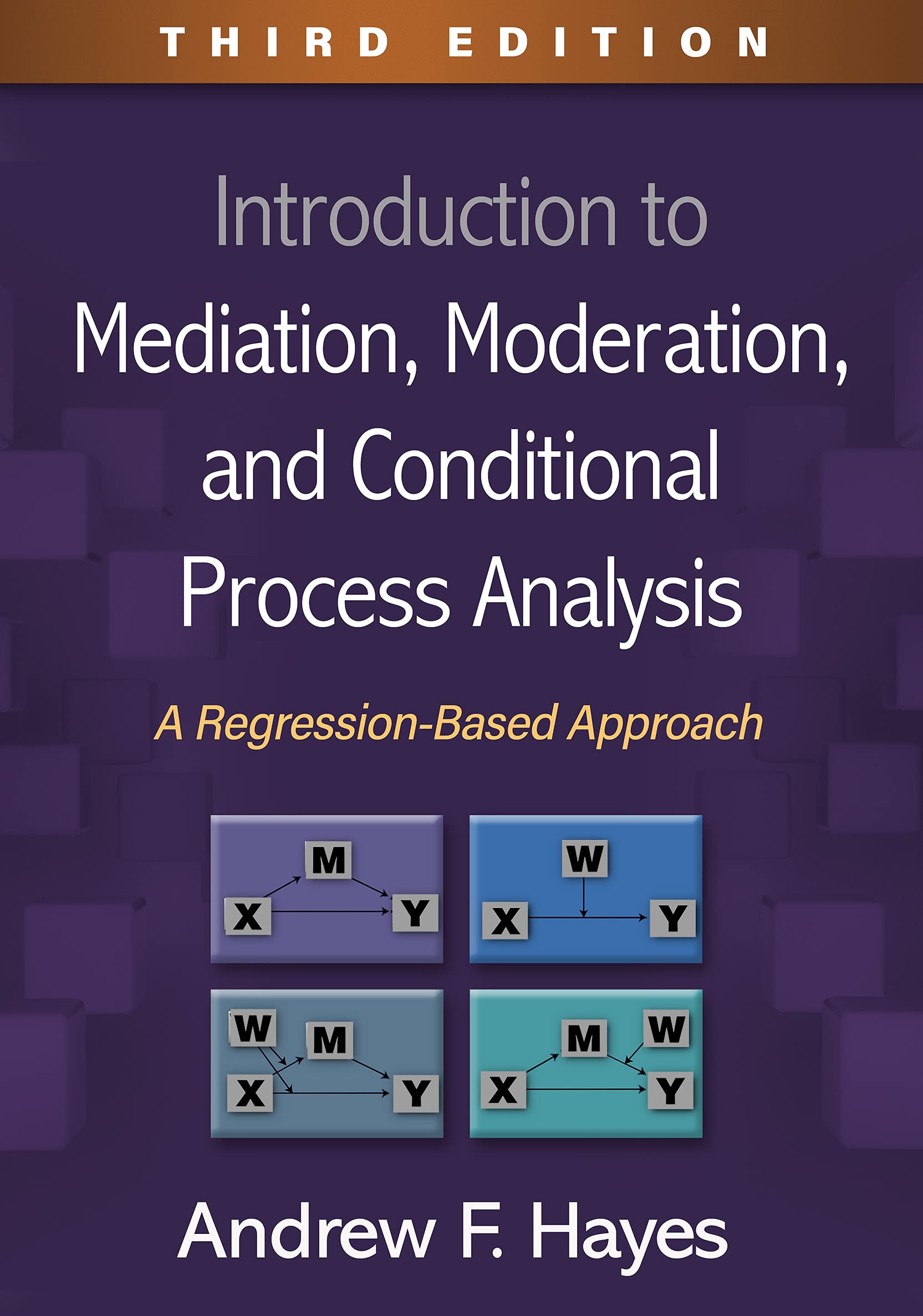
Introduction to Mediation, Moderation, and Conditional Process Analysis: A Regression-Based Approach
Inclusive of all applicable taxes. FREE shipping on all orders.
Available Offers
- 🚚Free Delivery — Free shipping on all orders
- 💵Cash on Delivery — Pay when your order arrives
- ↩️15-Day Easy Returns — Hassle-free return policy
- 🔒Cash on Delivery — Pay safely when your order arrives
Check Delivery
Product Description
Introduction
Welcome to the definitive guide for understanding mediation, moderation, and conditional process analysis. This third edition of Andrew F. Hayes's classic work is an essential resource for Indian students and researchers in psychology, sociology, business, and the social sciences. Whether you are a postgraduate student at Delhi University or a data analyst at an Indian market research firm, this book provides a clear, regression-based approach to advanced statistical modeling. Designed for readers who want to move beyond basic correlation and regression, this hardcover volume equips you with the tools to ask deeper questions about how and when effects occur. With updated coverage for SPSS, SAS, and the newly added R software, this book ensures you stay current with global analytical standards.
Book Overview
This book demystifies the complex world of mediation and moderation analysis using ordinary least squares regression. Andrew F. Hayes guides you step-by-step through each analytical procedure, using real-world examples from published studies. You will learn how to estimate and interpret direct, indirect, and conditional effects. The third edition includes a completely rewritten appendix that documents the PROCESS macro, a free tool that simplifies these analyses. The book also introduces conditional process analysis, which combines mediation and moderation to explore moderated mediation. For Indian readers, the examples are relevant across disciplines, from understanding consumer behaviour in e-commerce to studying social interventions in community health. The companion website provides data files for all examples, making it easy to practice with Indian datasets.
Key Highlights
- Updated for R: New to this edition, detailed R code alongside SPSS and SAS examples, catering to the growing use of open-source software in Indian academia.
- PROCESS Macro Documentation: The only complete documentation of the PROCESS macro, now rewritten for clarity and expanded functionality.
- Real-World Examples: Diverse studies from published research, illustrating how to apply these techniques in Indian contexts like education, marketing, and public health.
- Companion Website: Access to data files and the free PROCESS download, enabling hands-on learning with minimal setup.
- Regression-Based Approach: No need for advanced structural equation modeling; this book builds on basic regression skills taught in Indian postgraduate programs.
Inside the Book
Inside this hardcover edition, you will find a structured journey from foundational concepts to advanced applications. The book begins with simple mediation and moderation models, then progresses to multiple mediators, multiple moderators, and conditional process analysis. Each chapter includes annotated output from SPSS, SAS, and R, helping you interpret your own results. The rewritten Appendix A is a standalone reference for the PROCESS macro, covering syntax, options, and troubleshooting. You will also find guidance on probing interactions, visualizing conditional effects, and reporting findings in academic papers. The book emphasizes the link between statistics and causality, ensuring you understand not just how to run analyses, but what the data are telling you about real-world processes.
Key Topics
- Mediation Analysis: Understanding the mechanism through which an independent variable influences a dependent variable via one or more mediators.
- Moderation Analysis: Examining when or for whom an effect occurs, using interaction terms and simple slopes analysis.
- Conditional Process Analysis: Integrating mediation and moderation to explore moderated mediation and mediated moderation.
- Probing Interactions: Techniques for visualizing and testing interactions using the Johnson-Neyman method and pick-a-point approach.
- Reporting Results: Guidelines for writing up mediation, moderation, and conditional process analyses in APA style, essential for Indian journal publications.
Reader Benefits
By reading this book, you will gain the confidence to design and analyze complex studies. You will learn to move from simple correlations to nuanced causal explanations. The practical, hands-on approach means you can immediately apply the techniques to your own research. For Indian students, this book bridges the gap between classroom statistics and real-world data analysis. You will save time by using the PROCESS macro, which automates many steps. The inclusion of R code opens up possibilities for reproducible research and collaboration with international peers. Whether you are analysing customer satisfaction data for an Indian startup or evaluating a government health program, this book provides the analytical rigour you need.
Learning Outcomes
- Estimate Direct and Indirect Effects: Calculate and interpret total, direct, and indirect effects in mediation models.
- Test Moderation Hypotheses: Identify and probe interaction effects using both categorical and continuous moderators.
- Build Conditional Process Models: Combine mediation and moderation to test hypotheses about moderated mediation.
- Use Multiple Software: Run analyses in SPSS, SAS, and R, with code provided for every example.
- Visualize Results: Create graphs of conditional effects and interactions to communicate findings effectively.
Who Should Read
This book is ideal for graduate students in psychology, sociology, political science, business, education, and public health. It is also valuable for faculty members and researchers in Indian universities who want to upgrade their statistical skills. Professionals in market research, data science, and policy analysis will find the practical examples directly applicable. No prior knowledge of mediation or moderation is required, though familiarity with basic regression is helpful. The book is written at a level accessible to students in Indian MA and PhD programs, with clear explanations and minimal jargon.
About the Author
Andrew F. Hayes is a leading authority on mediation and moderation analysis. He is a professor at the Ohio State University and has published extensively on statistical methods. His work is widely cited in social science research globally. Hayes developed the PROCESS macro, which has become the standard tool for conditional process analysis. His writing is known for being both rigorous and accessible, making complex topics understandable for students and researchers.
About the Publisher
Guilford Publications is a respected academic publisher known for high-quality books in psychology, education, and social sciences. Their titles are used in leading universities worldwide, including top Indian institutions. This hardcover edition is printed on durable paper, ensuring it withstands years of use in libraries and labs.
Conclusion
Introduction to Mediation, Moderation, and Conditional Process Analysis, Third Edition, is an indispensable tool for anyone serious about understanding data. With its updated coverage of R, comprehensive PROCESS documentation, and practical examples, this book empowers you to conduct sophisticated analyses with confidence. For Indian readers, it offers a clear path from statistical theory to meaningful research outcomes. Add this essential volume to your library today and elevate your analytical skills to the next level.
Quick Summary
Introduction to Mediation, Moderation, and Conditional Process Analysis, Third Edition by Andrew F. Hayes is a definitive guide for researchers and graduate students seeking to understand and apply advanced regression-based methods. The book demystifies mediation (how X affects Y through a mediator), moderation (when the effect of X on Y depends on another variable), and conditional process analysis (integrating both). Using ordinary least squares regression as a foundation, Hayes provides step-by-step instructions for each analysis, illustrated with diverse examples from published social science studies. A major update in this edition is the inclusion of R code alongside SPSS and SAS, reflecting the growing popularity of open-source tools. Readers learn to estimate direct, indirect, and conditional effects; probe and visualize interactions; test hypotheses about moderated mediation; and report their findings professionally. The book also clarifies the critical link between statistical results and causal inference. Whether you are a psychology, sociology, education, or business researcher, this book equips you with the skills to answer sophisticated research questions. Buying from Bookshops.in ensures you receive a genuine print copy with fast delivery across India, along with excellent customer support.
Book Highlights
Book Specifications
| ISBN-13 | 9781462549030 |
| ISBN-10 | 1462549039 |
| Publisher | Guilford Pubn |
| Language | English |
| Dimensions | 17.78 x 3.97 x 25.4 cm |
| Weight | 215 g |
| Country | India |
| Category | Nursing › Research & Theory |
| Genre | Nonfiction |
| Reading Age | Adult |
| Original Language | English |
Frequently Asked Questions
What is the main focus of this book?
Who is Andrew F. Hayes?
Is this book suitable for beginners?
What software does this book cover?
Does the book include the PROCESS macro?
Is there a companion website?
How is this edition different from previous ones?
Can this book help with PhD research?
Does it cover moderated mediation?
Can Indian students use this book?
Does the book explain causality?
Readers Also Search For
Customers Also Bought

Robin Grille Press
Parenting for a Peaceful World by Robin Grille – Child Psychology & Peaceful Parenting

McFarland & Company
Welcome to Arkham Asylum | by Sharon Packer | Daniel R. Fredrick | McFarland & Company | by Sharon Packer | Daniel R. Fredrick | McFarland & Company | by Sharon Packer | Daniel R. Fredrick | McFarland & Company | by Sharon Packer | Daniel R. Fredrick | McFarland & Company | by Sharon Packer | Daniel R. Fredrick | McFarland & Company | by Sharon Packer | Daniel R. Fredrick | McFarland & Company | by Sharon Packer | Daniel R. Fredrick | McFarland & Company | by Sharon P

McFarland & Company
Playing with the Guys | by Marc A. Ouellette | Matthew Wilhelm Kapell | McFarland & Company | by Marc A. Ouellette | Matthew Wilhelm Kapell | McFarland & Company | by Marc A. Ouellette | Matthew Wilhelm Kapell | McFarland & Company | by Marc A. Ouellette | Matthew Wilhelm Kapell | McFarland & Company | by Marc A. Ouellette | Matthew Wilhelm Kapell | McFarland & Company | by Marc A. Ouellette | Matthew Wilhelm Kapell | McFarland & Company | by Marc A. Ouellette | Matthew W

Andrews McMeel Publishing
Calvin and Hobbes: It's a Magical World by Bill Watterson

Bettie Young's Books
Amazing Adventures Of A Nobody by Leon Logothetis – Travel Memoir
Springer
Contemporary Methods for Speech Parameterization (Springerbriefs in Electrical and Computer Engineering / Springerbriefs in Speech Technology)
Related Products
View All
Guilford Publications
The Mindful Path to Intimacy by James V. Cordova – Relationship Mindfulness Guide

Guilford Publications
Persona and Performance: The Meaning of Role in Drama and Therapy by Robert J. Landy – Drama Therapy

Guilford Publications
The Self in Process: Toward A Post-Rationalist Cognitive Therapy by Vittorio F. Guidano
Guilford Publications
Handbook of Family Therapy Training and Supervision by Howard A. Liddle – Family Therapy

Guilford Publications
An Early Start for Your Child with Autism: Using Everyday Activities to Help Kids Connect, Communicate, and Learn
Guilford Publications