
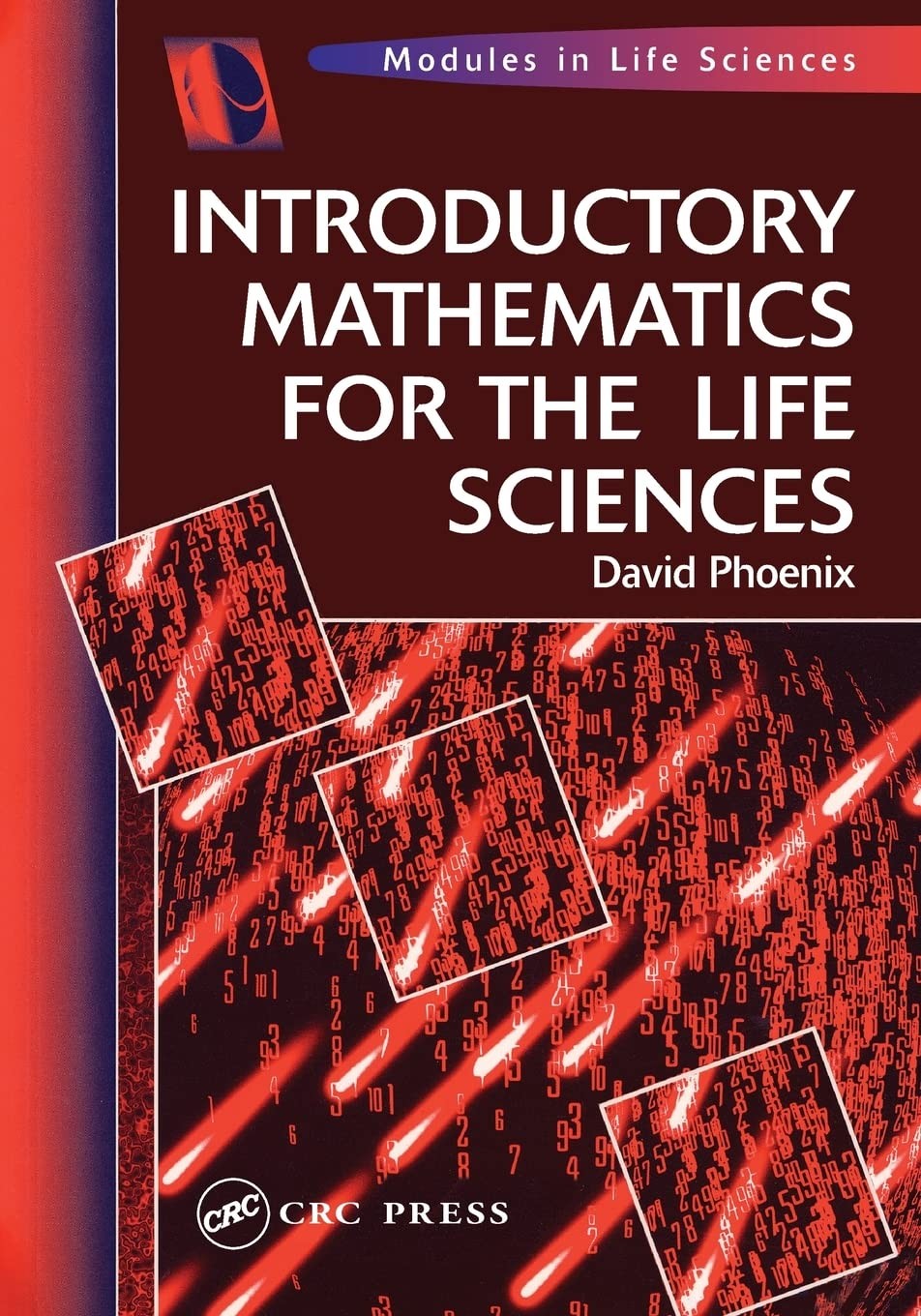
Introductory Mathematics for the Life Sciences by David Phoenix: A Practical Math Foundation for Biology and Biomedical
Inclusive of all applicable taxes. FREE shipping on all orders.
Available Offers
- 🚚Free Delivery — Free shipping on all orders
- 💵Cash on Delivery — Pay when your order arrives
- ↩️15-Day Easy Returns — Hassle-free return policy
- 🔒Cash on Delivery — Pay safely when your order arrives
Check Delivery
Product Description
Introduction
Mathematics is the silent engine behind every breakthrough in the life sciences—from understanding population dynamics to analysing clinical trial data. Yet for many students stepping into biology, biotechnology, or environmental science, numbers can feel like a foreign language. Introductory Mathematics for the Life Sciences by David Phoenix is the perfect bridge, designed specifically for Indian undergraduates who need a solid, intuitive grasp of maths without the intimidating jargon. Published by CRC Press, this hardbound edition is your companion for semesters of confident problem-solving.
Book Overview
This book starts exactly where you are—with the basics of numbers, fractions, ratios, and percentages—and gently builds up to more advanced concepts such as algebra, scientific notation, linear, power, exponential, and logarithmic functions, and finally introductory statistics. Every chapter is packed with worked examples drawn from real-life science contexts, so you never wonder why you are learning a particular formula. The author’s step-by-step approach ensures that even if you haven’t touched maths since Class X, you can master the quantitative skills essential for your degree.
Key Highlights
- Progressive difficulty: Moves from foundational arithmetic to university-level functions and statistics without sudden jumps.
- Science-focused examples: Every concept is illustrated with biological or environmental applications—enzyme kinetics, bacterial growth, drug dosage calculations, and more.
- End-of-chapter exercises: Hundreds of practice problems with answers provided at the back, perfect for self-study and exam preparation.
- Clear, conversational tone: David Phoenix explains complex ideas in simple language, making the book accessible to non-mathematicians.
- Hardcover durability: A sturdy edition that will survive years of use in libraries, labs, and study desks.
Inside the Book
Open the cover and you will find a carefully structured journey. The opening chapters revisit numbers, fractions, and decimals—often a stumbling block for life science students. From there, you move into algebra, where equations become tools for modelling biological relationships. Measurement and scientific notation help you handle the vast scales of molecular biology and ecology. Subsequent chapters dive into functions: linear functions for steady-state processes, power functions for allometric scaling, exponential functions for population explosions, and logarithmic functions for pH and sound intensity. The final section introduces descriptive and inferential statistics—mean, median, standard deviation, t-tests, and chi-square—equipping you to analyse experimental data with confidence.
Key Topics
- Numbers, fractions, ratios, and percentages
- Basic algebra and equation solving
- Units of measurement and scientific notation
- Linear, power, exponential, and logarithmic functions
- Graphing and data interpretation
- Introductory statistics: descriptive measures, probability, hypothesis testing
- Applications in genetics, ecology, pharmacology, and physiology
Reader Benefits
By working through this book, you will replace maths anxiety with mathematical fluency. You will learn to translate word problems into equations, interpret graphs like a pro, and choose the right statistical test for your lab reports. The worked examples mirror typical Indian university exam questions, so you can practise exactly what you need. The answer key at the end allows you to check your progress without waiting for a tutor. Whether you are preparing for NEET, GATE, or just your semester exams, this book builds the quantitative foundation that examiners look for.
Learning Outcomes
- Perform calculations involving fractions, ratios, percentages, and scientific notation with ease.
- Solve linear and non-linear equations relevant to biological systems.
- Plot and interpret graphs of linear, exponential, and logarithmic functions.
- Apply logarithms to problems in growth, decay, and pH.
- Calculate descriptive statistics and carry out basic hypothesis tests.
- Confidently handle quantitative data in lab reports and research papers.
Who Should Read
This book is ideal for undergraduate students in life sciences, biotechnology, microbiology, biochemistry, environmental science, agriculture, pharmacy, and nursing. It is also a valuable refresher for postgraduate students who need to strengthen their mathematical skills. Teachers and tutors will find it an excellent resource for designing foundation courses. If you are a student at an Indian university who feels that maths is a barrier to your science dreams, this book is your key.
About the Author
David Phoenix is a respected educator and researcher with decades of experience teaching mathematics to life science students. He understands the unique challenges that biology-oriented learners face and has crafted this book to address them directly. His clear, patient explanations have helped thousands of students worldwide turn their weakest subject into a strength.
About the Publisher
CRC Press is a premier global publisher of scientific, technical, and medical content. Known for rigorous peer review and high-quality educational materials, CRC Press has been a trusted name in academic publishing for over a century. This hardcover edition reflects their commitment to durable, long-lasting books that students can rely on throughout their academic journey.
Conclusion
Introductory Mathematics for the Life Sciences is more than a textbook—it is a mentor that walks with you from the first fraction to the final statistical test. With its practical approach, real-world examples, and student-friendly design, it transforms maths from a hurdle into a powerful tool for discovery. Order your copy today from Bookshops.in and take the first step toward mastering the mathematics behind the science of life.
Quick Summary
Introductory Mathematics for the Life Sciences by David Phoenix is a comprehensive yet accessible textbook designed to equip life sciences students with the mathematical skills they need. Starting from the very basics of numbers, fractions, ratios, and percentages, the book builds up to algebra, measurement, scientific notation, and a range of functions including linear, power, exponential, and logarithmic. It also introduces key statistical concepts, making it a complete foundation for biological, ecological, and biomedical studies. Each chapter is filled with worked examples that show how math applies to real-life science scenarios, and end-of-chapter exercises allow readers to test their understanding. The book is ideal for undergraduate students who may feel intimidated by math, as well as for teachers seeking a clear resource. Published by CRC Press, this hardcover edition is a durable addition to any student's library. By purchasing from Bookshops.in, Indian readers get a trusted, high-quality physical copy delivered to their doorstep, supporting local bookstores and ensuring fast delivery across the country.
Book Highlights
Book Specifications
| ISBN-13 | 9780748404285 |
| ISBN-10 | 0748404287 |
| Publisher | Taylor & Francis |
| Language | English |
| Dimensions | 17.81 x 1.4 x 25.4 cm |
| Weight | 215 g |
| Country | India |
| Category | Sciences, Technology & Medicine › Biology & Life Sciences |
| Genre | Nonfiction |
| Original Language | English |
Frequently Asked Questions
What is Introductory Mathematics for the Life Sciences about?
Who is the author of this book?
Is this book suitable for beginners in math?
Does the book include practice problems?
What topics are covered in the book?
Is this book useful for Indian students?
Who is the publisher?
What is the ISBN-13?
Does the book cover statistics?
Are there worked examples?
Can I use this book for self-study?
What is the price of the book?
Is the book available in hardcover?
What language is the book in?
Readers Also Search For
Customers Also Bought
Research
Mathematical Modeling of Biological Systems, Volume I (English, Andreas Deutsch | Lutz Brusch | Helen Byrne)
Research
Intermediate Statistics (English, James P. Stevens)
Research
Statistics Explained by Steve McKillup – Life Science Statistics Guide

Research
Data Analysis and Graphics Using R by John Maindonald – Statistical Computing

Research
Applied Longitudinal Data Analysis (English, Judith D. Singer | John B. Willett)
Research
Bayesian Biostatistics (STATISTICS, A SERIES OF TEXTBOOKS AND MONOGRAPHS)
Related Products
View All
Sciences, Technology & Medicine
African Philosophy and the Epistemic Marginalization of Women (Routledge African Studies)
Sciences, Technology & Medicine
Evolution Interrupted: How We Change Nature and How Nature Changes Us
Sciences, Technology & Medicine
The Tragicomedy of Classical Thermodynamics: Course Held at the Department of Mechanics of Solids (July 1971): 70 (CISM International Centre for Mechanical Sciences)
Sciences, Technology & Medicine
DNA Repair Protocols: 113 (Methods in Molecular Biology)
Sciences, Technology & Medicine
Acoustic Fish Reconnaissance: 32 (Marine Science, 32)

Sciences, Technology & Medicine