
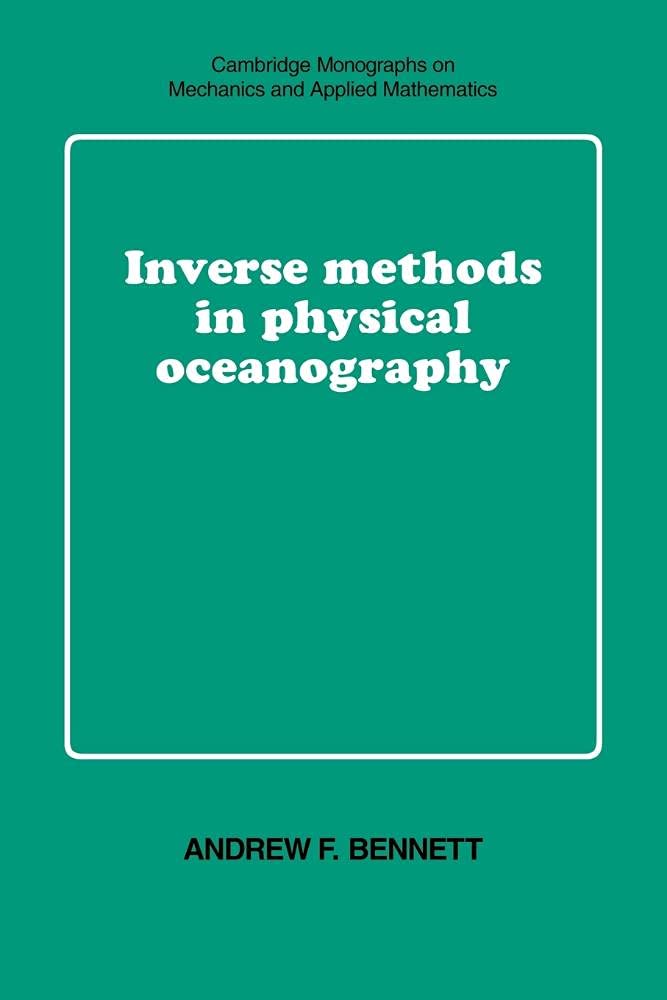
Inverse Methods in Physical Oceanography: A Deep Dive into Inverse Theory for Ocean Circulation Models by Andrew F. Benn
Inclusive of all applicable taxes. FREE shipping on all orders.
Available Offers
- 🚚Free Delivery — Free shipping on all orders
- 💵Cash on Delivery — Pay when your order arrives
- ↩️15-Day Easy Returns — Hassle-free return policy
- 🔒Cash on Delivery — Pay safely when your order arrives
Check Delivery
Product Description
Introduction
In the dynamic field of oceanography, the ability to interpret vast amounts of observational data is crucial for understanding our planet's complex marine systems. Inverse Methods in Physical Oceanography by Andrew F. Bennett offers a rigorous and insightful exploration into the mathematical techniques used to merge real-world observations with numerical models. Published by Cambridge University Press, this hardbound edition is an essential resource for Indian students, researchers, and environmental scientists seeking to master the art of deciphering ocean circulation patterns through advanced inverse theory.
Book Overview
This comprehensive volume delves deep into the potential of inverse methods, moving beyond simplistic applications to reveal their true power in oceanographic research. Professor Bennett presents a unified framework for combining sparse observational data—from field programs and satellite remote sensing—with numerical circulation models. The book emphasizes how these methods not only interpolate data but also enhance model realism, estimate unobserved variables, and refine forcing fields and parameters. It addresses ill-posed problems, aids in designing observation systems, and allows for rigorous hypothesis testing, making it a cornerstone text for modern physical oceanography.
Key Highlights
- Original and rigorous treatment of inverse theory tailored for ocean circulation studies, avoiding oversimplified approaches.
- Practical focus on data assimilation that bridges the gap between theoretical concepts and real-world oceanographic applications.
- Exercises of varying difficulty included throughout to reinforce technical skills and complement the theoretical development.
- Comprehensive coverage of estimation methods for unobserved flow variables, forcing fields, and model parameters.
- Relevance to ill-posed problems and design of oceanic observing systems, making it invaluable for environmental engineers.
Inside the Book
The book systematically builds from fundamental concepts to advanced applications. Readers will encounter detailed discussions on variational assimilation, least-squares estimation, and the use of adjoint models. Bennett explains how to formulate inverse problems for both linear and nonlinear models, and how to interpret solutions in the context of ocean dynamics. Each chapter is structured to provide a clear theoretical foundation, followed by illustrative examples and exercises that challenge the reader to apply the concepts. The text also covers the statistical underpinnings of inverse methods, including error analysis and the role of prior information.
Key Topics
- Data assimilation techniques for merging observations with numerical ocean models.
- Variational and sequential methods for solving inverse problems in geophysics.
- Estimation of circulation fields including velocity, temperature, and salinity from sparse data.
- Parameter identification for unknown model coefficients and forcing functions.
- Resolution of ill-posed problems through regularization and Bayesian approaches.
- Design of observing networks using inverse theory principles.
Reader Benefits
By engaging with this book, readers will gain a profound understanding of how to extract maximum information from oceanographic datasets. The exercises ensure that theoretical knowledge is translated into practical skills, enabling students and professionals to tackle real-world challenges. The hardcover format makes it a durable reference for long-term use in academic libraries, research labs, and personal collections. Indian readers, in particular, will find the content relevant for studying monsoonal dynamics, coastal circulation, and climate variability, where inverse methods play a pivotal role.
Learning Outcomes
- Master the principles of inverse theory as applied to physical oceanography.
- Develop proficiency in constructing and solving inverse problems using mathematical models.
- Learn to evaluate the reliability and uncertainty of model-based estimates.
- Gain the ability to design observational strategies that optimize data collection for model improvement.
- Acquire skills to critically assess published studies involving data assimilation and inverse methods.
Who Should Read
This book is ideally suited for advanced undergraduate and graduate students in oceanography, atmospheric science, geophysics, and applied mathematics. Environmental scientists and engineers working on ocean circulation, climate modeling, and marine resource management will also find it indispensable. Researchers involved in Indian oceanographic programs, such as those studying the Bay of Bengal or Arabian Sea dynamics, will benefit immensely from the rigorous framework presented. Additionally, professionals in remote sensing and data assimilation will appreciate the depth of coverage.
About the Author
Andrew F. Bennett is a distinguished oceanographer and mathematician, known for his pioneering contributions to inverse methods and data assimilation. With decades of research experience at leading institutions, including Oregon State University, Bennett has authored several influential texts that have shaped modern physical oceanography. His work emphasizes the synergy between observations and models, and he is widely respected for his clarity in explaining complex mathematical concepts to a broad scientific audience.
About the Publisher
Cambridge University Press is a world-renowned academic publisher with a legacy of producing high-quality scholarly works. Known for its rigorous editorial standards and commitment to scientific excellence, Cambridge University Press publishes authoritative texts across all disciplines. This hardcover edition of Inverse Methods in Physical Oceanography upholds their tradition of delivering durable, well-edited books that serve as essential resources for the global scientific community.
Conclusion
Inverse Methods in Physical Oceanography is more than a textbook—it is a gateway to advanced understanding of how we can use mathematics to unlock the secrets of the ocean. For Indian students and researchers striving to excel in the earth sciences, this book offers the theoretical depth and practical tools needed to make meaningful contributions. Whether you are just beginning your journey in oceanography or are an experienced professional, Bennett's work will expand your horizons and sharpen your analytical abilities. Add this essential volume to your library today from Bookshops.in and take a definitive step forward in your scientific career.
Quick Summary
Inverse Methods in Physical Oceanography by Andrew F. Bennett is a comprehensive exploration of how inverse theory can revolutionize the study of ocean circulation. The book delves into techniques for combining observational data—from field programs and satellite remote sensing—with numerical models to enhance realism and interpolate data. It goes beyond basic applications, showing how inverse methods can estimate unobserved flow variables, forcing fields, and model parameters. The book also addresses ill-posed modeling problems, provides design criteria for observing systems, and enables rigorous testing of models as scientific hypotheses. Written for graduate students and researchers, it offers a clear mathematical framework and practical examples. This Cambridge University Press hardcover is a must-have for anyone involved in physical oceanography, climate science, or data assimilation. By purchasing from Bookshops.in, Indian readers get a genuine, high-quality edition delivered to their doorstep.
Book Highlights
Book Specifications
| ISBN-13 | 9780521055284 |
| ISBN-10 | 0521055288 |
| Publisher | Cambridge University Press |
| Language | English |
| Dimensions | 15.24 x 2.34 x 22.86 cm |
| Weight | 553 g |
| Country | India |
| Category | Science & Mathematics › Earth Sciences |
| Genre | Science & Mathematics |
| Original Language | English |
Frequently Asked Questions
What is inverse methods in physical oceanography?
Who is the author of this book?
What topics are covered in this book?
Is this book suitable for beginners?
Does the book include practical examples?
How does this book help in research?
What is the ISBN for this book?
Is this book available in hardcover?
Can I use this book for coursework?
Does the book cover satellite remote sensing?
What is the price of this book?
Is this book part of a series?
Why should I buy from Bookshops.in?
Readers Also Search For
Customers Also Bought

Mathematics
Stereotype Spaces and Algebras: 73 (De Gruyter Expositions in Mathematics, 73)

Mathematics
Semigroups in Algebra, Geometry and Analysis: 20 (De Gruyter Expositions in Mathematics, 20)

Mathematics
Geometry from the Pacific Rim: Proceedings of the Pacific Rim Geometry Conference held at National University of Singapore, Republic of Singapore, ... 1994 (De Gruyter Proceedings in Mathematics)

Mathematics
First International Tainan-Moscow Algebra Workshop: Proceedings of the International Conference held at National Cheng Kung University Tainan, Taiwan, ... 1994 (De Gruyter Proceedings in Mathematics)

Mathematics
Differential Geometry - Proceedings of the VIII International Colloquium (English, Jesus A. Alvarez Lopez | Eduardo Garcia-Rio)
Mathematics
Mathematical Theory of Optimal Processes (Classics of Soviet Mathematics)
Related Products
View All
Science & Mathematics
Elements of Pelagos Biology: With Focus on the Mediterranean Sea

Science & Mathematics
Squid - Superconducting Quantum Interference Devices and Their Applications: Proceedings of the International Conference on Superconducting Quantum Devices, Berlin-west, October 4-8, 1976

Science & Mathematics
Thermodynamics and Pattern Formation in Biology

Science & Mathematics
The Nature of Mathematics and the Mathematics of Nature by S. Andersson – Mathematics & Science

Science & Mathematics
Linear Algebra | by Stephen Friedberg | Arnold Insel | Lawrence Spence | Pearson | by Stephen Friedberg | Arnold Insel | Lawrence Spence | Pearson | by Stephen Friedberg | Arnold Insel | Lawrence Spence | Pearson | by Stephen Friedberg | Arnold Insel | Lawrence Spence | Pearson | by Stephen Friedberg | Arnold Insel | Lawrence Spence | Pearson | by Stephen Friedberg | Arnold Insel | Lawrence Spence | Pearson | by Stephen Friedberg | Arnold Insel | Lawrence Spence | Pearson | by Stephen Friedberg

Science & Mathematics