
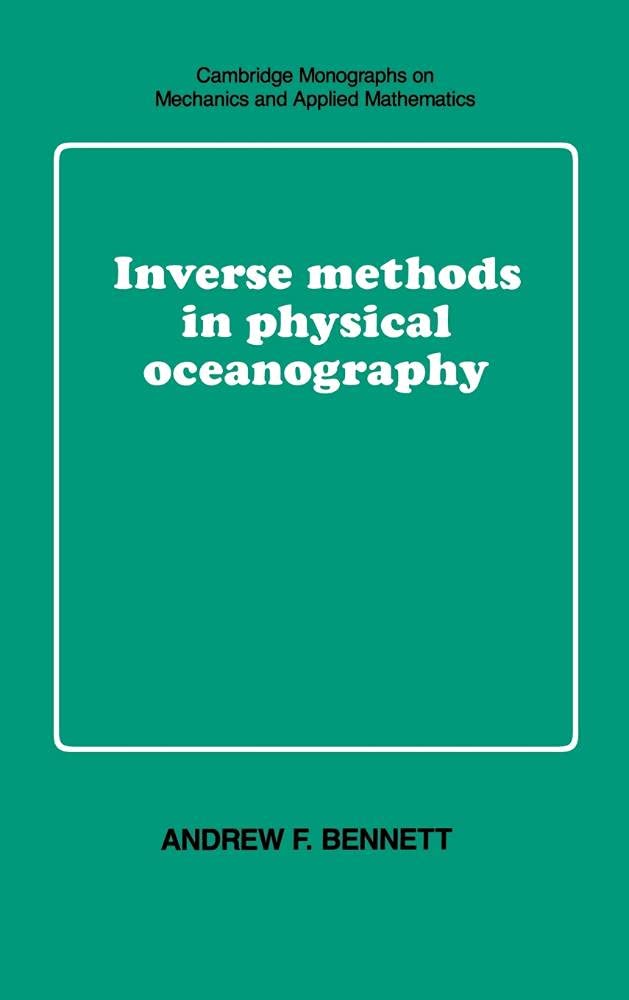
Inverse Methods in Physical Oceanography: A Comprehensive Guide to Ocean Circulation Modelling and Data Assimilation by
Inclusive of all applicable taxes. FREE shipping on all orders.
Available Offers
- 🚚Free Delivery — Free shipping on all orders
- 💵Cash on Delivery — Pay when your order arrives
- ↩️15-Day Easy Returns — Hassle-free return policy
- 🔒Cash on Delivery — Pay safely when your order arrives
Check Delivery
Product Description
Introduction
In the vast and dynamic field of physical oceanography, the challenge of interpreting sparse observational data within the framework of numerical models has long been a frontier of scientific inquiry. Inverse Methods in Physical Oceanography by Andrew F. Bennett stands as a definitive and rigorous guide to this complex domain. Published by Cambridge University Press, this hardcover volume is an essential resource for Indian researchers, postgraduate students, and environmental scientists who seek to master the art of extracting meaningful information from oceanographic measurements. Rather than offering quick fixes, Bennett’s work delves deep into the theoretical underpinnings and practical potential of inverse theory, making it a cornerstone text for anyone serious about ocean modelling and data assimilation.
Book Overview
This book is not a mere collection of recipes; it is a thoughtful exploration of how inverse methods can transform the way oceanographers combine observations with circulation models. Bennett systematically builds from fundamental concepts to advanced applications, emphasizing the power of these techniques to interpolate data, estimate unobserved variables, and even test models as scientific hypotheses. The text is enriched with exercises of varying difficulty, ensuring that readers not only grasp theory but also develop hands-on technical skills. For the Indian academic community, where oceanographic research is gaining momentum, this book provides a solid foundation for tackling problems related to monsoon dynamics, coastal processes, and climate variability.
Key Highlights
- Rigorous Theoretical Development: A comprehensive treatment of inverse methods tailored specifically for physical oceanography, avoiding oversimplified approaches.
- Practical Exercises: A range of problems—from basic to challenging—that reinforce core concepts and build computational competence.
- Emphasis on Potential: Focuses on what inverse methods can achieve, including resolving ill-posed problems and designing optimal observing systems.
- Interdisciplinary Relevance: Bridges oceanography with applied mathematics, environmental engineering, and climate science.
- Authoritative Source: Written by Andrew F. Bennett, a renowned expert in the field, and published by the prestigious Cambridge University Press.
Inside the Book
The content is structured to guide the reader from foundational principles to sophisticated applications. Early chapters introduce the basic concepts of inverse theory, including the formulation of inverse problems and the role of prior information. Subsequent sections delve into variational methods, adjoint models, and the estimation of forcing fields and model parameters. Bennett also explores the use of inverse methods for model testing and the design of observational networks. The book concludes with advanced topics that push the boundaries of current research, making it a valuable reference for both novices and seasoned practitioners. Each chapter is carefully paced, with mathematical derivations presented clearly alongside conceptual discussions.
Key Topics
- Fundamentals of inverse theory in oceanography
- Data assimilation and interpolation techniques
- Variational methods and adjoint equations
- Estimation of unobserved flow variables and forcing fields
- Parameter estimation in ocean models
- Resolving ill-posed modelling problems
- Design criteria for ocean observing systems
- Hypothesis testing using inverse formulations
Reader Benefits
By engaging with this book, readers will gain the ability to critically evaluate and apply inverse methods in their own research. The exercises provide a platform for developing practical skills in data analysis and numerical modelling. Indian students and professionals will find the content directly applicable to studies of the Indian Ocean, including monsoon circulation, upwelling zones, and ocean-atmosphere interactions. The book also equips readers to design more effective field experiments and to make the most of remote sensing data from satellites. Ultimately, it empowers oceanographers to move beyond simple data fitting toward a deeper understanding of ocean dynamics.
Learning Outcomes
- Understand the mathematical foundations of inverse methods in physical oceanography.
- Apply variational and adjoint techniques to assimilate observational data into numerical models.
- Estimate unobserved variables, forcing fields, and model parameters with confidence.
- Design observing systems that optimize data collection for specific scientific questions.
- Test numerical models as scientific hypotheses using inverse formulations.
- Solve ill-posed problems that arise in ocean modelling and data analysis.
Who Should Read
This book is ideal for advanced undergraduate and postgraduate students in physical oceanography, marine science, and applied mathematics. It is also a must-read for environmental scientists, climate researchers, and engineers working with ocean data and models. Indian academics and professionals involved in coastal management, fisheries oceanography, or monsoon research will find the techniques particularly relevant. The book assumes a solid background in calculus, linear algebra, and basic fluid dynamics, making it suitable for those with some prior exposure to ocean modelling.
About the Author
Andrew F. Bennett is a distinguished oceanographer and mathematician whose career has been dedicated to advancing the theory and application of inverse methods in geophysical fluid dynamics. He has held academic positions at leading institutions and has contributed extensively to the literature on data assimilation and ocean modelling. His expertise ensures that the content is both authoritative and accessible, bridging the gap between abstract theory and real-world oceanographic problems.
About the Publisher
Cambridge University Press is one of the world’s oldest and most respected academic publishers. Known for its rigorous editorial standards and commitment to scholarly excellence, Cambridge University Press brings this essential work to the global scientific community. For Indian readers, this hardcover edition represents a lasting investment in knowledge, offering durable quality and timeless content.
Conclusion
Inverse Methods in Physical Oceanography is more than a textbook—it is a gateway to advanced research in ocean science. For students and professionals in India, where the oceans play a crucial role in climate and economy, this book offers the tools needed to turn data into discovery. Whether you are a researcher seeking to refine model predictions or a student aspiring to contribute to oceanography, Bennett’s work will inspire and equip you to push the boundaries of what is possible. Add this essential volume to your library and unlock the full potential of inverse theory.
Quick Summary
Inverse Methods in Physical Oceanography by Andrew F. Bennett is a seminal work that bridges observational oceanography and numerical modelling through inverse theory. The book explores how oceanographers can combine data from international field programmes and satellite remote sensing with numerical circulation models to produce more realistic simulations. It goes beyond basic interpolation, showing how inverse methods can estimate unobserved flow variables, forcing fields, and model parameters. The book also addresses ill-posed modelling problems, provides design criteria for observing systems, and enables rigorous testing of models as scientific hypotheses. Written for graduate students and researchers, this Cambridge University Press hardcover is a valuable resource for anyone working in physical oceanography, climate dynamics, or geophysical fluid dynamics. Indian readers studying the Indian Ocean, Bay of Bengal, or Arabian Sea will find the methodologies directly applicable. Purchasing from Bookshops.in ensures you receive a genuine, high-quality print edition delivered to your doorstep across India.
Book Highlights
Book Specifications
| ISBN-13 | 9780521385688 |
| ISBN-10 | 0521385687 |
| Publisher | Cambridge University Press |
| Language | English |
| Dimensions | 16.51 x 2.54 x 24.13 cm |
| Weight | 605 g |
| Category | Science & Mathematics › Earth Sciences |
| Genre | Non-fiction |
| Original Language | English |
Frequently Asked Questions
What is the main focus of Inverse Methods in Physical Oceanography?
Who is the author of this book?
Is this book suitable for beginners in oceanography?
Does the book include Indian ocean examples?
What format is this book available in?
Can this book help with research in climate change?
Does the book cover satellite remote sensing data?
Is this book used in Indian university curricula?
What is the ISBN of this book?
Are there any prerequisites for reading this book?
Does the book include exercises or problems?
Can I use this book for self-study?
Why should I buy from Bookshops.in?
Readers Also Search For
Customers Also Bought

Mathematics
Stereotype Spaces and Algebras: 73 (De Gruyter Expositions in Mathematics, 73)

Mathematics
Semigroups in Algebra, Geometry and Analysis: 20 (De Gruyter Expositions in Mathematics, 20)

Mathematics
Geometry from the Pacific Rim: Proceedings of the Pacific Rim Geometry Conference held at National University of Singapore, Republic of Singapore, ... 1994 (De Gruyter Proceedings in Mathematics)

Mathematics
First International Tainan-Moscow Algebra Workshop: Proceedings of the International Conference held at National Cheng Kung University Tainan, Taiwan, ... 1994 (De Gruyter Proceedings in Mathematics)

Mathematics
Differential Geometry - Proceedings of the VIII International Colloquium (English, Jesus A. Alvarez Lopez | Eduardo Garcia-Rio)
Mathematics
Mathematical Theory of Optimal Processes (Classics of Soviet Mathematics)
Related Products
View All
Science & Mathematics
Squid - Superconducting Quantum Interference Devices and Their Applications: Proceedings of the International Conference on Superconducting Quantum Devices, Berlin-west, October 4-8, 1976

Science & Mathematics
Thermodynamics and Pattern Formation in Biology

Science & Mathematics
The Nature of Mathematics and the Mathematics of Nature by S. Andersson – Mathematics & Science

Science & Mathematics
Linear Algebra | by Stephen Friedberg | Arnold Insel | Lawrence Spence | Pearson | by Stephen Friedberg | Arnold Insel | Lawrence Spence | Pearson | by Stephen Friedberg | Arnold Insel | Lawrence Spence | Pearson | by Stephen Friedberg | Arnold Insel | Lawrence Spence | Pearson | by Stephen Friedberg | Arnold Insel | Lawrence Spence | Pearson | by Stephen Friedberg | Arnold Insel | Lawrence Spence | Pearson | by Stephen Friedberg | Arnold Insel | Lawrence Spence | Pearson | by Stephen Friedberg

Science & Mathematics
University Calculus | by Joel Hass | Christopher Heil | Maurice Weir | Pearson | by Joel Hass | Christopher Heil | Maurice Weir | Pearson | by Joel Hass | Christopher Heil | Maurice Weir | Pearson | by Joel Hass | Christopher Heil | Maurice Weir | Pearson | by Joel Hass | Christopher Heil | Maurice Weir | Pearson | by Joel Hass | Christopher Heil | Maurice Weir | Pearson | by Joel Hass | Christopher Heil | Maurice Weir | Pearson | by Joel Hass | Christopher Heil | Maurice Weir | Pearson | by Joe

Science & Mathematics