
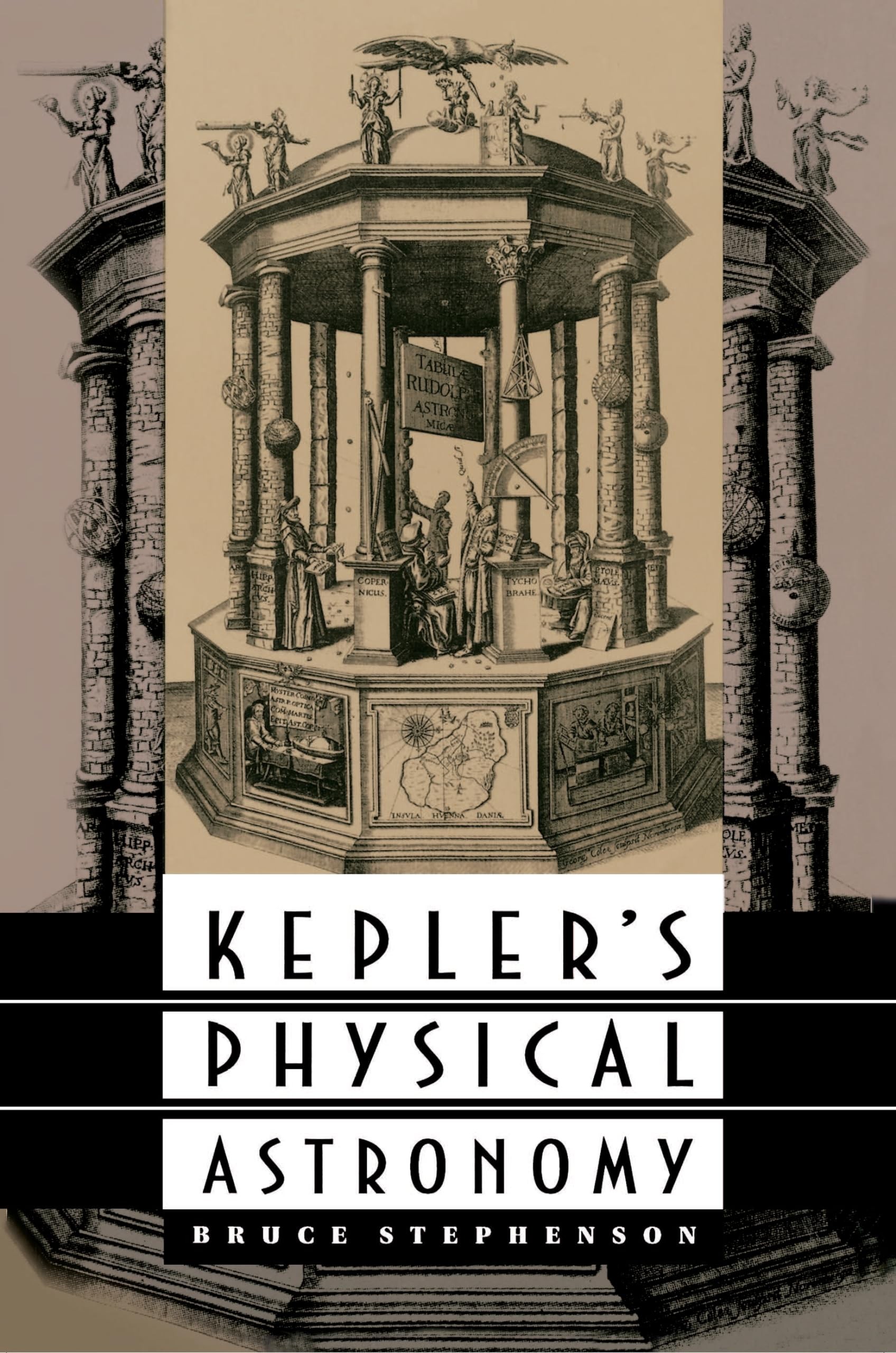
Kepler's Physical Astronomy: How Johannes Kepler Transformed Astronomy into Physics by Bruce Stephenson
Inclusive of all applicable taxes. FREE shipping on all orders.
Available Offers
- 🚚Free Delivery — Free shipping on all orders
- 💵Cash on Delivery — Pay when your order arrives
- ↩️15-Day Easy Returns — Hassle-free return policy
- 🔒Cash on Delivery — Pay safely when your order arrives
Check Delivery
Product Description
Introduction
Johannes Kepler stands as a towering figure in the history of science, a man who dared to bridge the gap between celestial geometry and terrestrial physics. In Kepler's Physical Astronomy, Bruce Stephenson offers a rigorous and illuminating exploration of how Kepler transformed astronomy by grounding it in physical principles. This book is an essential read for anyone fascinated by the Scientific Revolution, the evolution of celestial mechanics, or the intellectual journey that led to the laws of planetary motion.
Book Overview
Published by Princeton University Press, this hardcover volume delves deep into Kepler's groundbreaking work, particularly his Astronomia nova of 1609. Stephenson meticulously reconstructs Kepler's reasoning, showing how he abandoned the ancient tradition of purely geometrical models and instead sought to understand the forces that move the planets. The book reveals that even though Kepler's physical ideas—such as a magnetic force emanating from the Sun—were later superseded, they were crucial in enabling him to arrive at his first two laws of planetary motion. This is not a superficial summary but a detailed, scholarly analysis that respects the complexity of Kepler's thought.
Key Highlights
- In-depth analysis of Kepler's Astronomia nova and its revolutionary approach.
- Clear explanation of how Kepler combined physics with astronomy for the first time.
- Examination of the role of 'incorrect' physical principles in producing correct mathematical laws.
- Focus on Kepler's struggle with Mars's orbit and the concept of elliptical paths.
- Contextualizes Kepler's work within the broader history of astronomy from Ptolemy to Brahe.
Inside the Book
Stephenson takes readers inside Kepler's workshop, revealing the painstaking calculations, the false starts, and the bold hypotheses that defined his career. The book unpacks the core of the Astronomia nova, showing how Kepler used the idea of a 'moving force' from the Sun to derive the area law and the elliptical orbit. It also covers his later works, including the Epitome of Copernican Astronomy, and demonstrates how his physical astronomy evolved. The text is rich with diagrams and mathematical reasoning, yet Stephenson's prose remains accessible to dedicated readers willing to engage with primary sources.
Key Topics
- The shift from kinematic to dynamic astronomy in the 17th century.
- Kepler's concept of 'species' or immaterial force emanating from the Sun.
- The derivation of the ellipse from physical assumptions about planetary motion.
- The relationship between Kepler's work and the observations of Tycho Brahe.
- The philosophical implications of treating celestial bodies as physical objects subject to forces.
Reader Benefits
This book offers a rare opportunity to witness the birth of modern physics through the eyes of one of its greatest pioneers. Readers will gain a profound appreciation for the intellectual effort behind Kepler's laws, understanding that they were not simply discovered but constructed through a blend of intuition, error, and relentless logic. It also clarifies why Kepler is often called the first astrophysicist, and how his work laid the groundwork for Newton's universal gravitation.
Learning Outcomes
- Understand the historical context of Kepler's astronomical revolution.
- Analyze the physical arguments that led to the first two laws of planetary motion.
- Evaluate the role of hypothetical forces in early modern science.
- Trace the evolution of astronomical models from Ptolemy to Kepler.
- Appreciate the interplay between observation, mathematics, and physical reasoning.
Who Should Read
Kepler's Physical Astronomy is ideal for students and scholars of the history of science, astronomy, and physics. It will also captivate curious readers with a strong background in science or mathematics who wish to go beyond textbook summaries. Indian students preparing for competitive examinations or pursuing advanced studies in astrophysics will find this a valuable resource for understanding the conceptual foundations of celestial mechanics. It is best suited for those who enjoy deep, analytical reading rather than popular science narratives.
About the Author
Bruce Stephenson is a respected historian of science with a deep expertise in early modern astronomy. His research focuses on the works of Johannes Kepler and the transition from ancient to modern cosmology. Stephenson's writing is known for its clarity and precision, making complex historical arguments accessible without oversimplification. He has contributed significantly to Kepler scholarship and is recognized for his ability to reconstruct the astronomer's original thought processes.
About the Publisher
Princeton University Press is one of the world's most prestigious academic publishers, known for its rigorous standards and contributions to the humanities and sciences. Their history of science catalogue includes many landmark works, and this volume reflects their commitment to publishing definitive scholarship. For Indian readers, Princeton books are a trusted source for high-quality, authoritative content.
Conclusion
Kepler's Physical Astronomy is more than a historical study—it is a window into the mind of a genius who changed our understanding of the cosmos. Bruce Stephenson's masterful analysis shows that even flawed physics can lead to profound truths, and that the path to scientific knowledge is rarely straight. For anyone serious about understanding the roots of modern astronomy, this book is an indispensable addition to their library.
Quick Summary
Kepler's Physical Astronomy by Bruce Stephenson is a rigorous examination of how Johannes Kepler transformed astronomy by integrating physical reasoning into the study of planetary motion. Focusing on Kepler's groundbreaking 1609 work Astronomia nova, Stephenson dissects the intellectual journey that led to the first two laws of planetary motion. The book is ideal for advanced students of physics, astronomy, and history of science, as well as scholars interested in the Scientific Revolution. Readers will gain a nuanced understanding of Kepler's methods, including his use of Tycho Brahe's observational data and his sometimes misguided physical assumptions. By buying from Bookshops.in, Indian readers get a premium hardcover edition delivered to their doorstep, supporting a trusted local bookstore.
Book Highlights
Book Specifications
| ISBN-13 | 9780691036526 |
| ISBN-10 | 0691036527 |
| Publisher | Princeton University Press |
| Language | English |
| Dimensions | 15.24 x 1.47 x 22.86 cm |
| Weight | 340 g |
| Category | Science & Mathematics › Astronomy & Astrophysics |
| Genre | Non-fiction |
| Reading Age | Adult |
| Original Language | English |
Frequently Asked Questions
What is Kepler's Physical Astronomy about?
Who is the author of this book?
Is this book suitable for beginners in astronomy?
Does the book cover Kepler's third law?
What makes Kepler's approach unique?
Is this a hardcover edition?
Can I use this book for my university research?
Does the book include illustrations or diagrams?
Is the language accessible for Indian students?
Why is the book titled 'Physical Astronomy'?
What is the price of this book?
Does this book discuss Copernicus and Tycho Brahe?
Is there a digital version available?
Readers Also Search For
Customers Also Bought
Mathematics
Stereotype Spaces and Algebras: 73 (De Gruyter Expositions in Mathematics, 73)

Mathematics
Semigroups in Algebra, Geometry and Analysis: 20 (De Gruyter Expositions in Mathematics, 20)
Mathematics
Geometry from the Pacific Rim: Proceedings of the Pacific Rim Geometry Conference held at National University of Singapore, Republic of Singapore, ... 1994 (De Gruyter Proceedings in Mathematics)

Mathematics
First International Tainan-Moscow Algebra Workshop: Proceedings of the International Conference held at National Cheng Kung University Tainan, Taiwan, ... 1994 (De Gruyter Proceedings in Mathematics)
Mathematics
Differential Geometry - Proceedings of the VIII International Colloquium (English, Jesus A. Alvarez Lopez | Eduardo Garcia-Rio)
Mathematics
Mathematical Theory of Optimal Processes (Classics of Soviet Mathematics)
Related Products
View All
Science & Mathematics
Elements of Pelagos Biology: With Focus on the Mediterranean Sea

Science & Mathematics
Squid - Superconducting Quantum Interference Devices and Their Applications: Proceedings of the International Conference on Superconducting Quantum Devices, Berlin-west, October 4-8, 1976

Science & Mathematics
Thermodynamics and Pattern Formation in Biology
Science & Mathematics
The Nature of Mathematics and the Mathematics of Nature by S. Andersson – Mathematics & Science

Science & Mathematics
Linear Algebra | by Stephen Friedberg | Arnold Insel | Lawrence Spence | Pearson | by Stephen Friedberg | Arnold Insel | Lawrence Spence | Pearson | by Stephen Friedberg | Arnold Insel | Lawrence Spence | Pearson | by Stephen Friedberg | Arnold Insel | Lawrence Spence | Pearson | by Stephen Friedberg | Arnold Insel | Lawrence Spence | Pearson | by Stephen Friedberg | Arnold Insel | Lawrence Spence | Pearson | by Stephen Friedberg | Arnold Insel | Lawrence Spence | Pearson | by Stephen Friedberg
Science & Mathematics