
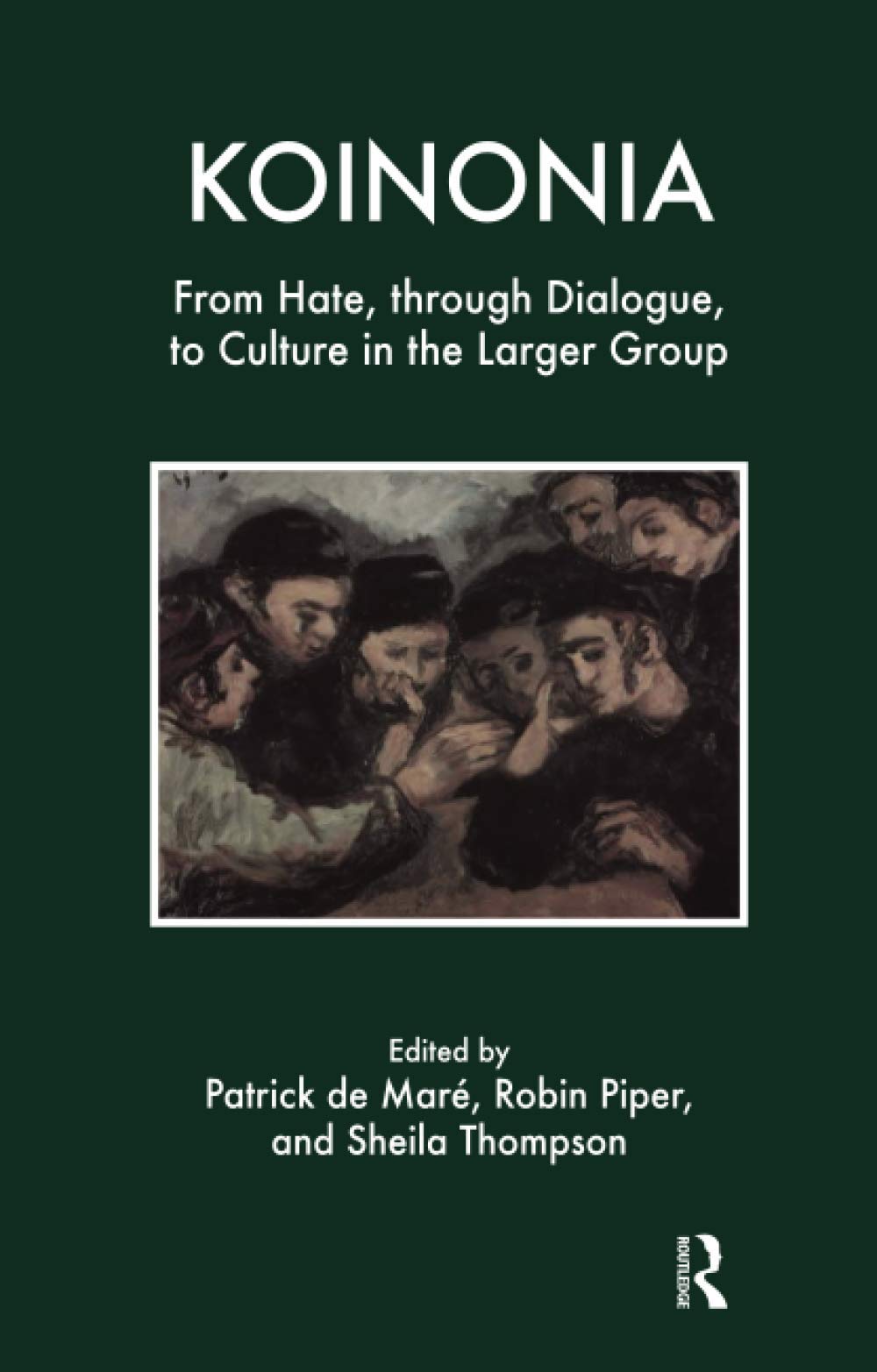
Koinonia: From Hate, Through Dialogue, to Culture in the Large Group – A Comprehensive Study of Group Micro-Culture and
Inclusive of all applicable taxes. FREE shipping on all orders.
Available Offers
- 🚚Free Delivery — Free shipping on all orders
- 💵Cash on Delivery — Pay when your order arrives
- ↩️15-Day Easy Returns — Hassle-free return policy
- 🔒Cash on Delivery — Pay safely when your order arrives
Check Delivery
Product Description
Introduction
In the vast landscape of group psychology and psychoanalytic thought, few works dare to explore the raw, chaotic undercurrents that shape human collectives. Patrick B. Demare's Koinonia: From Hate, Through Dialogue, to Culture in the Large Group is a profound and challenging study that journeys into the heart of large-group dynamics. Published by Routledge and now available in a durable hardcover edition, this book offers Indian students, clinicians, and organizational leaders a rare lens to understand how hostility transforms into fellowship. Drawing from the Greek concept of koinonia—a state of impersonal fellowship—Demare presents a bold operational framework for dialogue, culture, and the human mind. This is not merely a theoretical text; it is a practical guide for anyone seeking to navigate the emotional turbulence of large groups, from classrooms to corporate boardrooms.
Book Overview
Koinonia delves into the processes and dynamics through which a group's micro-culture emerges. Demare begins with the premise that initial frustrations in any large group inevitably find expression in hate. Instead of suppressing this negativity, he advocates for a transformative journey through dialogue, leading to the emergence of koinonia. The book adopts a direction similar to the group-analytic method of S. H. Foulkes, yet extends it by focusing on the unique dimension of the large group—a setting that bridges the inner world of the individual with the broader cultural context. Until now, neither psychoanalysis nor small-group studies have empirically handled this aspect. Demare's work fills that gap, offering a structured medium for linking intimate personal experiences with socio-cultural realities.
Key Highlights
- Original Framework: Introduces an operational approach to transforming hate into fellowship through structured dialogue.
- Large-Group Focus: Addresses the unique dynamics of groups larger than typical therapy or seminar settings, often overlooked in literature.
- Micro-Culture Concept: Explains how shared frustrations and dialogues create a distinct group culture that influences individual behaviour.
- Practical Application: Offers insights applicable to therapeutic communities, educational institutions, corporate teams, and social movements.
- Routledge Quality: Published by a leading academic press, ensuring rigorous scholarship and editorial excellence.
Inside the Book
The book is structured to guide the reader through the emotional and intellectual arc of group formation. Early chapters explore the inevitability of hate as a response to frustration in large groups, drawing on psychoanalytic and group-analytic theories. Demare then introduces dialogue as the mediating force, detailing how structured communication channels can channel destructive emotions into constructive exchange. The latter part of the book focuses on the emergence of koinonia—a state where individuals experience fellowship without personal intimacy, enabling collective creativity and problem-solving. Case illustrations and theoretical discussions are interwoven, making complex ideas accessible. The hardcover binding ensures durability for repeated reference, ideal for students and professionals alike.
Key Topics
- The nature of hate in large groups and its origins in frustration
- Dialogue as a transformative tool for group cohesion
- Micro-culture formation: how groups create their own norms and values
- Comparison with S. H. Foulkes' group-analytic method
- Bridging inner psychic worlds with external cultural contexts
- Empirical challenges in psychoanalysis and small-group therapy
- Practical strategies for facilitating large-group dialogue
Reader Benefits
Readers will gain a deep understanding of why large groups often descend into conflict and how to redirect that energy toward collaboration. The book equips you with a vocabulary to articulate group phenomena that are often felt but unnamed. For Indian readers, where community and collective identity are central, Demare's insights offer a way to harmonize diverse perspectives in educational, religious, and organizational settings. You will learn to recognize the early signs of group hate and intervene with dialogue-based strategies. The concept of koinonia provides a tangible goal for facilitators, therapists, and leaders aiming to build resilient, inclusive groups.
Learning Outcomes
- Identify the psychological roots of hate in large-group settings
- Apply dialogue techniques to transform hostility into fellowship
- Analyse the emergence of micro-cultures and their impact on individual behaviour
- Compare and contrast Demare's approach with Foulkes' group analysis
- Develop skills to facilitate large-group interventions in clinical, educational, or corporate contexts
- Understand the link between personal inner worlds and collective cultural dynamics
Who Should Read
This book is essential for clinical psychologists, psychiatrists, and psychoanalysts working with group therapy. It is equally valuable for social workers, organizational consultants, and HR professionals who manage large teams. Students of psychology, sociology, and anthropology will find it a rich resource for understanding group behaviour. Educators and community leaders in India, dealing with diverse and often conflicting groups, will benefit from Demare's practical wisdom. Anyone fascinated by how human beings come together—or fall apart—in large numbers will find this book illuminating.
About the Author
Patrick B. Demare is a distinguished scholar and practitioner in the field of group analysis and psychoanalysis. With years of experience facilitating large groups in therapeutic and organizational settings, Demare brings both theoretical depth and practical insight to his work. His writing reflects a commitment to bridging the gap between individual psychology and social dynamics. Koinonia is a culmination of his observations and experiments, offering a fresh perspective that challenges conventional psychoanalytic orthodoxy. Demare continues to influence the field through his teaching and clinical practice, making complex ideas accessible to a global audience.
About the Publisher
Routledge is a world-renowned academic publisher, known for its authoritative texts in the social sciences, humanities, and behavioural sciences. With a legacy spanning over a century, Routledge publishes works that shape scholarly discourse and professional practice. This hardcover edition of Koinonia reflects Routledge's commitment to quality, with durable binding and clear typography suitable for long-term use. Indian readers can trust Routledge for rigorous peer review and cutting-edge content that meets global academic standards.
Conclusion
Koinonia: From Hate, Through Dialogue, to Culture in the Large Group is a seminal work that addresses a critical gap in group psychology. Patrick B. Demare offers not just a theory, but a pathway—from the chaos of collective frustration to the harmony of impersonal fellowship. For Indian students and professionals navigating the complexities of group life, this book provides both understanding and tools. Whether you are a therapist, a manager, or a curious reader, Demare's insights will change how you see groups forever. Order your hardcover copy today and embark on a journey from hate to culture.
Quick Summary
Koinonia: From Hate, Through Dialogue, to Culture in the Large Group by Patrick B. Demare is a seminal work in group psychology that delves into the processes by which large groups evolve from initial states of frustration and hate into a cohesive culture of impersonal fellowship, known as koinonia. Drawing on the groupanalytic method of S. H. Foulkes, the book explores how dialogue serves as the transformative medium linking individual inner worlds with broader socio-cultural contexts. This book is intended for psychology students, group therapists, social scientists, and organizational professionals who seek a deeper understanding of group dynamics and micro-culture emergence. Readers will learn practical approaches to facilitating dialogue, managing conflict, and fostering fellowship in large group settings. By purchasing from Bookshops.in, Indian readers gain access to an authentic Routledge hardcover edition with reliable delivery and competitive pricing.
Book Highlights
Book Specifications
| ISBN-13 | 9780946439829 |
| ISBN-10 | 0946439826 |
| Publisher | Karnac Books |
| Language | English |
| Dimensions | 14.71 x 1.65 x 23.01 cm |
| Weight | 431 g |
| Country | India |
| Category | Psychology › Psychotherapy |
| Genre | Non-fiction |
| Original Language | English |
Frequently Asked Questions
What is Koinonia about?
Who is the author of Koinonia?
What is the groupanalytic method?
Is this book suitable for Indian students?
What does 'koinonia' mean?
What is the main theme of the book?
Does the book include practical examples?
What is the price of Koinonia on Bookshops.in?
Is this book available in paperback?
Who is the publisher?
What is the ISBN?
Can this book help group therapists?
Does the book reference other authors?
Why buy from Bookshops.in?
Readers Also Search For
Customers Also Bought
Psychology
Mindfulness-Based Interventions for Trauma and Its Consequences (Concise Guides on Trauma Care, 4)

Psychology
Handbook for Teaching Statistics and Research Methods by Mark E. Ware

Psychology
Psychoanalysis and the Nuclear Threat: Clinical and Theoretical Studies
Psychology
Humor and Psyche: Psychoanalytic Perspectives by James W. Barron

Psychology
Proceedings of the First International Conference on Genetic Algorithms and Their Applications

Relationships
The Experience and Expression of Uncertainty in Close Relationships by Jennifer A. Theiss
Related Products
View AllPsychology
Handbook for Teaching Statistics and Research Methods by Mark E. Ware
Psychology
Psychoanalysis and the Nuclear Threat: Clinical and Theoretical Studies
Psychology
Humor and Psyche: Psychoanalytic Perspectives by James W. Barron
Psychology
Proceedings of the First International Conference on Genetic Algorithms and Their Applications
Psychology
The Schreber Case: Psychoanalytic Profile of a Paranoid Personality
Psychology