
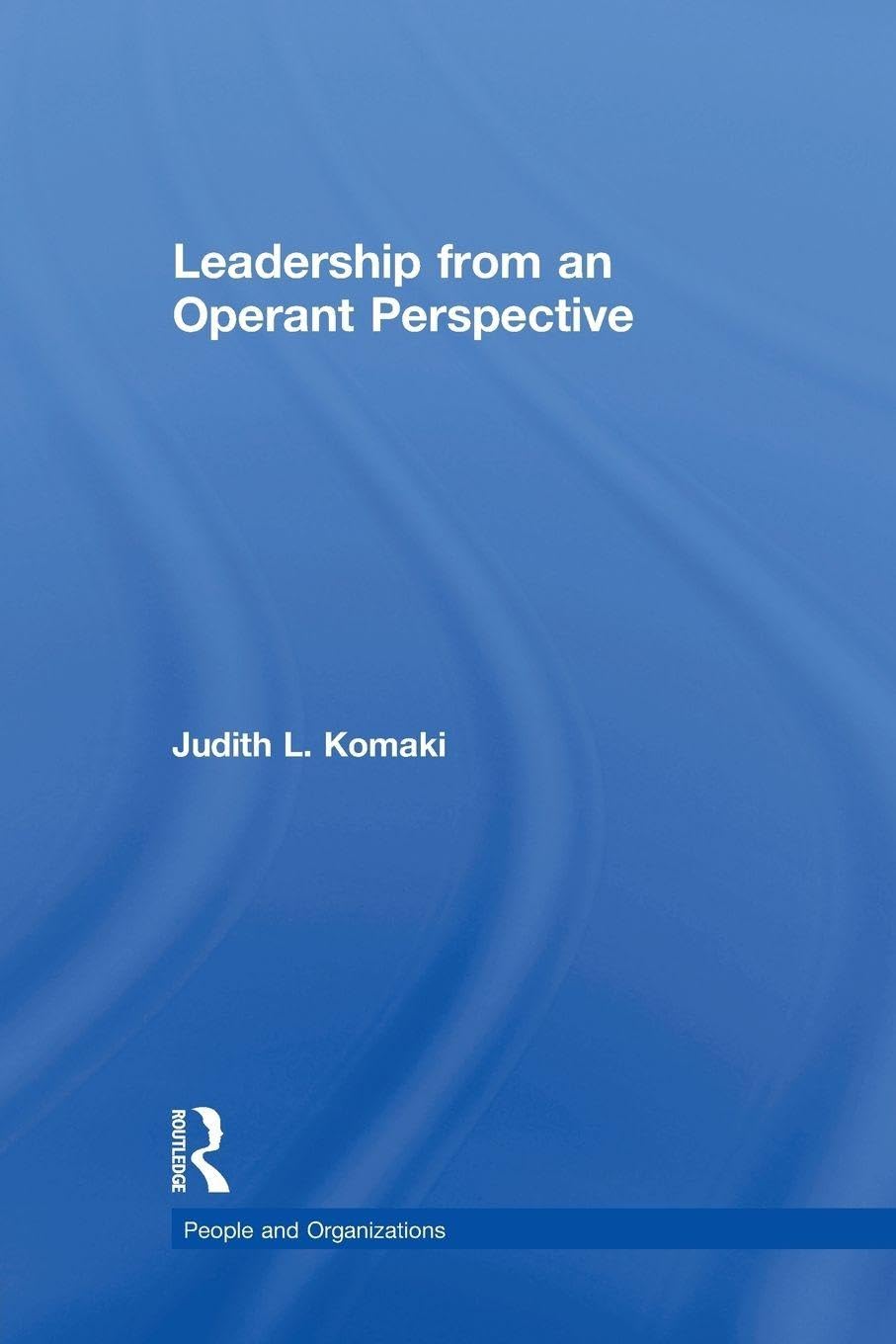
Leadership: The Operant Model of Effective Supervision by Judith L. Komaki – A Behavioural Framework for Managerial Succ
Inclusive of all applicable taxes. FREE shipping on all orders.
Available Offers
- 🚚Free Delivery — Free shipping on all orders
- 💵Cash on Delivery — Pay when your order arrives
- ↩️15-Day Easy Returns — Hassle-free return policy
- 🔒Cash on Delivery — Pay safely when your order arrives
Check Delivery
Product Description
Introduction
In the ever-evolving landscape of management and organizational behavior, the quest to understand what truly makes an effective leader remains paramount. Leadership: The Operant Model of Effective Supervision by Judith L. Komaki offers a groundbreaking, evidence-based approach to this age-old question. Published by Routledge, this hardcover edition is an essential resource for Indian managers, business students, and HR professionals seeking practical, actionable insights into motivating and guiding teams. Drawing on rigorous field studies across diverse environments—from corporate offices to competitive sailing crews—Komaki presents a fresh, operant perspective on leadership that moves beyond traditional trait-based theories.
Book Overview
This book systematically explores how managers can truly influence employee performance and motivation. Komaki challenges conventional wisdom by focusing on two critical behaviors that consistently distinguish effective supervisors from their less effective counterparts: monitoring performance and communicating consequences. Through a decade of meticulous research, the author builds a compelling case for an operant model of leadership—one rooted in observable actions and measurable outcomes. The text seamlessly blends behavioral and cognitive theories, providing a robust framework for understanding leadership as a dynamic, interactive process rather than a static set of attributes.
Key Highlights
- Evidence-Based Framework: The operant model is grounded in real-world field studies, not abstract theories.
- Focus on Observable Behaviors: Shifts attention from personality traits to actionable supervisory practices.
- Practical Application: Offers clear strategies for monitoring work and providing effective consequences.
- Interdisciplinary Approach: Integrates behavioral psychology with cognitive and organizational research.
- Relevant Case Studies: Features examples from diverse settings, including insurance offices and regatta sailboats.
Inside the Book
Komaki structures her argument with clarity and precision. The book begins by critiquing existing leadership models, then introduces the operant perspective, explaining how consequences shape behavior. Subsequent chapters delve into the mechanics of monitoring—what to observe, how often, and how to use data—and the art of delivering consequences that reinforce desired performance. The author also addresses common pitfalls, such as over-supervision or inconsistent feedback, offering corrective strategies. Each chapter concludes with summaries and discussion points, making it ideal for classroom use or self-study.
Key Topics
- The operant model of leadership and its theoretical foundations
- Behavioral monitoring techniques for managers
- Effective communication of consequences (praise, corrective feedback, incentives)
- Distinguishing effective vs. ineffective supervisory behaviors
- Application of operant principles in Indian organizational contexts
- Overcoming resistance to behavioral management approaches
Reader Benefits
This book empowers readers with a scientific toolkit to enhance their supervisory effectiveness. Managers will learn to identify specific behaviors that drive team performance and how to systematically reinforce them. Students will gain a deep understanding of an alternative leadership paradigm, enriching their academic knowledge. HR professionals can apply the operant model to design better performance management systems. The actionable nature of the content means readers can immediately implement strategies to boost morale, productivity, and accountability in their own workplaces.
Learning Outcomes
- Understand the core principles of operant leadership and how they differ from traditional models
- Identify the two key behaviors—monitoring and consequences—that define effective supervision
- Develop skills to observe and measure employee performance objectively
- Learn to deliver feedback that motivates and corrects without demoralizing
- Apply the operant framework to real-world management challenges in Indian industries
- Critically evaluate leadership practices using behavioral evidence
Who Should Read
Leadership: The Operant Model of Effective Supervision is ideal for current and aspiring managers across all sectors—corporate, nonprofit, government, and education. It is particularly valuable for students enrolled in MBA programs, organizational behavior courses, and industrial psychology curricula in Indian universities. Human resource professionals, team leaders, and executives seeking to refine their supervisory approach will find the content directly applicable. Additionally, coaches and trainers focused on leadership development will benefit from the robust theoretical and practical insights.
About the Author
Judith L. Komaki is a distinguished researcher and professor whose work has significantly influenced the field of organizational behavior and leadership. With a career dedicated to understanding what drives effective supervision, Komaki has conducted extensive field studies in varied settings, from corporate offices to competitive sports teams. Her research bridges behavioral psychology and management science, earning her recognition as a pioneer in the operant analysis of leadership. Her clear, engaging writing style makes complex concepts accessible to both academics and practitioners.
About the Publisher
Routledge is a globally respected academic publisher known for producing high-quality texts in the social sciences, humanities, and business disciplines. With a legacy of scholarly excellence, Routledge ensures that each publication, including this hardcover edition, meets rigorous editorial standards. Indian readers can trust Routledge for authoritative, well-researched content that advances knowledge in fields like leadership and management. This book is part of their commitment to bringing cutting-edge research to a worldwide audience.
Conclusion
Leadership: The Operant Model of Effective Supervision is not just another leadership book—it is a research-backed manual for transforming how managers think and act. By focusing on what leaders actually do, rather than who they are, Judith L. Komaki provides a path to measurable improvement in team performance and employee satisfaction. For Indian professionals navigating complex organizational dynamics, this hardcover edition from Bookshops.in offers a durable, insightful companion. Embrace a new paradigm of leadership and unlock the potential of your team with this essential read.
Quick Summary
Leadership: The Operant Model of Effective Supervision by Judith L. Komaki is a landmark work that redefines how we understand supervisory effectiveness. Based on rigorous field studies conducted in diverse settings—from insurance company offices to competitive regatta sailboats—Komaki identifies two pivotal behaviours that separate effective managers from ineffective ones: monitoring workers' performance and communicating consequences. The book integrates behavioural and cognitive theories to present a testable, operant model of leadership that moves beyond traditional trait-based approaches. Readers will learn how to systematically observe employee performance, provide timely feedback, and use consequences to drive motivation and productivity. This book is ideal for Indian managers, HR professionals, students of organisational psychology, and leadership coaches seeking evidence-based tools to improve team outcomes. By purchasing from Bookshops.in, you get a genuine hardcover copy delivered to your doorstep, supporting a trusted Indian bookstore committed to quality service and academic excellence.
Book Highlights
Book Specifications
| ISBN-13 | 9781138979567 |
| ISBN-10 | 1138979562 |
| Publisher | Routledge |
| Language | English |
| Dimensions | 15.6 x 1.7 x 23.39 cm |
| Weight | 435 g |
| Country | India |
| Category | Clinical › Psychiatry |
| Genre | Non-fiction |
| Original Language | English |
Frequently Asked Questions
What is the operant model of supervision?
Who is Judith L. Komaki?
Is this book suitable for Indian managers?
What kind of research is the book based on?
Does the book provide practical tips?
Is this a textbook or a general read?
What is the ISBN-13?
What makes this book different from other leadership books?
Does the book cover employee motivation?
Is the book available in hardcover?
What language is the book in?
Where can I buy this book in India?
Readers Also Search For
Customers Also Bought

Anatomy
Ultrastructure of the Digestive Tract: 4 (Electron Microscopy in Biology and Medicine)

Anatomy
Ultrastructure of the Connective Tissue Matrix: 3 (Electron Microscopy in Biology and Medicine)

Anatomy
Reproductive Genetics (Royal College of Obstetricians and Gynaecologists Study Group)

Anatomy
Human Gross Anatomy: An Outline Text by Robert J. Leonard – Medical Anatomy

Pharmacology
Mathematical Modeling and Simulation in Enteric Neurobiology

Anatomy
Nature’s Patterns and the Fractional Calculus: 2 (Fractional Calculus in Applied Sciences and Engineering, 2)
Related Products
View All
Medicine & Health Sciences
Handbook of Hospitality Strategic Management | by Olsen Michael | Taylor & Francis Ltd | by Olsen Michael | Taylor & Francis Ltd | by Olsen Michael | Taylor & Francis Ltd | by Olsen Michael | Taylor & Francis Ltd | by Olsen Michael | Taylor & Francis Ltd | by Olsen Michael | Taylor & Francis Ltd | by Olsen Michael | Taylor & Francis Ltd | by Olsen Michael | Taylor & Francis Ltd | by Olsen Michael | Taylor & Francis Ltd | by Olsen Michael | Taylor & Francis

Medicine & Health Sciences
Pediatrics on Call | by Charles A. Pohl | Kathleen Bradford | Clara Callahan | McGraw Hill / Medical | by Charles A. Pohl | Kathleen Bradford | Clara Callahan | McGraw Hill / Medical | by Charles A. Pohl | Kathleen Bradford | Clara Callahan | McGraw Hill / Medical | by Charles A. Pohl | Kathleen Bradford | Clara Callahan | McGraw Hill / Medical | by Charles A. Pohl | Kathleen Bradford | Clara Callahan | McGraw Hill / Medical | by Charles A. Pohl | Kathleen Bradford | Clara Callahan | McGraw Hill

Medicine & Health Sciences
The Physician's Guide to Depression and Bipolar Disorders | by Dwight L. Evans | Dennis S. Charney | Lydia Lewis | McGraw Hill / Medical | by Dwight L. Evans | Dennis S. Charney | Lydia Lewis | McGraw Hill / Medical | by Dwight L. Evans | Dennis S. Charney | Lydia Lewis | McGraw Hill / Medical | by Dwight L. Evans | Dennis S. Charney | Lydia Lewis | McGraw Hill / Medical | by Dwight L. Evans | Dennis S. Charney | Lydia Lewis | McGraw Hill / Medical | by Dwight L. Evans | Dennis S. Charney | Lydi

Medicine & Health Sciences
First Exposure to Internal Medicine | by Andrew R. Hoellein | Charles H. Griffith | McGraw Hill / Medical | by Andrew R. Hoellein | Charles H. Griffith | McGraw Hill / Medical | by Andrew R. Hoellein | Charles H. Griffith | McGraw Hill / Medical | by Andrew R. Hoellein | Charles H. Griffith | McGraw Hill / Medical | by Andrew R. Hoellein | Charles H. Griffith | McGraw Hill / Medical | by Andrew R. Hoellein | Charles H. Griffith | McGraw Hill / Medical | by Andrew R. Hoellein | Charles H. Griffit

Medicine & Health Sciences
First Exposure to Internal Medicine | by Charles H. Griffith | Andrew R. Hoellein | McGraw Hill / Medical | by Charles H. Griffith | Andrew R. Hoellein | McGraw Hill / Medical | by Charles H. Griffith | Andrew R. Hoellein | McGraw Hill / Medical | by Charles H. Griffith | Andrew R. Hoellein | McGraw Hill / Medical | by Charles H. Griffith | Andrew R. Hoellein | McGraw Hill / Medical | by Charles H. Griffith | Andrew R. Hoellein | McGraw Hill / Medical | by Charles H. Griffith | Andrew R. Hoellei

Medicine & Health Sciences