
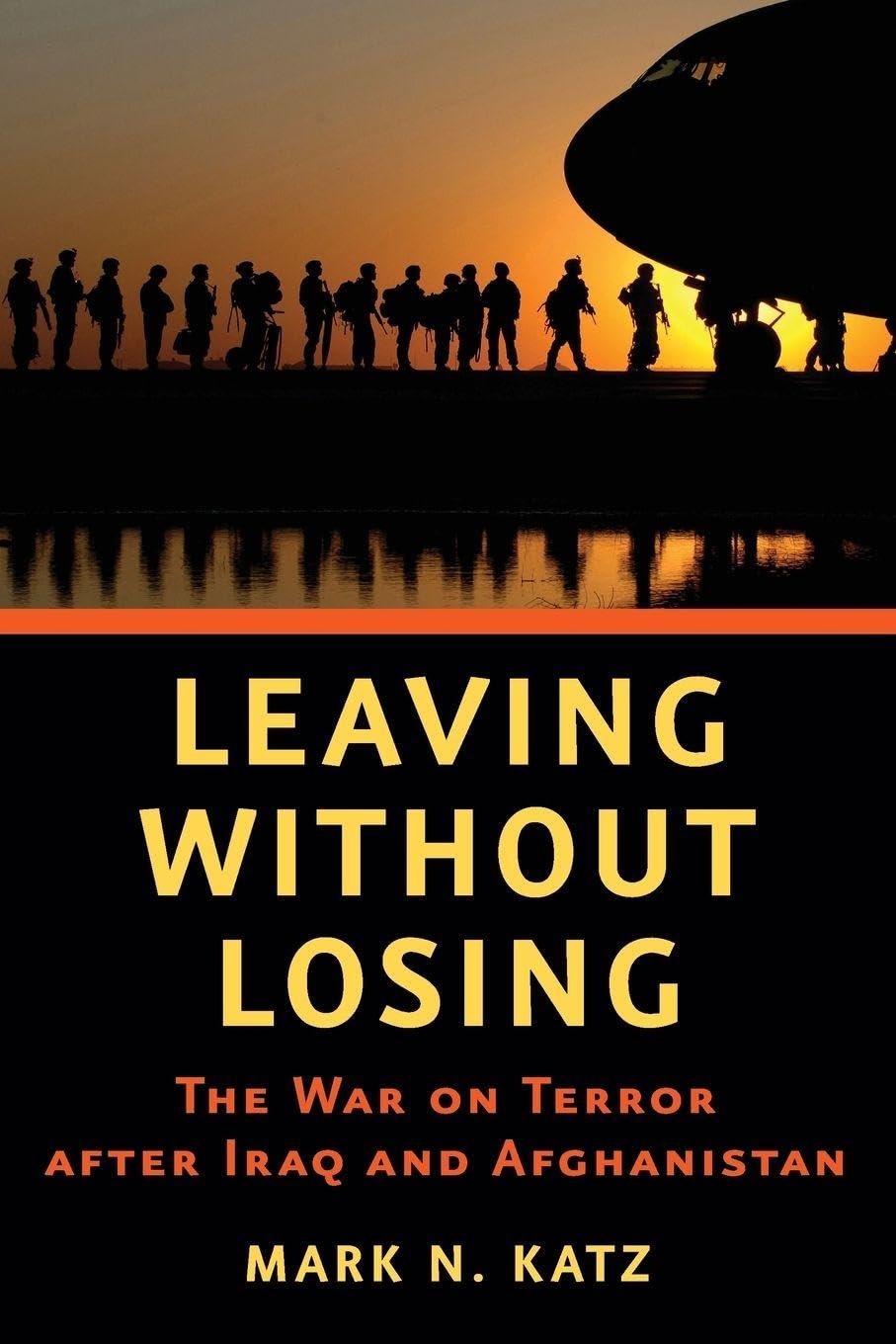
Leaving Without Losing: The War on Terror After Iraq and Afghanistan by Mark N. Katz – A Strategic Analysis of US Counte
Inclusive of all applicable taxes. FREE shipping on all orders.
Available Offers
- 🚚Free Delivery — Free shipping on all orders
- 💵Cash on Delivery — Pay when your order arrives
- ↩️15-Day Easy Returns — Hassle-free return policy
- 🔒Cash on Delivery — Pay safely when your order arrives
Check Delivery
Product Description
Introduction
In an era marked by shifting global alliances and the long shadow of military interventions, Mark N. Katz’s Leaving Without Losing: The War on Terror After Iraq and Afghanistan arrives as a timely and provocative examination of U.S. foreign policy. For Indian readers, students of international relations, and policymakers, this book offers a fresh lens through which to understand the complexities of withdrawal, counterterrorism, and the future of global security. Katz challenges the conventional narrative that exiting conflict zones signals weakness, arguing instead that strategic disengagement can be a powerful tool in the fight against radical Islam.
Book Overview
Published by the esteemed Johns Hopkins University Press, this hardcover volume delves into the parallels between the Cold War and the War on Terror. Katz, a distinguished scholar of international relations, systematically dissects the outcomes of the U.S. campaigns in Iraq and Afghanistan. He posits that the prolonged military presence in these nations has not only failed to achieve lasting stability but has also inadvertently fueled extremist narratives. By drawing lessons from the Cold War—where the United States eventually prevailed through containment rather than endless occupation—Katz builds a compelling case for a phased, strategic withdrawal. The book does not advocate for abandonment but for a recalibration of tactics, emphasizing diplomatic, economic, and intelligence-based approaches over sustained combat operations.
Key Highlights
- Cold War Parallels: Katz draws insightful comparisons between the Soviet withdrawal from Afghanistan and the current U.S. predicament, offering historical context often missing in mainstream debates.
- Strategic Reassessment: The book argues that ending the wars in Iraq and Afghanistan could actually strengthen America’s long-term position against radical Islam, a counterintuitive thesis backed by rigorous analysis.
- Focus on Radical Islam: Rather than framing the conflict as a clash of civilizations, Katz zeroes in on the ideological and organizational nature of extremist groups, providing a nuanced understanding of the adversary.
- Policy Recommendations: Concrete, actionable suggestions for U.S. and allied governments, including India, on how to navigate post-withdrawal scenarios without ceding influence to hostile actors.
Inside the Book
The narrative is structured to first establish the failures of the current engagement, then pivot to historical lessons, and finally propose a forward-looking strategy. Katz meticulously examines the political and social landscapes of Iraq and Afghanistan, highlighting how the presence of foreign troops has often been a recruitment tool for insurgents. He also explores the role of regional powers—including Iran, Pakistan, and Saudi Arabia—in shaping outcomes. The book does not shy away from uncomfortable truths about the limitations of military power and the necessity of accepting imperfect results in complex environments. Each chapter builds on the last, creating a cohesive argument that is both scholarly and accessible.
Key Topics
- The War on Terror: Origins, evolution, and current state
- U.S. withdrawal strategies from Iraq and Afghanistan
- Lessons from the Cold War for contemporary counterterrorism
- The rise and resilience of radical Islamist movements
- Regional geopolitics of South Asia and the Middle East
- The role of intelligence, diplomacy, and economic aid in post-conflict scenarios
- Critique of nation-building and democratization through military force
Reader Benefits
This book equips readers with a sophisticated framework for analyzing not just the War on Terror, but any prolonged military engagement. For Indian readers, it offers valuable insights into the challenges faced by neighbouring countries and the implications for India’s own security policy, particularly regarding cross-border terrorism. Students will gain a deeper understanding of international relations theory applied to real-world crises. Professionals in diplomacy, defence, and journalism will find the strategic arguments useful for shaping reports, analyses, and policy briefs. The hardcover format makes it a durable addition to any academic or personal library.
Learning Outcomes
- Understand the historical context and strategic errors of the U.S. interventions in Iraq and Afghanistan.
- Analyse the concept of ‘strategic patience’ and how it applies to modern counterterrorism.
- Evaluate the effectiveness of military withdrawal as a tool for long-term security.
- Identify the key drivers of radical Islam and the conditions that allow it to flourish.
- Develop critical thinking skills to assess media narratives and government policies on war and peace.
Who Should Read
Leaving Without Losing is essential reading for students of political science, international relations, and strategic studies. It is equally valuable for policymakers, diplomats, military strategists, and journalists covering global conflicts. Indian readers with an interest in South Asian security, the impact of U.S. foreign policy on the region, or the ideological roots of terrorism will find Katz’s analysis particularly relevant. The book is also accessible to general readers who seek a clearer understanding of why the War on Terror has proven so difficult to end.
About the Author
Mark N. Katz is a professor of government and politics at George Mason University, with decades of experience studying international relations, revolution, and the politics of the Middle East and South Asia. He has authored numerous books and articles on U.S. foreign policy, the Cold War, and radical movements. His expertise lends both authority and clarity to this work, making complex geopolitical ideas understandable without oversimplification.
About the Publisher
Johns Hopkins University Press is one of the oldest and most respected academic publishers in the United States. Known for its rigorous editorial standards and contributions to scholarly discourse, the press publishes works that shape policy, education, and research worldwide. This hardcover edition reflects the publisher’s commitment to producing durable, high-quality books that stand the test of time.
Conclusion
In a world where the consequences of war continue to ripple across borders, Leaving Without Losing offers a reasoned, historically grounded, and thought-provoking alternative to the prevailing wisdom. Mark N. Katz does not just critique the past; he charts a path forward—one that prioritises long-term victory over short-term occupation. For anyone seeking to understand the future of global security and the true meaning of winning a war, this book is an indispensable guide.
Quick Summary
Leaving Without Losing: The War on Terror After Iraq and Afghanistan by Mark N. Katz is a bold and insightful analysis of US foreign policy in the post-9/11 era. Katz, a seasoned international relations scholar, argues that withdrawing combat troops from Iraq and Afghanistan does not signify American decline but instead offers a strategic advantage in countering radical Islam. Drawing parallels with the Cold War, he demonstrates how ending military engagements can help the US and its allies more effectively combat terrorism and promote democracy. This book is ideal for students of political science, policy analysts, and anyone interested in global security. Readers will learn to rethink conventional wisdom about military intervention and gain a nuanced understanding of the war on terror. By purchasing from Bookshops.in, Indian readers receive a premium hardcover edition with reliable delivery and trusted service.
Book Highlights
Book Specifications
| ISBN-13 | 9781421411835 |
| ISBN-10 | 1421411830 |
| Publisher | Johns Hopkins Univ Pr |
| Language | English |
| Dimensions | 15.24 x 0.94 x 22.86 cm |
| Weight | 227 g |
| Country | India |
| Category | Political Science › Government |
| Genre | Nonfiction |
| Original Language | English |
Frequently Asked Questions
What is Leaving Without Losing about?
Who is the author of this book?
Is this book suitable for Indian readers?
What makes this book unique?
Does the book cover the Cold War?
What is the main argument of the book?
Is this a hardcover or paperback?
What is the price of this book in India?
Can I use this book for academic research?
Does the book discuss democracy in the Middle East?
What is the publication date?
Why should I buy from Bookshops.in?
Readers Also Search For
Customers Also Bought

McFarland & Company
Playing with the Guys | by Marc A. Ouellette | Matthew Wilhelm Kapell | McFarland & Company | by Marc A. Ouellette | Matthew Wilhelm Kapell | McFarland & Company | by Marc A. Ouellette | Matthew Wilhelm Kapell | McFarland & Company | by Marc A. Ouellette | Matthew Wilhelm Kapell | McFarland & Company | by Marc A. Ouellette | Matthew Wilhelm Kapell | McFarland & Company | by Marc A. Ouellette | Matthew Wilhelm Kapell | McFarland & Company | by Marc A. Ouellette | Matthew W

Rowman & Littlefield Publishers
Joss Whedon's Dollhouse: Confounding Purpose, Confusing Identity (Science Fiction Television)

State University of New York Press
Mexico Unmanned: The Cultural Politics of Masculinity in Mexican Cinema (SUNY series in Latin American Cinema)

McFarland & Company
Valley Forge to Monmouth | by Jim Stempel | McFarland & Company | by Jim Stempel | McFarland & Company | by Jim Stempel | McFarland & Company | by Jim Stempel | McFarland & Company | by Jim Stempel | McFarland & Company | by Jim Stempel | McFarland & Company | by Jim Stempel | McFarland & Company | by Jim Stempel | McFarland & Company | by Jim Stempel | McFarland & Company | by Jim Stempel | McFarland & Company | by Jim Stempel | McFarland & Company |

University of Toronto Press
Structures of Feeling in Seventeenth-Century Cultural Expression (UCLA Center Clark Library)

McFarland & Company
Welcome to Arkham Asylum | by Sharon Packer | Daniel R. Fredrick | McFarland & Company | by Sharon Packer | Daniel R. Fredrick | McFarland & Company | by Sharon Packer | Daniel R. Fredrick | McFarland & Company | by Sharon Packer | Daniel R. Fredrick | McFarland & Company | by Sharon Packer | Daniel R. Fredrick | McFarland & Company | by Sharon Packer | Daniel R. Fredrick | McFarland & Company | by Sharon Packer | Daniel R. Fredrick | McFarland & Company | by Sharon P
Related Products
View All
Johns Hopkins University Press
Academia Next | by Bryan Alexander | Johns Hopkins University Press | by Bryan Alexander | Johns Hopkins University Press | by Bryan Alexander | Johns Hopkins University Press | by Bryan Alexander | Johns Hopkins University Press | by Bryan Alexander | Johns Hopkins University Press | by Bryan Alexander | Johns Hopkins University Press | by Bryan Alexander | Johns Hopkins University Press | by Bryan Alexander | Johns Hopkins University Press | by Bryan Alexander | Johns Hopkins University Press

Johns Hopkins University Press
The College Stress Test | by Robert Zemsky | Susan Shaman | Susan Campbell Baldridge | Johns Hopkins University Press | by Robert Zemsky | Susan Shaman | Susan Campbell Baldridge | Johns Hopkins University Press | by Robert Zemsky | Susan Shaman | Susan Campbell Baldridge | Johns Hopkins University Press | by Robert Zemsky | Susan Shaman | Susan Campbell Baldridge | Johns Hopkins University Press | by Robert Zemsky | Susan Shaman | Susan Campbell Baldridge | Johns Hopkins University Press | by R

Johns Hopkins University Press
Melodies Unheard | by Anthony Hecht | Johns Hopkins University Press | by Anthony Hecht | Johns Hopkins University Press | by Anthony Hecht | Johns Hopkins University Press | by Anthony Hecht | Johns Hopkins University Press | by Anthony Hecht | Johns Hopkins University Press | by Anthony Hecht | Johns Hopkins University Press | by Anthony Hecht | Johns Hopkins University Press | by Anthony Hecht | Johns Hopkins University Press | by Anthony Hecht | Johns Hopkins University Press | by Anthony He

Johns Hopkins University Press
Powering American Farms by Richard F. Hirsh – History

Johns Hopkins University Press
Health Plans Unmasked | by Martin Lustick | Johns Hopkins University Press | by Martin Lustick | Johns Hopkins University Press | by Martin Lustick | Johns Hopkins University Press | by Martin Lustick | Johns Hopkins University Press | by Martin Lustick | Johns Hopkins University Press | by Martin Lustick | Johns Hopkins University Press | by Martin Lustick | Johns Hopkins University Press | by Martin Lustick | Johns Hopkins University Press | by Martin Lustick | Johns Hopkins University Press |

Johns Hopkins University Press