
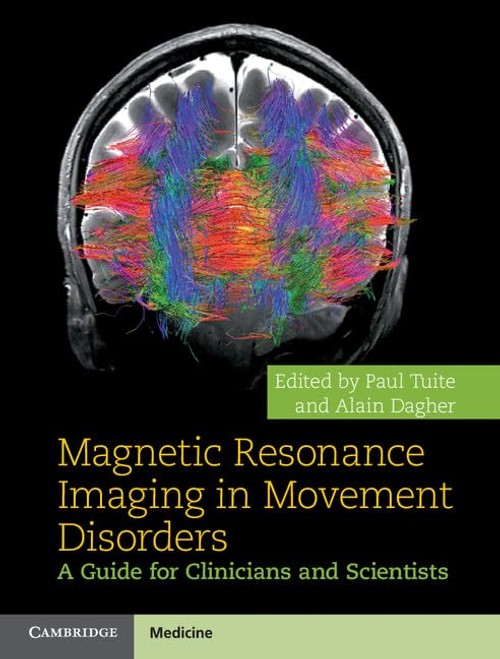
Magnetic Resonance Imaging in Movement Disorders: A Guide for Clinicians and Scientists by Paul Tuite
Inclusive of all applicable taxes. FREE shipping on all orders.
Available Offers
- 🚚Free Delivery — Free shipping on all orders
- 💵Cash on Delivery — Pay when your order arrives
- ↩️15-Day Easy Returns — Hassle-free return policy
- 🔒Cash on Delivery — Pay safely when your order arrives
Check Delivery
Product Description
Introduction
Movement disorders such as Parkinson's disease, Huntington's disease, and dystonia present complex diagnostic and management challenges. In recent years, magnetic resonance imaging (MRI) has emerged as a powerful tool to visualize brain structure, function, and chemistry in these conditions. Magnetic Resonance Imaging in Movement Disorders: A Guide for Clinicians and Scientists, authored by Paul Tuite and published by Cambridge University Press, is a comprehensive resource that bridges the gap between cutting-edge neuroimaging and clinical practice. This hardbound volume is an essential companion for neurologists, radiologists, and researchers in India and beyond who seek to harness MRI for better patient outcomes.
Book Overview
This book is the first of its kind to focus exclusively on the application of MRI in movement disorders. It systematically covers a wide spectrum of imaging strategies, from structural and functional MRI to advanced chemical and diffusion-based methods. The text is designed to be accessible to both clinicians who interpret scans daily and scientists exploring novel imaging biomarkers. With chapters dedicated to motor and non-motor aspects of Parkinson's disease, as well as conditions like Huntington's disease and dystonia, the book offers a holistic view of how MRI can inform diagnosis, prognosis, and treatment planning. It also addresses the role of MRI in surgical interventions and as a potential outcome measure in clinical trials, making it highly relevant for India's growing research community.
Key Highlights
- First dedicated reference on MRI in movement disorders, filling a critical gap in medical literature.
- Comprehensive coverage of structural, functional, and chemical imaging techniques.
- Clinical relevance with chapters on MRI-guided surgery and trial outcome measures.
- Advanced methods explained including diffusion tensor imaging (DTI), tractography, and resting-state fMRI.
- Authoritative contributions from leading international experts in neurology and radiology.
Inside the Book
The book is organized into well-structured chapters that guide readers from basic principles to advanced applications. Early chapters introduce the fundamentals of MRI physics and standard imaging protocols used in movement disorder clinics. Subsequent sections delve into specific techniques such as neuromelanin-sensitive imaging, iron-sensitive sequences, and spectroscopy. A standout feature is the detailed exploration of resting-state functional MRI and its ability to map brain networks disrupted in Parkinson's and related disorders. The book also includes practical guidance on image interpretation, pitfalls to avoid, and emerging trends like ultra-high-field MRI. Each chapter is enriched with illustrative figures, case examples, and references to key studies, making it a valuable learning tool for Indian medical students and practitioners.
Key Topics
- Structural MRI findings in Parkinson's disease, Huntington's disease, and dystonia
- Functional MRI (fMRI) for motor and cognitive symptoms
- Diffusion tensor imaging and tractography for white matter assessment
- Magnetic resonance spectroscopy for metabolic profiling
- Iron-sensitive imaging and neuromelanin imaging
- Resting-state fMRI and brain connectivity analysis
- MRI-guided deep brain stimulation and surgical planning
- Use of MRI as a biomarker in clinical trials
Reader Benefits
Readers will gain a deep understanding of how MRI can be used to differentiate movement disorders, monitor disease progression, and evaluate treatment responses. The book equips clinicians with the knowledge to select appropriate imaging protocols and interpret complex scans with confidence. For researchers, it provides a roadmap for designing studies that leverage advanced MRI techniques. Indian readers will appreciate the practical focus on cost-effective imaging strategies and the discussion of challenges relevant to resource-limited settings. The clear, jargon-free writing style ensures that even those new to neuroimaging can grasp the core concepts.
Learning Outcomes
- Identify key MRI features of common movement disorders
- Understand the principles behind functional and chemical imaging methods
- Apply MRI findings to differential diagnosis and treatment planning
- Evaluate the role of MRI in surgical and clinical trial contexts
- Critically assess emerging imaging techniques for research and practice
Who Should Read
This book is indispensable for neurologists, radiologists, and movement disorder specialists in India. It is also highly recommended for postgraduate students in neurology and radiology, clinical researchers, and neuroscientists interested in neuroimaging. Medical libraries and academic institutions will find it a valuable addition to their collections, supporting both clinical training and research initiatives.
About the Author
Paul Tuite is a renowned neurologist and researcher with extensive experience in movement disorders and neuroimaging. He has contributed significantly to the understanding of Parkinson's disease and related conditions through his work at leading academic medical centers. His expertise in translating imaging science into clinical practice makes him an ideal editor for this comprehensive guide.
About the Publisher
Cambridge University Press is a globally respected academic publisher known for its high-quality medical and scientific books. With a legacy of scholarly excellence, the press ensures that each title meets rigorous standards of accuracy and relevance. This hardcover edition is built to last, making it a reliable reference for years to come.
Conclusion
Magnetic Resonance Imaging in Movement Disorders is a landmark publication that empowers clinicians and scientists to fully leverage MRI in the battle against debilitating neurological conditions. Whether you are diagnosing a patient with early Parkinson's or designing a clinical trial for a new therapy, this book offers the insights and tools you need. Order your copy today from Bookshops.in and take a decisive step toward mastering the intersection of imaging and movement disorders.
Quick Summary
Magnetic Resonance Imaging in Movement Disorders: A Guide for Clinicians and Scientists by Paul Tuite is the first dedicated resource focusing on MRI applications in movement disorders. It provides an in-depth exploration of functional, structural, and chemical imaging methods as they relate to Parkinson's disease, Huntington's disease, dystonia, and other conditions. The book covers both motor and non-motor aspects, making it invaluable for comprehensive patient assessment. Advanced techniques such as diffusion tensor imaging (DTI), tractography, and resting state fMRI are explained in detail, along with their role in surgical planning and as outcome measures in clinical trials. Written by a renowned expert and published by Cambridge University Press, this hardcover volume is essential for neurologists, radiologists, researchers, and students seeking to master MRI in movement disorders. By purchasing from Bookshops.in, Indian readers get a genuine copy with fast delivery and excellent customer service.
Book Highlights
Book Specifications
| ISBN-13 | 9781107026360 |
| ISBN-10 | 1107026369 |
| Publisher | Cambridge University Press |
| Language | English |
| Dimensions | 19.69 x 1.91 x 25.4 cm |
| Weight | 1 kg 10 g |
| Country | United Kingdom |
| Category | Radiology & Nuclear Medicine › Diagnostic Imaging |
| Genre | Medical |
| Original Language | English |
Frequently Asked Questions
What is this book about?
Who is the author?
Is this book suitable for beginners?
Does it cover advanced MRI techniques?
Can I use this book for clinical practice?
What movement disorders are covered?
Is there a digital edition?
Does it include case studies?
Can researchers benefit from this book?
What is the reading level?
Is it available in India?
What is the price?
Readers Also Search For
Customers Also Bought

Anatomy
Ultrastructure of the Digestive Tract: 4 (Electron Microscopy in Biology and Medicine)

Anatomy
Ultrastructure of the Connective Tissue Matrix: 3 (Electron Microscopy in Biology and Medicine)

Anatomy
Reproductive Genetics (Royal College of Obstetricians and Gynaecologists Study Group)

Anatomy
Human Gross Anatomy: An Outline Text by Robert J. Leonard – Medical Anatomy

Pharmacology
Mathematical Modeling and Simulation in Enteric Neurobiology

Anatomy
Nature’s Patterns and the Fractional Calculus: 2 (Fractional Calculus in Applied Sciences and Engineering, 2)
Related Products
View All
Medicine & Health Sciences
Pediatrics on Call | by Charles A. Pohl | Kathleen Bradford | Clara Callahan | McGraw Hill / Medical | by Charles A. Pohl | Kathleen Bradford | Clara Callahan | McGraw Hill / Medical | by Charles A. Pohl | Kathleen Bradford | Clara Callahan | McGraw Hill / Medical | by Charles A. Pohl | Kathleen Bradford | Clara Callahan | McGraw Hill / Medical | by Charles A. Pohl | Kathleen Bradford | Clara Callahan | McGraw Hill / Medical | by Charles A. Pohl | Kathleen Bradford | Clara Callahan | McGraw Hill

Medicine & Health Sciences
The Physician's Guide to Depression and Bipolar Disorders | by Dwight L. Evans | Dennis S. Charney | Lydia Lewis | McGraw Hill / Medical | by Dwight L. Evans | Dennis S. Charney | Lydia Lewis | McGraw Hill / Medical | by Dwight L. Evans | Dennis S. Charney | Lydia Lewis | McGraw Hill / Medical | by Dwight L. Evans | Dennis S. Charney | Lydia Lewis | McGraw Hill / Medical | by Dwight L. Evans | Dennis S. Charney | Lydia Lewis | McGraw Hill / Medical | by Dwight L. Evans | Dennis S. Charney | Lydi

Medicine & Health Sciences
First Exposure to Internal Medicine | by Andrew R. Hoellein | Charles H. Griffith | McGraw Hill / Medical | by Andrew R. Hoellein | Charles H. Griffith | McGraw Hill / Medical | by Andrew R. Hoellein | Charles H. Griffith | McGraw Hill / Medical | by Andrew R. Hoellein | Charles H. Griffith | McGraw Hill / Medical | by Andrew R. Hoellein | Charles H. Griffith | McGraw Hill / Medical | by Andrew R. Hoellein | Charles H. Griffith | McGraw Hill / Medical | by Andrew R. Hoellein | Charles H. Griffit

Medicine & Health Sciences
First Exposure to Internal Medicine | by Charles H. Griffith | Andrew R. Hoellein | McGraw Hill / Medical | by Charles H. Griffith | Andrew R. Hoellein | McGraw Hill / Medical | by Charles H. Griffith | Andrew R. Hoellein | McGraw Hill / Medical | by Charles H. Griffith | Andrew R. Hoellein | McGraw Hill / Medical | by Charles H. Griffith | Andrew R. Hoellein | McGraw Hill / Medical | by Charles H. Griffith | Andrew R. Hoellein | McGraw Hill / Medical | by Charles H. Griffith | Andrew R. Hoellei
Medicine & Health Sciences
Internal Medicine | by Paul G. Schmitz | Kevin J. Martin | McGraw Hill / Medical | by Paul G. Schmitz | Kevin J. Martin | McGraw Hill / Medical | by Paul G. Schmitz | Kevin J. Martin | McGraw Hill / Medical | by Paul G. Schmitz | Kevin J. Martin | McGraw Hill / Medical | by Paul G. Schmitz | Kevin J. Martin | McGraw Hill / Medical | by Paul G. Schmitz | Kevin J. Martin | McGraw Hill / Medical | by Paul G. Schmitz | Kevin J. Martin | McGraw Hill / Medical | by Paul G. Schmitz | Kevin J. Martin |

Medicine & Health Sciences