
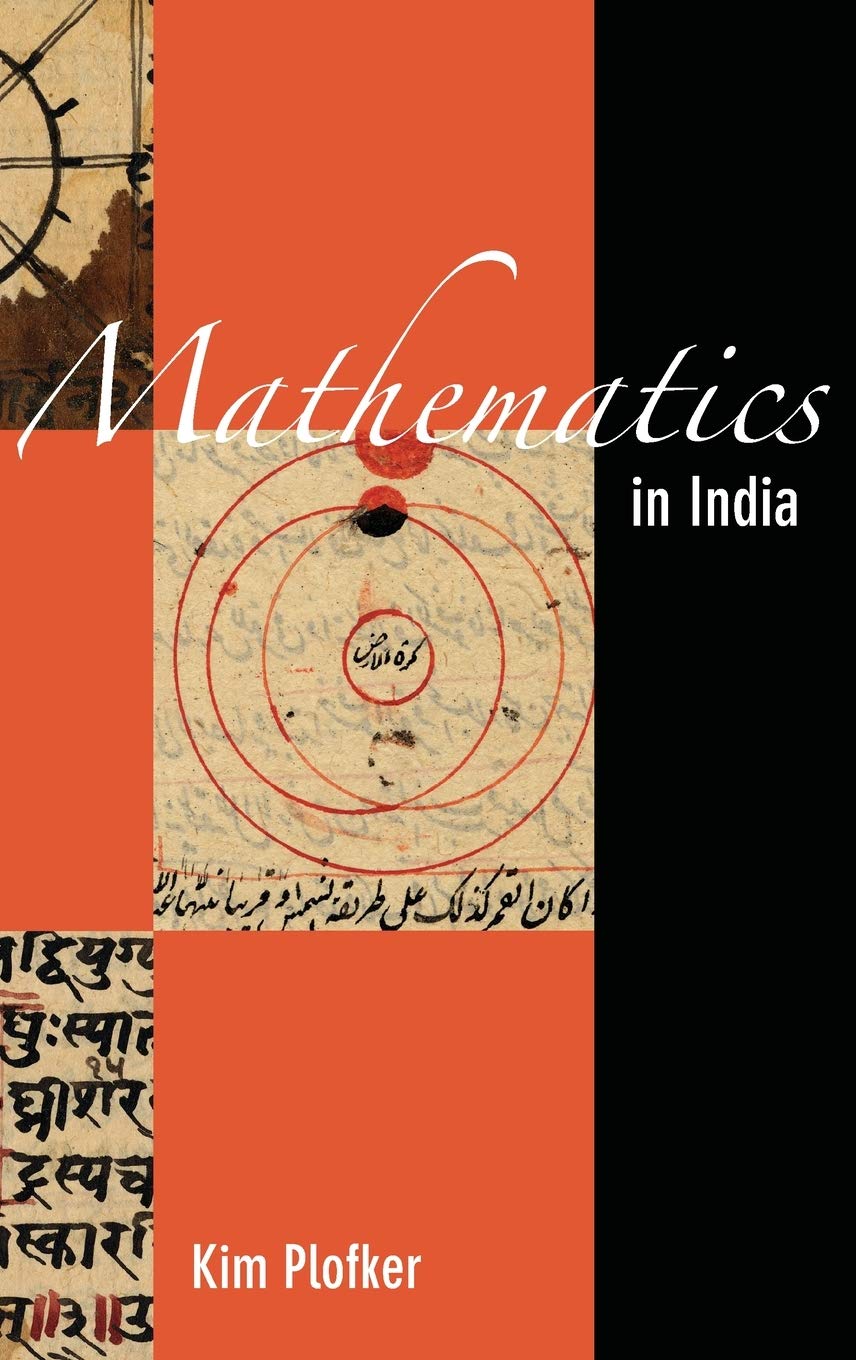
Mathematics in India: A Deep Dive into Ancient and Medieval Mathematical Traditions by Kim Plofker
Inclusive of all applicable taxes. FREE shipping on all orders.
Available Offers
- 🚚Free Delivery — Free shipping on all orders
- 💵Cash on Delivery — Pay when your order arrives
- ↩️15-Day Easy Returns — Hassle-free return policy
- 🔒Cash on Delivery — Pay safely when your order arrives
Check Delivery
Product Description
Introduction
India’s contribution to the world of numbers, algebra, and geometry is often reduced to a few well-known anecdotes—the invention of zero, the decimal system, and the so-called Arabic numerals. But the true story of mathematics in the Indian subcontinent is far richer, more complex, and deeply intertwined with astronomy, philosophy, and culture. Kim Plofker’s Mathematics in India (published by Princeton University Press) is a landmark work that takes readers beyond the myths and into the actual textual traditions of South Asian mathematics, spanning from the Vedic period to the early modern era. For students, researchers, and curious minds, this hardcover edition offers an authoritative yet accessible journey through centuries of mathematical thought.
Book Overview
Mathematics in India is not just a chronological list of discoveries; it is a meticulously researched narrative that places mathematical ideas within their social, religious, and scientific contexts. Kim Plofker, a renowned historian of mathematics, draws on extensive Sanskrit sources and cross-cultural exchanges with Islamic and European traditions. The book challenges oversimplified narratives and reveals a vibrant, unified discipline that evolved organically alongside astronomy, ritual, and commerce. From the Sulbasutras to the Kerala school, every chapter is grounded in primary texts and critical analysis, making this an essential reference for anyone serious about the history of science.
Key Highlights
- Groundbreaking Research: Based on decades of study of original Sanskrit manuscripts, offering fresh insights into familiar topics like the origin of zero and place-value notation.
- Cultural Context: Explains how mathematical knowledge was transmitted through oral traditions, commentaries, and pedagogical practices unique to India.
- Cross-Cultural Connections: Examines the exchange of ideas between Indian, Islamic, and European mathematicians, correcting many misconceptions about the flow of knowledge.
- Comprehensive Coverage: Covers everything from geometry in Vedic altars to the advanced infinite series of the Kerala school, and the influence of Indian numerals on global mathematics.
Inside the Book
The book is structured to guide both newcomers and specialists. It begins with the earliest evidence of mathematical activity in the Indus Valley and Vedic rituals, then moves through classical texts like the Brahmasphutasiddhanta and Lilavati. Plofker dedicates significant attention to the medieval period, when Indian astronomers like Aryabhata and Bhaskara made remarkable advances in trigonometry and calculus. Later chapters explore the impact of Islamic scholarship and the eventual encounter with European colonialism. Each chapter includes translations of key passages, detailed diagrams, and explanations of mathematical techniques, making complex ideas understandable without oversimplification.
Key Topics
- Vedic Geometry and the Sulbasutras: The earliest known Indian mathematical texts, used for constructing sacrificial altars.
- Place-Value Notation and Zero: The evolution of the decimal system and the concept of zero as both a numeral and a philosophical idea.
- Astronomical Mathematics: How Indian astronomers developed sophisticated methods for calculating planetary positions, eclipses, and calendars.
- Algebra and Equations: The work of Brahmagupta, Bhaskara, and others on quadratic equations, indeterminate equations, and number theory.
- Trigonometry and Sine Tables: Indian contributions to trigonometric functions, including the sine and cosine, long before their use in Europe.
- The Kerala School: A remarkable tradition in southern India that discovered infinite series for pi and trigonometric functions, centuries before Newton and Leibniz.
- Transmission to the Islamic World and Europe: How Indian numerals and astronomical tables travelled across continents, shaping global mathematics.
Reader Benefits
This book is more than a historical account—it is a tool for understanding how mathematics is shaped by culture and necessity. Readers will gain a nuanced appreciation for India’s intellectual heritage, free from nationalist exaggeration or colonial dismissal. The clear explanations of mathematical concepts make it suitable for non-specialists, while the depth of scholarship satisfies academics. By the end, you will see Indian mathematics not as a series of isolated “firsts,” but as a living tradition that thrived for millennia, adapting to new challenges and exchanging ideas with the wider world.
Learning Outcomes
- Understand the chronology and key figures of Indian mathematics from 1500 BCE to 1700 CE.
- Recognize the role of astronomy, religion, and commerce in shaping mathematical practice.
- Analyze primary source passages from Sanskrit mathematical texts with context.
- Critically evaluate common myths about Indian mathematics (e.g., the “invention” of zero).
- Trace the transmission of Indian mathematical ideas to the Islamic world and Europe.
- Appreciate the diversity of mathematical traditions within South Asia, including regional schools like Kerala.
Who Should Read
Mathematics in India is ideal for undergraduate and postgraduate students of history of science, mathematics, and South Asian studies. It is also a valuable resource for teachers who want to incorporate non-European perspectives into their curriculum. General readers with an interest in Indian culture or the history of ideas will find it engaging and enlightening. Whether you are a mathematician curious about your field’s global roots, or a historian seeking to understand the intellectual landscape of ancient India, this book offers a rigorous yet readable guide.
About the Author
Kim Plofker is a historian of mathematics specializing in Indian and Islamic traditions. She has held research positions at leading institutions including Brown University and the University of Utrecht, and has published extensively on Sanskrit mathematical and astronomical texts. Her work is known for its meticulous philological approach and its ability to make technical subjects accessible to a broad audience.
About the Publisher
Princeton University Press is a prestigious academic publisher known for its high-quality works in science, mathematics, history, and philosophy. With a commitment to scholarly excellence, Princeton Press has published many definitive texts in the history of science, including this volume which has become a standard reference in its field.
Conclusion
Mathematics in India by Kim Plofker is an indispensable addition to any serious library. It replaces oversimplified stories with a nuanced, evidence-based account of a rich intellectual tradition. For Indian readers, it offers a proud but honest look at our mathematical heritage; for the global audience, it corrects centuries of misunderstanding. If you want to truly understand the origins of the numbers you use every day, and the culture that shaped them, this hardcover edition from Bookshops.in is the perfect starting point.
Quick Summary
Mathematics in India by Kim Plofker is a definitive historical account of mathematical thought in South Asia, drawing on a wealth of Sanskrit manuscripts and other primary sources. The book traces the evolution of mathematical techniques from the Vedic period through the early modern era, highlighting key figures like Aryabhata, Brahmagupta, and Bhaskara, as well as the influential Kerala school. It goes beyond popular myths to reveal a vibrant, interconnected discipline that thrived alongside astronomy and engaged in fruitful exchanges with Islamic science. Readers will gain a deep appreciation for the Indian numeral system, the concept of zero, and the sophisticated algebraic and geometric traditions that emerged. This book is ideal for students, scholars, and anyone curious about the rich intellectual heritage of India. By choosing Bookshops.in, you support a premium Indian bookstore that offers authentic, high-quality editions delivered across the country.
Book Highlights
Book Specifications
| ISBN-13 | 9780691120676 |
| ISBN-10 | 0691120676 |
| Publisher | Princeton Univ Pr |
| Language | English |
| Dimensions | 15.88 x 3.18 x 23.5 cm |
| Weight | 771 g |
| Category | Social Sciences › Geography |
| Genre | Non-fiction |
| Original Language | English |
Frequently Asked Questions
What is Mathematics in India about?
Who is the author of this book?
Is this book suitable for beginners?
Does the book cover the origin of zero?
What time period does the book cover?
Are there illustrations in the book?
How is this book different from other histories of math?
Does the book discuss Islamic influences?
Is this a hardcover edition?
What is the ISBN of this book?
Can I use this book for academic research?
Does the book include the Kerala school?
What language is the book written in?
Readers Also Search For
Customers Also Bought
Mathematics
Stereotype Spaces and Algebras: 73 (De Gruyter Expositions in Mathematics, 73)

Mathematics
Semigroups in Algebra, Geometry and Analysis: 20 (De Gruyter Expositions in Mathematics, 20)

Mathematics
Geometry from the Pacific Rim: Proceedings of the Pacific Rim Geometry Conference held at National University of Singapore, Republic of Singapore, ... 1994 (De Gruyter Proceedings in Mathematics)
Mathematics
First International Tainan-Moscow Algebra Workshop: Proceedings of the International Conference held at National Cheng Kung University Tainan, Taiwan, ... 1994 (De Gruyter Proceedings in Mathematics)

Mathematics
Differential Geometry - Proceedings of the VIII International Colloquium (English, Jesus A. Alvarez Lopez | Eduardo Garcia-Rio)
Mathematics
Mathematical Theory of Optimal Processes (Classics of Soviet Mathematics)
Related Products
View All
Science & Mathematics
Elements of Pelagos Biology: With Focus on the Mediterranean Sea

Science & Mathematics
Squid - Superconducting Quantum Interference Devices and Their Applications: Proceedings of the International Conference on Superconducting Quantum Devices, Berlin-west, October 4-8, 1976

Science & Mathematics
Thermodynamics and Pattern Formation in Biology
Science & Mathematics
The Nature of Mathematics and the Mathematics of Nature by S. Andersson – Mathematics & Science

Science & Mathematics
Linear Algebra | by Stephen Friedberg | Arnold Insel | Lawrence Spence | Pearson | by Stephen Friedberg | Arnold Insel | Lawrence Spence | Pearson | by Stephen Friedberg | Arnold Insel | Lawrence Spence | Pearson | by Stephen Friedberg | Arnold Insel | Lawrence Spence | Pearson | by Stephen Friedberg | Arnold Insel | Lawrence Spence | Pearson | by Stephen Friedberg | Arnold Insel | Lawrence Spence | Pearson | by Stephen Friedberg | Arnold Insel | Lawrence Spence | Pearson | by Stephen Friedberg

Science & Mathematics