
All Books
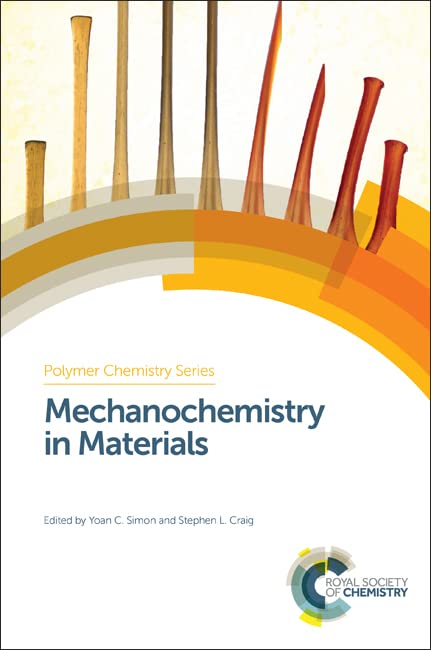
Mechanochemistry in Materials: Volume 26 (Polymer Chemistry Series)
Science & Mathematics

Mechanochemistry in Materials: Volume 26 (Polymer Chemistry Series)

5,963

Inclusive of all applicable taxes. FREE shipping on all orders.

Quantity:
1
Share:
Free DeliveryOn every order
15-Day ReturnEasy returns
Genuine BookPhysical copy only

Available Offers

  • 🚚Free DeliveryFree shipping on all orders
  • 💵Cash on DeliveryPay when your order arrives
  • ↩️15-Day Easy ReturnsHassle-free return policy
  • 🔒Cash on DeliveryPay safely when your order arrives

Check Delivery

Product Description

With tremendous growth over the last five years, mechanochemistry has become one of the most important topics in current polymer science research. With a particular focus on polymers and soft materials, Mechanochemistry in Materials looks at the subject from the application of macroscopic forces to solid systems of macroscopic dimensions.The book has been divided according to length scale covering both experimental and theoretical considerations simultaneously. The first section of the book focuses on inspiration from nature, exploring and explaining multiple biological phenomena. The second section discusses molecular mechanochemistry, including the theoretical understanding of the transduction of mechanical force and its impact on covalent bonds cleavage and formation. The final section considers the implementation of these phenomena at the mesoscale and discusses the use of supramolecular/reversible aspects with similarities to biological systems.The book provides a unique comparison with natural systems and contains all the important achievements in the area from the last decade. Appealing to a broad range of materials scientists, working in industry and academia, this well-presented and comprehensive title will be essential reading for researchers.

Product description Review Select Guide Rating From the Back Cover With tremendous growth over the last five years, mechanochemistry has become one of the most important topics in current polymer science research. With a particular focus on polymers and soft materials, Mechanochemistry in Materials looks at the subject from the application of macroscopic forces to solid systems of macroscopic dimensions. The book has been divided according to length scale covering both experimental and theoretical considerations simultaneously. The first section of the book focuses on inspiration from nature, exploring and explaining multiple biological phenomena. The second section discusses molecular mechanochemistry, including the theoretical understanding of the transduction of mechanical force and its impact on covalent bonds cleavage and formation. The final section considers the implementation of these phenomena at the mesoscale and discusses the use of supramolecular/reversible aspects with similarities to biological systems.The book provides a unique comparison with natural systems and contains all the important achievements in the area from the last decade. Appealing to a broad range of materials scientists, working in industry and academia, this well-presented and comprehensive title will be essential reading for researchers. Excerpt. © Reprinted by permission. All rights reserved. Mechanochemistry in MaterialsBy Yoan C. Simon, Stephen L. CraigThe Royal Society of ChemistryCopyright © 2018 The Royal Society of ChemistryAll rights reserved.ISBN: 978-1-78262-146-1ContentsChapter 1 Mechanochemistry: Inspiration from Biology Tamuka Chidanguro, Wengui Weng and Yoan C. Simon, 1, Chapter 2 Mechanophores for Chemical Function C. E. Diesendruck, 36, Chapter 3 Optical Sensing of Stress in Polymers R. Göstl, J. M. Clough and R. P. Sijbesma, 53, Chapter 4 Materials Design Principles for Mechanochemical Transduction M. N. Silberstein and M. S. Manivannan, 76, Chapter 5 Tailoring Mechanochemical Reactivity of Covalent Bonds in Polymers by Non-covalent Interactions Huan Zhang, Linxing Zhang, Yinjun Chen, Yangju Lin and Wengui Weng, 119, Chapter 6 Mechanochemistry of Polymer Brushes Nariye Cavusoglu Ataman, Jan Genzer and Harm-Anton Klok, 155, Chapter 7 Coupling Mechanics to Chemical Reactions to Create "Materials that Compute" Victor V Yashin, Steven P Levitan and Anna C. Balazs, 167, Subject Index, 194, CHAPTER 1Mechanochemistry: Inspiration from BiologyTAMUKA CHIDANGURO, WENGUI WENG AND YOAN C. SIMONUniversity of Southern Mississippi, Hattiesburg, MS, USA1.1 Introduction and Historical PerspectiveMechanochemistry from the contraction of [TEXT NOT REPRODUCIBLE IN ASCII] mekhanikos (mechanic) and [TEXT NOT REPRODUCIBLE IN ASCII] khemia (chemistry) is the study of the evolution of the formation and disruption of chemical bonds upon application of an external force. The terminology "mechanochemistry" was first coined by Ostwald as "the coupling of mechanical energy and chemical energy". Unlike electromagnetic force or gravity, mechanical force implies contact. Indeed, for a force to be applied on a given object or organism, it entails a connection or at least transmission of forces through a medium. Mechanical energy, often in the form of applied force, is a lesser-known way to initiate chemical reactions than conventional stimuli (e.g. heat, light and electricity). At first glance, it is especially interesting and somewhat intriguing to think of chemistry triggered by forces, as it is not something that is typically taught in your General Chemistry 101 class. However, bond ruptures upon mechanical action surround us from random chain scission as one tears through packaging material or simply as one presses on a surface and senses the mechanical deformation. In prehistory, our ancestors took advantage of mechanochemical phenomena for survival, e.g. drilling wood for fire. Theophrastus of Eresus (ca. 315 BC), Aristotle's student, first recorded that grinding cinnabar in a copper mortar using a brass pestle could reduce it to mercury. In the 19th century, Faraday and Lea applied sliding and grinding to study the chemical reactions of solid substances.In many other ways though, for the better part of its existence, humankind has tried to use materials that would minimize their alteration upon application of force. For instance, Damascus steel, which dates back to 900 AD, was a metal of choice for weaponry as it remarkably exhibited superplasticity along with incredible levels of hardness. Interestingly, it is also one of the early examples (though unwittingly) of nanotechnology and mechanochemistry as carbon nanotubes as well as cementite nanowires were proven to form during the forging and annealing of Indian wootz steel. It is indeed believed that the combination of heat and mechanical action along with impurities in the ore (including carburizing wood and leave additives) was responsible for the catalyzing the process responsible

Book Specifications

ISBN-139781782621461
ISBN-101782621466
Publisher‎ Royal Society of Chemistry
Language‎ English
Dimensions‎ 15.6 x 1.59 x 23.4 cm
Weight‎ 476 g
CategoryMechanical Engineering › Material Science & Engineering

Frequently Asked Questions

What is the price of Mechanochemistry in Materials: Volume 26?
Mechanochemistry in Materials: Volume 26 is available at ₹5,963 on BookShops.in.
Does BookShops.in offer free delivery for Mechanochemistry in Materials: Volume 26?
FREE delivery on all orders for Mechanochemistry in Materials: Volume 26.
Is Cash on Delivery available for Mechanochemistry in Materials: Volume 26?
Yes, Cash on Delivery (COD) is available for Mechanochemistry in Materials: Volume 26 on BookShops.in. Pay when your order arrives.
What is the return policy for Mechanochemistry in Materials: Volume 26?
BookShops.in offers a 15-day hassle-free return policy for Mechanochemistry in Materials: Volume 26. Contact us at support@bookshops.in or call +91 90874 10993.
Is Mechanochemistry in Materials: Volume 26 authentic?
Mechanochemistry in Materials: Volume 26 is listed on BookShops.in after verification of product details including ISBN, title, and availability information.

Related Products

View All
Buy Squid - Superconducting Quantum Interference Devices and Their Applications: Proceedings of the International Conference on Superconducting Quantum Devices, Berlin-west, October 4-8, 1976 — BookShops.in

Science & Mathematics

Squid - Superconducting Quantum Interference Devices and Their Applications: Proceedings of the International Conference on Superconducting Quantum Devices, Berlin-west, October 4-8, 1976

5,328
Buy Thermodynamics and Pattern Formation in Biology — BookShops.in

Science & Mathematics

Thermodynamics and Pattern Formation in Biology

5,033
Buy The Nature of Mathematics and the Mathematics of Nature by S. Andersson – Mathematics & Science — BookShops.in

Science & Mathematics

The Nature of Mathematics and the Mathematics of Nature by S. Andersson – Mathematics & Science

5,786
Buy Linear Algebra | by Stephen Friedberg | Arnold Insel | Lawrence Spence | Pearson | by Stephen Friedberg | Arnold Insel | Lawrence Spence | Pearson | by Stephen Friedberg | Arnold Insel | Lawrence Spence | Pearson | by Stephen Friedberg | Arnold Insel | Lawrence Spence | Pearson | by Stephen Friedberg | Arnold Insel | Lawrence Spence | Pearson | by Stephen Friedberg | Arnold Insel | Lawrence Spence | Pearson | by Stephen Friedberg | Arnold Insel | Lawrence Spence | Pearson | by Stephen Friedberg  — BookShops.in

Science & Mathematics

Linear Algebra | by Stephen Friedberg | Arnold Insel | Lawrence Spence | Pearson | by Stephen Friedberg | Arnold Insel | Lawrence Spence | Pearson | by Stephen Friedberg | Arnold Insel | Lawrence Spence | Pearson | by Stephen Friedberg | Arnold Insel | Lawrence Spence | Pearson | by Stephen Friedberg | Arnold Insel | Lawrence Spence | Pearson | by Stephen Friedberg | Arnold Insel | Lawrence Spence | Pearson | by Stephen Friedberg | Arnold Insel | Lawrence Spence | Pearson | by Stephen Friedberg

4,953
Buy University Calculus | by Joel Hass | Christopher Heil | Maurice Weir | Pearson | by Joel Hass | Christopher Heil | Maurice Weir | Pearson | by Joel Hass | Christopher Heil | Maurice Weir | Pearson | by Joel Hass | Christopher Heil | Maurice Weir | Pearson | by Joel Hass | Christopher Heil | Maurice Weir | Pearson | by Joel Hass | Christopher Heil | Maurice Weir | Pearson | by Joel Hass | Christopher Heil | Maurice Weir | Pearson | by Joel Hass | Christopher Heil | Maurice Weir | Pearson | by Joe — BookShops.in

Science & Mathematics

University Calculus | by Joel Hass | Christopher Heil | Maurice Weir | Pearson | by Joel Hass | Christopher Heil | Maurice Weir | Pearson | by Joel Hass | Christopher Heil | Maurice Weir | Pearson | by Joel Hass | Christopher Heil | Maurice Weir | Pearson | by Joel Hass | Christopher Heil | Maurice Weir | Pearson | by Joel Hass | Christopher Heil | Maurice Weir | Pearson | by Joel Hass | Christopher Heil | Maurice Weir | Pearson | by Joel Hass | Christopher Heil | Maurice Weir | Pearson | by Joe

4,388
Buy Elements of Pelagos Biology: With Focus on the Mediterranean Sea — BookShops.in

Science & Mathematics

Elements of Pelagos Biology: With Focus on the Mediterranean Sea

5,351

Your Cart

Your cart is empty

Add books to get started