
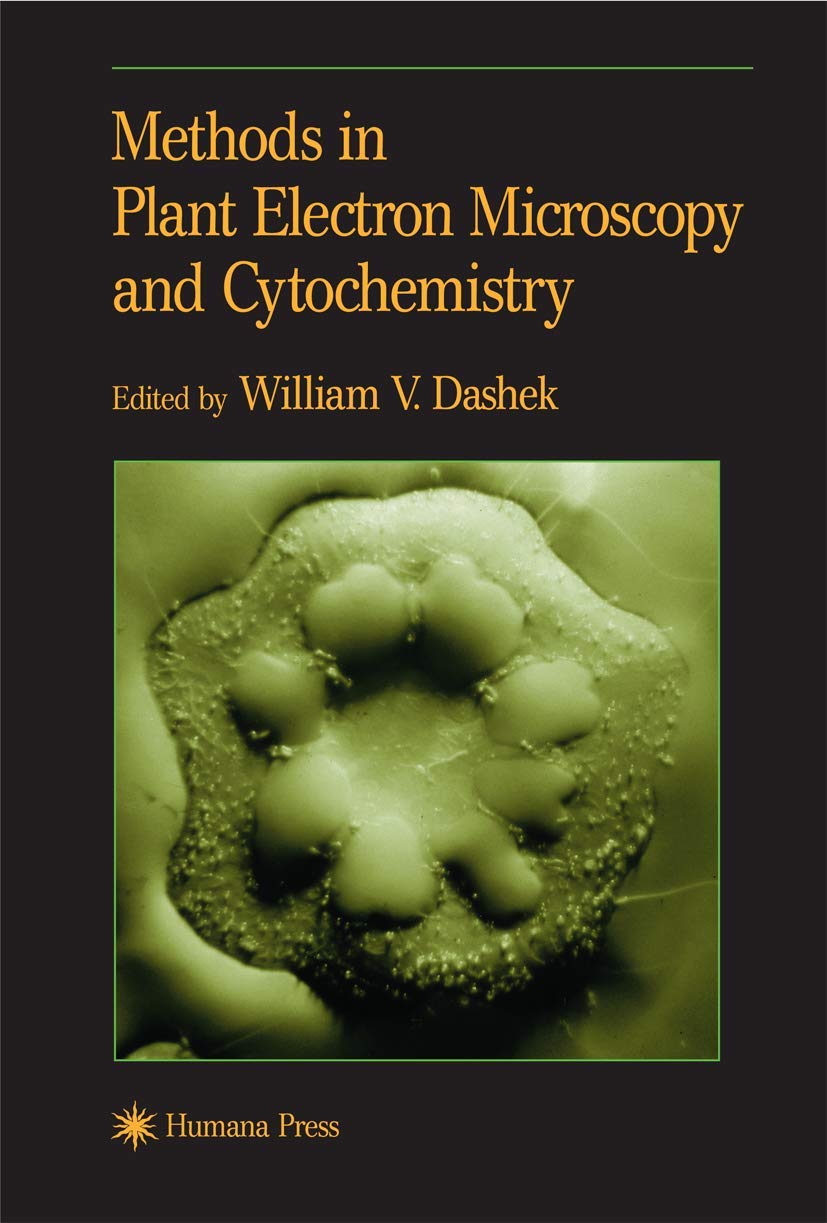
Methods in Plant Electron Microscopy & Cytochemistry by William V. Dashek – A Detailed Laboratory Guide for Plant Cell B
Inclusive of all applicable taxes. FREE shipping on all orders.
Available Offers
- 🚚Free Delivery — Free shipping on all orders
- 💵Cash on Delivery — Pay when your order arrives
- ↩️15-Day Easy Returns — Hassle-free return policy
- 🔒Cash on Delivery — Pay safely when your order arrives
Check Delivery
Product Description
Introduction
In the ever-evolving field of plant biology, understanding the intricate architecture and chemical composition of plant cells at the microscopic level is fundamental. Methods in Plant Electron Microscopy & Cytochemistry by William V. Dashek serves as a definitive guide for researchers, students, and laboratory professionals who seek to master the techniques required to explore the ultrastructure of plant tissues. Published by Humana Press, this hardcover volume brings together a wealth of practical protocols and theoretical insights, making it an indispensable resource for Indian classrooms and research laboratories alike.
Book Overview
This comprehensive reference work is designed to bridge the gap between basic microscopy and advanced cytochemical analysis. The book systematically covers the entire workflow—from specimen preparation and fixation to staining, sectioning, and interpretation of electron micrographs. It emphasizes the unique challenges posed by plant cells, including cell walls, vacuoles, and chloroplasts, and offers tailored solutions for obtaining high-resolution images and reliable cytochemical data. Whether you are a postgraduate student in botany or a seasoned plant scientist, this book provides the methodological clarity needed to produce reproducible results.
Key Highlights
- Comprehensive Protocol Coverage: Step-by-step instructions for transmission and scanning electron microscopy (TEM and SEM) specifically adapted for plant specimens.
- Cytochemical Techniques: Detailed methods for localizing enzymes, nucleic acids, polysaccharides, and other cellular components at the ultrastructural level.
- Troubleshooting Guidance: Practical advice on common pitfalls such as poor fixation, artifacts, and staining inconsistencies.
- Illustrated Examples: High-quality micrographs and diagrams that clarify complex procedures and help readers recognize cellular structures.
- Safety and Best Practices: Important notes on handling chemicals, operating equipment, and maintaining lab safety standards.
Inside the Book
The book is organized into logical sections that build foundational knowledge before progressing to specialized techniques. Early chapters cover the principles of electron optics and the anatomy of electron microscopes, ensuring readers understand the instrumentation. Subsequent chapters dive into fixation protocols using glutaraldehyde and osmium tetroxide, embedding in resins, and ultramicrotomy. The later sections focus on cytochemical staining methods, including immunogold labeling, enzyme cytochemistry, and autoradiography. Each chapter concludes with a list of required materials and a set of discussion questions, making it ideal for coursework and self-study.
Key Topics
- Specimen Preparation: Chemical fixation, cryofixation, and freeze-substitution for plant tissues.
- Embedding and Sectioning: Resin selection, polymerization, and ultra-thin sectioning techniques.
- Staining and Contrast Enhancement: Heavy metal stains, negative staining, and cytochemical markers.
- Immunocytochemistry: Localization of proteins and antigens using colloidal gold probes.
- Quantitative Analysis: Stereological methods for measuring organelle dimensions and densities.
- Specialized Techniques: Correlative light and electron microscopy (CLEM), electron tomography, and elemental analysis.
Reader Benefits
By studying this book, readers will gain the confidence to independently design and execute electron microscopy experiments. The clear, jargon-free language makes complex protocols accessible, while the emphasis on plant-specific modifications saves researchers from adapting animal-tissue methods. Indian students will particularly appreciate the inclusion of cost-effective alternatives to expensive reagents, as well as guidance on setting up a basic EM lab with limited resources. The book also encourages critical thinking by discussing how to interpret micrographs and avoid misinterpretation of artifacts.
Learning Outcomes
- Master the principles of electron optics and sample-beam interactions.
- Prepare high-quality plant specimens for TEM and SEM analysis.
- Apply cytochemical stains to identify specific biomolecules within cellular compartments.
- Troubleshoot common issues in fixation, embedding, and sectioning.
- Analyze and present ultrastructural data in scientific publications.
Who Should Read
This book is essential for postgraduate students and researchers in plant sciences, botany, cell biology, and agricultural biotechnology. It is equally valuable for laboratory technicians and faculty members who teach advanced microscopy courses. Professionals working in seed testing, plant pathology, and forestry research will find the protocols directly applicable to their work. The content is suitable for both beginners with basic microscopy knowledge and experienced microscopists looking to refine their cytochemical skills.
About the Author
William V. Dashek is a distinguished plant biologist with decades of experience in ultrastructural research and teaching. He has authored numerous peer-reviewed articles and book chapters on plant cell biology, with a special focus on the application of electron microscopy to understand developmental processes and stress responses. His hands-on approach to writing ensures that every protocol has been rigorously tested in the laboratory. Dr. Dashek's ability to explain complex concepts in a straightforward manner has made him a trusted name among students and researchers worldwide.
About the Publisher
Humana Press, an imprint of Springer Nature, is renowned for publishing high-quality reference works in the life sciences. Their Methods in Molecular Biology series is widely used in laboratories across the globe. With a commitment to clarity and practical utility, Humana Press ensures that each volume meets the highest standards of editorial excellence. This hardcover edition is built to withstand frequent use in busy lab environments, with durable binding and acid-free paper.
Conclusion
Methods in Plant Electron Microscopy & Cytochemistry is more than a manual—it is a mentor in book form. For Indian students and researchers striving to excel in plant ultrastructure research, this volume provides the roadmap to success. With its blend of theory, practical advice, and troubleshooting tips, it will empower you to capture the hidden beauty of plant cells and contribute meaningfully to the field. Add this essential resource to your library today and elevate your microscopy skills to the next level.
Quick Summary
Methods in Plant Electron Microscopy & Cytochemistry by William V. Dashek is a definitive laboratory manual for anyone studying plant cell ultrastructure. Published by Humana Press, this hardcover volume presents a systematic approach to preparing plant tissues—from fixation and dehydration to embedding, sectioning, and staining—for both transmission and scanning electron microscopy. The book also dives deep into cytochemical techniques, including enzyme localization, immunocytochemistry, and lectin labeling, enabling researchers to pinpoint specific molecules within plant cells. Designed for graduate students, postdoctoral researchers, and lab technicians, it bridges the gap between theory and hands-on practice. Readers will learn to avoid common artifacts, select appropriate fixatives, and interpret ultrastructural features of organelles like chloroplasts, mitochondria, and cell walls. With clear protocols, safety notes, and troubleshooting advice, this book is an indispensable resource for Indian botany departments and plant biology labs. By purchasing from Bookshops.in, you get a genuine imported edition at a fair price, backed by fast shipping and customer support tailored for Indian buyers.
Book Highlights
Book Specifications
| ISBN-13 | 9780896038097 |
| ISBN-10 | 0896038092 |
| Publisher | SPRINGER |
| Language | English |
| Dimensions | 15.24 x 1.68 x 22.86 cm |
| Weight | 215 g |
| Country | USA |
| Category | Diagnostics & Labs › Laboratory Medicine |
| Genre | Science & Mathematics |
| Reading Age | 18+ |
| Original Language | English |
Frequently Asked Questions
What is the main focus of this book?
Who is the author William V. Dashek?
Is this book suitable for beginners?
Does the book cover both TEM and SEM?
What types of cytochemical techniques are included?
Are there protocols for difficult plant tissues?
Is this book available in India?
Does the book include color images?
Can I use this book for teaching?
Is the binding hardcover?
Does it cover modern cryo-techniques?
What is the ISBN?
Why buy from Bookshops.in?
Readers Also Search For
Customers Also Bought

Anatomy
Ultrastructure of the Digestive Tract: 4 (Electron Microscopy in Biology and Medicine)

Anatomy
Ultrastructure of the Connective Tissue Matrix: 3 (Electron Microscopy in Biology and Medicine)

Anatomy
Reproductive Genetics (Royal College of Obstetricians and Gynaecologists Study Group)

Anatomy
Human Gross Anatomy: An Outline Text by Robert J. Leonard – Medical Anatomy

Pharmacology
Mathematical Modeling and Simulation in Enteric Neurobiology

Anatomy
Nature’s Patterns and the Fractional Calculus: 2 (Fractional Calculus in Applied Sciences and Engineering, 2)
Related Products
View All
Medicine & Health Sciences
Handbook of Hospitality Strategic Management | by Olsen Michael | Taylor & Francis Ltd | by Olsen Michael | Taylor & Francis Ltd | by Olsen Michael | Taylor & Francis Ltd | by Olsen Michael | Taylor & Francis Ltd | by Olsen Michael | Taylor & Francis Ltd | by Olsen Michael | Taylor & Francis Ltd | by Olsen Michael | Taylor & Francis Ltd | by Olsen Michael | Taylor & Francis Ltd | by Olsen Michael | Taylor & Francis Ltd | by Olsen Michael | Taylor & Francis

Medicine & Health Sciences
Pediatrics on Call | by Charles A. Pohl | Kathleen Bradford | Clara Callahan | McGraw Hill / Medical | by Charles A. Pohl | Kathleen Bradford | Clara Callahan | McGraw Hill / Medical | by Charles A. Pohl | Kathleen Bradford | Clara Callahan | McGraw Hill / Medical | by Charles A. Pohl | Kathleen Bradford | Clara Callahan | McGraw Hill / Medical | by Charles A. Pohl | Kathleen Bradford | Clara Callahan | McGraw Hill / Medical | by Charles A. Pohl | Kathleen Bradford | Clara Callahan | McGraw Hill

Medicine & Health Sciences
The Physician's Guide to Depression and Bipolar Disorders | by Dwight L. Evans | Dennis S. Charney | Lydia Lewis | McGraw Hill / Medical | by Dwight L. Evans | Dennis S. Charney | Lydia Lewis | McGraw Hill / Medical | by Dwight L. Evans | Dennis S. Charney | Lydia Lewis | McGraw Hill / Medical | by Dwight L. Evans | Dennis S. Charney | Lydia Lewis | McGraw Hill / Medical | by Dwight L. Evans | Dennis S. Charney | Lydia Lewis | McGraw Hill / Medical | by Dwight L. Evans | Dennis S. Charney | Lydi
Medicine & Health Sciences
First Exposure to Internal Medicine | by Andrew R. Hoellein | Charles H. Griffith | McGraw Hill / Medical | by Andrew R. Hoellein | Charles H. Griffith | McGraw Hill / Medical | by Andrew R. Hoellein | Charles H. Griffith | McGraw Hill / Medical | by Andrew R. Hoellein | Charles H. Griffith | McGraw Hill / Medical | by Andrew R. Hoellein | Charles H. Griffith | McGraw Hill / Medical | by Andrew R. Hoellein | Charles H. Griffith | McGraw Hill / Medical | by Andrew R. Hoellein | Charles H. Griffit
Medicine & Health Sciences
First Exposure to Internal Medicine | by Charles H. Griffith | Andrew R. Hoellein | McGraw Hill / Medical | by Charles H. Griffith | Andrew R. Hoellein | McGraw Hill / Medical | by Charles H. Griffith | Andrew R. Hoellein | McGraw Hill / Medical | by Charles H. Griffith | Andrew R. Hoellein | McGraw Hill / Medical | by Charles H. Griffith | Andrew R. Hoellein | McGraw Hill / Medical | by Charles H. Griffith | Andrew R. Hoellein | McGraw Hill / Medical | by Charles H. Griffith | Andrew R. Hoellei

Medicine & Health Sciences