
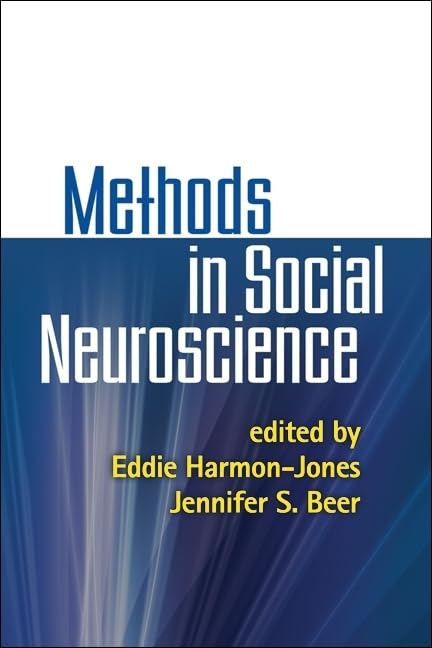
Methods in Social Neuroscience: A Comprehensive Guide to Neurobiological Techniques for Social Behavior Research by Eddi
Inclusive of all applicable taxes. FREE shipping on all orders.
Available Offers
- 🚚Free Delivery — Free shipping on all orders
- 💵Cash on Delivery — Pay when your order arrives
- ↩️15-Day Easy Returns — Hassle-free return policy
- 🔒Cash on Delivery — Pay safely when your order arrives
Check Delivery
Product Description
Introduction
Social neuroscience is one of the most exciting frontiers in modern psychology, bridging the gap between the mind and the biological systems that underpin human behaviour. For Indian students and researchers seeking a comprehensive, hands-on guide to this interdisciplinary field, Methods in Social Neuroscience by Eddie Harmon-Jones is an indispensable resource. Published by Guilford Press, this hardbound volume offers a rigorous yet accessible introduction to the neurobiological techniques used to study social behaviour, personality, and emotion. Whether you are a postgraduate psychology student in Delhi, a neuroscience researcher in Bangalore, or a faculty member designing a course on social cognition, this book provides the practical know-how to design and conduct experiments that yield meaningful insights.
Book Overview
This book is the first of its kind to systematically walk readers through the core methods of social neuroscience. It avoids overwhelming jargon and instead focuses on clear, step-by-step guidance. Each chapter is written by an expert in the field and covers a specific technique—from functional magnetic resonance imaging (fMRI) and electroencephalography (EEG) to hormonal assays and genetic measurement. The book emphasizes experimental design, data interpretation, and the ethical considerations unique to studying human social behaviour. With its balanced approach, it serves both as a textbook for advanced courses and a reference manual for active researchers.
Key Highlights
- First comprehensive guide to neurobiological methods in social neuroscience, tailored for students and professionals.
- Expert-led chapters from leading international researchers, ensuring depth and credibility.
- Practical focus on experimental design, including how to choose the right method for a research question.
- Interdisciplinary coverage spanning psychology, biology, and cognitive science.
- Indian context relevance – methods discussed are applicable to studies on social hierarchies, collectivism, and cultural differences.
Inside the Book
The book is organized into thematic sections, each dedicated to a major methodological approach. Chapters open with a clear explanation of the technique's underlying principles, followed by real-world examples of its application in social neuroscience research. Readers will find detailed discussions on neuroimaging methods (fMRI, PET, EEG), hormonal measurement (cortisol, testosterone, oxytocin), genetic analysis (including twin studies and candidate gene approaches), lesion studies, startle eyeblink responses, facial electromyography (EMG), autonomic nervous system recordings, and neural network modeling. Every chapter concludes with a summary of strengths and limitations, plus a checklist for designing robust experiments.
Key Topics
- Functional and structural neuroimaging techniques for social cognition
- Hormonal assays and their role in understanding social bonding and aggression
- Genetic methods for studying personality and social behaviour
- Lesion studies and their contribution to understanding brain-behaviour relationships
- Psychophysiological measures: startle eyeblink, facial EMG, and autonomic responses
- Computational modeling with neural networks to simulate social processes
- Ethical considerations in human neurobiological research
Reader Benefits
By engaging with this book, readers will gain the confidence to navigate the complex landscape of social neuroscience methods. The practical tips and cautionary notes help avoid common pitfalls in experimental design. Researchers in India will especially appreciate the clear guidance on adapting these methods to diverse populations and cultural settings. The book also demystifies the process of integrating multiple techniques—such as combining fMRI with hormonal measures—to answer multifaceted research questions. For students, it demystifies the 'black box' of neuroscience tools, making them accessible for thesis work or lab projects.
Learning Outcomes
- Understand the principles behind major neurobiological methods used in social neuroscience.
- Design experiments that effectively measure social behaviour using appropriate techniques.
- Critically evaluate published studies for methodological strengths and weaknesses.
- Integrate multiple methods to address complex questions about human sociality.
- Apply ethical guidelines specific to neurobiological research with human participants.
Who Should Read
This book is ideal for postgraduate students and researchers in psychology, neuroscience, cognitive science, and related fields. It is also highly valuable for faculty members designing courses in social neuroscience or biological psychology. Clinicians and mental health professionals interested in the biological underpinnings of social disorders will find the practical chapters useful. Additionally, Indian students preparing for UGC-NET, JRF, or PhD entrance exams in psychology or neuroscience will benefit from the clear, method-focused content.
About the Author
Eddie Harmon-Jones is a distinguished professor and researcher in social neuroscience and emotion. He has published extensively on the neural bases of motivation, emotion, and cognitive dissonance. Known for his innovative use of psychophysiological and neuroimaging methods, Dr. Harmon-Jones has been a driving force in integrating biological perspectives into social psychology. His editorial work and teaching have shaped a generation of researchers, and his commitment to clear, practical instruction is evident throughout this volume.
About the Publisher
Guilford Press is a leading academic publisher known for its high-quality books in psychology, neuroscience, and mental health. With a reputation for rigorous peer review and authoritative content, Guilford Press titles are widely used in universities and research institutions worldwide. This hardcover edition is built to last, making it a durable addition to any academic library or personal collection.
Conclusion
Methods in Social Neuroscience is more than a textbook—it is a roadmap for anyone serious about understanding the biological machinery behind human social behaviour. For Indian students and researchers looking to contribute to this dynamic field, this book offers the foundational knowledge and practical skills needed to design meaningful experiments. With its expert authorship, clear structure, and emphasis on real-world application, it is a must-have for any academic bookshelf. Order your copy today and take the first step into the fascinating world of social neuroscience.
Quick Summary
Methods in Social Neuroscience by Eddie Harmon-Jones is the first comprehensive, practical guide to applying neurobiological techniques in the study of human social behavior, personality, and affect. This book demystifies complex methods such as functional magnetic resonance imaging (fMRI), electroencephalography (EEG), genetic measurement, hormonal assays, lesion studies, startle eyeblink response, facial electromyography, autonomic nervous system measures, and neural network modeling. Each chapter is written by an expert and clearly introduces the method, provides illustrative examples from research, discusses strengths and limitations, and offers concrete experimental design advice. Targeted at graduate students, research scholars, and faculty in psychology, neuroscience, and social sciences, this book bridges the gap between theory and practice. Readers will gain the confidence to design and execute studies that integrate brain, body, and behavior. By purchasing from Bookshops.in, Indian students and researchers receive a durable hardcover edition with fast, reliable delivery—supporting local academic growth and interdisciplinary research.
Book Highlights
Book Specifications
| ISBN-13 | 9781606230404 |
| ISBN-10 | 1606230409 |
| Publisher | Guilford Press |
| Language | English |
| Dimensions | 16.51 x 2.54 x 23.5 cm |
| Weight | 635 g |
| Category | Basic Sciences › Neuroscience |
| Genre | Non-fiction |
| Original Language | English |
Frequently Asked Questions
What is Methods in Social Neuroscience about?
Who is the author of this book?
Is this book suitable for beginners?
What methods are covered in the book?
Can I use this book for my Indian university coursework?
Does the book include experimental design tips?
Is this a textbook or a reference work?
What is the ISBN-13?
Is this book available in hardcover?
What is the price in India?
Can I order from Bookshops.in?
Does the book include neural network modeling?
Is this book relevant for clinical psychology?
Readers Also Search For
Customers Also Bought

Anatomy
Ultrastructure of the Digestive Tract: 4 (Electron Microscopy in Biology and Medicine)

Anatomy
Ultrastructure of the Connective Tissue Matrix: 3 (Electron Microscopy in Biology and Medicine)

Anatomy
Reproductive Genetics (Royal College of Obstetricians and Gynaecologists Study Group)

Anatomy
Human Gross Anatomy: An Outline Text by Robert J. Leonard – Medical Anatomy

Pharmacology
Mathematical Modeling and Simulation in Enteric Neurobiology

Anatomy
Nature’s Patterns and the Fractional Calculus: 2 (Fractional Calculus in Applied Sciences and Engineering, 2)
Related Products
View All
Medicine & Health Sciences
Handbook of Hospitality Strategic Management | by Olsen Michael | Taylor & Francis Ltd | by Olsen Michael | Taylor & Francis Ltd | by Olsen Michael | Taylor & Francis Ltd | by Olsen Michael | Taylor & Francis Ltd | by Olsen Michael | Taylor & Francis Ltd | by Olsen Michael | Taylor & Francis Ltd | by Olsen Michael | Taylor & Francis Ltd | by Olsen Michael | Taylor & Francis Ltd | by Olsen Michael | Taylor & Francis Ltd | by Olsen Michael | Taylor & Francis

Medicine & Health Sciences
Pediatrics on Call | by Charles A. Pohl | Kathleen Bradford | Clara Callahan | McGraw Hill / Medical | by Charles A. Pohl | Kathleen Bradford | Clara Callahan | McGraw Hill / Medical | by Charles A. Pohl | Kathleen Bradford | Clara Callahan | McGraw Hill / Medical | by Charles A. Pohl | Kathleen Bradford | Clara Callahan | McGraw Hill / Medical | by Charles A. Pohl | Kathleen Bradford | Clara Callahan | McGraw Hill / Medical | by Charles A. Pohl | Kathleen Bradford | Clara Callahan | McGraw Hill

Medicine & Health Sciences
The Physician's Guide to Depression and Bipolar Disorders | by Dwight L. Evans | Dennis S. Charney | Lydia Lewis | McGraw Hill / Medical | by Dwight L. Evans | Dennis S. Charney | Lydia Lewis | McGraw Hill / Medical | by Dwight L. Evans | Dennis S. Charney | Lydia Lewis | McGraw Hill / Medical | by Dwight L. Evans | Dennis S. Charney | Lydia Lewis | McGraw Hill / Medical | by Dwight L. Evans | Dennis S. Charney | Lydia Lewis | McGraw Hill / Medical | by Dwight L. Evans | Dennis S. Charney | Lydi

Medicine & Health Sciences
First Exposure to Internal Medicine | by Andrew R. Hoellein | Charles H. Griffith | McGraw Hill / Medical | by Andrew R. Hoellein | Charles H. Griffith | McGraw Hill / Medical | by Andrew R. Hoellein | Charles H. Griffith | McGraw Hill / Medical | by Andrew R. Hoellein | Charles H. Griffith | McGraw Hill / Medical | by Andrew R. Hoellein | Charles H. Griffith | McGraw Hill / Medical | by Andrew R. Hoellein | Charles H. Griffith | McGraw Hill / Medical | by Andrew R. Hoellein | Charles H. Griffit

Medicine & Health Sciences
First Exposure to Internal Medicine | by Charles H. Griffith | Andrew R. Hoellein | McGraw Hill / Medical | by Charles H. Griffith | Andrew R. Hoellein | McGraw Hill / Medical | by Charles H. Griffith | Andrew R. Hoellein | McGraw Hill / Medical | by Charles H. Griffith | Andrew R. Hoellein | McGraw Hill / Medical | by Charles H. Griffith | Andrew R. Hoellein | McGraw Hill / Medical | by Charles H. Griffith | Andrew R. Hoellein | McGraw Hill / Medical | by Charles H. Griffith | Andrew R. Hoellei

Medicine & Health Sciences