
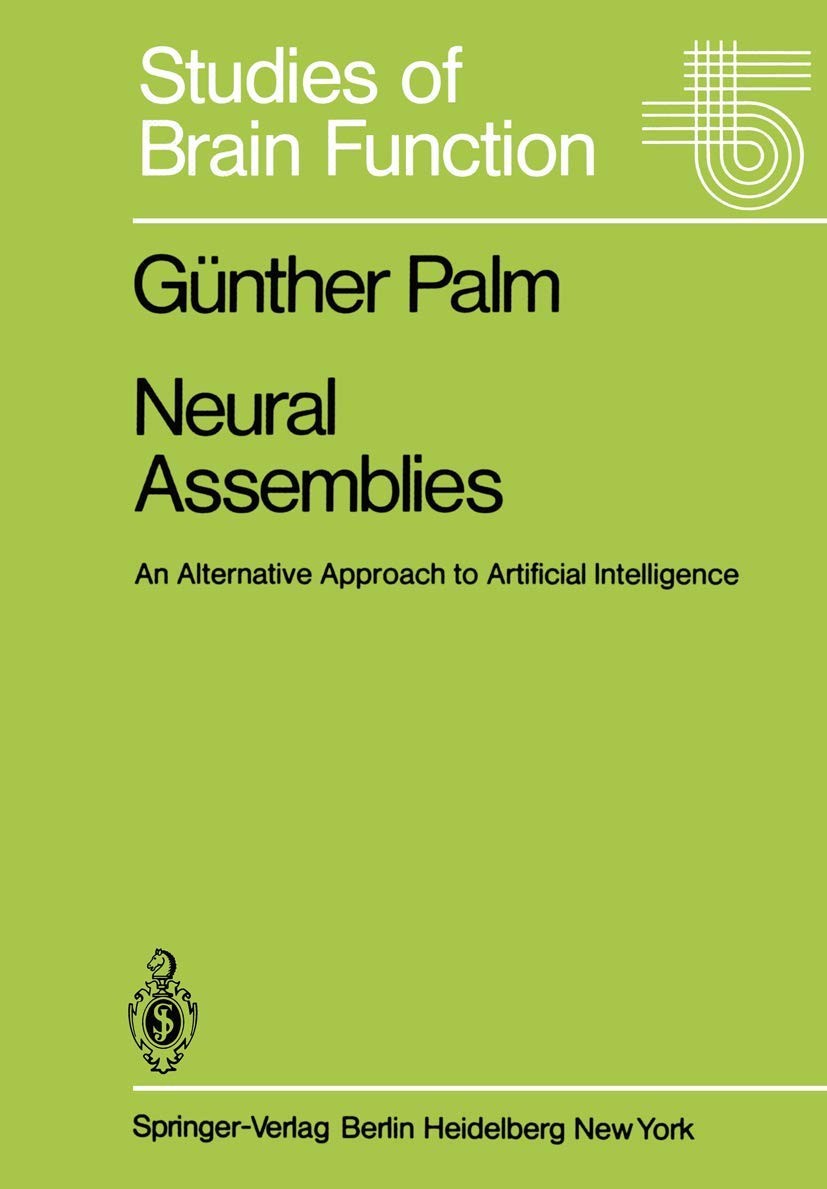
Neural Assemblies: An Alternative Approach to Artificial Intelligence
Inclusive of all applicable taxes. FREE shipping on all orders.
Available Offers
- 🚚Free Delivery — Free shipping on all orders
- 💵Cash on Delivery — Pay when your order arrives
- ↩️15-Day Easy Returns — Hassle-free return policy
- 🔒Cash on Delivery — Pay safely when your order arrives
Check Delivery
Product Description
Introduction
In the ever-evolving landscape of artificial intelligence, most discussions revolve around neural networks, deep learning, and computational models that mimic the human brain. But how often do we pause to ask: what is the brain actually doing? Neural Assemblies: An Alternative Approach to Artificial Intelligence by G. Palm dares to step back from the mainstream and offers a refreshingly original perspective. Published by Springer in a durable hardcover edition, this book is not just another technical manual — it is a thoughtful exploration of how groups of neurons, working together as assemblies, can give rise to intelligence. For Indian students, researchers, and AI enthusiasts who are tired of conventional textbooks, this volume provides a bridge between neuroscience and computation, grounded in rigorous mathematics and biological realism.
Book Overview
This hardbound volume presents a comprehensive yet accessible framework for understanding intelligence through the lens of neural assemblies. Instead of treating the brain as a black box or a mere collection of algorithms, G. Palm argues that the real magic lies in the cooperative activity of neuron groups. The book systematically builds from basic neurobiological principles to sophisticated models of memory, learning, and pattern recognition. It is a must-have for anyone in India looking to explore alternative pathways in AI, particularly those interested in biologically inspired computing. The Springer edition ensures high-quality printing and durable binding, making it a valuable addition to any academic library.
Key Highlights
- Original Perspective: Challenges mainstream AI approaches by focusing on neural assemblies rather than individual neurons or abstract algorithms.
- Interdisciplinary Depth: Merges mathematics, neuroscience, and computer science in a coherent narrative.
- Practical Foundations: Offers concrete models for memory, learning, and pattern recognition that can be implemented in artificial systems.
- Academic Rigour: Backed by Springer’s reputation for high-quality scientific publications.
- Hardcover Durability: Ideal for long-term reference in classrooms, labs, or personal collections.
Inside the Book
The book is structured to guide the reader from fundamental concepts to advanced applications. Early chapters introduce the biological basis of neural assemblies — how neurons fire, how they connect, and how groups of cells synchronize their activity. Middle sections delve into mathematical models, including correlation-based learning and associative memory. Later chapters explore how these principles can be applied to build alternative AI systems that are more robust, efficient, and closer to natural intelligence. Each chapter includes clear diagrams, worked examples, and thought-provoking exercises that encourage active learning.
Key Topics
- Neural Assembly Theory: The core concept of cooperative neuron groups as the basis of cognition.
- Associative Memory: How assemblies store and retrieve patterns without explicit programming.
- Learning Rules: Biologically plausible mechanisms for synaptic modification.
- Pattern Recognition: Using assembly dynamics to classify and predict.
- Mathematical Foundations: Probability, linear algebra, and dynamical systems applied to neural models.
- Comparison with Modern AI: Contrasting assembly-based approaches with deep learning and reinforcement learning.
Reader Benefits
- Gain a deeper understanding of how the brain actually works, beyond simplified metaphors.
- Learn alternative AI architectures that are more energy-efficient and biologically realistic.
- Develop mathematical skills applicable to both neuroscience and machine learning.
- Prepare for advanced research in computational neuroscience, cognitive science, or neuromorphic engineering.
- Appreciate the historical and philosophical context of AI, enriched by Palm’s unique perspective.
Learning Outcomes
By the end of this book, readers will be able to explain the concept of neural assemblies and their role in cognition. They will be equipped to design simple assembly-based models for memory and pattern recognition. The book also fosters critical thinking about the limitations of current AI and the potential for more brain-like systems. Students will gain confidence in reading and interpreting mathematical models of neural activity, bridging the gap between biology and computation.
Who Should Read
- AI Researchers seeking alternative frameworks beyond deep learning.
- Neuroscience Students wanting a computational perspective on brain function.
- Mathematics Undergraduates interested in applications to biology and intelligence.
- Computer Science Engineers exploring neuromorphic computing and cognitive architectures.
- Curious Minds in India who enjoy interdisciplinary science at the intersection of mind and machine.
About the Author
G. Palm is a distinguished mathematician and neuroscientist whose career has been dedicated to understanding the principles of neural computation. With decades of research experience, Palm has contributed seminal works on associative memory, neural networks, and the mathematics of brain function. His unique background — straddling pure mathematics and experimental neuroscience — lends this book an authenticity and depth rarely found in AI literature. Palm’s writing is clear, patient, and deeply insightful, making complex ideas accessible to motivated readers.
About the Publisher
Springer is a globally renowned academic publisher with a legacy spanning more than 180 years. Known for its rigorous peer-review process and high editorial standards, Springer publishes cutting-edge research in science, technology, and medicine. This hardcover edition reflects Springer’s commitment to quality — from the crisp typography to the durable binding. For Indian readers, a Springer title is a hallmark of trust and academic excellence, whether used in IITs, IISc, or central universities.
Conclusion
Neural Assemblies: An Alternative Approach to Artificial Intelligence is not just a book — it is an invitation to think differently about intelligence. In a world dominated by data-hungry algorithms, G. Palm reminds us that the most intelligent system we know — the human brain — operates on principles of cooperation, timing, and assembly dynamics. For students and professionals in India who aspire to push the boundaries of AI, this Springer hardcover is an essential companion. Order your copy today from Bookshops.in and embark on a journey that redefines what artificial intelligence can be.
Quick Summary
Neural Assemblies: An Alternative Approach to Artificial Intelligence by G. Palm offers a refreshingly original perspective on how we can build intelligent machines by emulating the brain's own neural structures. Instead of relying solely on deep learning or statistical methods, Palm argues that the key lies in understanding neural assemblies – coordinated groups of neurons that collectively encode information, memory, and cognition. Written by a mathematician who turned to neuroscience, this book bridges rigorous mathematical modeling with biological insight. It is ideal for researchers, graduate students, and professionals in AI, computational neuroscience, and cognitive science who want to explore beyond mainstream paradigms. Readers will learn about Hebbian learning, sparse coding, and the dynamics of cortical circuits, gaining tools to design more robust and adaptive AI systems. By purchasing from Bookshops.in, you support an Indian bookstore and receive a high-quality physical copy that will enrich your library for years.
Book Highlights
Book Specifications
| ISBN-13 | 9783642817946 |
| ISBN-10 | 3642817947 |
| Publisher | Springer-Verlag Berlin and Heidelberg GmbH & Co. K |
| Language | English |
| Dimensions | 16.99 x 1.47 x 24.41 cm |
| Weight | 413 g |
| Category | Basic Sciences › Neuroscience |
| Genre | Non-fiction |
| Original Language | English |
Frequently Asked Questions
What is Neural Assemblies about?
Who is the author G. Palm?
Is this book suitable for beginners?
How is this different from standard AI books?
Does the book include mathematical formulas?
Can I use this for my AI research?
Is the book available in India?
What is the ISBN?
Does it cover modern deep learning?
Is this a textbook?
What language is the book in?
Why should I buy from Bookshops.in?
Does the book have any reviews?
Readers Also Search For
Customers Also Bought

Anatomy
Ultrastructure of the Digestive Tract: 4 (Electron Microscopy in Biology and Medicine)

Anatomy
Ultrastructure of the Connective Tissue Matrix: 3 (Electron Microscopy in Biology and Medicine)

Anatomy
Reproductive Genetics (Royal College of Obstetricians and Gynaecologists Study Group)

Anatomy
Human Gross Anatomy: An Outline Text by Robert J. Leonard – Medical Anatomy

Pharmacology
Mathematical Modeling and Simulation in Enteric Neurobiology

Anatomy
Nature’s Patterns and the Fractional Calculus: 2 (Fractional Calculus in Applied Sciences and Engineering, 2)
Related Products
View All
Medicine & Health Sciences
Handbook of Hospitality Strategic Management | by Olsen Michael | Taylor & Francis Ltd | by Olsen Michael | Taylor & Francis Ltd | by Olsen Michael | Taylor & Francis Ltd | by Olsen Michael | Taylor & Francis Ltd | by Olsen Michael | Taylor & Francis Ltd | by Olsen Michael | Taylor & Francis Ltd | by Olsen Michael | Taylor & Francis Ltd | by Olsen Michael | Taylor & Francis Ltd | by Olsen Michael | Taylor & Francis Ltd | by Olsen Michael | Taylor & Francis

Medicine & Health Sciences
Pediatrics on Call | by Charles A. Pohl | Kathleen Bradford | Clara Callahan | McGraw Hill / Medical | by Charles A. Pohl | Kathleen Bradford | Clara Callahan | McGraw Hill / Medical | by Charles A. Pohl | Kathleen Bradford | Clara Callahan | McGraw Hill / Medical | by Charles A. Pohl | Kathleen Bradford | Clara Callahan | McGraw Hill / Medical | by Charles A. Pohl | Kathleen Bradford | Clara Callahan | McGraw Hill / Medical | by Charles A. Pohl | Kathleen Bradford | Clara Callahan | McGraw Hill

Medicine & Health Sciences
The Physician's Guide to Depression and Bipolar Disorders | by Dwight L. Evans | Dennis S. Charney | Lydia Lewis | McGraw Hill / Medical | by Dwight L. Evans | Dennis S. Charney | Lydia Lewis | McGraw Hill / Medical | by Dwight L. Evans | Dennis S. Charney | Lydia Lewis | McGraw Hill / Medical | by Dwight L. Evans | Dennis S. Charney | Lydia Lewis | McGraw Hill / Medical | by Dwight L. Evans | Dennis S. Charney | Lydia Lewis | McGraw Hill / Medical | by Dwight L. Evans | Dennis S. Charney | Lydi

Medicine & Health Sciences
First Exposure to Internal Medicine | by Andrew R. Hoellein | Charles H. Griffith | McGraw Hill / Medical | by Andrew R. Hoellein | Charles H. Griffith | McGraw Hill / Medical | by Andrew R. Hoellein | Charles H. Griffith | McGraw Hill / Medical | by Andrew R. Hoellein | Charles H. Griffith | McGraw Hill / Medical | by Andrew R. Hoellein | Charles H. Griffith | McGraw Hill / Medical | by Andrew R. Hoellein | Charles H. Griffith | McGraw Hill / Medical | by Andrew R. Hoellein | Charles H. Griffit

Medicine & Health Sciences
First Exposure to Internal Medicine | by Charles H. Griffith | Andrew R. Hoellein | McGraw Hill / Medical | by Charles H. Griffith | Andrew R. Hoellein | McGraw Hill / Medical | by Charles H. Griffith | Andrew R. Hoellein | McGraw Hill / Medical | by Charles H. Griffith | Andrew R. Hoellein | McGraw Hill / Medical | by Charles H. Griffith | Andrew R. Hoellein | McGraw Hill / Medical | by Charles H. Griffith | Andrew R. Hoellein | McGraw Hill / Medical | by Charles H. Griffith | Andrew R. Hoellei

Medicine & Health Sciences