
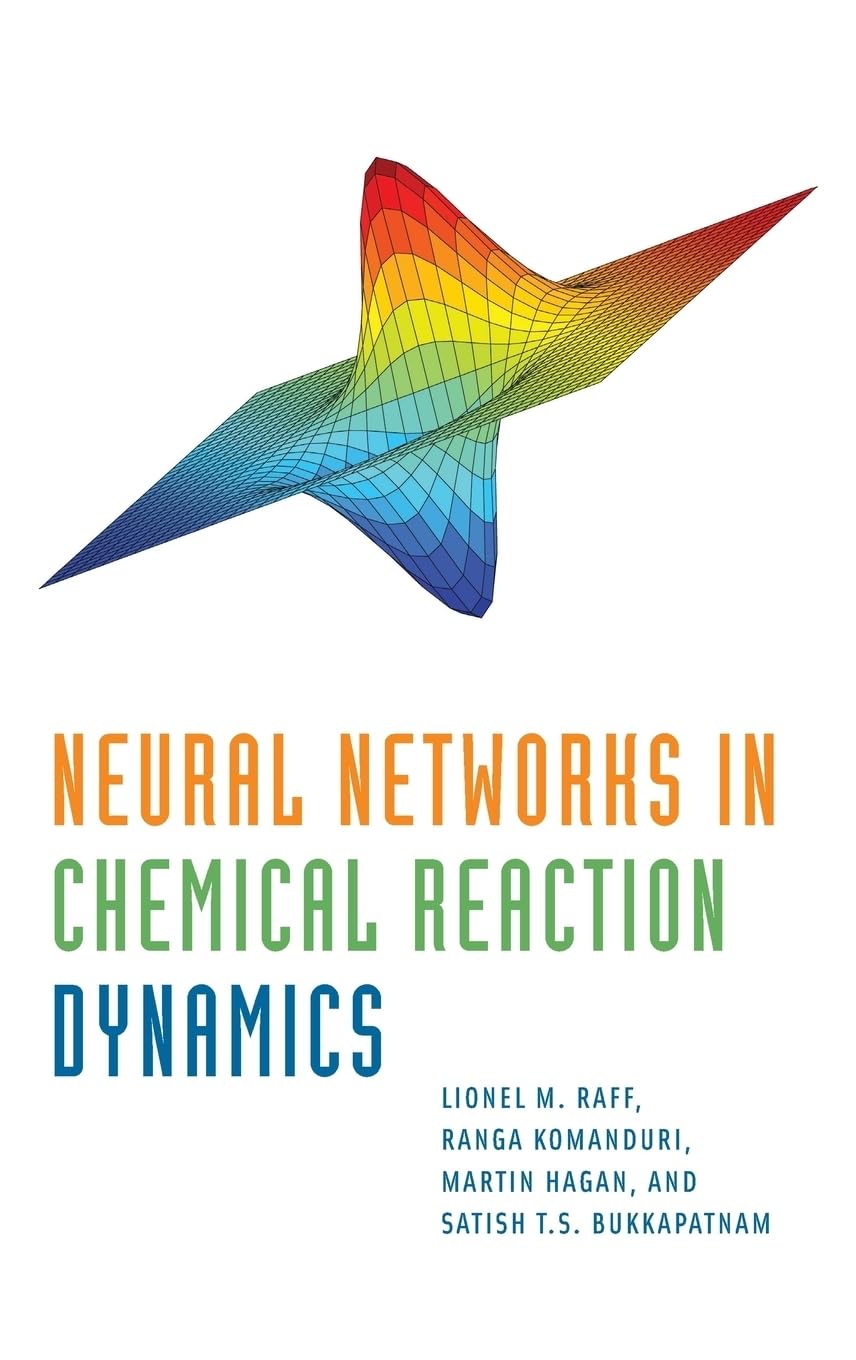
Neural Networks in Chemical Reaction Dynamics by Lionel Raff – Advanced Computational Chemistry Methods for Potential-En
Inclusive of all applicable taxes. FREE shipping on all orders.
Available Offers
- 🚚Free Delivery — Free shipping on all orders
- 💵Cash on Delivery — Pay when your order arrives
- ↩️15-Day Easy Returns — Hassle-free return policy
- 🔒Cash on Delivery — Pay safely when your order arrives
Check Delivery
Product Description
Introduction
Neural networks have revolutionised computational science, and their application to chemical reaction dynamics is one of the most exciting frontiers in modern research. Lionel Raff’s Neural Networks in Chemical Reaction Dynamics, published by Oxford University Press, offers a comprehensive and authoritative guide to this interdisciplinary field. For Indian students and researchers working at the intersection of machine learning, physical chemistry, and computational physics, this hardbound volume serves as both a textbook and a reference work. Whether you are a postgraduate student at an IIT or a scientist at a national laboratory, this book provides the theoretical depth and practical insights needed to harness neural networks for modelling complex molecular systems.
Book Overview
This monograph presents a systematic exploration of neural network methodologies tailored specifically for chemical reaction dynamics. It bridges the gap between abstract neural network theory and real-world chemical problems, such as constructing accurate potential-energy surfaces (PES) and simulating reaction pathways. The book covers cutting-edge techniques including modified novelty sampling, feedforward neural networks, genetic algorithms, and combined function derivative approximation (CFDA). With its focus on ab initio electronic structure calculations and direct dynamics, the book equips readers with tools to tackle multi-channel systems that are common in organic and inorganic chemistry. The text is richly illustrated with examples, algorithms, and case studies, making it accessible to those with a background in computational chemistry or machine learning.
Key Highlights
- Comprehensive coverage of neural network applications from basic concepts to advanced methods for potential-energy surface fitting.
- Practical algorithms for trajectory sampling, novelty sampling, and gradient fitting that can be implemented in research workflows.
- Integration of genetic algorithms with neural networks for efficient parametrization of interatomic potentials.
- Novel CFDA method for simultaneous fitting of energy surfaces and force fields, reducing computational overhead.
- Self-starting direct dynamics approaches that eliminate the need for precomputed data sets.
- Indian relevance: The methodologies are directly applicable to drug design, catalysis research, and materials science, all of which are growing fields in India.
Inside the Book
The book is organised into logically flowing chapters that build from foundational principles to state-of-the-art research. Early chapters introduce neural network architectures and their training algorithms, ensuring readers have the necessary background. Subsequent chapters delve into methods for sampling configuration space, including trajectory-based and novelty-based techniques. A significant portion is devoted to the development of ab initio potential-energy surfaces for complex multi-channel systems, a critical need in reaction dynamics. The later chapters explore gradient fitting, genetic algorithm acceleration, and the groundbreaking CFDA approach. Each chapter includes mathematical derivations, pseudocode, and references to original research, making it easy to translate theory into practice.
Key Topics
- Feedforward neural networks for potential-energy surface construction
- Modified novelty sampling and trajectory sampling methods
- Gradient fitting and force field approximation
- Genetic algorithm optimisation accelerated by neural networks
- Parametrization of analytic interatomic potential functions
- Combined function derivative approximation (CFDA)
- Self-starting direct dynamics from ab initio calculations
- Generalised potential-energy surfaces for many-body systems
Reader Benefits
By studying this book, you will gain a deep understanding of how neural networks can replace traditional computational chemistry methods, leading to faster and more accurate simulations. You will learn to design your own neural network models for fitting potential-energy surfaces, reducing the time spent on manual parametrisation. The practical algorithms included will help you implement solutions for your own research projects, whether you are studying reaction mechanisms, designing catalysts, or exploring molecular dynamics. Indian readers will particularly benefit from the book’s focus on ab initio methods, which align well with the computational resources available in Indian institutions. Moreover, the book emphasises reproducibility and methodological rigour, essential for publishing in high-impact journals.
Learning Outcomes
- Understand the theoretical foundations of neural networks as applied to chemical dynamics
- Develop and train feedforward neural networks for fitting potential-energy surfaces
- Apply novelty sampling and trajectory sampling to generate training data efficiently
- Implement genetic algorithm-based optimisation for interatomic potentials
- Use CFDA to simultaneously fit energy and force fields with high accuracy
- Design self-starting direct dynamics workflows for automated PES generation
- Critically evaluate neural network models for multi-channel reaction systems
Who Should Read
This book is ideal for postgraduate students in chemistry, physics, and computational science who are working on reaction dynamics or machine learning applications. It is equally valuable for researchers in Indian institutes such as IITs, IISc, NISER, and CSIR laboratories who need advanced tools for molecular modelling. Professionals in the pharmaceutical and materials industries will find the methods relevant for drug discovery and catalyst design. The book assumes a basic familiarity with quantum chemistry and linear algebra, but the clear explanations make it accessible to those new to neural networks. Advanced undergraduates with a strong background in physical chemistry will also benefit from the structured approach.
About the Author
Lionel Raff is a distinguished professor and researcher known for his pioneering contributions to computational chemistry and reaction dynamics. With decades of experience in developing theoretical methods for chemical systems, he has published extensively on neural network applications, potential-energy surfaces, and molecular simulations. His work has been instrumental in bridging the gap between artificial intelligence and quantum chemistry. In this book, Raff distils his expertise into a clear, systematic treatment that reflects both his deep understanding of the subject and his commitment to educating the next generation of scientists.
About the Publisher
Oxford University Press (OUP) is a world-renowned academic publisher with a legacy of excellence spanning over five centuries. Known for its rigorous peer-review process and high editorial standards, OUP publishes authoritative works across all major academic disciplines. This hardcover edition reflects OUP’s commitment to producing durable, high-quality books that serve as lasting resources for scholars. For Indian readers, OUP titles are widely available through Bookshops.in and other trusted retailers, ensuring access to global knowledge.
Conclusion
Neural Networks in Chemical Reaction Dynamics is an indispensable resource for anyone serious about applying machine learning to chemical problems. Lionel Raff’s clear exposition, combined with OUP’s production quality, makes this hardbound volume a valuable addition to any library. Whether you are a student embarking on a research career or an established scientist seeking new computational tools, this book will deepen your understanding and expand your capabilities. Order your copy today from Bookshops.in and take a decisive step towards mastering neural network methods in chemical dynamics.
Quick Summary
Neural Networks in Chemical Reaction Dynamics by Lionel Raff is a comprehensive monograph that explores the intersection of artificial neural networks and computational chemistry, specifically focusing on chemical reaction dynamics. The book delves into advanced methods for constructing ab initio potential-energy surfaces (PES) for complex multichannel systems, using modified novelty sampling and feedforward neural networks. It also covers innovative sampling techniques for configuration space, such as trajectory and novelty sampling, as well as gradient fitting methods. A significant portion is dedicated to parametrizing interatomic potential functions using genetic algorithms accelerated by neural networks, and self-starting methods for deriving analytic PES from direct dynamics. This book is aimed at graduate students, researchers, and professionals in computational chemistry, molecular dynamics, and machine learning who seek to apply neural network techniques to real-world chemical problems. Readers will gain practical skills in developing accurate PES, optimizing reaction paths, and integrating machine learning with quantum chemistry. By purchasing from Bookshops.in, Indian customers receive a genuine hardcover edition with reliable delivery and customer support.
Book Highlights
Book Specifications
| ISBN-13 | 9780199765652 |
| ISBN-10 | 0199765650 |
| Publisher | OUP USA |
| Language | English |
| Dimensions | 23.88 x 2.54 x 16 cm |
| Weight | 567 g |
| Category | Basic Sciences › Biochemistry |
| Genre | Nonfiction |
| Original Language | English |
Frequently Asked Questions
What is the main focus of this book?
Who is the author of Neural Networks in Chemical Reaction Dynamics?
Is this book suitable for beginners in neural networks?
What topics are covered in the book?
Does the book include practical examples?
Who should read this book?
Is this book available in hardcover?
What is the ISBN of the book?
How does this book differ from other computational chemistry books?
Can this book help with my research in potential-energy surfaces?
Does the book cover genetic algorithms?
Is there any discussion of direct dynamics?
What is the price of this book?
Where can I buy this book in India?
Readers Also Search For
Customers Also Bought

Anatomy
Ultrastructure of the Digestive Tract: 4 (Electron Microscopy in Biology and Medicine)

Anatomy
Ultrastructure of the Connective Tissue Matrix: 3 (Electron Microscopy in Biology and Medicine)

Anatomy
Reproductive Genetics (Royal College of Obstetricians and Gynaecologists Study Group)

Anatomy
Human Gross Anatomy: An Outline Text by Robert J. Leonard – Medical Anatomy

Pharmacology
Mathematical Modeling and Simulation in Enteric Neurobiology

Anatomy
Nature’s Patterns and the Fractional Calculus: 2 (Fractional Calculus in Applied Sciences and Engineering, 2)
Related Products
View All
Medicine & Health Sciences
Handbook of Hospitality Strategic Management | by Olsen Michael | Taylor & Francis Ltd | by Olsen Michael | Taylor & Francis Ltd | by Olsen Michael | Taylor & Francis Ltd | by Olsen Michael | Taylor & Francis Ltd | by Olsen Michael | Taylor & Francis Ltd | by Olsen Michael | Taylor & Francis Ltd | by Olsen Michael | Taylor & Francis Ltd | by Olsen Michael | Taylor & Francis Ltd | by Olsen Michael | Taylor & Francis Ltd | by Olsen Michael | Taylor & Francis

Medicine & Health Sciences
Pediatrics on Call | by Charles A. Pohl | Kathleen Bradford | Clara Callahan | McGraw Hill / Medical | by Charles A. Pohl | Kathleen Bradford | Clara Callahan | McGraw Hill / Medical | by Charles A. Pohl | Kathleen Bradford | Clara Callahan | McGraw Hill / Medical | by Charles A. Pohl | Kathleen Bradford | Clara Callahan | McGraw Hill / Medical | by Charles A. Pohl | Kathleen Bradford | Clara Callahan | McGraw Hill / Medical | by Charles A. Pohl | Kathleen Bradford | Clara Callahan | McGraw Hill

Medicine & Health Sciences
The Physician's Guide to Depression and Bipolar Disorders | by Dwight L. Evans | Dennis S. Charney | Lydia Lewis | McGraw Hill / Medical | by Dwight L. Evans | Dennis S. Charney | Lydia Lewis | McGraw Hill / Medical | by Dwight L. Evans | Dennis S. Charney | Lydia Lewis | McGraw Hill / Medical | by Dwight L. Evans | Dennis S. Charney | Lydia Lewis | McGraw Hill / Medical | by Dwight L. Evans | Dennis S. Charney | Lydia Lewis | McGraw Hill / Medical | by Dwight L. Evans | Dennis S. Charney | Lydi
Medicine & Health Sciences
First Exposure to Internal Medicine | by Andrew R. Hoellein | Charles H. Griffith | McGraw Hill / Medical | by Andrew R. Hoellein | Charles H. Griffith | McGraw Hill / Medical | by Andrew R. Hoellein | Charles H. Griffith | McGraw Hill / Medical | by Andrew R. Hoellein | Charles H. Griffith | McGraw Hill / Medical | by Andrew R. Hoellein | Charles H. Griffith | McGraw Hill / Medical | by Andrew R. Hoellein | Charles H. Griffith | McGraw Hill / Medical | by Andrew R. Hoellein | Charles H. Griffit
Medicine & Health Sciences
First Exposure to Internal Medicine | by Charles H. Griffith | Andrew R. Hoellein | McGraw Hill / Medical | by Charles H. Griffith | Andrew R. Hoellein | McGraw Hill / Medical | by Charles H. Griffith | Andrew R. Hoellein | McGraw Hill / Medical | by Charles H. Griffith | Andrew R. Hoellein | McGraw Hill / Medical | by Charles H. Griffith | Andrew R. Hoellein | McGraw Hill / Medical | by Charles H. Griffith | Andrew R. Hoellein | McGraw Hill / Medical | by Charles H. Griffith | Andrew R. Hoellei
Medicine & Health Sciences