
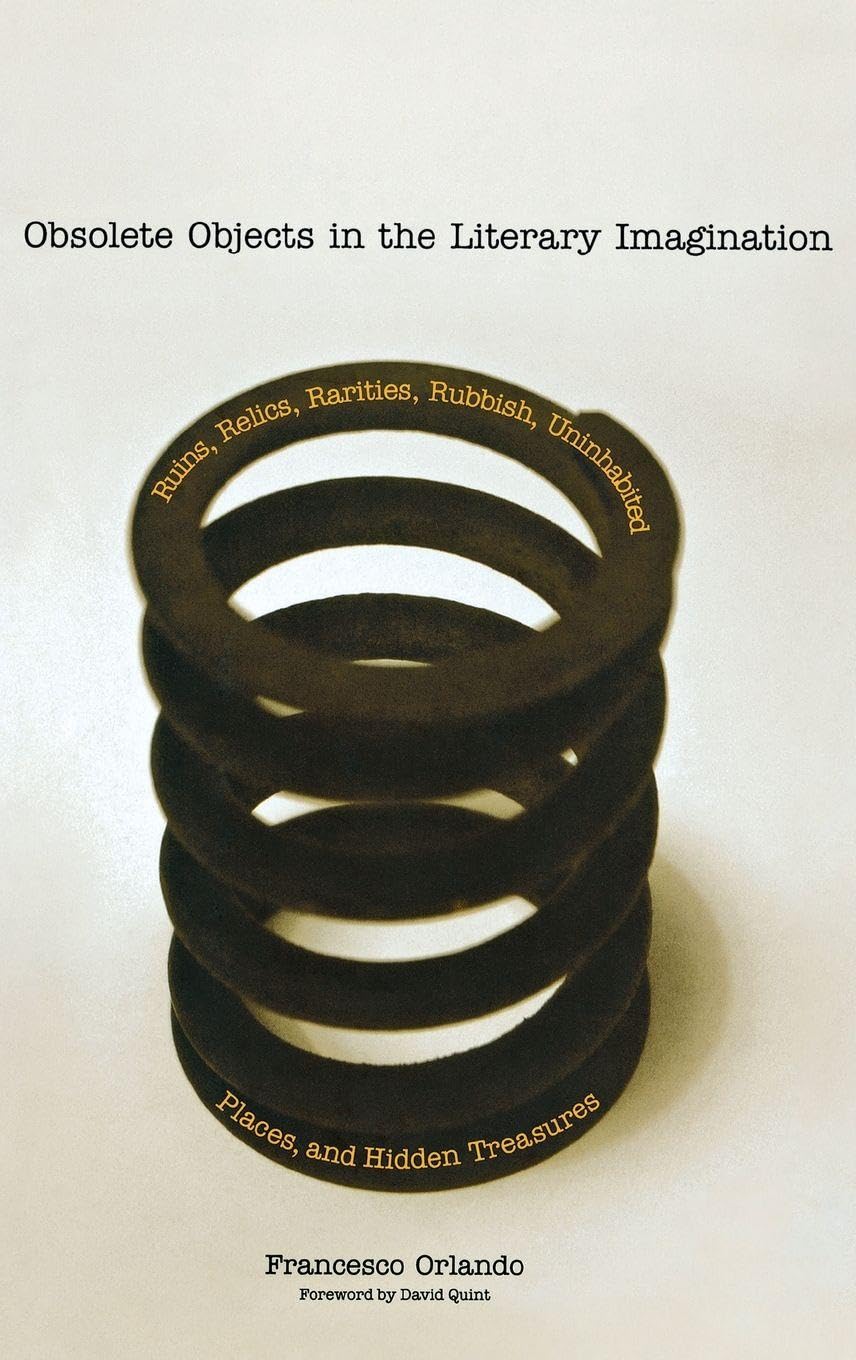
Obsolete Objects in Literary Imagination: Ruins, Relics, Rarities, Rubbish, Uninhabited Places, And Hidden Treasures by
Inclusive of all applicable taxes. FREE shipping on all orders.
Available Offers
- 🚚Free Delivery — Free shipping on all orders
- 💵Cash on Delivery — Pay when your order arrives
- ↩️15-Day Easy Returns — Hassle-free return policy
- 🔒Cash on Delivery — Pay safely when your order arrives
Check Delivery
Product Description
Introduction
In an age that prizes speed, utility, and the relentless march of progress, what happens to the things we leave behind? Francesco Orlando’s monumental work, Obsolete Objects in Literary Imagination: Ruins, Relics, Rarities, Rubbish, Uninhabited Places, And Hidden Treasures, offers a profound answer. Translated into English for the first time, this landmark study explores how Western literature has long been fascinated with objects that have outlived their purpose—from crumbling ruins and broken machinery to forgotten relics and hidden treasures. For Indian readers, students, and lovers of literature, this book opens a new lens to understand how the past speaks through the written word.
Book Overview
Published by Yale University Press, this hardcover volume is a sweeping journey through centuries of literary history. Orlando, one of Italy’s most distinguished critics, combines psychoanalysis with literary-political history to trace the origins of our obsession with the obsolete. He argues that at the end of the eighteenth century, as industrialization took hold, functionality became the dominant value of Western culture. In response, literature began to preserve what was being discarded—ruins, relics, rubbish, and uninhabited spaces. The book is a rich tapestry of examples drawn from every genre, from poetry and drama to novels and essays, making it an essential reference for anyone studying the deeper currents of Western literature.
Key Highlights
- First English translation of a seminal Italian work, comparable in scope to Erich Auerbach’s Mimesis
- Unique classification system that categorises obsolete images into distinct types, such as ruins, rarities, and hidden treasures
- Interdisciplinary approach blending psychoanalysis, history, and literary criticism
- Extensive coverage of works from Homer to modernism, including Shakespeare, Dante, Balzac, and Proust
- Reveals literature’s role as a guardian of memory against the tide of industrial progress
Story Themes
At its core, the book examines the tension between the functional and the nonfunctional. Orlando shows how ruins symbolise the fragility of human ambition, while relics carry the weight of sacred or emotional memory. Rubbish, he argues, is not merely waste but a testament to what a society chooses to forget. Uninhabited places—deserted houses, abandoned cities—become metaphors for loss and longing. Hidden treasures, meanwhile, represent the hope that something valuable endures beneath the surface. Together, these themes underscore a central idea: literature’s purpose is to remind us of what we have lost and what we are losing as we rush toward the future.
Reader Benefits
- Deepen your literary analysis with a framework that reveals hidden layers in familiar texts
- Understand cultural shifts through the lens of material objects and their literary representations
- Enhance your academic writing with insights from one of the most original critics of the twentieth century
- Explore connections between Western literature and universal themes of decay, memory, and value
- Gain a new perspective on how literature resists the tyranny of utility and efficiency
Who Should Read
This book is ideal for students and scholars of literature, comparative literature, cultural studies, and history. It will also appeal to writers, critics, and anyone fascinated by the way objects carry stories. Indian readers interested in postcolonial or global literatures will find Orlando’s method adaptable to studying how cultures preserve their own obsolete objects—from abandoned havelis to forgotten manuscripts. If you are a teacher preparing a course on literary theory or a curious reader wanting to explore the strange beauty of things left behind, this book belongs on your shelf.
About the Author
Francesco Orlando (1934–2010) was a towering figure in Italian literary criticism. A professor at the University of Pisa and later at the University of Venice, he brought a rare combination of psychoanalytic insight and historical materialism to his work. His other major studies include Toward a Freudian Theory of Literature and Infanzia, memoria e storia. Orlando’s scholarship has influenced generations of critics worldwide, and his ability to weave together vast literary traditions makes him a worthy successor to critics like Auerbach and Benjamin.
About the Publisher
Yale University Press is one of the most respected academic publishers in the world, known for its rigorous editorial standards and groundbreaking scholarship. Since its founding in 1908, it has published works that shape intellectual discourse across disciplines. This translation of Orlando’s masterpiece reflects Yale’s commitment to bringing essential European criticism to a global audience, ensuring that students and scholars everywhere can access this transformative work.
Conclusion
Obsolete Objects in Literary Imagination is not just a book about old things—it is a meditation on what it means to remember, to value, and to create in a world that constantly demands the new. Orlando’s erudition is matched only by his humanity, and his work stands as a testament to the enduring power of literature to hold onto what we might otherwise discard. For anyone seeking to understand the deep structures of Western storytelling, this hardcover edition from Yale University Press is an indispensable addition to your library. Order your copy from Bookshops.in today and rediscover the treasures hidden in the ruins of the past.
Quick Summary
Obsolete Objects in Literary Imagination is a landmark work of literary history and criticism by Italian scholar Francesco Orlando, now available in English for the first time. The book explores Western literature's enduring fascination with objects that have outlived their usefulness—ruins, relics, broken machinery, trash, and hidden treasures. Orlando argues that this obsession intensified after the eighteenth-century Industrial Revolution, when functionality became the dominant cultural value. Drawing on psychoanalysis and political history, he identifies distinct categories of obsolete images and traces them through genres from ancient epic to modern poetry. This book is essential for scholars of literary theory, cultural history, and material culture, as well as graduate students seeking a rigorous theoretical framework. Readers will learn to see familiar texts in a new light, understanding how discarded objects carry deep symbolic and ideological weight. By purchasing from Bookshops.in, Indian students and academics gain access to a premium hardcover edition from Yale University Press, ensuring a durable addition to their library.
Book Highlights
Book Specifications
| ISBN-13 | 9780300108088 |
| ISBN-10 | 0300108087 |
| Publisher | Yale Univ Pr |
| Language | English |
| Dimensions | 16.2 x 3.81 x 23.99 cm |
| Weight | 907 g |
| Category | World Literature › European |
| Genre | Literary Criticism |
| Reading Age | Adult |
| Original Language | Italian |
Frequently Asked Questions
What is 'Obsolete Objects in Literary Imagination' about?
Who is the author Francesco Orlando?
Is this book available in English for the first time?
What makes this book comparable to Eric Auerbach's Mimesis?
Which literary genres does the book cover?
Does the book include Indian or non-Western literature?
What theoretical frameworks does Orlando use?
Is this book suitable for undergraduate students?
Why is the book relevant to Indian readers?
Can I use this book for a PhD dissertation?
Does the book contain illustrations?
How does Orlando define 'obsolete objects'?
Where can I buy this book in India?
Readers Also Search For
Customers Also Bought
Contemporary Fiction
Stepladder Junction and Other Stories
Contemporary Fiction
Fabrications by Pamela Painter – Short Story Collection

Contemporary Fiction
The Double Life of an Alaskan Sled Dog (English, Andrea Finney Aufder Heyde)

Contemporary Fiction
The Alabaster Girl by Zan Perrion

Contemporary Fiction
Grimm and Grimmer: Classic Fairy Tales Rebooted by Mark Russell
Classic Literature
The Prose Works of Andrew Marvell: 1676-1678 by Andrew Marvell – Restoration Literature
Related Products
View All
Literature & Fiction
Shakespeare, Madness, and Music: Scoring Insanity in Cinematic Adaptations
Literature & Fiction
Literary Research and Canadian Literature: Strategies and Sources: 10 (Literary Research: Strategies and Sources, 10)

Literature & Fiction
Crime Fiction and National Identities in the Global Age | by Julie H. Kim | McFarland & Company | by Julie H. Kim | McFarland & Company | by Julie H. Kim | McFarland & Company | by Julie H. Kim | McFarland & Company | by Julie H. Kim | McFarland & Company | by Julie H. Kim | McFarland & Company | by Julie H. Kim | McFarland & Company | by Julie H. Kim | McFarland & Company | by Julie H. Kim | McFarland & Company | by Julie H. Kim | McFarland & Company | by
Literature & Fiction
Greek Literature in the Classical Period: The Poetics of Drama in Athens: 4 (Greek Literature Vol. 4)
Literature & Fiction
Greek Literature and Philosophy (Greek Literature, Volume 6)
Literature & Fiction