
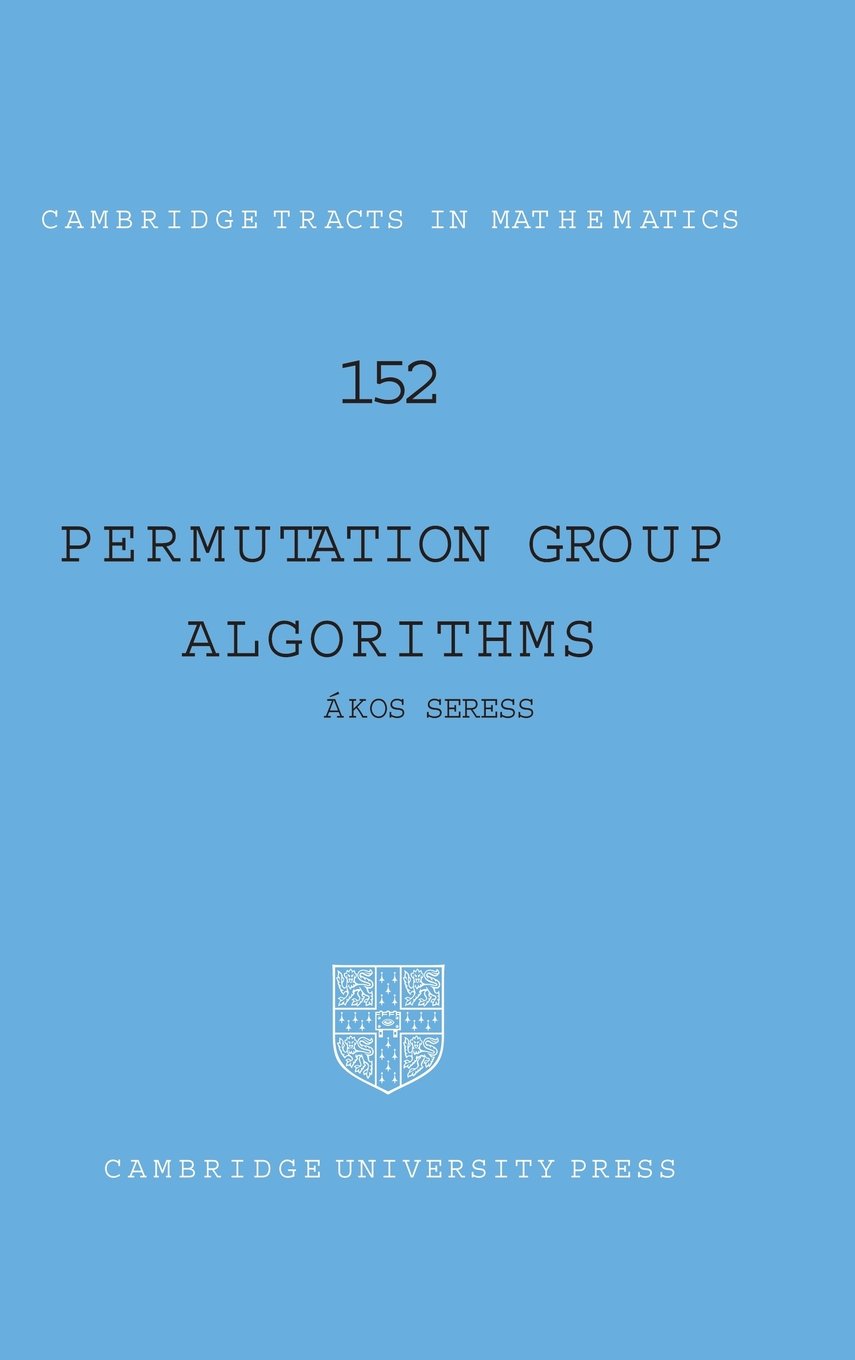
Permutation Group Algorithms: A Comprehensive Computational Group Theory Textbook by Akos Seress – Cambridge University
Inclusive of all applicable taxes. FREE shipping on all orders.
Available Offers
- 🚚Free Delivery — Free shipping on all orders
- 💵Cash on Delivery — Pay when your order arrives
- ↩️15-Day Easy Returns — Hassle-free return policy
- 🔒Cash on Delivery — Pay safely when your order arrives
Check Delivery
Product Description
Introduction
Permutation groups form the backbone of computational group theory, enabling mathematicians and computer scientists to study symmetry, structure, and algebraic properties through efficient algorithms. In the Indian academic context, where computational mathematics and symbolic algebra are gaining increasing prominence, Permutation Group Algorithms by Akos Seress stands as an essential reference. Published by Cambridge University Press, this hardcover volume bridges the gap between abstract group theory and practical computation, offering a rigorous yet accessible treatment of nearly linear time algorithms. Whether you are a graduate student in mathematics, a researcher in theoretical computer science, or a programmer working with algebraic systems, this book provides the theoretical foundation and implementation insights needed to master permutation group algorithms.
Book Overview
Permutation Group Algorithms is a comprehensive guide to the theory and practice of algorithms that operate on permutation groups. The book traces the development of these algorithms from classical methods to modern nearly linear time approaches, many of which are implemented in the GAP (Groups, Algorithms, Programming) system. Seress carefully explains how the classification of finite simple groups has influenced algorithmic design, making this work both historically significant and practically relevant. The text is structured to move from basic concepts to advanced topics, with rigorous complexity estimates, implementation hints, and challenging exercises that deepen understanding. This is not a mere programming manual; it is a scholarly treatise that equips readers with the mathematical insight to design and analyze algorithms for permutation groups.
Key Highlights
- Nearly linear time algorithms: The central theme of the book is the description of algorithms that run in nearly linear time, offering both theoretical elegance and practical speed.
- GAP-based examples: A significant portion of the permutation group library in the GAP system is based on the algorithms discussed, allowing readers to connect theory with real-world implementation.
- Classification of finite simple groups: The book incorporates recent developments that rely on this monumental classification, showing how deep mathematical results inform algorithmic design.
- Rigorous complexity analysis: Every algorithm is accompanied by precise complexity estimates, making it suitable for researchers who need to understand performance guarantees.
- Advanced exercises: Each chapter includes exercises that challenge readers to extend their knowledge and apply concepts to new problems.
Inside the Book
The book is organized into chapters that systematically build the reader's expertise. Early chapters cover fundamental concepts such as group actions, orbits, and stabilizers, then progress to algorithms for membership testing, order computation, and construction of subgroups. Later chapters delve into advanced topics like backtrack search, isomorphism testing, and algorithms for primitive groups. Throughout, Seress emphasizes the interplay between group theory and computation, providing pseudocode and implementation hints that translate directly into working code. The appendices offer additional mathematical background and references to the GAP system, ensuring that readers have all the tools needed to apply the algorithms.
Key Topics
- Basic permutation group algorithms: Schreier–Sims method, base and strong generating sets
- Nearly linear time algorithms for membership and order
- Randomized algorithms for permutation groups
- Algorithms for primitive and imprimitive groups
- Backtrack search for subgroups and normalizers
- Isomorphism testing of permutation groups
- Implementation strategies in computational algebra systems
Reader Benefits
- Deep theoretical grounding: Gain a thorough understanding of the mathematical principles that underpin fast permutation group algorithms.
- Practical implementation skills: Learn how to implement algorithms efficiently, with hints that avoid common pitfalls.
- Research readiness: The book prepares readers to contribute to ongoing research in computational group theory and symbolic algebra.
- Self-contained resource: All necessary group theory is reviewed, making the book accessible to those with a basic background in abstract algebra.
Learning Outcomes
By the end of this book, readers will be able to design and analyze algorithms for permutation groups with an emphasis on efficiency. They will understand the theoretical foundations of nearly linear time methods and be able to implement key algorithms such as the Schreier–Sims procedure, randomized stabilizer chains, and backtrack search. Readers will also gain insight into how the classification of finite simple groups impacts algorithmic development, and will be equipped to read and extend research literature in computational group theory. The exercises ensure that knowledge is applied actively, not just passively absorbed.
Who Should Read
- Graduate students in mathematics or computer science specializing in algebra, combinatorics, or theoretical computer science.
- Researchers in computational group theory, symbolic computation, or algebraic algorithms.
- Programmers working with computational algebra systems like GAP, Magma, or SageMath who want to understand the algorithms behind the functions.
- Advanced undergraduates with a strong background in group theory and algorithms who seek a challenging and rewarding exploration.
About the Author
Akos Seress was a distinguished mathematician and a leading figure in computational group theory. He made fundamental contributions to the development of nearly linear time algorithms for permutation groups and was deeply involved in the design of the GAP system. His work has had a lasting impact on how groups are studied computationally, and this book represents the culmination of his expertise. Seress's clear writing style and pedagogical approach make complex ideas accessible without sacrificing rigor.
About the Publisher
Cambridge University Press is a world-renowned academic publisher with a long history of producing authoritative texts in mathematics and computer science. Their commitment to quality ensures that this hardcover edition is meticulously edited, typeset, and bound, making it a durable addition to any library. Indian readers will appreciate the global standard of scholarship that Cambridge brings, along with the availability of this title through Bookshops.in.
Conclusion
Permutation Group Algorithms is an indispensable resource for anyone serious about computational group theory. Its blend of deep theory, practical implementation, and historical context sets it apart from other books in the field. For Indian students and researchers who want to push the boundaries of what is computationally possible with groups, this book is a gateway to both understanding and innovation. Add this hardcover volume to your collection and explore the algorithms that power modern symbolic algebra systems.
Quick Summary
Permutation Group Algorithms by Akos Seress is an authoritative textbook that delves into the algorithms central to computational group theory, particularly those dealing with permutation groups. The book is written for advanced students and researchers who already have a strong foundation in abstract algebra. It covers a wide range of topics, from basic permutation group algorithms to sophisticated nearly linear time methods that are both theoretically elegant and practically efficient. A key feature is its connection to the GAP system, a widely used computational algebra environment, making the content directly applicable. Readers will learn how these algorithms have been instrumental in proving major results, such as the construction of sporadic finite simple groups. The book includes rigorous complexity analyses, implementation hints, and challenging exercises. By choosing this physical hardcover edition from Bookshops.in, Indian students and academics gain access to a durable reference that supports deep learning and research in a specialized mathematical domain.
Book Highlights
Book Specifications
| ISBN-13 | 9780521661034 |
| ISBN-10 | 052166103X |
| Publisher | Cambridge University Press |
| Language | English |
| Dimensions | 15.88 x 2.54 x 23.5 cm |
| Weight | 520 g |
| Country | India |
| Category | Medicine › General |
| Genre | Non-fiction |
| Original Language | English |
Frequently Asked Questions
What is Permutation Group Algorithms about?
Who is the author of this book?
Is this book suitable for beginners?
What makes this book unique?
Does the book include exercises?
Which publisher released this book?
What is the language of the book?
What is the ISBN?
Is this a hardcover or paperback?
What is the price in India?
Can I use this book with GAP software?
Does the book cover the classification of finite simple groups?
Where can I buy this book in India?
Readers Also Search For
Customers Also Bought

Anatomy
Ultrastructure of the Digestive Tract: 4 (Electron Microscopy in Biology and Medicine)

Anatomy
Ultrastructure of the Connective Tissue Matrix: 3 (Electron Microscopy in Biology and Medicine)

Anatomy
Reproductive Genetics (Royal College of Obstetricians and Gynaecologists Study Group)

Anatomy
Human Gross Anatomy: An Outline Text by Robert J. Leonard – Medical Anatomy

Pharmacology
Mathematical Modeling and Simulation in Enteric Neurobiology

Anatomy
Nature’s Patterns and the Fractional Calculus: 2 (Fractional Calculus in Applied Sciences and Engineering, 2)
Related Products
View All
Medicine & Health Sciences
Handbook of Hospitality Strategic Management | by Olsen Michael | Taylor & Francis Ltd | by Olsen Michael | Taylor & Francis Ltd | by Olsen Michael | Taylor & Francis Ltd | by Olsen Michael | Taylor & Francis Ltd | by Olsen Michael | Taylor & Francis Ltd | by Olsen Michael | Taylor & Francis Ltd | by Olsen Michael | Taylor & Francis Ltd | by Olsen Michael | Taylor & Francis Ltd | by Olsen Michael | Taylor & Francis Ltd | by Olsen Michael | Taylor & Francis

Medicine & Health Sciences
Pediatrics on Call | by Charles A. Pohl | Kathleen Bradford | Clara Callahan | McGraw Hill / Medical | by Charles A. Pohl | Kathleen Bradford | Clara Callahan | McGraw Hill / Medical | by Charles A. Pohl | Kathleen Bradford | Clara Callahan | McGraw Hill / Medical | by Charles A. Pohl | Kathleen Bradford | Clara Callahan | McGraw Hill / Medical | by Charles A. Pohl | Kathleen Bradford | Clara Callahan | McGraw Hill / Medical | by Charles A. Pohl | Kathleen Bradford | Clara Callahan | McGraw Hill

Medicine & Health Sciences
The Physician's Guide to Depression and Bipolar Disorders | by Dwight L. Evans | Dennis S. Charney | Lydia Lewis | McGraw Hill / Medical | by Dwight L. Evans | Dennis S. Charney | Lydia Lewis | McGraw Hill / Medical | by Dwight L. Evans | Dennis S. Charney | Lydia Lewis | McGraw Hill / Medical | by Dwight L. Evans | Dennis S. Charney | Lydia Lewis | McGraw Hill / Medical | by Dwight L. Evans | Dennis S. Charney | Lydia Lewis | McGraw Hill / Medical | by Dwight L. Evans | Dennis S. Charney | Lydi

Medicine & Health Sciences
First Exposure to Internal Medicine | by Andrew R. Hoellein | Charles H. Griffith | McGraw Hill / Medical | by Andrew R. Hoellein | Charles H. Griffith | McGraw Hill / Medical | by Andrew R. Hoellein | Charles H. Griffith | McGraw Hill / Medical | by Andrew R. Hoellein | Charles H. Griffith | McGraw Hill / Medical | by Andrew R. Hoellein | Charles H. Griffith | McGraw Hill / Medical | by Andrew R. Hoellein | Charles H. Griffith | McGraw Hill / Medical | by Andrew R. Hoellein | Charles H. Griffit

Medicine & Health Sciences
First Exposure to Internal Medicine | by Charles H. Griffith | Andrew R. Hoellein | McGraw Hill / Medical | by Charles H. Griffith | Andrew R. Hoellein | McGraw Hill / Medical | by Charles H. Griffith | Andrew R. Hoellein | McGraw Hill / Medical | by Charles H. Griffith | Andrew R. Hoellein | McGraw Hill / Medical | by Charles H. Griffith | Andrew R. Hoellein | McGraw Hill / Medical | by Charles H. Griffith | Andrew R. Hoellein | McGraw Hill / Medical | by Charles H. Griffith | Andrew R. Hoellei

Medicine & Health Sciences