All Books
Plagiarism And Literary Property in the Romantic Period (Material Texts)
Literature & Fiction

Plagiarism And Literary Property in the Romantic Period (Material Texts)

4,577

Inclusive of all applicable taxes. FREE shipping on all orders.

Quantity:
1
Share:
Free DeliveryOn every order
15-Day ReturnEasy returns
Genuine BookPhysical copy only

Available Offers

  • 🚚Free DeliveryFree shipping on all orders
  • 💵Cash on DeliveryPay when your order arrives
  • ↩️15-Day Easy ReturnsHassle-free return policy
  • 🔒Cash on DeliveryPay safely when your order arrives

Check Delivery

Product Description

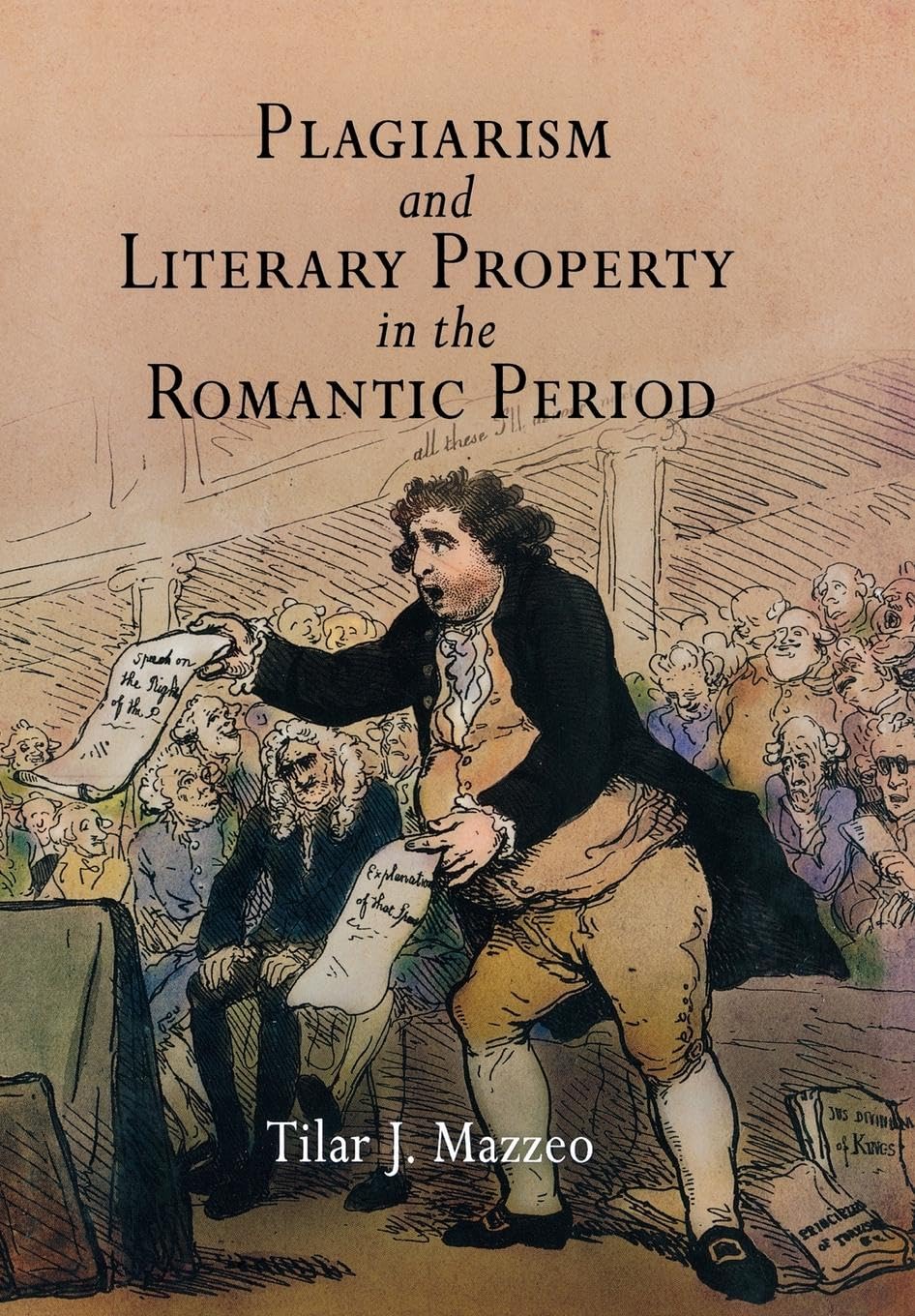
In a series of articles published in Tait's Magazine in 1834, Thomas DeQuincey catalogued four potential instances of plagiarism in the work of his friend and literary competitor Samuel Taylor Coleridge. DeQuincey's charges and the controversy they ignited have shaped readers' responses to the work of such writers as Coleridge, Lord Byron, William Wordsworth, and John Clare ever since. But what did plagiarism mean some two hundred years ago in Britain? What was at stake when early nineteenth-century authors levied such charges against each other? How would matters change if we were to evaluate these writers by the standards of their own national moment? And what does our moral investment in plagiarism tell us about ourselves and about our relationship to the Romantic myth of authorship?In Plagiarism and Literary Property in the Romantic Period, Tilar Mazzeo historicizes the discussion of late eighteenth- and early nineteenth-century plagiarism and demonstrates that it had little in common with our current understanding of the term. The book offers a major reassessment of the role of borrowing, textual appropriation, and narrative mastery in British Romantic literature and provides a new picture of the period and its central aesthetic contests. Above all, Mazzeo challenges the almost exclusive modern association of Romanticism with originality and takes a fresh look at some of the most familiar writings of the period and the controversies surrounding them.

Product description Review Select Guide Rating About the Author Tilar J. Mazzeo teaches English at Colby College. Excerpt. © Reprinted by permission. All rights reserved. PrefaceThis book reconsiders allegations that the Romantic poets were plagiarists. In many ways, the subject is a treacherous one. Even after some two hundred years, more or less, these charges of plagiarism evoke strong responses. My objective here, however, is not to reignite a familiar controversy, and it is not to defend or to indict either an individual poet or a literary movement. This is not a book about guilt or innocence, although those have been the terms of the plagiarism debate almost since its inception.Rather, this study sets out to answer what turns out to be a deceptively simple question: What constituted plagiarism in Britain during the late eighteenth and early nineteenth centuries? From this central historical question, a series of other questions inevitably develop, and these become the topics that give shape to the chapters that constitute this book. For if plagiarism did, indeed, mean something different in Georgian Britain—and how could it not, in a period where the relationship to literary property was legally, culturally, and historically distinctive—then what was at stake when Romantic-period writers levied these charges against each other? How was the articulation of acceptable literary appropriation framed within British culture? To what extent did the rhetoric of plagiarism intersect with the other eighteenth- and nineteenth-century discourses of inheritance, legitimacy, miscegenation, colonialism, consciousness, gender, class, improvement, and enclosure? Was the relationship between commercial print culture and literary culture, between reviewer and poet, constitutive? Perhaps most importantly, has Romanticism's almost exclusive critical association with the values of self-legislating originality helped to obscure the degree to which these writers were concerned with issues of borrowing, textual assimilation, and narrative mastery over another?The first chapter of this book begins by considering the critical tradition that has privileged Romantic ideas of the autogenous author to the exclusion of models of coterie or collaborative authorship, and it explains why this tradition has focused so intently on the plagiarisms of a single poet, Samuel Taylor Coleridge, as ideologically and culturally aberrant. Within this context, I historicize Romantic plagiarism and its immediate eighteenth-century precursors by distinguishing these borrowings from familiar textual strategies such as imitation and satire. The following chapters take up the alleged plagiarisms of a range of Romantic-period authors, beginning in Chapter 2 with Coleridge's literary obligations and with the conventions of plagiarism outlined by his first accuser, Thomas DeQuincey. My particular interest here is in the critical description of Coleridge's borrowings as psychologically motivated, and, by rereading Romantic-period models of the unconscious, I consider how plagiarism was linked to habit and inhabitation for the poet. Chapter 3 examines the problem of coterie and oral circulation and issues of plagiarism as they emerged primarily in the Wordsworth and Shelley households, and the argument addresses the ways in which private ownership was complicated by both gender and genre, especially for cultural materials located at the margins of literary print culture. Chapter 4 focuses on charges of aesthetic plagiarism levied against Lord Byron, particularly by William Wordsworth and his supporter Henry Taylor, while Chapter 5 rereads Percy Bysshe Shelley's "A Defence of Poetry" and Alastor in light of the poet's anxieties about his literary obligations. Finally, Chapter 6 explores Wordsworth's concern regarding the appropriation of his style and voice and examines the charges of plagiarism brought against him in The Excursion in relation to the larger legal discourse of enclosure. Wordsworth's rhetorical investment in class metaphors is contrasted with the accusations of plagiarism brought against "peasant" poets such as Ann Yearsley and John Clare in the periodical press.This study is an avowedly historicist project, and part of my larger objective here has been to interrogate the limits of historical imagination. Put another way, the theoretical ground that this book attempts to negotiate is this: What would it mean to attempt to judge the literary obligations of Romantic-era writers by the standards of their own national moment? In the most obvious sense, of course, this is an impossible project, but the effort has shaped my critical methodology. For me, in this work, that project began with an effort to forestall interpretation and to listen intently to what Romantic-period writers and critics said about the problem of plagiarism, even when that evidence had nothing to recommend it as obviously momentous or contentious. These initially unpromising

Book Specifications

ISBN-139780812239676
ISBN-100812239679
Publisher‎ Univ of Pennsylvania Pr
Language‎ English
Dimensions‎ 14.61 x 2.54 x 24.13 cm
Weight‎ 526 g
Country‎ India
CategoryLiterature › English Literature

Frequently Asked Questions

What is the price of Plagiarism And Literary Property in the Romantic Period?
Plagiarism And Literary Property in the Romantic Period is available at ₹4,577 on BookShops.in.
Does BookShops.in offer free delivery for Plagiarism And Literary Property in the Romantic Period?
FREE delivery on all orders for Plagiarism And Literary Property in the Romantic Period.
Is Cash on Delivery available for Plagiarism And Literary Property in the Romantic Period?
Yes, Cash on Delivery (COD) is available for Plagiarism And Literary Property in the Romantic Period on BookShops.in. Pay when your order arrives.
What is the return policy for Plagiarism And Literary Property in the Romantic Period?
BookShops.in offers a 15-day hassle-free return policy for Plagiarism And Literary Property in the Romantic Period. Contact us at [email protected] or call +91 81899 68108.
Is Plagiarism And Literary Property in the Romantic Period authentic?
Plagiarism And Literary Property in the Romantic Period is listed on BookShops.in after verification of product details including ISBN, title, and availability information.
Get In Touch

Contact BookShops.in

Find our bookstore in Madurai on the map below, or let us know about your reading experience by leaving a review.

Phone+91 81899 68108
Address12, Rajan Street, Main Road, KK Nagar, Madurai — 625020, Tamil Nadu, India
Support HoursMon–Sat, 10:00 AM – 6:00 PM (IST)

Value your feedback

Enjoyed the books you ordered from us? Your review helps fellow readers discover our store and helps us improve.

Leave a Google Review

Your Cart

Your cart is empty

Add books to get started