
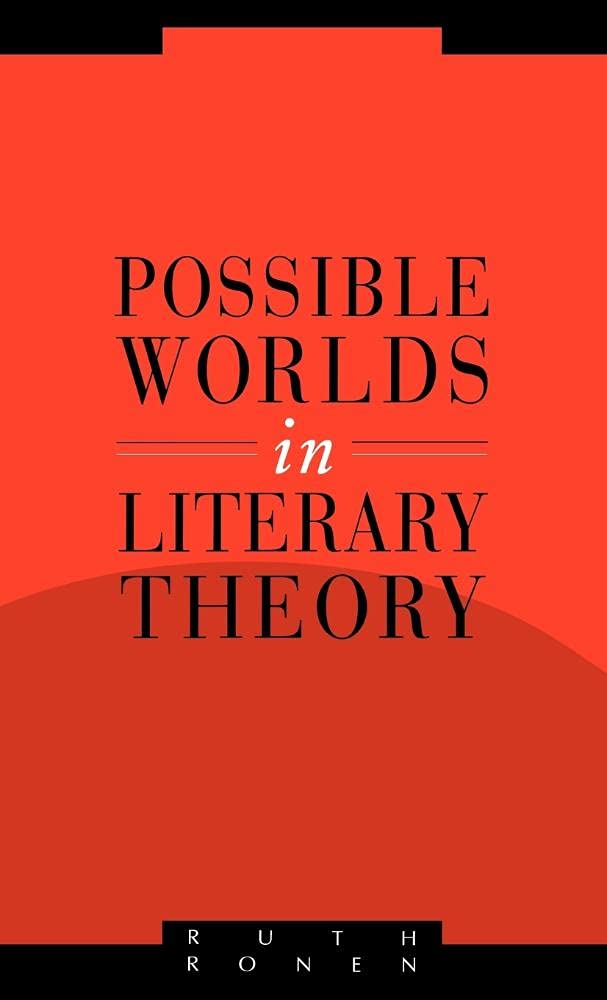
Possible Worlds in Literary Theory by Ruth Ronen – A Groundbreaking Study of Fictional Worlds and Narrative Ontology
Inclusive of all applicable taxes. FREE shipping on all orders.
Available Offers
- 🚚Free Delivery — Free shipping on all orders
- 💵Cash on Delivery — Pay when your order arrives
- ↩️15-Day Easy Returns — Hassle-free return policy
- 🔒Cash on Delivery — Pay safely when your order arrives
Check Delivery
Product Description
Introduction
In the vast landscape of literary theory, few concepts have proven as fertile and intellectually provocative as the idea of possible worlds. Ruth Ronen's groundbreaking work, Possible Worlds in Literary Theory, published by the esteemed Cambridge University Press, offers a rigorous and illuminating exploration of how this philosophical notion reshapes our understanding of fictionality. For students, scholars, and avid readers in India seeking to deepen their grasp of narrative structure and the ontology of fiction, this hardcover edition is an indispensable addition to any serious library.
Book Overview
Originally a cornerstone of philosophical logic, the concept of possible worlds has transcended its disciplinary origins to become a powerful tool in literary theory. Ruth Ronen masterfully charts this interdisciplinary journey, providing a comparative reading that reveals both the promise and the pitfalls of borrowing such a concept. She does not merely apply philosophical models to literature; instead, she critically examines how the notion of possible worlds can be adapted to explain the unique nature of fictional worlds—their boundaries, their inhabitants, and their temporal and spatial logic. Through a series of carefully argued analyses, Ronen proposes a new set of criteria for defining fictionality, making rigorous and necessary distinctions between possible worlds (as conceived in logic) and fictional worlds (as constructed in literature). The book culminates in a radical rethinking of fictional narrativity, challenging long-held assumptions about events, objects, time, and point of view within fictional domains.
Key Highlights
- Interdisciplinary Synthesis: Bridges the gap between philosophical logic and literary theory, offering a clear and nuanced comparison of how each field uses the concept of possible worlds.
- Original Framework: Develops a fresh set of criteria for understanding fictionality, moving beyond simplistic definitions to account for the complexity of literary worlds.
- Focused Case Studies: Delves into specific domains within fictional worlds—including events, objects, time, and point of view—to demonstrate the practical application of theoretical insights.
- Critical Rigour: Maintains a sharp critical edge, questioning assumptions and proposing new pathways for understanding the relationship between reality, possibility, and fiction.
- Authoritative Publication: Published by Cambridge University Press, ensuring the highest standards of academic scholarship and editorial quality.
Story Themes
While this is a work of literary theory rather than a narrative, its thematic concerns are deeply resonant. The book grapples with the nature of possibility itself—how imagined worlds can feel as real as our own, how time flows differently in fiction, and how point of view creates entire universes of meaning. At its heart, Possible Worlds in Literary Theory explores the tension between the actual and the imagined, the logical and the literary. It asks profound questions about how we construct, inhabit, and interpret worlds that exist only in language. Themes of ontology (the study of being), epistemology (how we know what is true), and narratology (the structure of stories) weave together, making this a rich text for anyone interested in the philosophical underpinnings of literature.
Reader Benefits
For Indian readers, this book offers more than academic insight—it provides a toolkit for reading and analysing literature with greater depth. By understanding how fictional worlds are constructed, you will develop a sharper critical eye for narrative technique, whether you are studying a classic novel, a contemporary short story, or a work of regional Indian literature. The book encourages you to think about fiction not as a mere escape from reality, but as a serious engagement with the realm of the possible. It will enhance your appreciation of how writers create coherence, manage time, and manipulate perspective. For postgraduate students and faculty in English, comparative literature, or philosophy departments, this volume is a vital resource for seminars, dissertations, and research papers.
Who Should Read
- Literature Students and Scholars: Ideal for postgraduate and doctoral researchers in literary theory, narratology, and comparative literature.
- Philosophy Enthusiasts: Those interested in the philosophy of language, metaphysics, and the logic of fiction will find the interdisciplinary approach highly rewarding.
- Writers and Creative Thinkers: Novelists, short story writers, and screenwriters seeking a deeper theoretical understanding of world-building will gain valuable insights.
- Indian Academics: Professors and students in Indian universities offering courses in literary criticism, cultural studies, or aesthetics will find this a foundational text.
- Curious Readers: Anyone with a serious interest in how fiction works—why stories feel real and how they shape our perception of reality—will be captivated.
About the Author
Ruth Ronen is a distinguished literary theorist and philosopher, known for her incisive work at the intersection of narrative theory and analytic philosophy. Her scholarship is characterised by a commitment to clarity, critical rigour, and interdisciplinary dialogue. With a deep understanding of both the philosophical tradition and the complexities of literary structures, Ronen has contributed significantly to contemporary debates on fictionality, ontology, and the nature of narrative worlds. Possible Worlds in Literary Theory stands as a testament to her ability to bridge seemingly disparate fields, offering insights that are both theoretically sophisticated and accessible to dedicated readers.
About the Publisher
Cambridge University Press is one of the world's oldest and most respected academic publishers, with a legacy dating back to 1534. Renowned for its commitment to scholarly excellence, the Press publishes works that set the standard in fields ranging from literature and philosophy to science and history. This hardcover edition of Possible Worlds in Literary Theory reflects the Press's dedication to producing durable, beautifully bound books that are as much a pleasure to hold as they are to read. For Indian readers, a Cambridge University Press title is a mark of quality and intellectual authority.
Conclusion
Possible Worlds in Literary Theory is not just a book—it is an intellectual adventure. Ruth Ronen invites you to rethink everything you thought you knew about fiction, reality, and the spaces between them. Whether you are a seasoned scholar or a passionate reader, this volume will challenge your assumptions and expand your horizons. Order your hardcover copy from Bookshops.in today and step into a world where the boundaries of possibility are redrawn with every page.
Quick Summary
Ruth Ronen's 'Possible Worlds in Literary Theory' is a landmark interdisciplinary study that brings the philosophical concept of possible worlds into dialogue with literary theory. The book systematically compares how possible worlds are used in logic and in literary criticism, and proposes a new framework for understanding fictional worlds, their ontology, and their narrative structures. Readers will explore the nature of fictionality, the role of time, events, objects, and point of view in fiction, and how these elements construct the fabric of literary narratives. This work is essential for postgraduate students, researchers, and teachers of English literature, comparative literature, and philosophy of literature. It challenges conventional boundaries between fiction and reality, offering a radical rethinking of how we interpret literary texts. By purchasing from Bookshops.in, Indian readers gain access to a premium Cambridge University Press edition, ensuring authenticity and quality for academic and personal libraries.
Book Highlights
Book Specifications
| ISBN-13 | 9780521450171 |
| ISBN-10 | 0521450179 |
| Publisher | Cambridge University Press |
| Language | English |
| Dimensions | 14.61 x 1.91 x 22.86 cm |
| Weight | 470 g |
| Country | India |
| Category | Literature › Literary Theory |
| Genre | Literary Criticism |
| Reading Age | Adult |
| Original Language | English |
Frequently Asked Questions
What is 'Possible Worlds in Literary Theory' about?
Who is the author of this book?
Is this book suitable for undergraduate students?
What key topics does the book cover?
How is this book different from other literary theory books?
Does the book include examples from literature?
Is this book available in hardcover?
Can I use this book for my PhD research?
What is the ISBN of this book?
Does the book discuss Indian literature?
Is this book part of a series?
What is the price of this book?
Why buy from Bookshops.in?
Readers Also Search For
Related Products
View All
Literature & Fiction
Literary Research and Canadian Literature: Strategies and Sources: 10 (Literary Research: Strategies and Sources, 10)

Literature & Fiction
Crime Fiction and National Identities in the Global Age | by Julie H. Kim | McFarland & Company | by Julie H. Kim | McFarland & Company | by Julie H. Kim | McFarland & Company | by Julie H. Kim | McFarland & Company | by Julie H. Kim | McFarland & Company | by Julie H. Kim | McFarland & Company | by Julie H. Kim | McFarland & Company | by Julie H. Kim | McFarland & Company | by Julie H. Kim | McFarland & Company | by Julie H. Kim | McFarland & Company | by

Literature & Fiction
The Irregular at Magic High School by Tsutomu Sato
Literature & Fiction
Greek Literature and Philosophy (Greek Literature, Volume 6)
Literature & Fiction
Greek Literature in the Classical Period: The Poetics of Drama in Athens: 4 (Greek Literature Vol. 4)
Literature & Fiction