
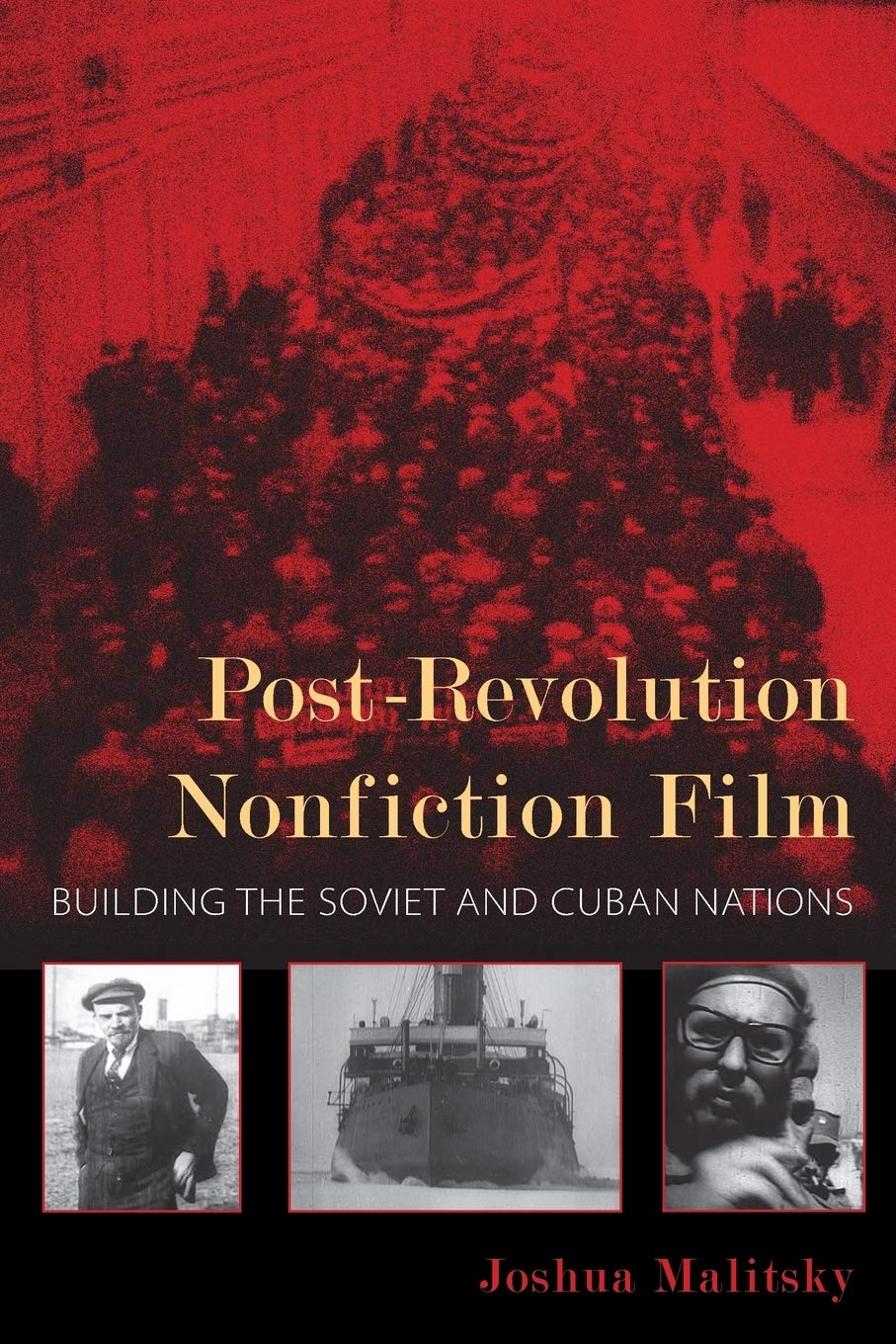
Post-Revolution Nonfiction Film: Building the Soviet and Cuban Nations by Joshua Malitsky – A Deep Dive into Documentary
Inclusive of all applicable taxes. FREE shipping on all orders.
Available Offers
- 🚚Free Delivery — Free shipping on all orders
- 💵Cash on Delivery — Pay when your order arrives
- ↩️15-Day Easy Returns — Hassle-free return policy
- 🔒Cash on Delivery — Pay safely when your order arrives
Check Delivery
Product Description
Introduction
In the turbulent aftermath of revolution, nations are reborn not only through political decrees but also through cultural artifacts that shape collective memory and national identity. Joshua Malitsky's Post-Revolution Nonfiction Film: Building the Soviet and Cuban Nations offers a compelling exploration of how documentary cinema became a powerful instrument for state-building in two of the most transformative revolutions of the twentieth century. This meticulously researched work reveals the intricate relationship between film, ideology, and the forging of a new citizenry, making it an essential read for students of film studies, political history, and cultural theory.
Book Overview
This hardcover volume from Indiana University Press delves into the role of nonfiction film in constructing national narratives after the Russian Revolution of 1917 and the Cuban Revolution of 1959. Malitsky examines newsreels, documentaries, and other nonfiction works to demonstrate how these films were used to unify diverse populations, modernize societies, and cultivate a sense of shared purpose. By juxtaposing the Soviet and Cuban experiences, the book highlights both unique historical contexts and universal strategies of visual propaganda and cultural pedagogy. The analysis extends beyond aesthetics to consider the political and rhetorical frameworks that shaped these cinematic efforts, offering a nuanced understanding of documentary film as a tool of governance and identity formation.
Key Highlights
- Comparative Framework: A rare dual analysis of post-revolution Soviet and Cuban filmmaking, revealing parallels and divergences in state-sponsored documentary practices.
- Archival Depth: Draws on extensive primary sources, including newsreels and rarely studied documentaries from both nations.
- Interdisciplinary Approach: Bridges film theory, political science, and cultural history for a holistic understanding of nation-building.
- Critical Perspective: Challenges conventional narratives by examining how film both reflects and constructs revolutionary ideals.
Inside the Book
The book is organized into thematic chapters that trace the evolution of nonfiction film from its revolutionary origins to its institutionalisation. Malitsky unpacks the aesthetic choices of filmmakers—montage, voice-over, and visual symbolism—and connects them to broader political objectives. Case studies include Dziga Vertov's Soviet newsreels and Cuban documentaries from the Instituto Cubano del Arte e Industria Cinematográficos (ICAIC). The author also explores the tension between artistic innovation and state control, showing how filmmakers negotiated their roles as both artists and propagandists. Each chapter is enriched with historical context, making the analysis accessible even to readers new to film studies.
Key Topics
- Nonfiction Film as State Apparatus: How documentaries served to educate, mobilise, and discipline post-revolution populations.
- Visual Rhetoric of Revolution: The use of imagery to create new heroes, villains, and collective memories.
- Comparative Revolutionary Cultures: Soviet and Cuban approaches to modernity, socialism, and national identity.
- Filmmaker Agency: The creative and political dilemmas faced by documentary makers under authoritarian regimes.
- Legacy and Influence: How these films shaped later documentary traditions in the Global South and beyond.
Reader Benefits
- Deepen Your Understanding: Gain insights into the political power of nonfiction film beyond mere entertainment.
- Enhance Critical Thinking: Learn to analyse film as a historical and ideological document.
- Broaden Academic Horizons: Perfect for coursework in film studies, history, political science, or cultural studies.
- Engage with Primary Sources: Access rare examples of early Soviet and Cuban documentary work through Malitsky's detailed descriptions.
- Connect Past and Present: Understand how revolutionary media strategies resonate in today's digital propaganda landscape.
Learning Outcomes
- Identify key characteristics of post-revolution nonfiction film in Soviet and Cuban contexts.
- Analyse the relationship between state ideology and cinematic form.
- Evaluate the role of documentary film in constructing national identity and historical memory.
- Compare and contrast different revolutionary models of cultural production.
- Apply theoretical frameworks from film and cultural studies to real-world political contexts.
Who Should Read
- Students and Scholars: Ideal for undergraduate and postgraduate courses in film history, documentary studies, Russian or Latin American history, and political communication.
- Film Enthusiasts: Anyone interested in the intersection of cinema and politics will find this book eye-opening.
- History Buffs: Readers fascinated by the Soviet and Cuban revolutions will appreciate the fresh perspective on cultural nation-building.
- Media Professionals: Journalists, documentarians, and content creators seeking historical context for state-sponsored media.
About the Author
Joshua Malitsky is a respected scholar of film and media studies, with a focus on documentary film, visual culture, and political history. He has published extensively on the relationship between cinema and state power, and his work has been recognised for its interdisciplinary rigour and archival depth. Malitsky teaches at Indiana University Bloomington, where he continues to explore the global dimensions of nonfiction filmmaking.
About the Publisher
Indiana University Press is a leading academic publisher known for its distinguished list in film studies, Slavic studies, and Latin American studies. With a commitment to scholarly excellence, the press has published numerous award-winning works that advance knowledge in the humanities and social sciences.
Conclusion
Post-Revolution Nonfiction Film: Building the Soviet and Cuban Nations is more than a historical study—it is a vital contribution to our understanding of how moving images can shape the destiny of nations. For Indian readers and students navigating an era of visual media saturation, this book offers timeless lessons about the power of film to inform, inspire, and influence. Whether you are a researcher, a student, or a curious reader, this volume will transform the way you watch documentaries and think about revolutions. Add it to your library today from Bookshops.in.
Quick Summary
Post-Revolution Nonfiction Film by Joshua Malitsky is a scholarly study of how documentary and newsreel films were deployed as instruments of nation building in the Soviet Union after 1917 and in Cuba after 1959. The book examines the intersection of politics, aesthetics, and state power, showing how nonfiction film helped shape new citizens, unify societies, and modernize post-revolution cultures. Malitsky draws on extensive archival research and film theory to compare the two revolutionary contexts, highlighting the rhetorical strategies and visual styles used to create compelling historical narratives. This book is ideal for film studies scholars, history researchers, political science students, and anyone interested in the role of media in statecraft. Readers will gain insights into how governments use documentary film to craft national identity, control historical memory, and promote ideological agendas. By purchasing from Bookshops.in, Indian customers receive a genuine hardcover edition with fast delivery and trusted service.
Book Highlights
Book Specifications
| ISBN-13 | 9780253007667 |
| ISBN-10 | 0253007666 |
| Publisher | Indiana Univ Pr |
| Language | English |
| Dimensions | 22.61 x 15.24 x 2.03 cm |
| Weight | 476 g |
| Country | India |
| Category | Performing Arts › Film & Television |
| Genre | Nonfiction |
| Original Language | English |
Frequently Asked Questions
What is Post-Revolution Nonfiction Film about?
Who is the author of this book?
Which revolutions are covered in the book?
Is this book suitable for undergraduate students?
What types of films are analyzed?
Does the book compare Soviet and Cuban cinema?
What is the binding of this book?
Is this book available in Indian bookstores?
What language is the book written in?
What is the ISBN of this book?
Who should read this book?
Does the book discuss propaganda?
Why buy from Bookshops.in?
Readers Also Search For
Customers Also Bought
Mathematics
Stereotype Spaces and Algebras: 73 (De Gruyter Expositions in Mathematics, 73)
Mathematics
Semigroups in Algebra, Geometry and Analysis: 20 (De Gruyter Expositions in Mathematics, 20)
Mathematics
Geometry from the Pacific Rim: Proceedings of the Pacific Rim Geometry Conference held at National University of Singapore, Republic of Singapore, ... 1994 (De Gruyter Proceedings in Mathematics)

Mathematics
First International Tainan-Moscow Algebra Workshop: Proceedings of the International Conference held at National Cheng Kung University Tainan, Taiwan, ... 1994 (De Gruyter Proceedings in Mathematics)
Mathematics
Differential Geometry - Proceedings of the VIII International Colloquium (English, Jesus A. Alvarez Lopez | Eduardo Garcia-Rio)
Mathematics
Mathematical Theory of Optimal Processes (Classics of Soviet Mathematics)
Related Products
View All
Science & Mathematics
Elements of Pelagos Biology: With Focus on the Mediterranean Sea

Science & Mathematics
Squid - Superconducting Quantum Interference Devices and Their Applications: Proceedings of the International Conference on Superconducting Quantum Devices, Berlin-west, October 4-8, 1976

Science & Mathematics
Thermodynamics and Pattern Formation in Biology
Science & Mathematics
The Nature of Mathematics and the Mathematics of Nature by S. Andersson – Mathematics & Science

Science & Mathematics
Linear Algebra | by Stephen Friedberg | Arnold Insel | Lawrence Spence | Pearson | by Stephen Friedberg | Arnold Insel | Lawrence Spence | Pearson | by Stephen Friedberg | Arnold Insel | Lawrence Spence | Pearson | by Stephen Friedberg | Arnold Insel | Lawrence Spence | Pearson | by Stephen Friedberg | Arnold Insel | Lawrence Spence | Pearson | by Stephen Friedberg | Arnold Insel | Lawrence Spence | Pearson | by Stephen Friedberg | Arnold Insel | Lawrence Spence | Pearson | by Stephen Friedberg
Science & Mathematics