
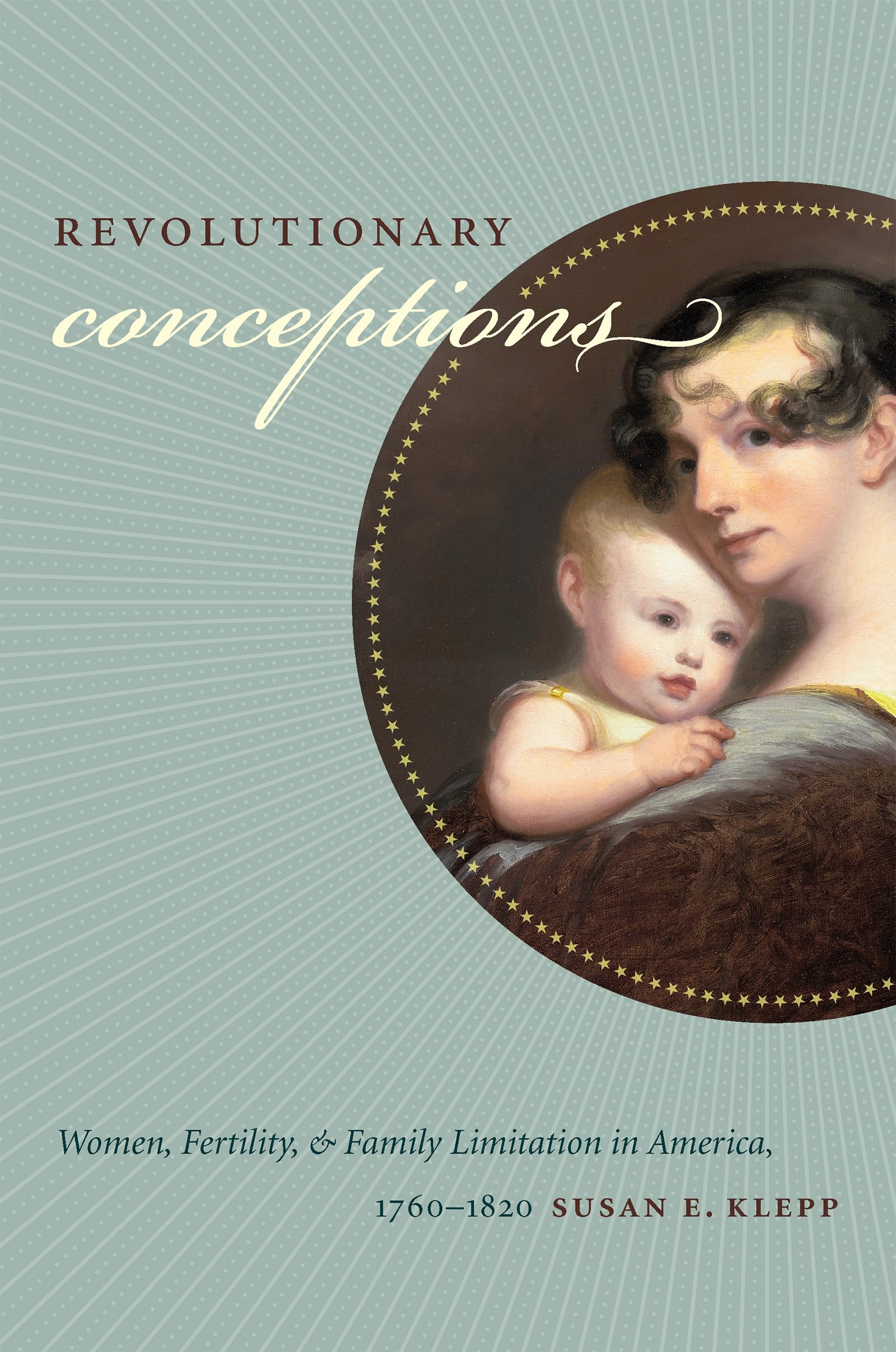
Revolutionary Conceptions: Women, Fertility, and Family Limitation in America, 1760-1820
Inclusive of all applicable taxes. FREE shipping on all orders.
Available Offers
- 🚚Free Delivery — Free shipping on all orders
- 💵Cash on Delivery — Pay when your order arrives
- ↩️15-Day Easy Returns — Hassle-free return policy
- 🔒Cash on Delivery — Pay safely when your order arrives
Check Delivery
Product Description
Introduction
In the crucible of the American Revolution, a quieter but equally profound transformation was taking place within the homes and hearts of women. 'Revolutionary Conceptions: Women, Fertility, and Family Limitation in America, 1760-1820' by Susan E. Klepp uncovers a pivotal shift in how American women began to reimagine their bodies, their marriages, and their futures. This compelling work reveals that long before modern contraception, women were quietly asserting control over fertility and family size, driven by ideals of liberty, equality, and personal autonomy. For students of history, gender studies, and social change, this book offers a fresh and deeply researched perspective on a transformative era.
Book Overview
Susan E. Klepp’s groundbreaking study examines the period from the eve of the American Revolution through the early republic, when American women—both free and enslaved, rural and urban—began to challenge the longstanding expectation of continuous childbearing. Drawing on diaries, letters, advice manuals, portraits, and demographic data, Klepp shows how women redefined motherhood, sexuality, and family obligation. The book traces the gradual decline in birth rates and the emergence of new ideals of rational, virtuous womanhood. By focusing on the intimate decisions of women, Klepp illuminates a quiet revolution that reshaped American society from the inside out.
Key Highlights
- Original Research: Uses previously overlooked sources such as women’s personal writings and material culture to uncover hidden histories.
- Intersectional Approach: Explores the experiences of both white and enslaved women, highlighting differences and commonalities in reproductive choices.
- Demographic Insights: Provides concrete evidence of declining birth rates and changing family sizes in the late 18th and early 19th centuries.
- Cultural Analysis: Examines how ideas of liberty, religion, and Enlightenment thought influenced women’s perceptions of their own bodies.
Inside the Book
The book is organized thematically, moving from broad cultural contexts to intimate personal decisions. Early chapters set the stage by describing the traditional expectations of large families and the religious and social pressures on women. Subsequent sections delve into the methods women used to limit fertility—including abstinence, prolonged breastfeeding, and even abortion—and the moral and emotional justifications they offered. Klepp also analyzes portraits and visual culture to show how ideals of femininity evolved, emphasizing slender, independent figures over maternal abundance. The final chapters address the resistance and gradual acceptance of these changes by men and society at large.
Key Topics
- Reproductive choices and family limitation in early America
- The impact of revolutionary ideals on women’s autonomy
- Contraception, abortion, and sexual attitudes in the 18th century
- Race, class, and the politics of fertility
- Changing definitions of motherhood and femininity
- Demographic transitions and their social causes
Reader Benefits
- Gain a nuanced understanding of women’s agency in a period often seen as patriarchal and restrictive.
- Learn how historical debates about fertility and family resonate with contemporary issues of reproductive rights.
- Access a wealth of primary source material that brings the voices of historical women to life.
- Develop critical thinking about how social movements and individual choices shape demographic trends.
Learning Outcomes
Readers will emerge with a deeper appreciation for the complexity of women’s lives in revolutionary America. They will understand that the decline in birth rates was not a simple result of economic change but a deliberate, often courageous, assertion of personal will. Students will learn to analyze historical evidence from diverse sources, from personal letters to visual art, and to connect micro-level decisions to macro-level social transformations. The book also equips readers to critically evaluate assumptions about motherhood, gender roles, and bodily autonomy across time.
Who Should Read
This book is essential for undergraduate and postgraduate students in history, women’s studies, American studies, and sociology. It will also appeal to general readers interested in the history of family, reproduction, and gender. Educators teaching courses on the American Revolution, social history, or the history of sexuality will find it a valuable resource. Additionally, anyone curious about the roots of modern reproductive debates will discover a rich and illuminating narrative.
About the Author
Susan E. Klepp is a distinguished historian and professor emerita at Temple University, specializing in early American history, women’s history, and the history of reproduction. She has published widely on topics ranging from colonial demography to the cultural history of childbirth. Her meticulous scholarship combines quantitative analysis with sensitive readings of personal narratives, making her work both rigorous and accessible.
About the Publisher
Published by the Omohundro Institute of Early American History and Culture in association with the University of North Carolina Press, this book is part of a prestigious series that advances the study of early America. The Omohundro Institute is renowned for its commitment to innovative, interdisciplinary research, and UNC Press is a leading academic publisher known for its high editorial standards.
Conclusion
'Revolutionary Conceptions' is a vital contribution to our understanding of how ordinary women shaped the course of American history through their most intimate decisions. Susan E. Klepp’s careful scholarship and compelling storytelling reveal that the quest for bodily autonomy is not a modern invention but a thread woven deeply into the fabric of the American experience. This book will change how you think about revolution, family, and the quiet power of women’s choices.
Quick Summary
Revolutionary Conceptions: Women, Fertility, and Family Limitation in America, 1760-1820 by Susan E. Klepp is a landmark study that transforms our understanding of women’s lives in early America. The book reveals how American women—both free and enslaved, rural and urban—began to challenge the ideal of large families and instead pursued smaller families, greater autonomy, and improved opportunities for their daughters. Drawing on a rich array of diaries, letters, legal records, and newspapers, Klepp shows that women were not passive recipients of demographic change but active agents who used contraception, abortion, and delayed marriage to control their fertility. This work connects the revolutionary ideals of liberty, equality, and heartfelt religion to intimate decisions about childbearing, sexuality, and identity. Readers will gain a fresh perspective on the origins of modern family planning and the deep roots of gender roles in American society. This book is ideal for students, historians, and anyone interested in women’s history, reproductive rights, or social change. Buy your copy from Bookshops.in—India’s trusted online bookstore—for an authentic hardcover edition with fast delivery.
Book Highlights
Book Specifications
| ISBN-13 | 9780807859926 |
| ISBN-10 | 0807859923 |
| Publisher | Omohundro Inst of Early Amer |
| Language | English |
| Dimensions | 15.6 x 2.08 x 23.39 cm |
| Weight | 476 g |
| Country | India |
| Category | Clinical › Reproductive Medicine & Technology |
| Genre | History / Women's Studies / Social History |
| Reading Age | Adult |
| Original Language | English |
Frequently Asked Questions
What is Revolutionary Conceptions about?
Who is the author of Revolutionary Conceptions?
What time period does the book cover?
Is this book suitable for undergraduate students?
Does the book discuss contraception and abortion?
What sources does Susan E. Klepp use?
How does this book differ from other women's history books?
Is the book only about white women?
Does the book cover religious influences on fertility?
What is the price of Revolutionary Conceptions in India?
Is this book available in paperback?
Can I use this book for my research paper?
Why should I buy from Bookshops.in?
Readers Also Search For
Customers Also Bought

Anatomy
Ultrastructure of the Digestive Tract: 4 (Electron Microscopy in Biology and Medicine)

Anatomy
Ultrastructure of the Connective Tissue Matrix: 3 (Electron Microscopy in Biology and Medicine)

Anatomy
Reproductive Genetics (Royal College of Obstetricians and Gynaecologists Study Group)

Anatomy
Human Gross Anatomy: An Outline Text by Robert J. Leonard – Medical Anatomy

Pharmacology
Mathematical Modeling and Simulation in Enteric Neurobiology

Anatomy
Nature’s Patterns and the Fractional Calculus: 2 (Fractional Calculus in Applied Sciences and Engineering, 2)
Related Products
View All
Medicine & Health Sciences
Handbook of Hospitality Strategic Management | by Olsen Michael | Taylor & Francis Ltd | by Olsen Michael | Taylor & Francis Ltd | by Olsen Michael | Taylor & Francis Ltd | by Olsen Michael | Taylor & Francis Ltd | by Olsen Michael | Taylor & Francis Ltd | by Olsen Michael | Taylor & Francis Ltd | by Olsen Michael | Taylor & Francis Ltd | by Olsen Michael | Taylor & Francis Ltd | by Olsen Michael | Taylor & Francis Ltd | by Olsen Michael | Taylor & Francis

Medicine & Health Sciences
Pediatrics on Call | by Charles A. Pohl | Kathleen Bradford | Clara Callahan | McGraw Hill / Medical | by Charles A. Pohl | Kathleen Bradford | Clara Callahan | McGraw Hill / Medical | by Charles A. Pohl | Kathleen Bradford | Clara Callahan | McGraw Hill / Medical | by Charles A. Pohl | Kathleen Bradford | Clara Callahan | McGraw Hill / Medical | by Charles A. Pohl | Kathleen Bradford | Clara Callahan | McGraw Hill / Medical | by Charles A. Pohl | Kathleen Bradford | Clara Callahan | McGraw Hill

Medicine & Health Sciences
The Physician's Guide to Depression and Bipolar Disorders | by Dwight L. Evans | Dennis S. Charney | Lydia Lewis | McGraw Hill / Medical | by Dwight L. Evans | Dennis S. Charney | Lydia Lewis | McGraw Hill / Medical | by Dwight L. Evans | Dennis S. Charney | Lydia Lewis | McGraw Hill / Medical | by Dwight L. Evans | Dennis S. Charney | Lydia Lewis | McGraw Hill / Medical | by Dwight L. Evans | Dennis S. Charney | Lydia Lewis | McGraw Hill / Medical | by Dwight L. Evans | Dennis S. Charney | Lydi
Medicine & Health Sciences
First Exposure to Internal Medicine | by Andrew R. Hoellein | Charles H. Griffith | McGraw Hill / Medical | by Andrew R. Hoellein | Charles H. Griffith | McGraw Hill / Medical | by Andrew R. Hoellein | Charles H. Griffith | McGraw Hill / Medical | by Andrew R. Hoellein | Charles H. Griffith | McGraw Hill / Medical | by Andrew R. Hoellein | Charles H. Griffith | McGraw Hill / Medical | by Andrew R. Hoellein | Charles H. Griffith | McGraw Hill / Medical | by Andrew R. Hoellein | Charles H. Griffit
Medicine & Health Sciences
First Exposure to Internal Medicine | by Charles H. Griffith | Andrew R. Hoellein | McGraw Hill / Medical | by Charles H. Griffith | Andrew R. Hoellein | McGraw Hill / Medical | by Charles H. Griffith | Andrew R. Hoellein | McGraw Hill / Medical | by Charles H. Griffith | Andrew R. Hoellein | McGraw Hill / Medical | by Charles H. Griffith | Andrew R. Hoellein | McGraw Hill / Medical | by Charles H. Griffith | Andrew R. Hoellein | McGraw Hill / Medical | by Charles H. Griffith | Andrew R. Hoellei

Medicine & Health Sciences