
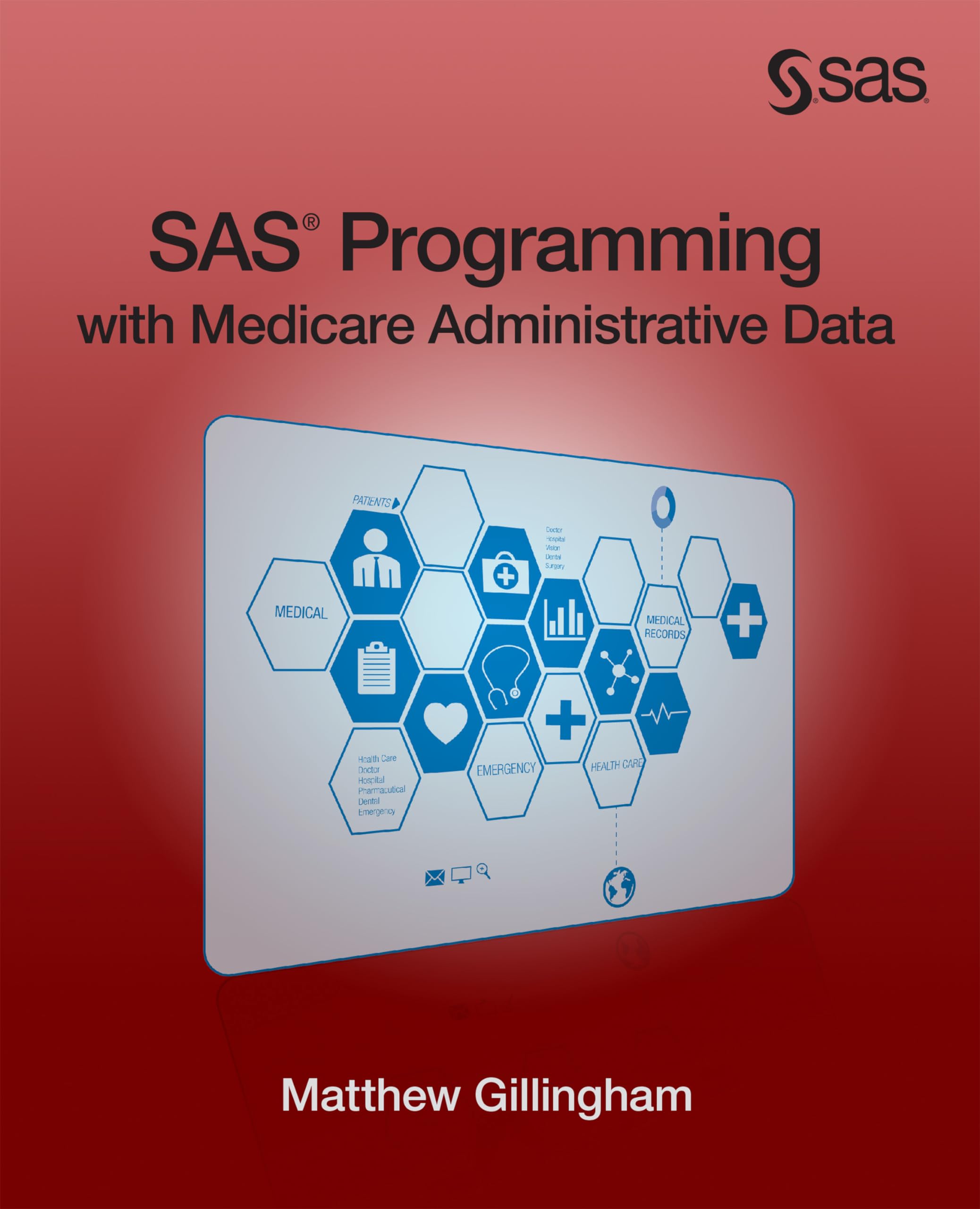
SAS Programming with Medicare Administrative Data: A Comprehensive Guide for Researchers and Programmers by Matthew Gill
Inclusive of all applicable taxes. FREE shipping on all orders.
Available Offers
- 🚚Free Delivery — Free shipping on all orders
- 💵Cash on Delivery — Pay when your order arrives
- ↩️15-Day Easy Returns — Hassle-free return policy
- 🔒Cash on Delivery — Pay safely when your order arrives
Check Delivery
Product Description
Introduction
Navigating the complexities of Medicare administrative data can be a daunting task for any programmer or researcher. With vast datasets, intricate coding systems, and strict regulatory requirements, a solid guide is essential. SAS Programming with Medicare Administrative Data by Matthew Gillingham is the definitive resource for anyone looking to master the art of working with Medicare data using SAS. Published by the SAS Institute, this hardcover edition is a must-have for Indian data analysts, biostatisticians, and healthcare researchers who need to handle large-scale health claims and beneficiary data with precision and efficiency.
Book Overview
This book serves as both a practical tutorial for beginners and a comprehensive reference for seasoned programmers. It bridges the gap between raw Medicare data and actionable research insights. Gillingham systematically walks you through the structure of Medicare files, data extraction techniques, cleaning methods, and analytical programming. The focus is on real-world application, ensuring that you can immediately apply the techniques to your own projects. Whether you are studying healthcare policy, conducting epidemiological research, or building data pipelines for insurance analytics, this book provides the foundational knowledge and advanced strategies you need.
Key Highlights
- Comprehensive coverage of Medicare administrative data, including Part A, Part B, Part D, and beneficiary summary files.
- Step-by-step SAS programming examples that are easy to follow and adapt.
- Practical tips for handling missing data, merging large datasets, and ensuring data integrity.
- Real-world case studies that demonstrate how to answer research questions using Medicare data.
- Focus on efficiency – techniques to optimize SAS code for massive datasets common in healthcare analytics.
Inside the Book
The book is structured into logical sections that build upon each other. It begins with an introduction to the Medicare program and the types of administrative data available. You will then learn how to access and import data into SAS, followed by detailed chapters on data cleaning, variable recoding, and handling longitudinal data. Advanced topics include working with diagnosis and procedure codes (ICD-9, ICD-10, CPT, HCPCS), calculating episode costs, and performing risk adjustment. Each chapter includes annotated SAS code, output interpretation, and exercises to reinforce learning. The appendices provide quick-reference guides for common Medicare data elements and SAS macros.
Key Topics
- Understanding Medicare data sources and file layouts
- Data import, merging, and subsetting techniques in SAS
- Working with dates, enrollment periods, and claims history
- Managing large datasets with SAS procedures like DATA step, PROC SQL, and PROC SUMMARY
- Analytical methods for cost, utilization, and quality measurement
- Compliance with data privacy and security requirements (HIPAA, CMS guidelines)
Reader Benefits
By studying this book, you will gain the confidence to tackle Medicare data projects independently. You will save countless hours by avoiding common pitfalls and adopting best practices shared by an expert. The code examples are production-ready and can be directly integrated into your workflow. For Indian researchers working with US healthcare data or collaborating with international teams, this book offers a clear pathway to understanding the nuances of Medicare claims. It also enhances your SAS programming skills, making you more valuable in the job market for data-heavy roles in healthcare, insurance, and government sectors.
Learning Outcomes
- Ability to identify and access relevant Medicare data files for your research.
- Proficiency in cleaning, merging, and analyzing Medicare claims using SAS.
- Skills to compute key healthcare metrics such as costs, readmission rates, and comorbidity scores.
- Understanding of how to handle longitudinal data and create analytical cohorts.
- Knowledge of regulatory considerations when working with sensitive health data.
Who Should Read
This book is ideal for SAS programmers who are new to Medicare data, as well as experienced analysts who want a deeper understanding of healthcare claims. It is also suitable for biostatisticians, epidemiologists, health economists, and data scientists working in public health, pharmaceutical research, or health insurance. Students pursuing advanced degrees in public health, biostatistics, or data science will find it an invaluable supplement to their coursework. Even if you are based in India and working with US healthcare datasets, this book provides the necessary context and technical guidance to excel.
About the Author
Matthew Gillingham is a seasoned SAS programmer and healthcare data analyst with extensive experience in Medicare administrative data. He has worked on numerous research projects involving large claims databases and has taught SAS programming to professionals across various industries. His practical, hands-on approach comes from years of solving real-world data challenges. Gillingham’s expertise ensures that every technique in this book is battle-tested and designed to deliver results.
About the Publisher
SAS Institute is the world leader in analytics software and services. With decades of experience in developing SAS programming language and tools, the SAS Institute is uniquely positioned to publish authoritative content on data analysis. Their books are known for technical accuracy, clarity, and practical relevance. This publication upholds that tradition, offering readers a reliable resource backed by the institution that powers millions of data-driven decisions worldwide.
Conclusion
SAS Programming with Medicare Administrative Data is more than a textbook – it is a career asset. For anyone serious about healthcare data analytics, this book will transform how you work with Medicare information. By combining deep domain knowledge with expert SAS programming, Matthew Gillingham has created a resource that will serve you for years. Order your hardcover copy from Bookshops.in today and take the first step toward mastering Medicare data with SAS.
Quick Summary
SAS Programming with Medicare Administrative Data by Matthew Gillingham is a definitive guide for anyone who needs to work with Medicare claims data using SAS. The book starts by explaining how to access the various Medicare data files—beneficiary summary, inpatient, outpatient, carrier, and prescription drug events—and then moves into practical techniques for cleaning, merging, and analyzing these large datasets. It is written for both novice programmers who are new to Medicare data and experienced SAS users who need a comprehensive reference. Readers will learn how to handle common data issues like missing values, date variables, and coding systems (ICD-9, CPT, HCPCS). The book includes numerous SAS code examples, macros, and best practices for data validation. It is an essential resource for health services researchers, public health analysts, and data scientists working with administrative healthcare data. By purchasing from Bookshops.in, Indian customers get a reliable physical copy delivered to their doorstep, with the assurance of quality and prompt service.
Book Highlights
Book Specifications
| ISBN-13 | 9781612903224 |
| ISBN-10 | 1612903223 |
| Publisher | SAS Institute |
| Language | English |
| Dimensions | 19.05 x 0.97 x 23.5 cm |
| Weight | 1 kg 50 g |
| Category | Clinical › Family & General Practice |
| Genre | Non-fiction |
| Original Language | English |
Frequently Asked Questions
What is this book about?
Who is the author?
Do I need prior SAS experience?
What type of Medicare data does it cover?
Is this book for researchers or programmers?
Does the book include actual SAS code?
Can I use this for other administrative data?
Is this a textbook?
Does it cover SAS macros?
How is the book organized?
Can I learn data visualization from this book?
Is the book available in Indian bookstores?
What is the price?
Readers Also Search For
Customers Also Bought

Anatomy
Ultrastructure of the Digestive Tract: 4 (Electron Microscopy in Biology and Medicine)

Anatomy
Ultrastructure of the Connective Tissue Matrix: 3 (Electron Microscopy in Biology and Medicine)

Anatomy
Reproductive Genetics (Royal College of Obstetricians and Gynaecologists Study Group)

Anatomy
Human Gross Anatomy: An Outline Text by Robert J. Leonard – Medical Anatomy

Pharmacology
Mathematical Modeling and Simulation in Enteric Neurobiology

Anatomy
Nature’s Patterns and the Fractional Calculus: 2 (Fractional Calculus in Applied Sciences and Engineering, 2)
Related Products
View All
Medicine & Health Sciences
Handbook of Hospitality Strategic Management | by Olsen Michael | Taylor & Francis Ltd | by Olsen Michael | Taylor & Francis Ltd | by Olsen Michael | Taylor & Francis Ltd | by Olsen Michael | Taylor & Francis Ltd | by Olsen Michael | Taylor & Francis Ltd | by Olsen Michael | Taylor & Francis Ltd | by Olsen Michael | Taylor & Francis Ltd | by Olsen Michael | Taylor & Francis Ltd | by Olsen Michael | Taylor & Francis Ltd | by Olsen Michael | Taylor & Francis

Medicine & Health Sciences
Pediatrics on Call | by Charles A. Pohl | Kathleen Bradford | Clara Callahan | McGraw Hill / Medical | by Charles A. Pohl | Kathleen Bradford | Clara Callahan | McGraw Hill / Medical | by Charles A. Pohl | Kathleen Bradford | Clara Callahan | McGraw Hill / Medical | by Charles A. Pohl | Kathleen Bradford | Clara Callahan | McGraw Hill / Medical | by Charles A. Pohl | Kathleen Bradford | Clara Callahan | McGraw Hill / Medical | by Charles A. Pohl | Kathleen Bradford | Clara Callahan | McGraw Hill

Medicine & Health Sciences
The Physician's Guide to Depression and Bipolar Disorders | by Dwight L. Evans | Dennis S. Charney | Lydia Lewis | McGraw Hill / Medical | by Dwight L. Evans | Dennis S. Charney | Lydia Lewis | McGraw Hill / Medical | by Dwight L. Evans | Dennis S. Charney | Lydia Lewis | McGraw Hill / Medical | by Dwight L. Evans | Dennis S. Charney | Lydia Lewis | McGraw Hill / Medical | by Dwight L. Evans | Dennis S. Charney | Lydia Lewis | McGraw Hill / Medical | by Dwight L. Evans | Dennis S. Charney | Lydi

Medicine & Health Sciences
First Exposure to Internal Medicine | by Andrew R. Hoellein | Charles H. Griffith | McGraw Hill / Medical | by Andrew R. Hoellein | Charles H. Griffith | McGraw Hill / Medical | by Andrew R. Hoellein | Charles H. Griffith | McGraw Hill / Medical | by Andrew R. Hoellein | Charles H. Griffith | McGraw Hill / Medical | by Andrew R. Hoellein | Charles H. Griffith | McGraw Hill / Medical | by Andrew R. Hoellein | Charles H. Griffith | McGraw Hill / Medical | by Andrew R. Hoellein | Charles H. Griffit

Medicine & Health Sciences
First Exposure to Internal Medicine | by Charles H. Griffith | Andrew R. Hoellein | McGraw Hill / Medical | by Charles H. Griffith | Andrew R. Hoellein | McGraw Hill / Medical | by Charles H. Griffith | Andrew R. Hoellein | McGraw Hill / Medical | by Charles H. Griffith | Andrew R. Hoellein | McGraw Hill / Medical | by Charles H. Griffith | Andrew R. Hoellein | McGraw Hill / Medical | by Charles H. Griffith | Andrew R. Hoellein | McGraw Hill / Medical | by Charles H. Griffith | Andrew R. Hoellei
Medicine & Health Sciences