
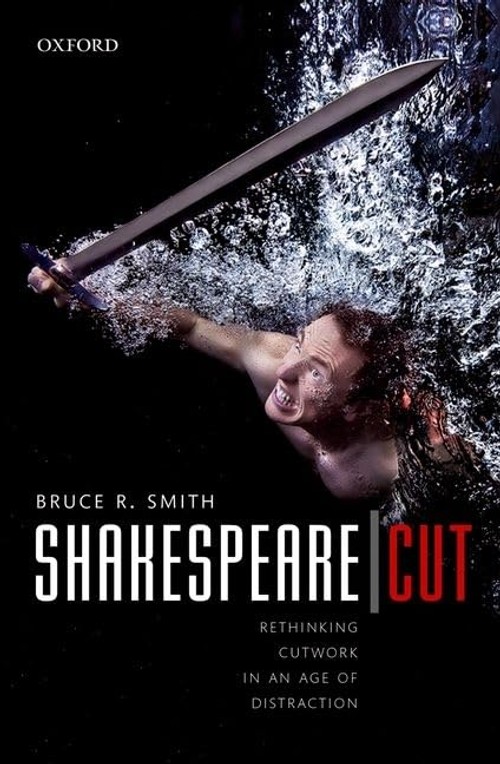
Shakespeare Cut: Rethinking Cutwork in an Age of Distraction by Bruce R. Smith – A Deep Dive into Cutting Shakespeare fo
Inclusive of all applicable taxes. FREE shipping on all orders.
Available Offers
- 🚚Free Delivery — Free shipping on all orders
- 💵Cash on Delivery — Pay when your order arrives
- ↩️15-Day Easy Returns — Hassle-free return policy
- 🔒Cash on Delivery — Pay safely when your order arrives
Check Delivery
Product Description
Introduction
In an age where our attention is constantly fragmented by notifications, endless scrolling, and digital noise, how do we truly engage with something as timeless as Shakespeare? Bruce R. Smith’s Shakespeare | Cut: Rethinking cutwork in an age of distraction offers a provocative and deeply original answer. This hardcover edition from Oxford University Press invites readers to explore the creative, often radical, ways in which Shakespeare’s texts have been physically and conceptually cut, rearranged, and reimagined—from the playwright’s own era to the YouTube generation. It is not merely a book about editing; it is a meditation on how we perceive, fragment, and reconstruct meaning itself.
Book Overview
Shakespeare | Cut is a scholarly yet accessible work that examines the practice of “cutting” as both a physical act and a conceptual tool. Smith argues that cutting is not a violation of Shakespeare’s genius but an essential part of how his works have lived and evolved. The book delves into stage productions that trim speeches, videogames that splice soliloquies into gameplay, book sculptures that carve words into art, and YouTube videos that remix famous lines. But it also reaches back to Shakespeare’s own time, showing how playwrights and actors routinely cut scripts for performance. The result is a rich, interdisciplinary study that bridges literature, performance theory, media studies, and cultural history.
Key Highlights
- Original cut-up experiments: For the first time in print, the book features the cut-up texts that William S. Burroughs and Brion Gysin created using Shakespeare’s works in the 1950s, offering a rare glimpse into avant-garde literary practice.
- Five distinct angles on cutting: The book’s chapters explore cutting as bodily experience, as script-crafting technique, as a unit of perception, as a technology between figure and life, and as a modern fetish.
- Twenty-four illustrations: The text is accompanied by images that span multiple media—from Renaissance manuscripts to contemporary digital art—helping readers visualise the concept of cutwork.
- Broad historical scope: Smith traces cutting from the Elizabethan playhouse to the present, showing that our “age of distraction” is not unique but part of a longer human story.
Story Themes
At its heart, Shakespeare | Cut explores the tension between wholeness and fragmentation. It asks: What happens when we break a sacred text into pieces? Does cutting destroy meaning or create new ones? The book also examines themes of embodiment—how cutting is a physical act that involves hands, scissors, and screens—and perception, questioning how our brains process disjointed information. Another powerful theme is the fetishisation of the original: why do we cling to the idea of an uncut, authentic Shakespeare, even as every performance and edition necessarily involves cutting? Smith challenges readers to see cutting not as loss but as a creative, even necessary, act of engagement.
Reader Benefits
This book will deepen your appreciation of Shakespeare by showing you that his texts are not static monuments but living, malleable materials. You will gain a new vocabulary for discussing adaptations, abridgements, and remixes—whether in theatre, film, or digital media. The insights on perception and distraction are particularly relevant for students and teachers navigating today’s short-attention-span culture. Smith’s clear, engaging prose makes complex ideas accessible, while the illustrations provide visual anchors for abstract concepts. By the end, you’ll see Shakespeare—and perhaps all literature—as a dynamic cutwork that invites your own creative participation.
Who Should Read
- Students of English literature, especially those studying Shakespeare, textual criticism, or performance studies.
- Theatre practitioners (directors, dramaturgs, actors) who regularly make cuts and want to understand the deeper implications.
- Scholars of media and culture interested in how texts are repurposed in the digital age.
- General readers who enjoy thought-provoking books about creativity, attention, and the afterlife of classic works.
- Indian readers who engage with Shakespeare in classrooms, on stage, or in popular culture will find fresh perspectives on why we keep cutting him up.
About the Author
Bruce R. Smith is a distinguished scholar of English literature and a professor at the University of Southern California. He has written extensively on Shakespeare, early modern culture, and the history of the senses. His previous works include The Acoustic World of Early Modern England and Phenomenal Shakespeare, both known for their innovative, interdisciplinary approaches. Smith’s expertise in performance history and material culture makes him uniquely qualified to explore the physical and conceptual act of cutting.
About the Publisher
Oxford University Press (OUP) is one of the oldest and most respected academic publishers in the world, with a legacy of excellence in scholarly and educational books. This hardcover edition reflects OUP’s commitment to rigorous research, beautiful design, and lasting quality. For Indian readers, OUP titles are a trusted source of authoritative knowledge in literature, history, and the humanities.
Conclusion
Shakespeare | Cut: Rethinking cutwork in an age of distraction is not just a book for Shakespeare specialists—it is a timely reflection on how we read, watch, and remember in a world full of interruptions. By embracing the cut, Bruce R. Smith offers a liberating vision: that fragmentation can be a form of love, and that distraction itself might be the very condition for new creativity. Whether you are a student, a teacher, a theatre lover, or simply someone curious about why we keep taking scissors to the Bard, this book will change how you see both Shakespeare and the act of reading. Add this thought-provoking hardcover to your collection and discover the surprising power of the cut.
Quick Summary
Shakespeare Cut: Rethinking Cutwork in an Age of Distraction by Bruce R. Smith is a groundbreaking scholarly work that explores the practice of cutting Shakespeare's texts from the Elizabethan era to the present day. The book examines cutwork in stage productions, videogames, book sculptures, and YouTube postings, revealing how cuts shape perception, meaning, and cultural engagement. Smith organizes his analysis into five chapters that consider cutwork as bodily experience, script crafting, perceptual units, technological interface, and fetish in Western culture. This book is ideal for Indian students and scholars of English literature, performance studies, digital humanities, and cultural history. Readers will gain a deep understanding of how cutting has always been integral to Shakespeare's legacy, and how it continues to evolve in the age of distraction. By purchasing from Bookshops.in, you get a premium hardcover edition from Oxford University Press, delivered reliably across India. This book is a must-have for anyone interested in Shakespeare's enduring relevance and the creative possibilities of textual fragmentation.
Book Highlights
Book Specifications
| ISBN-13 | 9780198735526 |
| ISBN-10 | 0198735529 |
| Publisher | OUP Oxford |
| Language | English |
| Dimensions | 19.81 x 2.54 x 12.7 cm |
| Weight | 318 g |
| Category | Literature › English Literature |
| Genre | Literature & Fiction |
| Original Language | English |
Frequently Asked Questions
What is Shakespeare Cut about?
Who is the author of Shakespeare Cut?
Is this book suitable for Indian students?
Does the book cover modern digital media?
What is cutwork in the context of Shakespeare?
How many chapters are in the book?
Is this book available in hardcover?
Can this book be used for academic research?
What makes this book different from other Shakespeare books?
Does the book discuss videogames?
Who is the publisher?
Is the book written in English?
How can I buy this book?
Readers Also Search For
Customers Also Bought
Contemporary Fiction
Stepladder Junction and Other Stories
Contemporary Fiction
Fabrications by Pamela Painter – Short Story Collection

Contemporary Fiction
The Double Life of an Alaskan Sled Dog (English, Andrea Finney Aufder Heyde)
Contemporary Fiction
The Alabaster Girl by Zan Perrion

Contemporary Fiction
Grimm and Grimmer: Classic Fairy Tales Rebooted by Mark Russell
Classic Literature
The Prose Works of Andrew Marvell: 1676-1678 by Andrew Marvell – Restoration Literature
Related Products
View All
Literature & Fiction
Shakespeare, Madness, and Music: Scoring Insanity in Cinematic Adaptations
Literature & Fiction
Literary Research and Canadian Literature: Strategies and Sources: 10 (Literary Research: Strategies and Sources, 10)

Literature & Fiction
Crime Fiction and National Identities in the Global Age | by Julie H. Kim | McFarland & Company | by Julie H. Kim | McFarland & Company | by Julie H. Kim | McFarland & Company | by Julie H. Kim | McFarland & Company | by Julie H. Kim | McFarland & Company | by Julie H. Kim | McFarland & Company | by Julie H. Kim | McFarland & Company | by Julie H. Kim | McFarland & Company | by Julie H. Kim | McFarland & Company | by Julie H. Kim | McFarland & Company | by
Literature & Fiction
Greek Literature in the Classical Period: The Poetics of Drama in Athens: 4 (Greek Literature Vol. 4)
Literature & Fiction
Greek Literature and Philosophy (Greek Literature, Volume 6)
Literature & Fiction