
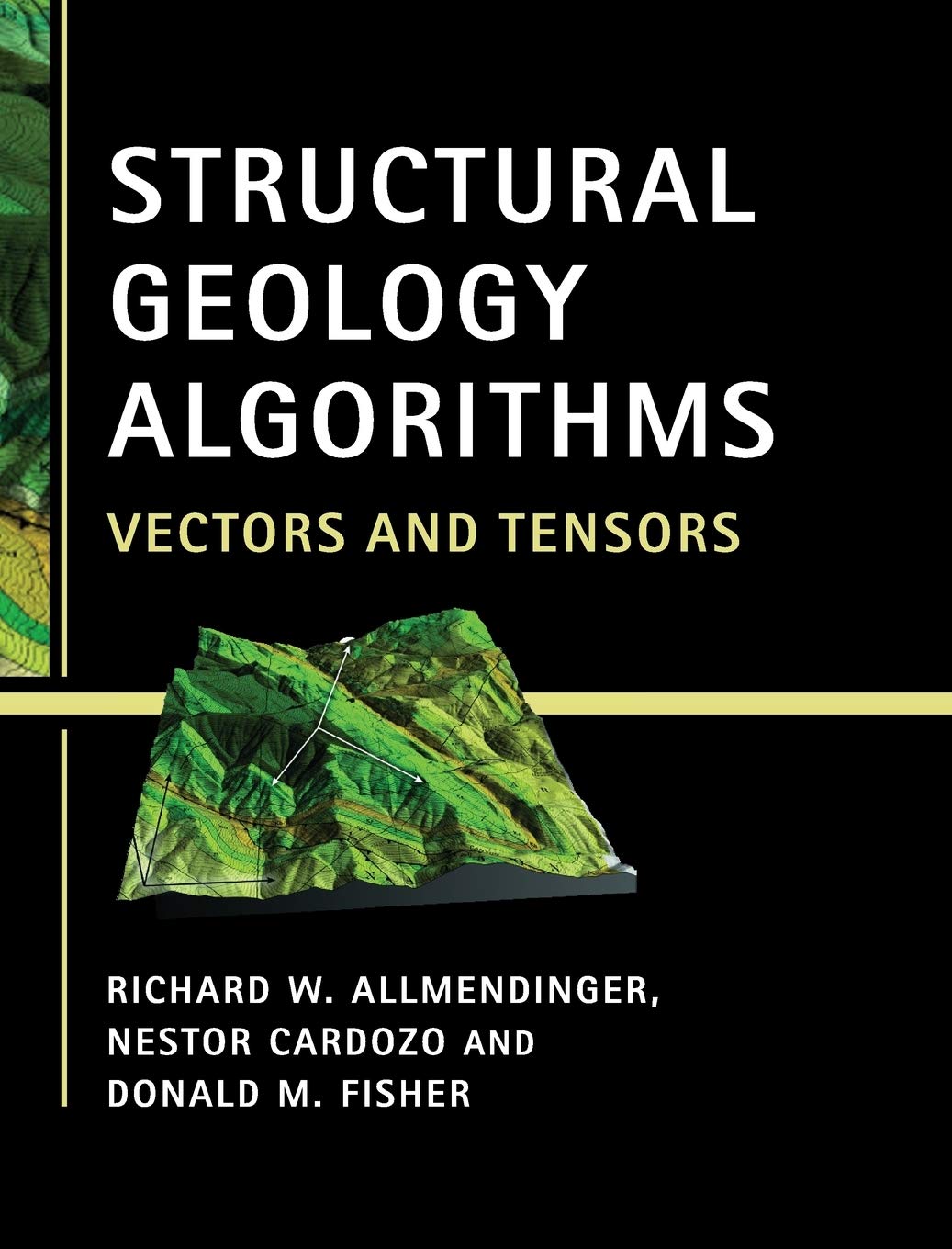
Structural Geology Algorithms: Vectors and Tensors by Richard W. Allmendinger – A Quantitative Lab Book for Geology Stud
Inclusive of all applicable taxes. FREE shipping on all orders.
Available Offers
- 🚚Free Delivery — Free shipping on all orders
- 💵Cash on Delivery — Pay when your order arrives
- ↩️15-Day Easy Returns — Hassle-free return policy
- 🔒Cash on Delivery — Pay safely when your order arrives
Check Delivery
Product Description
Introduction
Structural geology is undergoing a quiet revolution, shifting from traditional graphical methods toward quantitative, computation-driven analysis. For Indian students and researchers in earth sciences, mastering this new approach is essential—yet most textbooks assume a strong background in mathematics. Structural Geology Algorithms: Vectors and Tensors by Richard W. Allmendinger bridges this gap with clarity and precision. Published by Cambridge University Press, this hardcover volume offers a unified, algorithm-based methodology that empowers readers to solve real-world structural problems using linear algebra and MATLAB. Whether you are an advanced undergraduate in an Indian university or a graduate student preparing for fieldwork, this book provides the computational toolkit you need.
Book Overview
This lab-oriented book redefines how structural geology is taught and practiced. It begins with classic orientation problems—such as strike, dip, and lineation—and progresses to advanced topics like stress tensors, strain analysis, and error propagation. The author assumes only limited mathematical training, making the content accessible to students who may have avoided quantitative courses. Each concept is illustrated with worked examples and over 60 exercises, all supported by a suite of online MATLAB functions that readers can modify for their own research. The book is structured to serve as both a classroom resource and a self-study guide, blending theory with hands-on coding.
Key Highlights
- Unified methodology: Uses linear algebra as the foundation for understanding vectors and tensors, eliminating the need for separate mathematics courses.
- MATLAB integration: Includes a complete set of online MATLAB functions that allow readers to implement algorithms directly and adapt them to their own data.
- 20 worked examples and 60+ exercises: Provides ample practice to build confidence and competence in quantitative structural analysis.
- Progressive difficulty: Moves from simple orientation problems to complex topics like finite strain and stress, ensuring a smooth learning curve.
- Error propagation coverage: A rare and valuable inclusion that teaches how to quantify uncertainty in geological measurements.
Inside the Book
The book is divided into logical sections that build upon each other. Early chapters cover vector operations, coordinate transformations, and the geometry of planes and lines—essential for interpreting field measurements. Mid-section chapters introduce tensor concepts, stress, and strain, using clear diagrams and code snippets. Later chapters delve into advanced topics such as kinematics, deformation gradients, and error analysis. Every chapter ends with exercises that reinforce key ideas, and the MATLAB functions are documented in detail, making it easy to run simulations and visualize results. The hardcover binding ensures durability for frequent use in libraries, labs, or fieldwork prep.
Key Topics
- Vectors and vector algebra in three dimensions
- Representation of planes, lines, and orientations
- Coordinate transformations and rotation matrices
- Introduction to tensors: stress and strain tensors
- Finite strain and deformation kinematics
- Error propagation and uncertainty quantification
- Computational problem-solving with MATLAB
Reader Benefits
- For students: Gain a competitive edge by learning quantitative methods that are increasingly expected in geoscience curricula and research.
- For researchers: Access ready-to-use algorithms that can be customized for structural mapping, seismic interpretation, or tectonic studies.
- For Indian educators: Adopt a modern, computation-focused approach that aligns with NEP 2020’s emphasis on skill-based learning and interdisciplinary training.
- For self-learners: The clear explanations and online code make it possible to master the material independently, without a formal class.
Learning Outcomes
After working through this book, readers will be able to: solve orientation problems using vector and tensor methods; write and modify MATLAB scripts for structural analysis; calculate stress and strain from field data; quantify errors in measurements and models; and apply these skills to real-world geological problems. The book ensures that students not only understand theory but can also produce actionable results—a critical skill for careers in academia, oil and gas, mining, or geotechnical engineering.
Who Should Read
This book is ideal for advanced undergraduate and graduate students in geology, geophysics, and earth sciences across Indian universities. It is also a valuable resource for early-career researchers, industry professionals in exploration and engineering geology, and faculty members looking to modernize their lab courses. Anyone who has struggled with the mathematics of structural geology will find this book a welcoming and practical guide.
About the Author
Richard W. Allmendinger is a renowned structural geologist and professor at Cornell University, with decades of experience in teaching and research. He is known for his work on fault mechanics, fold-and-thrust belts, and quantitative structural analysis. His ability to make complex topics accessible has made him a sought-after educator, and this book reflects his commitment to empowering students with computational skills.
About the Publisher
Cambridge University Press is one of the world’s oldest and most respected academic publishers, with a strong presence in India. Known for rigorous peer review and high-quality educational materials, Cambridge books are trusted by universities and research institutions globally. This hardcover edition upholds that tradition of excellence, offering a durable and authoritative resource for Indian students and professionals.
Conclusion
Structural Geology Algorithms: Vectors and Tensors is more than a textbook—it is a practical laboratory companion that transforms how structural geology is learned and applied. By combining linear algebra with real-world problem-solving, it equips readers with the tools to tackle modern geoscience challenges. Whether you are preparing for fieldwork, writing a thesis, or advancing your career, this book from Bookshops.in is a wise investment in your quantitative skills. Order your copy today and step into the future of structural geology.
Quick Summary
Structural Geology Algorithms: Vectors and Tensors by Richard W. Allmendinger is a transformative lab book that introduces a unified, quantitative methodology for solving structural geology problems using linear algebra and computation. Written for students with only limited mathematical training, the book begins with classic orientation problems and progresses to advanced topics such as stress, strain, and error propagation. It emphasizes understanding vectors and tensors as the foundation of geological analysis, eliminating the need for a supplementary mathematics course. All algorithms are illustrated with a suite of online MATLAB functions, allowing readers to modify and apply them to real-world data. This book is ideal for undergraduate and postgraduate geology students, geoscience researchers, and professionals who want to move beyond traditional graphical methods. By purchasing from Bookshops.in, Indian readers get a premium hardcover edition with fast delivery and reliable service, making it a valuable addition to any geoscience library.
Book Highlights
Book Specifications
| ISBN-13 | 9781107012004 |
| ISBN-10 | 1107012007 |
| Publisher | Cambridge University Press |
| Language | English |
| Dimensions | 19.69 x 2.54 x 25.4 cm |
| Weight | 810 g |
| Country | India |
| Category | Science & Mathematics › Earth Sciences |
| Genre | Non-fiction |
| Original Language | English |
Frequently Asked Questions
What is Structural Geology Algorithms about?
Who is the author of this book?
What mathematical background is required?
Does the book include software or code?
Is this book suitable for Indian university courses?
What topics are covered?
How is this book different from traditional structural geology texts?
Can I use this book for self-study?
Does the book cover error propagation?
Is MATLAB knowledge necessary?
What is the ISBN?
Where can I buy this book in India?
Readers Also Search For
Customers Also Bought
Mathematics
Stereotype Spaces and Algebras: 73 (De Gruyter Expositions in Mathematics, 73)
Mathematics
Semigroups in Algebra, Geometry and Analysis: 20 (De Gruyter Expositions in Mathematics, 20)
Mathematics
Geometry from the Pacific Rim: Proceedings of the Pacific Rim Geometry Conference held at National University of Singapore, Republic of Singapore, ... 1994 (De Gruyter Proceedings in Mathematics)
Mathematics
First International Tainan-Moscow Algebra Workshop: Proceedings of the International Conference held at National Cheng Kung University Tainan, Taiwan, ... 1994 (De Gruyter Proceedings in Mathematics)

Mathematics
Differential Geometry - Proceedings of the VIII International Colloquium (English, Jesus A. Alvarez Lopez | Eduardo Garcia-Rio)
Mathematics
Mathematical Theory of Optimal Processes (Classics of Soviet Mathematics)
Related Products
View All
Science & Mathematics
Squid - Superconducting Quantum Interference Devices and Their Applications: Proceedings of the International Conference on Superconducting Quantum Devices, Berlin-west, October 4-8, 1976

Science & Mathematics
Thermodynamics and Pattern Formation in Biology
Science & Mathematics
The Nature of Mathematics and the Mathematics of Nature by S. Andersson – Mathematics & Science

Science & Mathematics
Linear Algebra | by Stephen Friedberg | Arnold Insel | Lawrence Spence | Pearson | by Stephen Friedberg | Arnold Insel | Lawrence Spence | Pearson | by Stephen Friedberg | Arnold Insel | Lawrence Spence | Pearson | by Stephen Friedberg | Arnold Insel | Lawrence Spence | Pearson | by Stephen Friedberg | Arnold Insel | Lawrence Spence | Pearson | by Stephen Friedberg | Arnold Insel | Lawrence Spence | Pearson | by Stephen Friedberg | Arnold Insel | Lawrence Spence | Pearson | by Stephen Friedberg

Science & Mathematics
University Calculus | by Joel Hass | Christopher Heil | Maurice Weir | Pearson | by Joel Hass | Christopher Heil | Maurice Weir | Pearson | by Joel Hass | Christopher Heil | Maurice Weir | Pearson | by Joel Hass | Christopher Heil | Maurice Weir | Pearson | by Joel Hass | Christopher Heil | Maurice Weir | Pearson | by Joel Hass | Christopher Heil | Maurice Weir | Pearson | by Joel Hass | Christopher Heil | Maurice Weir | Pearson | by Joel Hass | Christopher Heil | Maurice Weir | Pearson | by Joe

Science & Mathematics