
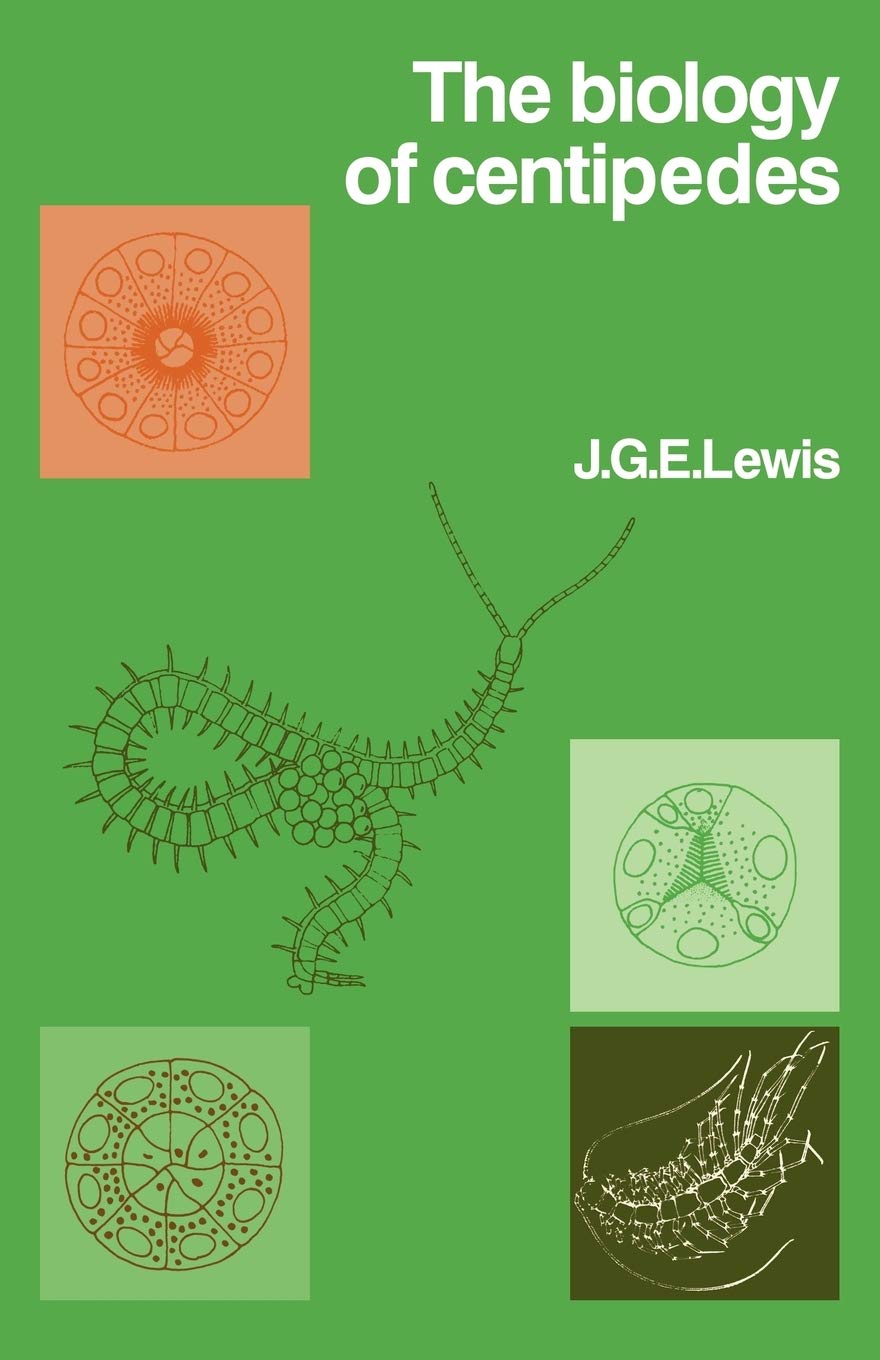
The Biology of Centipedes by J. G. E. Lewis: A Detailed Scientific Study of Centipede Anatomy, Behaviour, Ecology, and T
Inclusive of all applicable taxes. FREE shipping on all orders.
Available Offers
- 🚚Free Delivery — Free shipping on all orders
- 💵Cash on Delivery — Pay when your order arrives
- ↩️15-Day Easy Returns — Hassle-free return policy
- 🔒Cash on Delivery — Pay safely when your order arrives
Check Delivery
Product Description
Introduction
Centipedes are among the most fascinating yet misunderstood creatures in the animal kingdom. With their elongated bodies, numerous legs, and swift movements, they have intrigued biologists and naturalists for centuries. The Biology of Centipedes by J. G. E. Lewis is the definitive reference work that unravels the mysteries of these arthropods. Published by Cambridge University Press, this hardbound volume offers a thorough scientific exploration of centipede anatomy, behaviour, ecology, and evolution. For Indian students, researchers, and wildlife enthusiasts, this book opens a window into the world of soil-dwelling predators that play a vital role in our ecosystems.
Book Overview
This comprehensive treatise brings together decades of research on centipedes from temperate and tropical regions, including studies from the Indian subcontinent. J. G. E. Lewis, an internationally respected scientist, presents a critical review of existing knowledge while sharing first-hand accounts from his own fieldwork. The book covers everything from the basic structure of centipedes to their complex life histories, making it an indispensable resource for anyone studying arthropod biology. Whether you are a postgraduate student in zoology or a professional ecologist, this book provides the depth and detail needed to understand these remarkable creatures.
Key Highlights
- Comprehensive coverage: Every aspect of centipede biology is addressed, from anatomy and physiology to behaviour and taxonomy.
- First-hand research: Includes original observations and data from the author's extensive work on both temperate and tropical species.
- Global perspective: Examines centipede diversity across continents, with relevance to Indian fauna and soil ecosystems.
- Critical review: Synthesises and evaluates the scientific literature, highlighting gaps and future research directions.
- Authoritative source: Written by a leading expert and published by Cambridge University Press, ensuring academic rigour.
Inside the Book
The book is structured to guide readers from foundational knowledge to advanced topics. It begins with an introduction to centipede morphology and systematics, then delves into their internal anatomy, including the nervous, circulatory, and reproductive systems. Behavioural chapters explore hunting strategies, mating rituals, and parental care. A significant portion is devoted to ecology, covering habitat preferences, population dynamics, and interactions with other organisms. The final sections address centipede evolution and their phylogenetic relationships within the arthropod group. Numerous diagrams, tables, and photographs enhance understanding of complex structures and processes.
Key Topics
- External and internal anatomy of centipedes
- Sensory organs and nervous system function
- Feeding behaviour and venom apparatus
- Reproduction, egg-laying, and life cycle stages
- Predators, parasites, and defence mechanisms
- Physiology: respiration, circulation, and osmoregulation
- Ecology: habitats, distribution, and community interactions
- Taxonomy and classification of centipede orders and families
- Evolutionary history and fossil record
Reader Benefits
Readers will gain a deep, integrated understanding of centipedes as living organisms rather than mere specimens. The book bridges the gap between general arthropod biology and specialised myriapodology. For Indian students preparing for competitive exams like CSIR-UGC NET, GATE, or IIT JAM in life sciences, this book provides authoritative content on a lesser-known but important group. Researchers will appreciate the extensive bibliography and critical analysis of past studies. Wildlife educators and nature guides can use the book to enrich their knowledge of soil fauna, which is often overlooked in mainstream biology courses.
Learning Outcomes
- Identify and describe the major anatomical features of centipedes
- Explain the physiological adaptations that enable centipedes to thrive in diverse environments
- Analyse the ecological roles of centipedes in soil food webs
- Evaluate the evolutionary relationships among centipede groups
- Apply taxonomic keys to classify centipedes at the family level
- Critically assess research methodologies used in centipede studies
Who Should Read
This book is essential for postgraduate students and researchers in entomology, zoology, ecology, and soil science. It is also highly valuable for undergraduate students pursuing advanced courses in invertebrate biology. Professional biologists working in biodiversity assessment, pest management, or conservation will find practical insights. Additionally, naturalists and science communicators who wish to deepen their understanding of arthropods will enjoy this well-written volume. Indian readers with an interest in the country's rich soil biodiversity will discover how centipedes contribute to ecosystem health in forests, agricultural fields, and urban gardens.
About the Author
J. G. E. Lewis is a distinguished biologist whose career has been dedicated to the study of myriapods, particularly centipedes. He has conducted extensive fieldwork in Europe, Africa, Asia, and the Americas, bringing a wealth of practical experience to his writing. His meticulous research and clear exposition have made him a trusted authority in the field. This book reflects his lifelong passion for these arthropods and his commitment to advancing scientific knowledge.
About the Publisher
Cambridge University Press is one of the world's oldest and most prestigious academic publishers. Known for producing high-quality, peer-reviewed books in science and humanities, Cambridge ensures that every title meets rigorous scholarly standards. This hardcover edition is built to last, with durable binding and acid-free paper, making it a permanent addition to any library.
Conclusion
The Biology of Centipedes is more than a textbook; it is a gateway to understanding a hidden world beneath our feet. J. G. E. Lewis has crafted a masterful synthesis that will serve as the standard reference for generations. For Indian students, teachers, and researchers, this book offers unparalleled depth and clarity. Add this essential volume to your collection and discover the remarkable biology of centipedes.
Quick Summary
The Biology of Centipedes by J. G. E. Lewis is the definitive scientific reference on centipede biology. This comprehensive volume critically reviews all major aspects of centipede life, from anatomy and behaviour to reproduction, ecology, physiology, and taxonomy. Drawing on decades of research, including the author's own fieldwork on temperate and tropical species, the book offers an unparalleled depth of knowledge. It covers the structure and function of centipede organ systems, their sensory capabilities, venom apparatus, and evolutionary adaptations. The ecological sections explore their roles as predators in soil food webs, their interactions with parasites and predators, and their life history strategies. The taxonomic chapters provide a systematic overview of centipede orders and families, making it an essential reference for taxonomists. Written by an internationally respected scientist and published by Cambridge University Press, this book is aimed at zoologists, entomologists, soil ecologists, and any researcher interested in arthropod biology. Indian students and professionals will find it invaluable for advanced studies in invertebrate zoology. By purchasing from Bookshops.in, you receive a genuine hardcover copy with assured quality and prompt delivery across India.
Book Highlights
Book Specifications
| ISBN-13 | 9780521034111 |
| ISBN-10 | 0521034116 |
| Publisher | Cambridge University Press |
| Language | English |
| Dimensions | 13.97 x 3.1 x 21.59 cm |
| Weight | 636 g |
| Country | India |
| Category | Biology & Life Sciences › Zoology |
| Genre | Science & Mathematics |
| Original Language | English |
Frequently Asked Questions
What is the main focus of The Biology of Centipedes?
Who is the author of this book?
Is this book suitable for undergraduate students?
Does the book cover both temperate and tropical centipedes?
What topics are covered in the anatomy section?
Is there information on centipede behaviour?
Does the book include taxonomic keys?
Can this book help with soil ecology research?
Is the book written in technical language?
Does the book cover centipede venom?
Are there illustrations or diagrams?
Why should I buy from Bookshops.in?
What is the price of this book?
Readers Also Search For
Customers Also Bought
Mathematics
Stereotype Spaces and Algebras: 73 (De Gruyter Expositions in Mathematics, 73)

Mathematics
Semigroups in Algebra, Geometry and Analysis: 20 (De Gruyter Expositions in Mathematics, 20)

Mathematics
Geometry from the Pacific Rim: Proceedings of the Pacific Rim Geometry Conference held at National University of Singapore, Republic of Singapore, ... 1994 (De Gruyter Proceedings in Mathematics)

Mathematics
First International Tainan-Moscow Algebra Workshop: Proceedings of the International Conference held at National Cheng Kung University Tainan, Taiwan, ... 1994 (De Gruyter Proceedings in Mathematics)

Mathematics
Differential Geometry - Proceedings of the VIII International Colloquium (English, Jesus A. Alvarez Lopez | Eduardo Garcia-Rio)

Mathematics
Mathematical Theory of Optimal Processes (Classics of Soviet Mathematics)
Related Products
View All
Science & Mathematics
Elements of Pelagos Biology: With Focus on the Mediterranean Sea

Science & Mathematics
Squid - Superconducting Quantum Interference Devices and Their Applications: Proceedings of the International Conference on Superconducting Quantum Devices, Berlin-west, October 4-8, 1976

Science & Mathematics
Thermodynamics and Pattern Formation in Biology

Science & Mathematics
The Nature of Mathematics and the Mathematics of Nature by S. Andersson – Mathematics & Science

Science & Mathematics
Linear Algebra | by Stephen Friedberg | Arnold Insel | Lawrence Spence | Pearson | by Stephen Friedberg | Arnold Insel | Lawrence Spence | Pearson | by Stephen Friedberg | Arnold Insel | Lawrence Spence | Pearson | by Stephen Friedberg | Arnold Insel | Lawrence Spence | Pearson | by Stephen Friedberg | Arnold Insel | Lawrence Spence | Pearson | by Stephen Friedberg | Arnold Insel | Lawrence Spence | Pearson | by Stephen Friedberg | Arnold Insel | Lawrence Spence | Pearson | by Stephen Friedberg

Science & Mathematics