
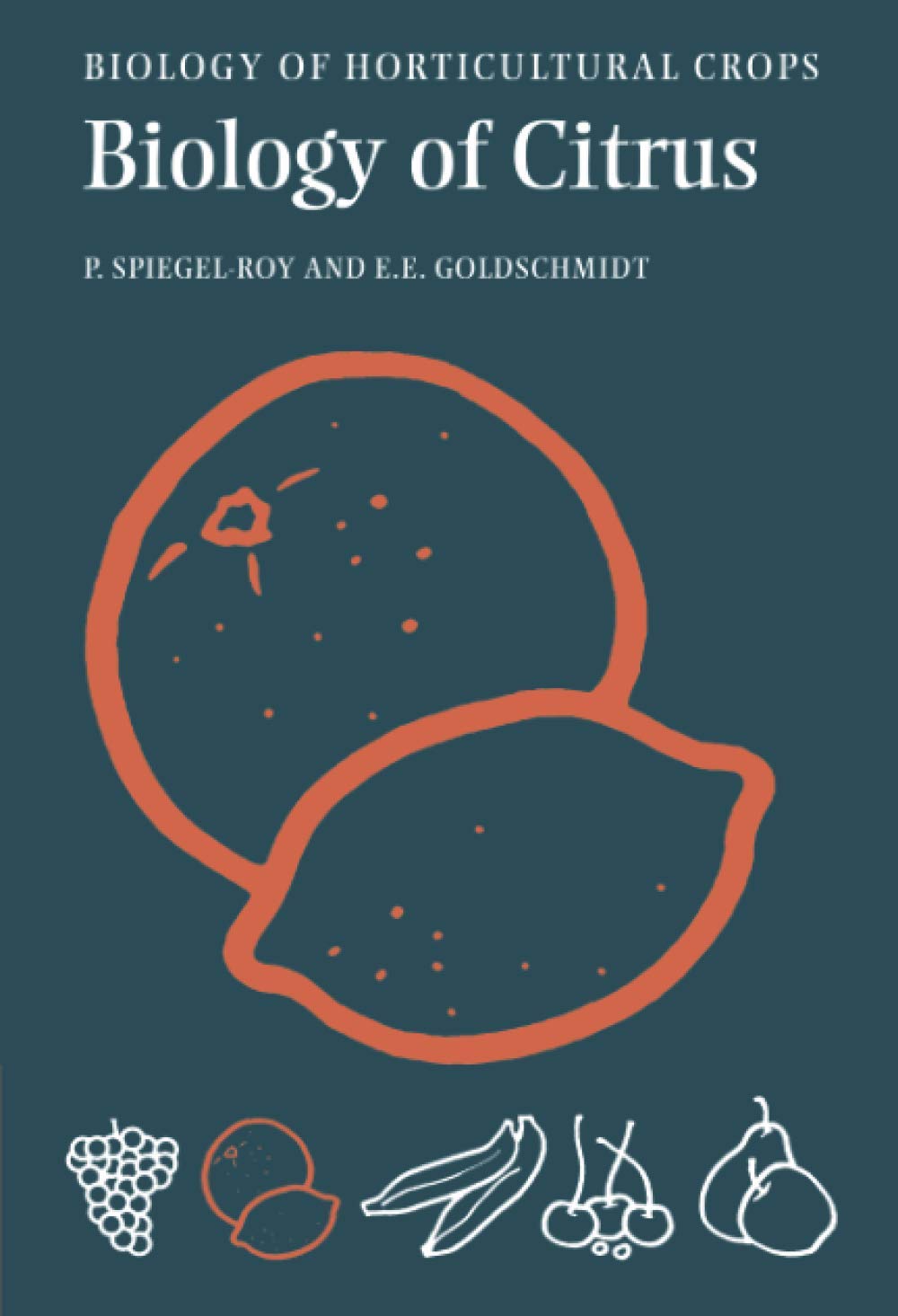
The Biology of Citrus: A Comprehensive Scientific Study by Pinhas Spiegel-Roy – Cambridge University Press
Inclusive of all applicable taxes. FREE shipping on all orders.
Available Offers
- 🚚Free Delivery — Free shipping on all orders
- 💵Cash on Delivery — Pay when your order arrives
- ↩️15-Day Easy Returns — Hassle-free return policy
- 🔒Cash on Delivery — Pay safely when your order arrives
Check Delivery
Product Description
Introduction
Citrus fruits are among the most widely cultivated and economically significant crops in India and across the tropical and subtropical world. From the familiar sweet oranges and tangy lemons to the exotic pomelos and kumquats, the citrus family holds a special place in agriculture, cuisine, and commerce. The Biology of Citrus by Pinhas Spiegel-Roy, published by Cambridge University Press, is a definitive hardcover reference that explores the science behind these remarkable fruits. This book offers a deep, research-backed understanding of citrus biology, making it an essential resource for students, horticulturists, and agricultural professionals in India.
Book Overview
This comprehensive volume presents a complete account of citrus from its ancient origins to modern cultivation practices. The author, a renowned expert in fruit tree genetics, weaves together history, taxonomy, physiology, and biotechnology into a single cohesive narrative. The book begins with the historical spread of citrus from Southeast Asia to the rest of the world, then moves into detailed discussions of tree structure, flowering, fruit development, and post-harvest biology. Later chapters address practical aspects such as rootstock selection, pest management, and disease control, culminating in a forward-looking chapter on genetic improvement and tissue culture techniques. The text is enriched with original illustrations and extensive bibliographies that guide further reading.
Key Highlights
- Comprehensive coverage: Spans from ancient history and global distribution to cutting-edge biotechnology.
- Horticultural classification: Includes a practical classification of edible citrus species for growers and breeders.
- Original illustrations: Features specially produced diagrams and photographs that clarify complex biological processes.
- Extensive references: Each chapter includes detailed reading lists for advanced study and research.
- Indian relevance: Addresses climatic adaptation and cultivation practices applicable to Indian growing conditions.
Inside the Book
Readers will find a logical progression through the subject. Early chapters lay the foundation with the history and taxonomy of citrus, providing context for the biological details that follow. The core of the book examines tree structure and function, including root systems, canopy architecture, and physiological processes like photosynthesis and water use. Reproductive physiology is covered in depth, with separate sections on flowering, fruit set, fruit growth, ripening, and post-harvest changes. The book also delves into the chemical composition of citrus fruits, explaining the compounds responsible for flavour, aroma, and nutritional value. Later chapters address applied topics such as irrigation strategies, nutrient management, and integrated pest control, making the book equally valuable for scientists and practitioners.
Key Topics
- History and global distribution of citrus cultivation
- Taxonomy, systematics, and horticultural classification of edible species
- Tree structure: roots, stems, leaves, and canopy dynamics
- Reproductive physiology: flowering, pollination, fruit set, and development
- Fruit ripening, post-harvest biology, and fruit constituents
- Rootstocks: selection, compatibility, and influence on tree performance
- Irrigation and water management for optimal yield
- Major pests, viruses, and diseases affecting citrus
- Genetic improvement: conventional breeding, tissue culture, and biotechnology
Reader Benefits
By reading this book, you will gain a solid grounding in the biological principles that govern citrus growth and productivity. Students will find clear explanations of complex topics, while researchers can rely on the authoritative references for their work. Horticulturists and farmers will appreciate the practical insights into rootstock choice, irrigation strategies, and disease management. The book also helps readers understand how modern biotechnological tools are being used to improve citrus varieties for better yield, disease resistance, and fruit quality. Whether you are preparing for exams, planning a research project, or managing an orchard, this book provides the knowledge you need.
Learning Outcomes
- Understand the evolutionary history and taxonomic relationships within the citrus genus.
- Explain the structural and functional organisation of citrus trees.
- Describe the physiological processes behind flowering, fruit set, and fruit development.
- Identify key factors affecting fruit quality, ripening, and post-harvest shelf life.
- Evaluate different rootstock options and their impact on tree health and productivity.
- Recognise common pests, diseases, and disorders, and understand management strategies.
- Discuss the principles and applications of citrus genetic improvement, including tissue culture.
Who Should Read
This book is ideally suited for undergraduate and postgraduate students of botany, horticulture, agriculture, and plant sciences. It is also a valuable resource for citrus researchers, breeders, and extension officers working in the field. Commercial citrus growers and farm managers seeking a deeper scientific understanding of their crop will find the practical chapters highly useful. Additionally, teachers and professors looking for a comprehensive textbook for advanced courses on fruit science or tropical horticulture will appreciate the depth and clarity of the content.
About the Author
Pinhas Spiegel-Roy was a distinguished Israeli plant scientist and professor specialising in fruit tree genetics and breeding. With decades of research experience, particularly in citrus and deciduous fruit crops, he contributed significantly to the understanding of reproductive biology and genetic improvement of horticultural plants. His work has been widely cited in scientific literature, and his expertise is reflected in the thorough, well-organised content of this book. He brings both academic rigour and practical field knowledge to every chapter.
About the Publisher
Cambridge University Press is one of the oldest and most respected academic publishers in the world. Founded in 1534, it has a long tradition of publishing authoritative works across all disciplines of science and humanities. Their science and mathematics titles are known for their high editorial standards, accurate content, and durable production quality. This hardcover edition reflects that commitment, making it a lasting addition to any library.
Conclusion
The Biology of Citrus is an indispensable guide for anyone serious about understanding citrus from a scientific perspective. Its blend of historical context, biological detail, and practical application makes it stand out among books on fruit science. For Indian students and professionals working with citrus, this book offers both foundational knowledge and advanced insights that can directly inform study and practice. Add this hardcover volume to your collection and explore the fascinating world of citrus biology.
Quick Summary
The Biology of Citrus by Pinhas Spiegel-Roy is a definitive reference work that systematically covers the entire field of citrus science. From the historical origins and global distribution of citrus to modern genetic improvement and biotechnology, this book leaves no stone unturned. It begins with taxonomy and systematics, providing a clear horticultural classification of edible citrus species. Subsequent chapters delve into tree structure and function, reproductive physiology including flowering and fruiting, and factors affecting productivity. The book also addresses practical aspects of citriculture such as rootstock selection, irrigation, pest and disease management. A significant portion is devoted to postharvest biology and fruit constituents. The concluding chapters explore cutting-edge topics like tissue culture and plant biotechnology, making it relevant for contemporary researchers. Published by Cambridge University Press, this hardcover edition is ideal for Indian students pursuing degrees in botany, horticulture, agriculture, and plant sciences. Researchers and professionals in the citrus industry will also find it indispensable. By purchasing from Bookshops.in, customers receive a genuine, high-quality print edition with reliable delivery across India.
Book Highlights
Book Specifications
| ISBN-13 | 9780521054249 |
| ISBN-10 | 0521054249 |
| Publisher | Cambridge University Press |
| Language | English |
| Dimensions | 15.24 x 1.4 x 22.35 cm |
| Weight | 387 g |
| Country | India |
| Category | Biology & Life Sciences › Botany |
| Genre | Science & Mathematics |
| Original Language | English |
Frequently Asked Questions
What is The Biology of Citrus about?
Who is the author of The Biology of Citrus?
Is this book suitable for Indian students?
Does the book cover citrus diseases?
What is the ISBN of The Biology of Citrus?
What language is the book written in?
What is the price of the book?
Is this a hardcover or paperback?
Does the book include biotechnology topics?
Can I use this book for my research?
Where can I buy The Biology of Citrus in India?
Does the book discuss citrus rootstocks?
Readers Also Search For
Customers Also Bought

Mathematics
Stereotype Spaces and Algebras: 73 (De Gruyter Expositions in Mathematics, 73)

Mathematics
Semigroups in Algebra, Geometry and Analysis: 20 (De Gruyter Expositions in Mathematics, 20)

Mathematics
Geometry from the Pacific Rim: Proceedings of the Pacific Rim Geometry Conference held at National University of Singapore, Republic of Singapore, ... 1994 (De Gruyter Proceedings in Mathematics)

Mathematics
First International Tainan-Moscow Algebra Workshop: Proceedings of the International Conference held at National Cheng Kung University Tainan, Taiwan, ... 1994 (De Gruyter Proceedings in Mathematics)

Mathematics
Differential Geometry - Proceedings of the VIII International Colloquium (English, Jesus A. Alvarez Lopez | Eduardo Garcia-Rio)

Mathematics
Mathematical Theory of Optimal Processes (Classics of Soviet Mathematics)
Related Products
View All
Science & Mathematics
Squid - Superconducting Quantum Interference Devices and Their Applications: Proceedings of the International Conference on Superconducting Quantum Devices, Berlin-west, October 4-8, 1976

Science & Mathematics
Thermodynamics and Pattern Formation in Biology

Science & Mathematics
The Nature of Mathematics and the Mathematics of Nature by S. Andersson – Mathematics & Science

Science & Mathematics
Linear Algebra | by Stephen Friedberg | Arnold Insel | Lawrence Spence | Pearson | by Stephen Friedberg | Arnold Insel | Lawrence Spence | Pearson | by Stephen Friedberg | Arnold Insel | Lawrence Spence | Pearson | by Stephen Friedberg | Arnold Insel | Lawrence Spence | Pearson | by Stephen Friedberg | Arnold Insel | Lawrence Spence | Pearson | by Stephen Friedberg | Arnold Insel | Lawrence Spence | Pearson | by Stephen Friedberg | Arnold Insel | Lawrence Spence | Pearson | by Stephen Friedberg

Science & Mathematics
University Calculus | by Joel Hass | Christopher Heil | Maurice Weir | Pearson | by Joel Hass | Christopher Heil | Maurice Weir | Pearson | by Joel Hass | Christopher Heil | Maurice Weir | Pearson | by Joel Hass | Christopher Heil | Maurice Weir | Pearson | by Joel Hass | Christopher Heil | Maurice Weir | Pearson | by Joel Hass | Christopher Heil | Maurice Weir | Pearson | by Joel Hass | Christopher Heil | Maurice Weir | Pearson | by Joel Hass | Christopher Heil | Maurice Weir | Pearson | by Joe
Science & Mathematics