
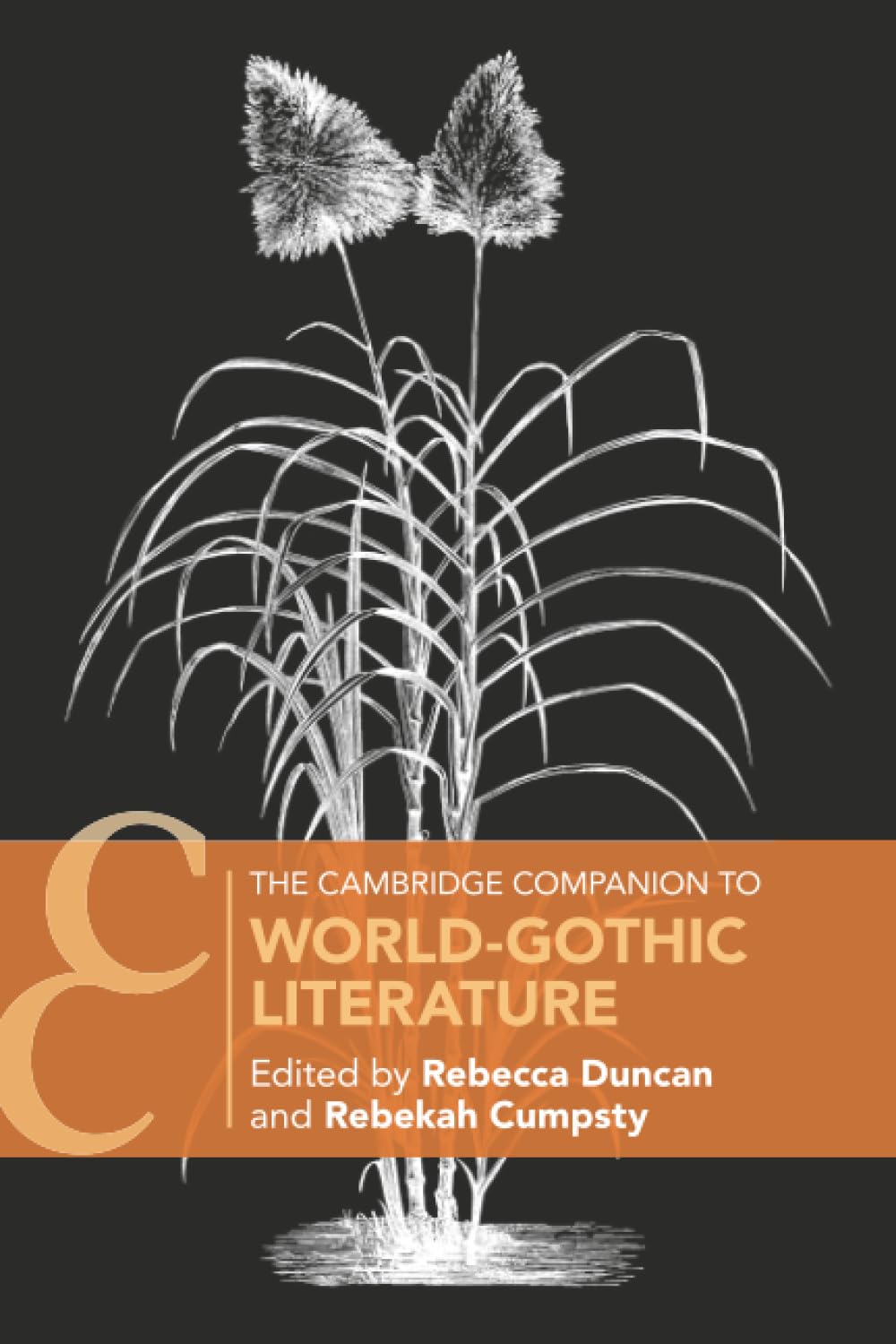
The Cambridge Companion to World-Gothic Literature by Rebecca Duncan – Decolonizing Gothic Studies from Colonial Plantat
Inclusive of all applicable taxes. FREE shipping on all orders.
Available Offers
- 🚚Free Delivery — Free shipping on all orders
- 💵Cash on Delivery — Pay when your order arrives
- ↩️15-Day Easy Returns — Hassle-free return policy
- 🔒Cash on Delivery — Pay safely when your order arrives
Check Delivery
Product Description
Introduction
For decades, the Gothic has been understood as a European literary tradition that began with Horace Walpole and spread outward. But what if this narrative is fundamentally flawed? The Cambridge Companion to World-Gothic Literature, edited by Rebecca Duncan and published by Cambridge University Press, shatters this colonial perspective. It argues that Gothic storytelling has always been a global phenomenon, born from the anxieties of capitalist modernity wherever it took root—from the plantations of the Americas to the bustling cities of postcolonial India. This hardcover volume is an essential resource for students, scholars, and curious readers in India who want to understand how the Gothic speaks to our shared, fractured world.
Book Overview
This companion repositions the Gothic not as a genre that 'went global', but as one that was always already global. The book’s central thesis is that Gothic literature emerges wherever capitalist modernization creates alienation, displacement, and fear. The essays within provincialise the so-called 'Western' Gothic tradition, revealing how early British Gothic was itself a belated response to colonial horrors already haunting the 'New World'. By tracing the monstrous figures that swarm at the frontiers of colonialism and capitalism, the volume builds a new theoretical infrastructure for reading world-Gothic. It connects the plantation Gothic of the Caribbean to the postcolonial horror of South Asia, the economic anxieties of Victorian England to the ecological dread of the Anthropocene. For Indian readers, this framework is particularly powerful, as it allows us to see our own literary traditions of the uncanny—from Bengali Bhooter Golpo to contemporary Indian horror—as part of a global conversation about modernity’s dark side.
Key Highlights
- Decolonizes Gothic Studies: Challenges the Eurocentric origin story of the Gothic, showing how colonial violence and capitalism shaped the genre from its inception.
- Global Scope: Covers Gothic expressions from the Americas, Europe, Africa, Asia, and the Caribbean, with specific attention to postcolonial contexts.
- New Theoretical Tools: Introduces concepts like 'planetary Gothic' and 'capitalist spectrality' to help readers analyse contemporary horror.
- Rigorous Scholarship: Features contributions from leading international scholars, making it a definitive academic reference.
- Accessible Language: Despite its depth, the essays are written clearly, suitable for advanced undergraduates and postgraduate students.
Story Themes
The book explores how Gothic narratives consistently grapple with alienation—the feeling of being haunted by forces one cannot control, whether they be colonial armies, global markets, or ecological collapse. Monstrosity is redefined: the vampire, the zombie, and the ghost are not just supernatural beings but symbols of exploited labour, stolen land, and repressed histories. A recurring theme is the return of the repressed, where the violence of the past—slavery, indenture, extraction—refuses to stay buried. The volume also examines anxiety as a structural condition of modernity, showing how Gothic literature gives shape to the formless dread of living in a world where value is extracted from human and natural resources alike. For Indian readers, themes of postcolonial haunting resonate deeply, as the book discusses how nations like India grapple with the ghosts of empire and the spectres of globalisation.
Reader Benefits
- Deepen Your Literary Understanding: Move beyond surface-level readings of Gothic texts to grasp their political and economic underpinnings.
- Expand Your Canon: Discover Gothic works from outside the Western tradition, including texts from Indian, African, and Caribbean authors.
- Critical Thinking Skills: Learn to analyse how literature responds to real-world crises like colonialism, climate change, and inequality.
- Academic Edge: Perfect for university courses in English literature, postcolonial studies, cultural studies, and comparative literature.
- Contextualised Knowledge: Understand how Indian Gothic traditions—from the stories of Ruskin Bond to contemporary horror films—fit into a global framework.
Who Should Read
This book is ideal for postgraduate students and researchers in English literature, especially those focusing on Gothic, postcolonial, or world literature. Advanced undergraduates taking courses in literary theory or genre studies will find it challenging yet rewarding. Teachers and professors seeking to decolonise their syllabi will discover invaluable perspectives. Indian readers with an interest in horror, the uncanny, or the social history of modernity will appreciate how the book illuminates our own cultural productions. Finally, anyone curious about why monsters haunt our stories—from the churel to the capitalist vampire—will find this companion a thrilling and enlightening read.
About the Author
Rebecca Duncan is a scholar of Gothic and postcolonial literature, currently affiliated with the University of Stirling. Her research focuses on the intersections of global capitalism, colonialism, and the literary imagination. She has published widely on world-Gothic, Caribbean literature, and the environmental humanities. Duncan’s editorial vision for this companion reflects her commitment to dismantling Eurocentric literary hierarchies and building a more inclusive, planetary approach to genre studies. Her work is known for its theoretical rigour and its attentiveness to the voices of the Global South, making her an ideal guide for this transformative project.
About the Publisher
Cambridge University Press is one of the world’s oldest and most prestigious academic publishers, founded in 1534. Renowned for its rigorous peer-review process and commitment to scholarly excellence, Cambridge publishes books that shape academic discourse across the humanities and sciences. Their Companions series is particularly celebrated for bringing together leading experts to produce authoritative, accessible overviews of key literary and cultural fields. This volume upholds that tradition, offering a cutting-edge intervention in Gothic studies. For Indian readers, a Cambridge University Press book represents a guarantee of quality, depth, and global relevance.
Conclusion
The Cambridge Companion to World-Gothic Literature is not merely a book about ghosts and monsters—it is a radical rethinking of how we understand literary tradition itself. By arguing that the Gothic has always been a global response to the traumas of modernity, Rebecca Duncan and her contributors offer Indian readers a powerful new lens through which to view our own literary heritage and contemporary anxieties. Whether you are a student preparing for exams, a researcher seeking a new theoretical framework, or a general reader fascinated by the dark side of storytelling, this hardcover volume will haunt your thoughts long after you close its covers. It is a vital addition to any serious library of world literature.
Quick Summary
The Cambridge Companion to World-Gothic Literature, edited by Rebecca Duncan and published by Cambridge University Press, is a groundbreaking academic volume that reimagines the gothic tradition as a global phenomenon rather than a British invention. The book argues that gothic literature has always been a response to the alienation and anxiety produced by capitalist modernity, from the colonial plantations of the Americas to today's planetary climate emergency. Through a series of incisive essays, it renovates established gothic concepts and draws new comparisons across cultures and periods. This volume is essential for students, researchers, and teachers of English literature, postcolonial studies, and cultural theory who seek a decolonized understanding of gothic. Readers will learn to analyze gothic texts in their global contexts, explore themes of horror, the uncanny, and social critique, and gain fresh perspectives on canonical works. Buying from Bookshops.in ensures you receive an authentic hardcover edition with fast delivery across India, supporting a trusted local bookstore dedicated to academic and literary excellence.
Book Highlights
Book Specifications
| ISBN-13 | 9781009382564 |
| ISBN-10 | 100938256X |
| Publisher | Cambridge University Press |
| Language | English |
| Dimensions | 15.24 x 1.83 x 22.86 cm |
| Weight | 463 g |
| Country | India |
| Category | Literature › English Literature |
| Series | Cambridge Companions to Literature |
| Genre | Literary Criticism |
| Original Language | English |
Frequently Asked Questions
What is The Cambridge Companion to World-Gothic Literature about?
Who is the author of this book?
Is this book suitable for undergraduate students?
Does the book include analysis of Indian gothic literature?
How is this book different from other gothic companions?
What is the ISBN of this book?
Is this a hardcover or paperback?
What is the price of this book in India?
Can I use this book for my PhD research?
Does the book cover climate change?
What are some key themes in the book?
Who is the publisher?
Is this part of a series?
Where can I buy this book in India?
Readers Also Search For
Customers Also Bought
Contemporary Fiction
Stepladder Junction and Other Stories

Contemporary Fiction
Fabrications by Pamela Painter – Short Story Collection

Contemporary Fiction
The Double Life of an Alaskan Sled Dog (English, Andrea Finney Aufder Heyde)

Contemporary Fiction
The Alabaster Girl by Zan Perrion

Contemporary Fiction
Grimm and Grimmer: Classic Fairy Tales Rebooted by Mark Russell
Classic Literature
The Prose Works of Andrew Marvell: 1676-1678 by Andrew Marvell – Restoration Literature
Related Products
View All
Literature & Fiction
Shakespeare, Madness, and Music: Scoring Insanity in Cinematic Adaptations

Literature & Fiction
Literary Research and Canadian Literature: Strategies and Sources: 10 (Literary Research: Strategies and Sources, 10)

Literature & Fiction
Crime Fiction and National Identities in the Global Age | by Julie H. Kim | McFarland & Company | by Julie H. Kim | McFarland & Company | by Julie H. Kim | McFarland & Company | by Julie H. Kim | McFarland & Company | by Julie H. Kim | McFarland & Company | by Julie H. Kim | McFarland & Company | by Julie H. Kim | McFarland & Company | by Julie H. Kim | McFarland & Company | by Julie H. Kim | McFarland & Company | by Julie H. Kim | McFarland & Company | by
Literature & Fiction
Greek Literature in the Classical Period: The Poetics of Drama in Athens: 4 (Greek Literature Vol. 4)
Literature & Fiction
Greek Literature and Philosophy (Greek Literature, Volume 6)
Literature & Fiction